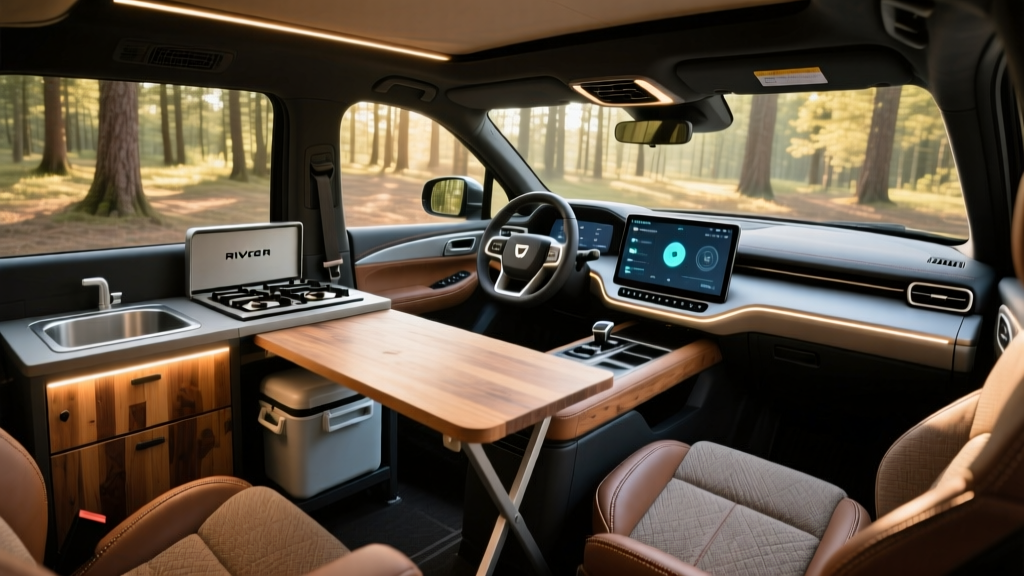
The phrase Rivian Theatre doesn't refer to a single trim or standalone product — it's become shorthand among owners and enthusiasts for the immersive, outdoor-living ecosystem baked into the R1S SUV and R1T pickup. That includes the available Camp Kitchen with its slide-out induction cooktop, the 1,800-watt Meridian Elevation audio system, the 15.6-inch central infotainment display, and the vehicle's integrated V2L (vehicle-to-load) power capability. Together, these features create what Rivian markets as an adventure platform rather than just an electric truck.
But the Theatre experience only matters if the underlying EV delivers on range, charging speed, and daily-driver practicality. This review covers the full 2026 Rivian R1S and R1T lineup — the Dual-Motor, Performance Dual-Motor, and Tri-Motor — with exact EPA figures, real-world range expectations, charging curves, pricing, and tax-credit eligibility.
2026 Rivian R1S and R1T: Spec Table at a Glance
| Spec | R1S Dual-Motor (Standard) | R1S Tri-Motor | R1T Dual-Motor (Standard) | R1T Tri-Motor |
|---|---|---|---|---|
| EPA Range | 420 mi (Max Pack) | 410 mi (Max Pack) | 420 mi (Max Pack) | 415 mi (Max Pack) |
| Battery (usable) | ~149 kWh (Max, NMC) | ~149 kWh (Max, NMC) | ~149 kWh (Max, NMC) | ~149 kWh (Max, NMC) |
| Horsepower | 665 hp | 850 hp | 665 hp | 850 hp |
| 0–60 mph | 4.5 sec | 2.9 sec | 4.5 sec | 3.0 sec |
| Drivetrain | AWD (Dual-Motor) | AWD (Tri-Motor) | AWD (Dual-Motor) | AWD (Tri-Motor) |
| Peak DC Fast Charge | ~220 kW | ~220 kW | ~220 kW | ~220 kW |
| 10–80% DCFC Time | ~42 min | ~42 min | ~42 min | ~42 min |
| Level 2 Home Charging | 11.5 kW (~25 mi/hr) | 11.5 kW (~25 mi/hr) | 11.5 kW (~25 mi/hr) | 11.5 kW (~25 mi/hr) |
| MPGe (combined) | 73 MPGe | 70 MPGe | 73 MPGe | 70 MPGe |
| Towing Capacity | 7,700 lb | 7,700 lb | 11,000 lb | 11,000 lb |
| Base MSRP | $79,900 | $104,900 | $73,000 | $99,000 |
| Battery Warranty | 8 yr / 175,000 mi | 8 yr / 175,000 mi | 8 yr / 175,000 mi | 8 yr / 175,000 mi |
Source: fueleconomy.gov and Rivian official specs. Figures reflect 2026 Max Pack configurations. Standard and Large packs yield lower range.
Real-World Range: What to Actually Expect
Real-World Highway (70 mph, mild weather): ~320–350 miles
Cold Weather (below 32°F, highway): ~260–290 miles
Towing (5,000+ lb trailer): ~180–220 miles
The 420-mile EPA figure on the Max Pack is legitimate, but it's a combined cycle that includes low-speed city driving where regenerative braking recovers energy. On a sustained 70 mph highway run in moderate temperatures, expect to consume roughly 38–42 kWh per 100 miles — translating to about 320–350 usable miles before you'd want to stop.
Cold weather compounds this. Below freezing, battery preconditioning helps (the R1's thermal management system warms the pack when a charge stop is navigated to), but you'll still see a 20–30% reduction in range due to cabin heating and increased internal resistance in the NMC cells. Rivian's heat pump, standard on Gen 2 models, mitigates this somewhat compared to resistive heating, but physics wins in deep cold.
Towing is the range-killer. With a 5,000-pound travel trailer, energy consumption jumps to 60–70 kWh/100mi. If you're towing on the R1T regularly, plan for stops every 180–220 miles on the Max Pack. The Standard Pack (~106 kWh usable) drops that to roughly 120–140 miles under tow.
Charging Speed: DC Fast Charge and Home Level 2
| Charging Level | Power / Rate | Miles Added per Hour | Notes |
|---|---|---|---|
| Level 1 (120V) | ~1.4 kW | ~3 mi/hr | Emergency/trickle only |
| Level 2 (240V, 48A) | 11.5 kW | ~25 mi/hr | Full overnight charge in ~13 hrs (Max Pack) |
| DC Fast Charge (peak) | ~220 kW | ~550 mi/hr (at peak) | 10–80% in ~42 min; tapers significantly above 80% |
| DC Fast Charge (sustained avg, 10–80%) | ~140 kW avg | — | Peak is brief; average matters more |
Rivian's Gen 2 architecture supports a peak DC fast-charge rate of approximately 220 kW on NACS-equipped vehicles. The R1S and R1T built from mid-2024 onward ship with the NACS (North American Charging Standard) port, granting native access to Tesla Supercharger V3/V4 stalls (350 kW capable) and Electrify America stations without an adapter.
However, peak kW is not sustained kW. The R1's charge curve peaks around 220 kW at low state-of-charge (10–25% SoC) and tapers progressively — dropping to roughly 150 kW by 50% SoC and to under 80 kW past 80%. This is typical NMC behavior to protect cell longevity. The practical result: a 10–80% session on a 350 kW-capable Supercharger takes about 42 minutes for the Max Pack. The Standard Pack, with its smaller ~106 kWh battery, completes 10–80% in roughly 30 minutes.
For home charging, the onboard 11.5 kW AC charger means a 48-amp Level 2 wall connector adds roughly 25 miles of range per hour. A full 0–100% charge on the Max Pack takes about 13 hours — perfectly adequate for overnight charging but worth noting if you plan back-to-back long trips. You'll need a 60-amp dedicated circuit for the full 48A; most homes with a 200-amp panel can accommodate this, but confirm with a licensed electrician.
The Rivian Theatre Experience: Camp Kitchen, Audio, and Tech
What owners colloquially call the "Rivian Theatre" centers on three hardware pillars:
Camp Kitchen (R1T Exclusive, Available Add-On)
The Camp Kitchen is a $5,000–$7,000 accessory that slides out of the R1T's Gear Tunnel. It includes a two-burner induction cooktop, a pull-out sink with pressurized water (from an integrated 4.2-gallon tank), and integrated storage for cookware. It draws power directly from the vehicle's traction battery via Rivian's V2L system, meaning you can cook a full meal without draining range meaningfully — an induction burner at medium heat draws roughly 1.0–1.5 kW, or about 2–3 miles of range per 30 minutes of cooking.
The Camp Kitchen is not available on the R1S due to the SUV's different rear architecture. R1S owners rely on the available Gear Tunnel Shuttle or aftermarket slide-out solutions.
Meridian Elevation Audio System
The available Meridian Elevation system features 18 speakers, a dedicated subwoofer, and 1,800 watts of amplification. It supports Dolby Atmos spatial audio and includes what Rivian calls "Nature Sounds" — ambient soundscapes that can play when parked, turning the cabin into a relaxation space. Audio quality is a clear step above the standard Meridian system and competitive with the best factory audio in the EV segment (Burmeister in the Mercedes EQS, Naim in the Bentley Bentayga).
Infotainment and Displays
The 15.6-inch central touchscreen runs Rivian's proprietary OS, which has matured significantly since the 2022 launch. The interface is responsive, supports over-the-air updates, and integrates trip planning with charger routing (similar to Tesla's navigation). The 12.3-inch digital driver display and available head-up display round out the screen real estate. Notably, Rivian does not support Apple CarPlay or Android Auto — the native system is the only option, which remains a pain point for some buyers.
Driver Assistance: Rivian Driver+ (SAE Level 2)
Pricing, Trims, and Federal Tax Credit Eligibility
| Configuration | Base MSRP | As-Tested (Typical) | §30D Credit Eligible? |
|---|---|---|---|
| R1T Dual-Motor Standard Pack | $73,000 | $78,000–$84,000 | Likely no (see below) |
| R1T Dual-Motor Max Pack | $85,000 | $90,000–$98,000 | Likely no |
| R1T Tri-Motor Max Pack | $99,000 | $105,000–$115,000 | No (MSRP over cap) |
| R1S Dual-Motor Standard Pack | $79,900 | $85,000–$92,000 | Likely no (MSRP over SUV cap) |
| R1S Tri-Motor Max Pack | $104,900 | $110,000–$125,000 | No (MSRP over cap) |
Under IRS §30D rules, new clean vehicle credits are subject to several constraints:
- MSRP Cap: Vans, SUVs, and pickups must not exceed $80,000 MSRP. The R1S is classified as an SUV (cap: $80,000); the R1T is classified as a pickup (cap: $80,000). Most R1 configurations exceed this once options are added, though the base R1T Dual-Motor Standard Pack at $73,000 technically clears the threshold.
- Battery Sourcing / Critical Minerals: At least a percentage of battery components must be manufactured or assembled in North America, and critical minerals must be sourced from the U.S. or FTA partners. Rivian's Samsung SDI battery cells have faced scrutiny under these rules, and eligibility has fluctuated. As of early 2026, most Rivian configurations do not qualify for the full $7,500 credit.
- Buyer Income Cap: AGI must not exceed $150,000 (single), $225,000 (head of household), or $300,000 (joint).
- Point-of-Sale Transfer: If eligible, the credit can be transferred to the dealer at purchase, reducing the purchase price directly.
Bottom line: Do not count on the $7,500 federal credit when budgeting for a new Rivian. Verify current eligibility on the IRS clean vehicle credit page before purchasing. Some buyers may qualify for state-level incentives (California's CVRP, Colorado's state credit) — check your state's energy office for current amounts.
Cargo, Passenger Space, and Practicality
R1S (Three-Row SUV)
- Cargo (behind 3rd row): 21.0 cu ft
- Cargo (behind 2nd row, 3rd folded): 57.2 cu ft
- Cargo (max, all rear seats folded): 104.7 cu ft
- Front trunk (frunk): 11.0 cu ft
- 3rd-row legroom: 30.1 inches (tight for adults on long trips; fine for kids)
- 2nd-row legroom: 38.9 inches
R1T (Pickup, 4-Door Crew Cab)
- Bed length: 54.2 inches (4.5 ft — short bed; mitigated by the Gear Tunnel)
- Gear Tunnel: 11.0 cu ft (pass-through storage behind the rear seats, accessible from both sides)
- Frunk: 11.0 cu ft (front trunk with drain, usable as a cooler)
- Rear-seat legroom: 38.4 inches
- Total enclosed storage: ~76 cu ft (bed + Gear Tunnel + frunk combined)
The R1T's Gear Tunnel is a genuine differentiator — no other pickup in the segment offers this kind of secure, weatherproof pass-through storage. It's the reason the Camp Kitchen works as an integrated system. The trade-off is a short 4.5-foot bed, which limits what you can haul without a trailer. For most adventure-oriented buyers, this is an acceptable compromise.
Who Should Buy the Rivian R1S or R1T?
- You want a daily-drivable electric pickup with genuine off-road capability (up to 14.9 inches of ground clearance, 34.4° approach angle)
- You value the Camp Kitchen and Gear Tunnel ecosystem for camping and overlanding
- You tow occasionally but not daily (11,000-lb max, but range drops sharply under load)
- You need three rows for family duty and want EV efficiency for the school run and road trips
- You prefer SUV cargo flexibility over a truck bed
- You want Rivian's adventure platform without the pickup form factor
- Budget is under $70,000 (consider the Tesla Model Y, Hyundai Ioniq 5, or Ford F-150 Lightning Pro)
- You need CarPlay/Android Auto
- You rely on the federal $7,500 tax credit to make the math work
Pros and Cons
- Class-leading range on Max Pack (420 mi EPA)
- Excellent off-road capability with quad-motor torque vectoring (Tri-Motor)
- Gear Tunnel and Camp Kitchen ecosystem (R1T) — no competitor equivalent
- Over-the-air updates continuously improve the vehicle
- Strong build quality and materials for the price point
- NACS port standard — native Supercharger access
- Most configurations exceed the $80,000 MSRP cap for §30D tax credit
- No Apple CarPlay or Android Auto
- Charge curve tapers early — 10–80% in ~42 min is slower than Hyundai/Kia's 800V platforms
- R1T bed is only 4.5 feet; limits utility for large cargo
- R1S third row is tight for adults
- Service center network still limited outside major metros
Frequently Asked Questions
What is the real-world range of the Rivian R1S and R1T?
On the Max Pack (420-mile EPA), expect roughly 320–350 miles on a highway road trip in mild weather, 260–290 miles in freezing conditions, and 180–220 miles when towing a 5,000-pound trailer. The Standard Pack (~270-mile EPA) scales proportionally — about 200–220 miles highway in mild weather.
How fast does the Rivian charge at home and on the road?
At home on a 240V/48A Level 2 charger, the R1 adds about 25 miles of range per hour (11.5 kW). A full Max Pack charge takes ~13 hours. On a DC fast charger, it peaks at ~220 kW and completes 10–80% in roughly 42 minutes. The smaller Standard Pack charges 10–80% in about 30 minutes.
Does the Rivian R1T or R1S qualify for the federal EV tax credit?
As of early 2026, most configurations do not qualify for the full $7,500 §30D credit. The base R1T Dual-Motor Standard Pack at $73,000 is under the $80,000 MSRP cap, but battery-sourcing and critical-mineral requirements under the Inflation Reduction Act have made eligibility uncertain for Rivian's Samsung SDI cells. Always verify on irs.gov before purchase.
Is the Rivian R1T worth buying over the Ford F-150 Lightning?
It depends on your priorities. The R1T offers more range (420 vs. 320 miles on the Lightning Extended Range), a more innovative storage ecosystem (Gear Tunnel, Camp Kitchen), and better off-road capability. The F-150 Lightning has a longer bed (5.5 ft vs. 4.5 ft), a lower starting price (~$55,000 for the Pro), and broader dealer/service coverage. If you prioritize adventure features and range, the R1T wins. If you need a work truck with a usable bed and dealer support, the Lightning is more practical.
What is the Rivian Camp Kitchen and how much does it cost?
The Camp Kitchen is a $5,000–$7,000 slide-out kitchen system available for the R1T's Gear Tunnel. It includes a two-burner induction cooktop, a sink with pressurized water from a 4.2-gallon tank, and integrated cookware storage. It draws power from the vehicle's traction battery via V2L. It is not available on the R1S.
Does the Rivian have Apple CarPlay?
No. Rivian uses its proprietary infotainment OS and does not support Apple CarPlay or Android Auto. The native system includes navigation, streaming apps, and trip planning, but phone-mirroring is not an option. This is a dealbreaker for some buyers who prefer CarPlay's interface.
What is Rivian's battery warranty?
Rivian provides an 8-year / 175,000-mile warranty on the battery pack and drive unit, with a capacity-retention threshold of 70%. This is more generous in mileage than most competitors (Tesla offers 8 yr / 120,000 mi on the Model Y; Ford offers 8 yr / 100,000 mi on the Lightning). If the pack degrades below 70% capacity within that window, Rivian will repair or replace it.
Final Verdict
The so-called "Rivian Theatre" — the Camp Kitchen, Meridian audio, and integrated adventure tech — is genuinely compelling and has no direct rival in the EV truck/SUV space. But it's the underlying vehicle that earns the recommendation: 420 miles of EPA range, NACS Supercharger access, legitimate off-road chops, and an 8-year/175,000-mile battery warranty that leads the segment.
The main friction points are pricing (most builds push past $90,000), the lack of federal tax-credit eligibility for most trims, no CarPlay, and a DC fast-charge curve that's adequate but not class-leading. If you're an adventure-oriented buyer who camps, tows occasionally, and wants an EV that feels purpose-built for the outdoors rather than adapted from a commuter platform, the R1S and R1T remain the best options available in 2026. Just budget honestly, verify credit eligibility before you sign, and install a proper 48A Level 2 charger at home — you'll need it to enjoy this truck the way it was designed to be used.