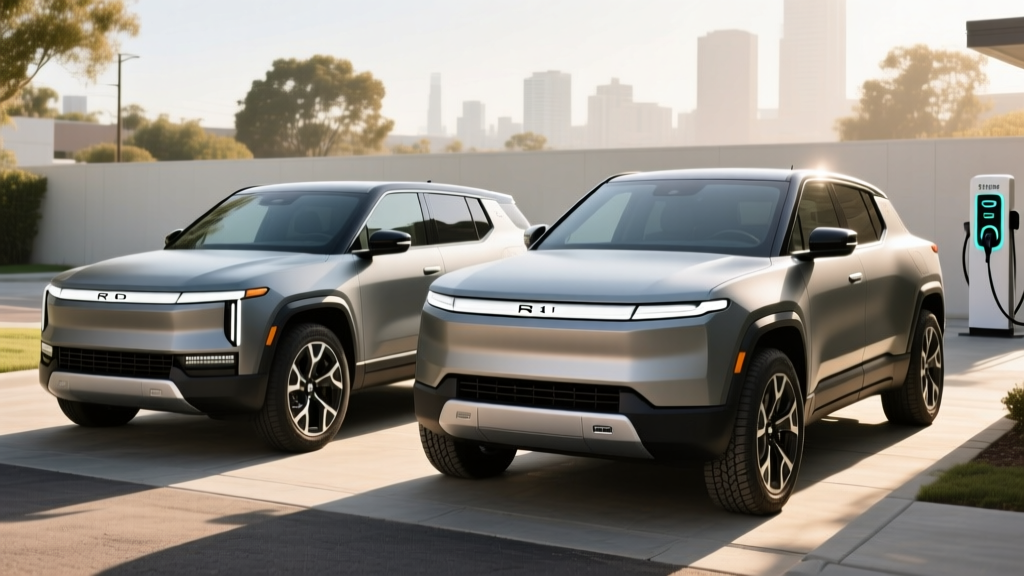
If you're researching a Rivian purchase, the federal EV tax credit is likely a major line item in your budget. The IRS §30D clean vehicle credit can shave up to $7,500 off the effective cost of a new R1S SUV or R1T pickup — but eligibility hinges on MSRP caps, buyer income limits, and battery-sourcing requirements that shift year to year. This guide maps the 2026 Rivian tax credit landscape against the latest R1 Dual-Motor and Tri-Motor specs so you know exactly what you'll pay and what you'll drive.
Rivian R1S and R1T: 2026 Lineup at a Glance
Rivian refreshed both the R1S (three-row SUV) and R1T (crew-cab pickup) for the 2025 model year with a new electrical architecture, upgraded drive units, and enhanced software. Those changes carry into 2026 with minor trim adjustments. Both vehicles share the same skateboard platform, battery options, and powertrain configurations, so the core EV specs apply across body styles.
| Spec | R1S (SUV) | R1T (Pickup) |
|---|---|---|
| EPA Range | ~270 miles (Standard) / ~352 miles (Max) | ~270 miles (Standard) / ~352 miles (Max) |
| Battery (usable) | ~92 kWh (Standard) / ~141 kWh (Max) | ~92 kWh (Standard) / ~141 kWh (Max) |
| Chemistry | NMC (nickel manganese cobalt) | NMC |
| Peak DC Fast Charge | 220 kW | 220 kW |
| 10–80% DC Charge Time | ~21 minutes | ~21 minutes |
| Level 2 Home Charging | 11.5 kW (~25 mi/hr) | 11.5 kW (~25 mi/hr) |
| 0–60 mph | 4.5 sec (Dual-Motor) | 4.5 sec (Dual-Motor) |
| Horsepower | 533 hp (Dual-Motor) | 533 hp (Dual-Motor) |
| Drivetrain | AWD (Dual-Motor) | AWD (Dual-Motor) |
| MPGe (combined) | ~73 MPGe | ~70 MPGe |
| Efficiency | ~46 kWh/100 mi | ~48 kWh/100 mi |
| Battery Warranty | 8 yr / 175,000 mi | 8 yr / 175,000 mi |
Real-World Range: What the EPA Sticker Doesn't Tell You
The EPA estimates up to 352 miles for the R1S Max Pack and ~270 miles for the Standard Pack. In real-world highway driving at 70–75 mph, expect roughly 10–15% less than the EPA figure — putting the Max Pack around 300–315 miles and the Standard Pack around 230–245 miles. In cold weather (below 30°F), range can drop an additional 15–25%, meaning a Standard Pack R1S may deliver as little as 185–200 miles on a winter highway trip. Rivian's heat pump helps mitigate cabin energy draw, but battery chemistry still loses efficiency in the cold.
Rivian offers three battery configurations: Standard (~92 kWh usable NMC), Large (~109 kWh usable), and Max (~141 kWh usable). The Large and Max packs use higher-nickel NMC cells optimized for energy density. Rivian has not adopted LFP (lithium iron phosphate) chemistry in the R1 platform, likely due to the energy-density requirements of a large SUV/truck and the weight trade-offs LFP's heavier cells would impose.
Charging Speed: DC Fast Charging and Home Level 2
Rivian's 2025+ architecture upgraded the DC fast-charge capability to a peak of 220 kW on Large and Max packs (Standard pack peaks around 190 kW). On a 350 kW-capable charger, the R1 can add roughly 140 miles of range in 15 minutes under ideal conditions. However, as with all EVs, the charge curve tapers significantly above 80% state of charge (SoC). A 10–80% session takes approximately 21 minutes; pushing from 80–100% can add another 20+ minutes. For road-trip planning, plan stops around the 10–80% window to minimize time at the charger.
| Charging Level | Power | Miles Added per Hour | Notes |
|---|---|---|---|
| Level 1 (120V outlet) | ~1.4 kW | ~3–4 mi/hr | Emergency/trickle only |
| Level 2 (240V, 48A) | 11.5 kW | ~25 mi/hr | Full overnight charge in ~10–14 hrs |
| DC Fast (peak) | 220 kW | ~140 mi in 15 min | Tapers above 80% SoC |
At home, the R1's onboard charger accepts up to 11.5 kW on a 240V / 48-amp Level 2 circuit. That translates to roughly 25 miles of range per hour of charging, or a full Standard Pack recharge in about 10 hours. Rivian sells its own Wall Connector, but any J1772-compatible Level 2 station (ChargePoint Home Flex, Emporia Vue, etc.) will work. Note: Rivian vehicles currently use the CCS1 connector; the brand has announced a future transition to NACS (Tesla's connector), but 2026 models still ship with CCS1. You can use a NACS-to-CCS adapter at Tesla Superchargers that support non-Tesla vehicles.
Pricing, Trims, and the 2026 Rivian Tax Credit
This is where buyer research gets critical. The federal IRS §30D clean vehicle credit offers up to $7,500, but qualification depends on three factors that frequently change:
- MSRP Cap: SUVs (R1S) must have an MSRP at or below $80,000; pickups (R1T) must be at or below $80,000. Many R1 configurations — especially Tri-Motor and Max Pack builds — exceed this cap.
- Buyer Income Limits: Modified adjusted gross income (MAGI) cannot exceed $300,000 (joint), $225,000 (head of household), or $150,000 (single).
- Battery Sourcing: A percentage of critical minerals and battery components must be sourced from the U.S. or free-trade-agreement countries. These thresholds increase annually and can disqualify vehicles that qualified in prior years.
| Model / Trim | Base MSRP | Below $80K Cap? | Est. §30D Credit | Effective Price (after credit) |
|---|---|---|---|---|
| R1S Dual-Motor Standard | ~$75,900 | Yes | Up to $7,500* | ~$68,400 |
| R1S Dual-Motor Large | ~$82,900 | No | $0 | ~$82,900 |
| R1T Dual-Motor Standard | ~$69,900 | Yes | Up to $7,500* | ~$62,400 |
| R1T Dual-Motor Large | ~$76,900 | Yes | Up to $7,500* | ~$69,400 |
| R1T Tri-Motor Max | ~$99,000+ | No | $0 | ~$99,000+ |
*Eligibility depends on your income, the vehicle's battery-sourcing compliance in the purchase year, and point-of-sale transfer rules. Always verify current status at fueleconomy.gov and consult a tax professional before relying on the credit.
Starting in 2024, the §30D credit can be transferred to the dealer as a point-of-sale discount, meaning you don't have to wait until tax filing to benefit. However, if your tax liability is less than the credit amount, the excess is non-refundable — you only benefit up to what you owe. Rivian's configurator typically displays credit eligibility per build, but always cross-reference with the IRS because sourcing rules can shift mid-year.
Performance, Efficiency, and Daily Drivability
The Dual-Motor R1S and R1T produce 533 horsepower and hit 0–60 mph in approximately 4.5 seconds. Step up to the Tri-Motor configuration (available on Adventure and Ascend trims) and you're looking at 850+ hp with a 0–60 time near 3.0 seconds — supercar territory in a 6,000+ lb vehicle. All configurations are AWD with independent torque vectoring per axle.
Efficiency is the R1's weakest spec relative to lighter EVs. The R1S averages around 46 kWh per 100 miles (roughly 73 MPGe combined), and the R1T sits at approximately 48 kWh/100 mi (70 MPGe). For context, a Tesla Model Y uses about 28 kWh/100 mi. The R1's size, weight, and aerodynamic profile mean you'll spend more per mile on electricity than a sedan or crossover — but you're getting vastly more cargo room, ground clearance, and towing capacity (up to 7,700 lbs for the R1T).
Interior, Cargo, and Technology
The R1S seats up to seven across three rows, though the third row is best suited for children or short trips. Cargo volume behind the third row is approximately 10.5 cu ft, expanding to ~46 cu ft with the third row folded and ~92 cu ft with both rear rows down. The R1T offers a 4.5-foot bed with a unique Gear Tunnel (11 cu ft of lockable, pass-through storage) and a front trunk (frunk) of ~11 cu ft.
Rivian's infotainment runs on a custom 15.6-inch center display with a dedicated driver cluster. The software is responsive and includes native trip planning with charging stops, over-the-air updates, and a built-in camp mode that levels the air suspension and runs climate control overnight. The driver-assistance suite, called Rivian Driver+, combines adaptive cruise control and lane centering. This is an SAE Level 2 system — it requires continuous driver supervision and is not autonomous driving.
Rivian Driver+ is a Level 2 driver-assistance system. The driver must keep hands on the wheel and eyes on the road at all times. It does not navigate autonomously, handle all intersections, or replace attentive driving.
Pros and Cons
- Best-in-class adventure capability (air suspension, 14.9" ground clearance, wading)
- Strong DC fast-charge speed (220 kW peak, ~21 min 10–80%)
- Gear Tunnel and frunk give R1T unmatched storage versatility
- Over-the-air updates continuously add features
- Generous 8-yr / 175,000-mi battery warranty
- Standard Pack trims can qualify for the $7,500 §30D credit
- Efficiency is low vs. lighter EVs (46–48 kWh/100 mi)
- Large and Max Pack trims exceed the $80K MSRP cap — no federal credit
- Third-row space in R1S is tight for adults
- CCS1 connector requires an adapter for Tesla Superchargers
- Real-world cold-weather range drops can be severe (~20–25%)
- Insurance premiums run higher than average for the segment
Who Should Buy a Rivian R1S or R1T?
The R1 platform is purpose-built for buyers who need genuine off-road capability, towing, and cargo versatility without going diesel. It's ideal for:
- Active families who tow a boat or camper on weekends and need three rows during the week.
- Outdoor enthusiasts who value the Gear Tunnel, air suspension, and camp mode for overlanding.
- Truck buyers going electric who want a crew-cab bed with frunk and don't need a heavy-duty work truck.
It's less ideal for pure commuters prioritizing efficiency (a Model Y or Ioniq 5 will cost far less per mile) or buyers who need the longest possible range without stopping — the Max Pack helps, but at a price that eliminates the tax credit.
Frequently Asked Questions
Does the 2026 Rivian R1 qualify for the federal EV tax credit?
It depends on the trim. The R1S and R1T Dual-Motor Standard and some Large Pack configurations fall under the $80,000 MSRP cap and may qualify for up to $7,500 under IRS §30D — provided you meet the income thresholds (MAGI ≤ $300K joint / $150K single) and the vehicle's battery sourcing meets current-year critical-mineral and component requirements. Tri-Motor and Max Pack builds generally exceed the MSRP cap and do not qualify. Always verify at irs.gov before purchasing.
What is the real-world range of the Rivian R1?
The EPA rates the R1S/R1T Max Pack at ~352 miles and the Standard Pack at ~270 miles. Real-world highway driving at 70–75 mph typically yields 300–315 miles (Max) and 230–245 miles (Standard). In sub-30°F weather, reduce those figures by an additional 15–25%.
How fast does the Rivian R1 charge at home and on the road?
On a 240V / 48A Level 2 home charger, the R1 accepts 11.5 kW, adding about 25 miles of range per hour (full charge in 10–14 hours depending on pack size). On a DC fast charger, it peaks at 220 kW and charges from 10–80% in approximately 21 minutes, with significant tapering above 80% SoC.
Is the Rivian R1 worth it vs. the Tesla Model X or Ford F-150 Lightning?
If you prioritize off-road capability, build quality, and adventure features (Gear Tunnel, air suspension, camp mode), the Rivian stands apart. The Tesla Model X offers more range and Supercharger access but less ruggedness. The F-150 Lightning is more affordable and work-oriented but less refined on-road. The Rivian occupies a premium adventure niche and prices accordingly.
What is Rivian's battery warranty?
Rivian covers the battery pack and drive units for 8 years or 175,000 miles, whichever comes first. The warranty guarantees the battery will retain a minimum percentage of its original capacity (typically around 70%) over that period. This is above the industry-standard 8yr/100,000-mi coverage.