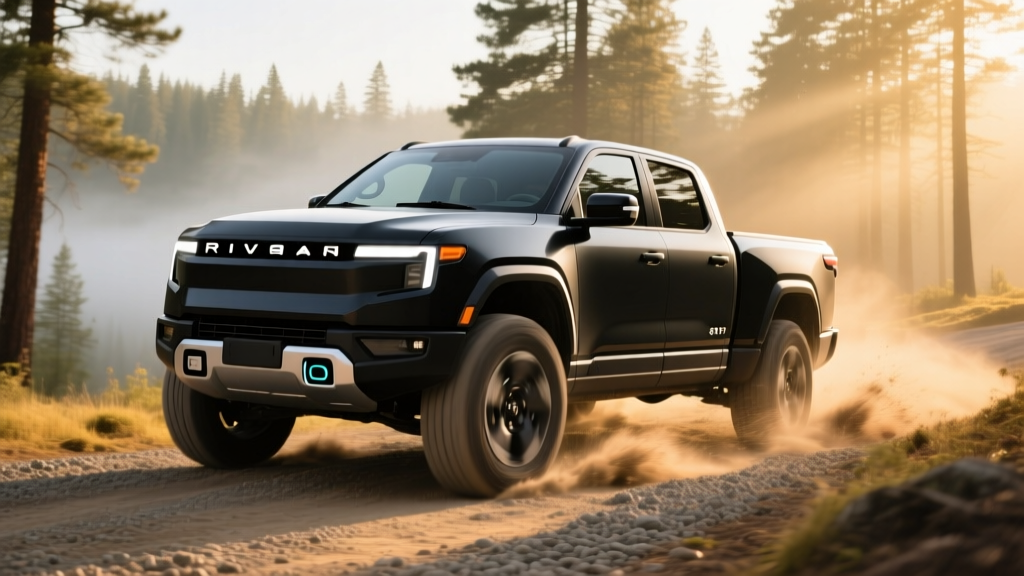
Rivian Tank Turn sounds like a party trick: spin the truck in place by counter-rotating the wheels on each side. But for 2026 R1T Tri-Motor owners, it's one of several off-road tools bundled with a 300+ mile pickup that also posts sub-3-second 0-60 times. Below, we break down what Tank Turn actually does, where it's useful, and how the rest of the 2026 R1T Tri-Motor package — range, charging, price, tax credits — stacks up for real buyers.
What Is Rivian Tank Turn and How Does It Work?
Tank Turn is a software-controlled off-road maneuver enabled by the R1T's multi-motor architecture. On the Tri-Motor configuration (one front motor, two rear), Rivian's drive system can spin the left-side and right-side wheels in opposite directions at low speed, allowing the truck to pivot roughly around its center axle. The result is a near-360-degree turn in place — similar to how a tracked vehicle turns.
In practice, it is most useful in tight off-road scenarios: dead-end trails, narrow forest roads, boat ramps with no turnaround, or rocky switchbacks where a three-point turn would risk underbody damage. Rivian gates the feature behind specific off-road drive modes and low speeds (typically under 5 mph) to protect driveline components.
It is not a daily-driving feature, and it is not street-legal for use on public pavement in most jurisdictions. Think of it as a specialized tool alongside Hill Descent Control, rock-crawl mode, and the R1T's 14.9 inches of ground clearance in Max mode.
2026 Rivian R1T Tri-Motor: Core Specs at a Glance
| Spec | Value |
|---|---|
| Drivetrain | Tri-Motor AWD (1 front, 2 rear) |
| Horsepower | ~850 hp (combined) |
| 0-60 mph | ~2.9 seconds |
| Battery (Max Pack) | ~141 kWh usable, NMC chemistry |
| EPA Range (Max Pack) | ~328 miles (Dual-Motor); Tri-Motor ~300-310 mi est. |
| Efficiency | ~48-52 kWh/100 mi (Tri-Motor) |
| Max DC Fast Charge | ~220 kW peak |
| 10-80% DC Charge Time | ~30-35 minutes (Max Pack) |
| Level 2 Home Charging | 11.5 kW onboard (~16-19 mi/hr) |
| Towing Capacity | Up to 11,000 lbs (properly equipped) |
| Ground Clearance (Max) | 14.9 inches |
| Bed Length | 4.5 ft (with Gear Tunnel storage) |
| Warranty | 5 yr/60,000 mi vehicle; 8 yr/175,000 mi battery & drive units |
Source: Rivian R1T specifications. Tri-Motor range figures are preliminary estimates pending final EPA certification for the 2026 model year.
Real-World Range: EPA Sticker vs What You'll Actually See
Real-world highway (70 mph, 72°F): ~240-270 miles
Cold weather (32°F, mixed driving): ~200-230 miles
Towing (5,000 lb trailer, flat terrain): ~140-170 miles
The R1T is a heavy, boxy, 7,000+ lb pickup. Aerodynamic drag dominates at highway speed, and the Tri-Motor's extra rear motor adds weight and parasitic loss versus the Dual-Motor. In EPA testing cycles — which include substantial city/regen driving — the R1T posts strong numbers. On sustained interstate runs at 75-80 mph, expect a 15-20% reduction from the sticker.
Cold weather compounds this. The R1T's heat-pump-based thermal management helps, but battery chemistry (NMC) loses efficiency below freezing, and cabin heating is a significant load. Plan for 25-35% range loss in sub-40°F conditions, especially on short trips where the pack never fully warms.
For road trips, the practical planning range on the Max Pack Tri-Motor is roughly 220-250 miles between charges in moderate weather — enough to hit most DC fast-charger spacing on major corridors, but tight on rural routes in the Mountain West.
Charging Speed: DC Fast, Level 2, and the Curve Reality
The 2026 R1T with the Max Pack supports up to ~220 kW peak on DC fast chargers via its NACS (Tesla-standard) charge port — Rivian transitioned to NACS for the 2025 model year, giving R1T owners native access to the Tesla Supercharger network without an adapter.
| Charging Level | Power (kW) | Miles Added per Hour | Notes |
|---|---|---|---|
| Level 1 (120V, 12A) | ~1.4 kW | ~2-3 mi/hr | Emergency/trickle only |
| Level 2 (240V, 48A) | 11.5 kW | ~16-19 mi/hr | Full overnight charge in ~12-14 hr |
| DC Fast (peak) | 220 kW | ~600+ mi/hr (at peak) | 10-80% in ~30-35 min (Max Pack) |
A critical nuance: peak kW is not sustained kW. The R1T's charge curve tapers significantly above 80% State of Charge to protect the NMC cells. A 10-80% session on a 250+ kW Supercharger or Electrify America station takes roughly 30-35 minutes; pushing from 80-100% can add another 25-30 minutes. For road trips, plan stops around the 10-80% window and skip the top-off unless you're ending the day.
At home on a 48-amp Level 2 wall connector (requiring a 60-amp circuit), the R1T gains about 16-19 miles of range per hour. A full 10-100% charge takes roughly 12-14 hours — fine for overnight replenishment, but you'll want a dedicated 240V/60A circuit installed by a licensed electrician. Budget $800-$2,000 for the install depending on panel capacity and run length; a panel upgrade to 200A service can add $1,500-$3,000 if your home needs it.
Performance: Tri-Motor Power and the Tank Turn Advantage
The Tri-Motor R1T's ~850 horsepower and sub-3-second 0-60 time put it in supercar territory, which is genuinely absurd for a pickup that can tow 11,000 pounds and ford 3+ feet of water. But straight-line speed is the least interesting part of this powertrain.
The two independent rear motors enable torque vectoring — sending different amounts of torque to each rear wheel — which sharpens on-road cornering and, more importantly, provides precise low-speed traction control off-road. Tank Turn is an extension of this: by commanding opposite rotation on each side, the truck pivots without needing forward space.
Rivian's air suspension (standard on R1T) offers adjustable ride height from a low "Park" mode for easier entry to a "Max" off-road height of 14.9 inches of ground clearance. Approach, departure, and breakover angles are competitive with body-on-frame off-roaders, and the independent suspension articulates well for a unibody platform.
Driver assistance comes via Rivian's Driver+ suite, which includes adaptive cruise, lane-centering, and automated lane changes on divided highways. This is an SAE Level 2 system — the driver must keep hands on the wheel and eyes on the road at all times. It is not autonomous driving.
Pricing, Trims, and Federal Tax Credit Eligibility
The 2026 R1T Tri-Motor sits at the top of the R1T lineup and is priced accordingly:
| Configuration | Pack | Est. Base MSRP |
|---|---|---|
| Dual-Motor Adventure | Standard (~106 kWh) | ~$71,700 |
| Dual-Motor Adventure | Max (~141 kWh) | ~$81,700 |
| Tri-Motor Adventure | Max (~141 kWh) | ~$101,700 |
Prices are estimates based on Rivian's current pricing structure and may vary by final 2026 model-year announcement. Destination charges and options (camp kitchen, gear tunnel shuttle, premium audio) add to as-tested cost.
Does the R1T Tri-Motor Qualify for the §30D Federal Tax Credit?
This is where Tri-Motor buyers face a hard reality. Under IRS §30D rules, the federal clean vehicle credit has several gating requirements:
- MSRP cap: Pickup trucks must have an MSRP at or below $80,000 to qualify.
- Buyer income cap: Modified AGI must not exceed $300,000 (joint), $225,000 (head of household), or $150,000 (single).
- Battery sourcing: Critical minerals and battery components must meet escalating domestic/free-trade-agreement thresholds that tighten each year.
- Point-of-sale transfer: Eligible buyers can transfer the credit to the dealer at purchase for an immediate price reduction.
At an estimated ~$101,700 MSRP, the R1T Tri-Motor with Max Pack exceeds the $80,000 pickup MSRP cap and does not qualify for the §30D credit. The Dual-Motor Standard Pack (at ~$71,700) may qualify, subject to income limits and battery-sourcing compliance — but buyers should verify current-year eligibility with a tax professional before relying on the credit.
Cargo, Interior, and Daily Livability
The R1T's 4.5-foot bed is shorter than a conventional midsize pickup (Tacoma, Colorado), but Rivian compensates with the Gear Tunnel — a lockable, pass-through storage compartment spanning the width of the truck behind the rear seats. It holds roughly 11 cubic feet and is ideal for skis, tools, or the optional Camp Kitchen.
Interior space is generous for four adults:
- Front legroom: ~41.3 inches
- Rear legroom: ~38.2 inches
- Cargo (bed): 4.5 ft bed; ~15.2 cu ft (with tonneau)
- Gear Tunnel: ~11 cu ft
- Frunk (front trunk): ~11 cu ft
The 15.6-inch center touchscreen runs Rivian's in-house OS, which has improved significantly since launch with faster response and better route-planning integration. Apple CarPlay and Android Auto are not supported — Rivian uses its own interface exclusively, which is a dealbreaker for some buyers accustomed to phone projection.
Pros, Cons, and Who Should Buy the R1T Tri-Motor
- Tank Turn + torque vectoring: genuine off-road capability
- Sub-3-sec 0-60 with 11,000-lb towing — no compromise
- 300+ mile range (Max Pack) for a full-size-class pickup
- NACS native — full Supercharger network access
- Air suspension with 14.9" ground clearance
- Gear Tunnel + frunk expand usable storage
- Tri-Motor exceeds $80K MSRP cap — no §30D credit
- Real-world highway range drops to ~240-270 mi
- No Apple CarPlay / Android Auto
- Short 4.5-ft bed limits conventional truck utility
- High insurance premiums (performance EV pickup)
- Tank Turn is niche — not useful on pavement
Who This Truck Suits Best
Buy the R1T Tri-Motor if: You want a do-everything electric pickup with serious off-road chops, need towing capacity, frequently explore tight backcountry trails where Tank Turn and torque vectoring add real value, and can absorb six-figure pricing without a tax credit.
Consider the Dual-Motor R1T instead if: Your needs are 90% on-road with occasional light trails, you want to stay under the $80K MSRP cap for §30D eligibility, and you don't need sub-3-second acceleration.
Look at the Ford F-150 Lightning or Chevy Silverado EV if: You need a full-size 5.5+ ft bed, prioritize fleet/commercial utility, or want a lower entry price with tax-credit eligibility.
Frequently Asked Questions
Can I use Tank Turn on pavement?
No. Tank Turn is designed for loose, off-road surfaces at very low speeds. Using it on pavement would cause severe tire scrubbing, driveline stress, and potential surface damage. Rivian's software restricts the feature to off-road drive modes.
Is the R1T Tri-Motor worth it over the Dual-Motor?
For most buyers, no. The Dual-Motor with Max Pack delivers 340+ miles of range, still posts a ~4.5-second 0-60, and may qualify for the §30D credit. The Tri-Motor's extra performance and Tank Turn are compelling for off-road enthusiasts and towing-heavy users, but the $20,000+ premium and loss of tax-credit eligibility are steep tradeoffs.
How reliable is the Rivian R1T?
Rivian's early build-quality issues (panel gaps, software glitches) have improved with the 2024+ Gen 2 platform. The 8-year/175,000-mile battery and drive-unit warranty is among the best in the segment. Long-term reliability data for the Tri-Motor is still limited given its recent introduction.
Does the R1T work in cold climates?
Yes, with planning. The heat pump and battery preconditioning help preserve range and maintain charge speed in cold weather. Expect 25-35% range reduction below freezing. The R1T's AWD system, air suspension, and available all-terrain tires make it competent in snow — but always precondition the battery before DC fast charging in cold conditions.