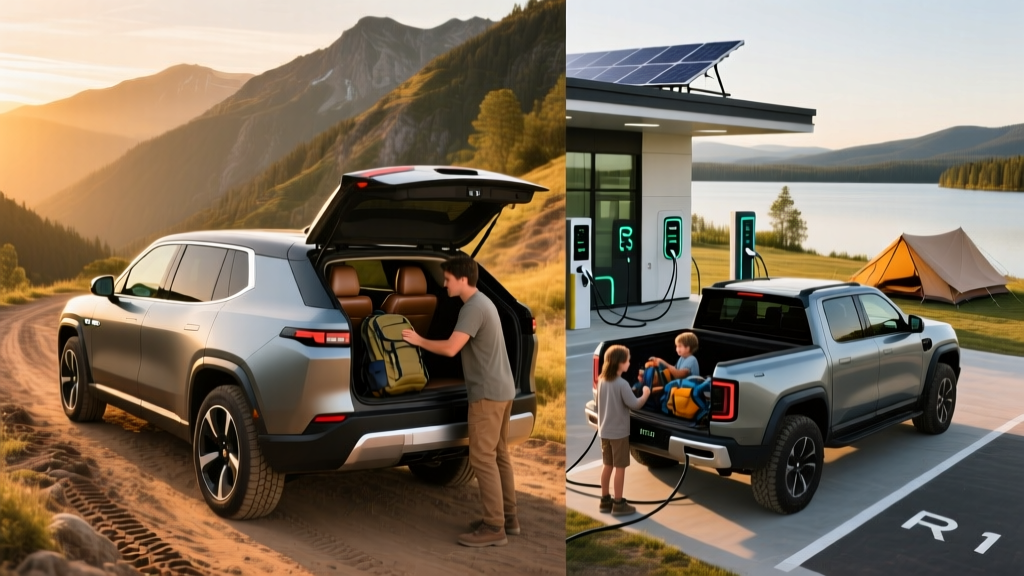
If you're researching a Rivian in the Tampa Bay area, you're likely weighing whether the R1S SUV or R1T pickup fits Florida driving — from I-275 commutes to weekend runs up to Orlando or across the state to Miami. Tampa's heat, highway-heavy driving patterns, and growing but uneven charging infrastructure create a unique ownership profile for these dual-motor and quad-motor electric adventure vehicles.
This guide covers the 2026 Rivian R1S and R1T with exact EPA range figures, real-world Florida efficiency data, DC fast-charge performance on Electrify America and Tesla Superchargers (via NACS adapter), home Level 2 installation realities in Hillsborough and Pinellas counties, and current federal tax credit eligibility under IRS §30D rules.
2026 Rivian R1S and R1T: Quick Spec Overview
For the 2026 model year, Rivian offers both the R1S (three-row SUV) and R1T (crew-cab pickup) on the updated Gen 2 platform with tri-motor and dual-motor configurations. The Max battery pack now uses a high-silicon-anode NMC chemistry, while the Standard pack retains conventional NMC. Rivian discontinued the LFP-equipped Standard pack option for Gen 2 vehicles.
| Spec | R1S Dual-Motor Max | R1T Tri-Motor Max |
|---|---|---|
| EPA Range | 410 miles | 380 miles |
| Battery (usable) | ~149 kWh (NMC) | ~149 kWh (NMC) |
| 0–60 mph | 4.5 sec | 2.9 sec |
| Horsepower | 665 hp | 850 hp |
| Drivetrain | AWD (dual-motor) | AWD (tri-motor) |
| Peak DC Charge Rate | 220 kW | 220 kW |
| 10–80% DC Fast Charge | ~30 min | ~30 min |
| Level 2 Home Charge | 11.5 kW (~25 mi/hr) | 11.5 kW (~25 mi/hr) |
| MPGe (combined) | 73 MPGe | 69 MPGe |
| kWh/100 mi | 46 kWh | 49 kWh |
| Base MSRP | $83,900 | $99,900 |
| Battery Warranty | 8 yr / 175,000 mi | 8 yr / 175,000 mi |
Real-World Range in Tampa's Climate
EPA Sticker: 410 miles (R1S Dual-Motor Max) / 380 miles (R1T Tri-Motor Max)
Real-World Expectation (Tampa, FL): 330–370 miles highway at 70–75 mph in summer heat; 350–390 miles mixed city/highway in cooler months
According to fueleconomy.gov, the R1S Dual-Motor Max achieves 73 MPGe combined. But EPA estimates assume a mix of city and highway driving under moderate conditions. In Tampa's real-world environment, several factors shift that number:
Summer highway driving: Tampa's summer temperatures regularly exceed 90°F, and cabin A/C draws significant energy — typically 2–4 kW continuously. On a 75-mph run up I-75 to Gainesville or across I-4 to Orlando, expect energy consumption around 48–54 kWh/100mi, translating to roughly 330–360 miles of real range from the Max pack.
City and suburban driving: Around South Tampa, Carrollwood, or Brandon with stop-and-go traffic, regenerative braking recovers substantial energy. Expect closer to 370–400 miles from the same pack under these conditions.
Cold-weather caveat: Tampa rarely sees freezing temperatures, so the 15–30% range loss that northern Rivian owners experience in winter is largely irrelevant here. Battery preconditioning still matters for DC fast charging, but ambient Florida heat actually helps keep the pack in its optimal operating window.
The heat factor: Prolonged exposure to Florida sun while parked can heat-soak the battery, slightly increasing thermal management energy draw. Rivian's active liquid cooling system manages this, but expect a few percent efficiency penalty versus moderate-climate ownership. Garage parking helps.
Charging Speeds: DC Fast Charging and Home Level 2
Rivian's Gen 2 platform supports a peak DC fast-charge rate of 220 kW via NACS (native Tesla connector, now standard on all 2026 Rivians). The charge curve peaks around 20–40% state of charge and tapers progressively above 60%, which is typical for large NMC packs.
| Charging Level | Power | Speed | Notes |
|---|---|---|---|
| Level 1 (120V outlet) | ~1.4 kW | ~3 miles/hour | Emergency/trickle only |
| Level 2 (240V, 48A) | 11.5 kW | ~25 miles/hour | Full overnight charge in ~14 hours |
| DC Fast Charge (peak) | 220 kW | ~140 miles in 10 min | Peak rate at 20–40% SoC |
| DC Fast Charge (10–80%) | ~170 kW avg | ~30 minutes | Tapers significantly above 80% |
Tampa DC fast-charging landscape: The Tampa Bay area has a growing network of DC fast chargers. Electrify America stations at Westshore Plaza and International Plaza offer 150–350 kW CCS chargers (Rivian owners use the included CCS-to-NACS adapter or the EA app with NACS support). Tesla Superchargers — now open to Rivian via the NACS adapter and Tesla app — are available at multiple locations including Citrus Park, Brandon, and along I-75 and I-4 corridors.
Real charging reality: The 220 kW peak rate is not sustained. On a typical 10–80% session at a 250 kW charger, the R1S/R1T averages around 165–175 kW. Expect a 10–80% charge in roughly 30 minutes. Charging above 80% slows dramatically — an 80–100% top-off can add another 25–35 minutes. For road trips, plan stops around the 10–80% window for optimal time efficiency.
Home Level 2 charging: The Rivian Wall Charger delivers 11.5 kW on a 240V/48A circuit. For Tampa homeowners, this means a full charge from near-empty in about 14 hours — practical for overnight replenishment. Most daily driving of 30–60 miles requires only 1–3 hours of Level 2 charging each night.
Home Level 2 Installation Costs in Tampa Bay
Installing a Level 2 home charger in the Tampa area involves equipment, electrical work, and permitting. Here's a realistic cost breakdown based on typical Hillsborough and Pinellas county rates:
| Component | Cost Range | Details |
|---|---|---|
| Rivian Wall Charger | $500–$600 | 11.5 kW, 25-ft cable, NACS |
| Electrician labor (standard install) | $600–$1,200 | Run 60A circuit from panel, mount charger |
| Electrical panel upgrade (if needed) | $1,500–$3,000 | Many older Tampa homes have 100A panels |
| Permit (Hillsborough/Pinellas) | $50–$150 | Required for new 240V circuits |
| Total (no panel upgrade) | $1,150–$1,950 | Most common scenario for newer homes |
| Total (with panel upgrade) | $2,650–$4,950 | Common in pre-2000 construction |
Tampa-specific note: Many homes in South Tampa, Seminole Heights, and St. Pete were built before 2000 with 100-amp or 150-amp electrical panels. A 48A EV charger draws 60A at the breaker (125% continuous-load rule per NEC), which may require a panel upgrade to 200A. Get a load calculation from a licensed electrician before committing. Tampa Electric (TECO) offers no specific EV rate plan as of 2026, but their standard residential rate of approximately $0.14/kWh means a full R1S Max pack charge costs roughly $21 — equivalent to about $0.05–0.06 per mile.
Pricing, Trims, and Federal Tax Credit Eligibility
The 2026 Rivian lineup spans multiple trims and battery configurations. Here's how pricing breaks down and where the federal tax credit applies:
| Model / Trim | MSRP | §30D Credit Eligible? | Effective Price (if eligible) |
|---|---|---|---|
| R1S Dual-Motor Standard | $75,900 | Yes (under $80K cap) | ~$68,400 |
| R1S Dual-Motor Max | $83,900 | No (over $80K SUV cap) | $83,900 |
| R1S Tri-Motor Max | $99,900 | No | $99,900 |
| R1T Dual-Motor Standard | $69,900 | Yes (under $80K truck cap) | ~$62,400 |
| R1T Dual-Motor Max | $79,900 | Yes (under $80K truck cap) | ~$72,400 |
| R1T Tri-Motor Max | $99,900 | No | $99,900 |
Critical tax credit rules for 2026 (IRS §30D): According to the IRS, the clean vehicle credit of up to $7,500 is subject to multiple requirements:
- MSRP caps: SUVs (R1S) must be under $80,000; trucks (R1T) must be under $80,000. This eliminates most Max and all Tri-Motor configurations from credit eligibility.
- Buyer income limits: AGI must not exceed $300,000 (joint), $225,000 (head of household), or $150,000 (single).
- Battery sourcing: Critical minerals and battery components must meet phased-in domestic content thresholds. Rivian's supply chain has been evolving; confirm current-year sourcing compliance on the IRS qualified vehicles list before purchase.
- Point-of-sale transfer: Eligible buyers can transfer the credit to the dealer for an immediate price reduction rather than claiming it at tax time.
- Consult a tax professional: Eligibility is taxpayer-specific. Always verify against the current IRS qualified vehicle list and your personal tax situation.
Performance, Cargo, and Daily Practicality
The R1S and R1T deliver sports-car acceleration in adventure-vehicle packaging — a combination that defines the Rivian ownership experience.
R1S SUV: The Dual-Motor Max produces 665 hp and hits 0–60 mph in 4.5 seconds. The Tri-Motor variant drops that to 2.9 seconds with 850 hp. Cargo volume is 104.7 cu ft with the second and third rows folded, 46.7 cu ft behind the second row, and a front trunk (frunk) offering 11.1 cu ft. Third-row legroom is 30.4 inches — adequate for children on shorter trips but tight for adults.
R1T Pickup: The crew-cab R1T offers a 4.5-foot bed (extendable to 6+ feet with the gear tunnel and midgate), a 11.0 cu ft frunk, and a unique gear tunnel that runs between the cab and bed. Towing capacity reaches 11,000 pounds when properly equipped, though towing at that limit will reduce range by roughly 40–50%.
Tech and driver assistance: Rivian's in-house developed infotainment runs on a 15.6-inch center display with native navigation, over-the-air updates, and a camp mode that maintains climate control overnight. The Driver+ system provides SAE Level 2 highway assistance with adaptive cruise and lane centering — functional on I-75 and I-4, but it requires continuous driver supervision and is not autonomous driving.
Driver+ is SAE Level 2, not self-driving. You must keep your hands on the wheel and eyes on the road at all times. The system does not handle construction zones, unmapped roads, or severe weather autonomously. Rivian has not announced any Level 3 or Level 4 capability for 2026 models.
Rivian vs. Competitors: Is It Worth Buying in Tampa?
For Tampa buyers cross-shopping the Rivian R1S and R1T, the competitive set includes the Tesla Model X, Ford F-150 Lightning, GMC Hummer EV, and the Chevrolet Tahoe-based Silverado EV. Here's how the Rivian stacks up on the metrics that matter:
Range winner: Rivian R1S Max (410 mi EPA)
The Tesla Model X Long Range posts 348 miles; the Hummer EV SUV manages 314 miles. Rivian's Max pack leads the three-row EV SUV segment.
Charging speed winner: Rivian (220 kW peak, NACS native)
Native NACS means direct Supercharger access without an adapter, a meaningful advantage over CCS-equipped competitors still relying on adapters for Tesla network access.
Price value winner: Ford F-150 Lightning (from ~$55,000)
The Lightning undercuts the R1T by $15,000+ at base level. If you need a work truck more than an adventure vehicle, the Lightning is the budget play.
Adventure capability winner: Rivian R1T
Quad-motor torque vectoring, 14.9 inches of ground clearance, and a wading depth of 3+ feet make the R1T the most capable off-road EV pickup available.
Pros and Cons of Rivian Ownership in Tampa
Pros
- Class-leading EPA range (410 mi R1S Max) handles Tampa–Miami round trips with one charge stop
- Native NACS connector = seamless Tesla Supercharger access across Florida
- Florida heat is battery-friendly — minimal cold-weather range loss
- R1T gear tunnel and frunk provide unique storage no competitor matches
- Over-the-air updates continuously add features and refine performance
- 8-year/175,000-mile battery warranty exceeds most competitors
Cons
- Most trims exceed $80,000 MSRP cap, eliminating federal tax credit eligibility
- No Rivian Service Center in Tampa — nearest is in Orlando (~85 miles)
- 46–49 kWh/100mi efficiency means higher charging costs than lighter EVs
- Third row in R1S is tight for adults on longer drives
- DC fast-charge taper above 80% adds time if you need a full pack
- Insurance premiums run 15–25% higher than comparable ICE vehicles
Who the Rivian R1S and R1T Are Best For
Buy the R1S if: You need three rows for family hauling, prioritize maximum range for Florida road trips (Tampa to Key West is ~370 miles — doable on one Max-pack charge with conservative driving), and want native Supercharger access without adapter hassle. The Dual-Motor Standard at $75,900 is the sweet spot for tax credit eligibility.
Buy the R1T if: You want an electric pickup that's genuinely capable off-road and on-road, value the gear tunnel and frunk for kayaks, bikes, or camping gear, and plan to tow a boat on weekends. The Dual-Motor Max at $79,900 squeaks under the truck MSRP cap for credit eligibility.
Look elsewhere if: Your budget is under $65,000 (consider the Ford F-150 Lightning or Chevrolet Silverado EV Work Truck), you don't need off-road or adventure capability (a Tesla Model Y or Hyundai Ioniq 5 is more efficient and affordable), or you need a nearby service center for peace of mind (Rivian's mobile service handles most issues, but major repairs require an Orlando trip).
Frequently Asked Questions
What is the real-world range of the Rivian R1S in Tampa?
Expect 330–370 miles on highway trips at 70–75 mph in summer heat with A/C running, and 350–390 miles in mixed city/highway driving during cooler months. The EPA rates the R1S Dual-Motor Max at 410 miles, but sustained highway speeds and cabin cooling in Florida's climate reduce that figure in practice.
How fast does the Rivian charge at home and on DC fast chargers?
At home on a Level 2 (240V/48A) Rivian Wall Charger, the R1S or R1T gains about 25 miles of range per hour, with a full charge taking roughly 14 hours from near-empty. On a DC fast charger, the Gen 2 platform peaks at 220 kW and charges from 10–80% in approximately 30 minutes, though the rate tapers significantly above 80% state of charge.
Does the 2026 Rivian qualify for the $7,500 federal EV tax credit?
It depends on the trim. The R1S Dual-Motor Standard ($75,900) and R1T Dual-Motor Standard ($69,900) and R1T Dual-Motor Max ($79,900) fall under the $80,000 MSRP cap and may qualify, provided the buyer meets income limits and the vehicle meets battery sourcing requirements per IRS §30D rules. Most Max and all Tri-Motor trims exceed the MSRP cap and do not qualify.
Is there a Rivian service center in Tampa?
As of 2026, Rivian does not operate a dedicated Service Center in Tampa. The nearest is in Orlando, approximately 85 miles away. Rivian does offer mobile service for many maintenance and repair tasks, and a growing network of certified collision centers. For warranty-covered major repairs, plan for an Orlando trip or mobile service appointment.
How does Tampa's heat affect the Rivian's battery longevity?
Florida's warm climate is actually favorable for lithium-ion battery longevity compared to extreme cold climates. The R1S and R1T use active liquid thermal management to keep the pack in its optimal temperature range. Rivian warranties the battery for 8 years or 175,000 miles against degradation below 70% of original capacity. Real-world data from early Rivian owners in warm climates shows minimal degradation in the first 2–3 years of ownership.
Can I tow a boat with the Rivian R1T from Tampa to the coast?
The R1T is rated to tow up to 11,000 pounds when properly equipped, which covers most recreational boats and trailers. However, towing at or near maximum capacity reduces range by approximately 40–50%. A trip from Tampa to Clearwater Beach (~30 miles) is trivial, but a longer tow — say to the Keys — will require careful charge planning with one or two DC fast-charge stops.