Rivian in 2026: Understanding the Stock Disconnect and the Real Vehicles
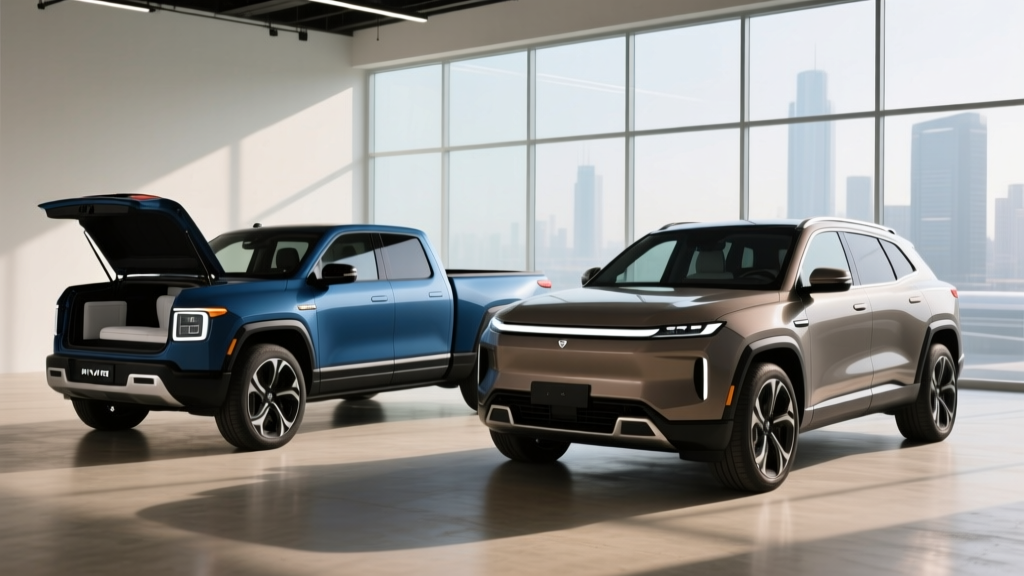
Search "why is Rivian stock so low" and you will find a tangle of Wall Street narratives: production ramp delays, tariff headwinds, EV demand softening, and intense competition from Tesla, Ford, and Hyundai-Kia. But for buyers and owners, the stock price is noise. What matters is the metal. In 2026, Rivian sells two core vehicles—the R1T pickup and the R1S SUV—both refreshed on the Gen 2 platform with tri-motor and dual-motor options, improved efficiency, and the company's proprietary charge network access via the NACS adapter.
This review breaks down the real-world specs, ownership economics, and competitive positioning of the 2026 R1T and R1S to help you decide whether Rivian's vehicles deserve your money, even if the stock market remains skeptical.
Range, Efficiency, and the Real-World Reality
The 2026 R1T Dual-Motor with the Standard battery (105 kWh usable, NMC lithium-ion) carries an EPA-estimated range of 270 miles. Upgrade to the Large battery pack (128.9 kWh usable, Samsung SDI 2170 NMC cells) and the EPA number climbs to 352 miles on the Dual-Motor, or up to 415 miles on the Max pack configuration (141 kWh). The R1S SUV posts nearly identical figures, with the Large pack Dual-Motor rated at 341 miles EPA.
Efficiency lands around 70–73 MPGe combined depending on trim, translating to roughly 46–48 kWh per 100 miles for the Dual-Motor R1T. That is thirsty by EV standards—blame the 7,000+ lb curb weight, boxy aero profile, and all-terrain tires. For comparison, the Tesla Cybertruck AWD achieves 79 MPGe, and the Ford F-150 Lightning Extended Range sits at 70 MPGe (source: fueleconomy.gov).
Charging Speed: DC Fast, Level 2, and the NACS Transition
Rivian's Gen 2 vehicles support up to 220 kW peak DC fast charging on the Large and Max battery packs. The Standard pack peaks at roughly 175 kW. In practice, the charge curve tapers significantly after 80% state of charge (SoC), as is typical for NMC chemistry to preserve long-term battery health.
| Charge Level | Power / Rate | Time or Miles Added |
|---|---|---|
| DC Fast Charge (peak) | 220 kW (Large/Max pack) | 10–80% in ~21 minutes (ideal conditions) |
| DC Fast Charge (Standard pack) | 175 kW peak | 10–80% in ~28 minutes |
| Level 2 Home (48A / 11.5 kW) | 11.5 kW | ~16–19 miles of range per hour |
| Level 2 Home (32A / 7.7 kW) | 7.7 kW | ~11–13 miles of range per hour |
| Level 1 (120V) | ~1.4 kW | ~2–3 miles per hour (emergency only) |
At a 350 kW Electrify America or Tesla Supercharger stall (via the NACS adapter Rivian began shipping in 2024), you will see peak speeds sustained from roughly 15–55% SoC, then a taper. Plan road-trip stops around 20-minute charges from 10–80%. Rivian's built-in route planner automatically preconditioned the battery when navigating to a charger, which is essential for hitting advertised speeds in cold weather.
Performance: Tri-Motor Thrills and Dual-Motor Practicality
The 2026 R1T and R1S offer three powertrain tiers:
- Dual-Motor AWD: 533 hp, 610 lb-ft torque, 0–60 mph in 4.5 seconds. This is the volume seller and the efficiency leader.
- Performance Dual-Motor: 665 hp, 829 lb-ft, 0–60 in 3.4 seconds.
- Tri-Motor AWD (R1T only, R1S available): 850+ hp, 1,100+ lb-ft, 0–60 in approximately 2.9 seconds. This positions the R1T as one of the quickest production pickups ever built.
All configurations use a single-speed reduction gearbox with AWD as standard. Towing capacity maxes out at 11,000 lbs for the R1T (properly equipped) and 7,700 lbs for the R1S. Note: towing at max capacity cuts range by roughly 40–50%, a reality every EV truck buyer must accept.
| Spec | R1T Dual-Motor (Large) | R1T Tri-Motor (Max) | R1S Dual-Motor (Large) |
|---|---|---|---|
| EPA Range | 352 mi | 415 mi | 341 mi |
| Battery (usable) | 128.9 kWh NMC | 141 kWh NMC | 128.9 kWh NMC |
| Horsepower | 533 hp | 850+ hp | 533 hp |
| 0–60 mph | 4.5 sec | ~2.9 sec | 4.5 sec |
| Max DC Charge | 220 kW | 220 kW | 220 kW |
| 10–80% DC Time | ~21 min | ~24 min | ~21 min |
| Towing Capacity | 11,000 lbs | 11,000 lbs | 7,700 lbs |
| Cargo (bed / behind 2nd row) | 54 cu ft bed + 11 cu ft frunk | 54 cu ft bed + 11 cu ft frunk | 47 cu ft (behind 2nd row) |
| Base MSRP | $71,700 | $99,900 | $77,700 |
Pricing, Tax Credits, and the Cost Question
The 2026 R1T starts at $71,700 for the Dual-Motor Standard pack and climbs to over $100,000 for a Tri-Motor Max with Adventure package options. The R1S starts at $77,700 and can exceed $110,000 fully loaded.
- MSRP Cap: Vans, SUVs, and pickups have an $80,000 MSRP cap. Many R1T and R1S trims exceed this threshold, disqualifying them from the new-vehicle credit.
- Income Cap: $150,000 single / $300,000 joint modified AGI.
- Battery Sourcing: Critical minerals and battery components must meet escalating domestic-content percentages per the Inflation Reduction Act. Rivian has worked to shift sourcing, but not all configurations qualify. Verify at the point of sale.
- Point-of-Sale Transfer: If eligible, the $7,500 credit can be applied as a down-payment reduction at the dealer. Confirm eligibility on the IRS clean vehicle portal (irs.gov).
In practice, the Dual-Motor Standard pack R1T at $71,700 may qualify for the full $7,500 credit if sourcing and income requirements are met, bringing the effective price to ~$64,200. Higher trims almost always cross the $80,000 MSRP cap. This pricing reality is one reason Rivian's addressable market remains narrower than Tesla's or Hyundai's—and a factor behind the stock's struggles.
Interior, Tech, and Daily Livability
Rivian's interior is minimalist but functional. The 15.6-inch center touchscreen runs Rivian's proprietary OS—responsive, with over-the-air updates, integrated route planning, and camp-mode climate control. A 12.3-inch digital driver display replaces traditional gauges. Wireless Apple CarPlay and Android Auto are not natively supported (Rivian uses its own interface), which frustrates some buyers accustomed to phone-mirroring.
Driver assistance comes via Rivian's Driver+ system, a Level 2 SAE system with adaptive cruise control, lane centering, and automatic lane changes on divided highways. This is a supervised hands-on-wheel system—not self-driving. It competes with Ford BlueCruise and GM Super Cruise but trails Tesla's FSD (Supervised) in mapped highway coverage.
Passenger space is generous: the R1T offers 41.4 inches of front legroom and 38.2 inches rear. The R1S three-row SUV provides 41.4 / 38.2 / 32.5 inches across rows, though the third row is best for children. Cargo versatility is a highlight—the R1T's gear tunnel (11.7 cu ft, lockable, weather-sealed) is a uniquely practical feature no competitor matches.
Warranty and Long-Term Battery Outlook
Rivian provides an 8-year / 175,000-mile battery and driveunit warranty, with a capacity retention threshold of 70% over that period. The bumper-to-bumper limited warranty covers 5 years / 60,000 miles. These terms are competitive with Tesla's 8-year / 120,000–150,000-mile coverage and exceed Ford's 8-year / 100,000-mile battery warranty for the Lightning.
NMC battery degradation data on Rivian's Gen 2 packs is still maturing, but early Gen 1 fleet data suggests approximately 5–8% capacity loss over the first 50,000 miles, typical for liquid-cooled NMC packs. Rivian's thermal management system and conservative charge buffers (the displayed 100% is not true cell-level 100%) help preserve longevity. For maximum lifespan, daily charging to 80–90% is recommended, with 100% reserved for road trips.
Pros, Cons, and Who Should Buy
- Class-leading adventure versatility: gear tunnel, camp mode, built-in air compressor
- Up to 415 miles EPA (Max pack) — highest in the EV truck segment
- Tri-motor performance: sub-3-second 0–60 in a pickup
- 11,000-lb towing capacity with integrated trailer brake controller
- Over-the-air updates continuously adding features
- NACS adapter unlocks Tesla Supercharger network access
- Pricing starts above $70K; most trims exceed $80K MSRP tax-credit cap
- Efficiency is low (46–48 kWh/100mi) — high charging costs on road trips
- No wireless Apple CarPlay / Android Auto
- Service center network still limited outside major metros
- Third-row space in R1S is tight for adults
- Real-world highway range falls 10–15% below EPA; more in cold weather
Best for: Outdoor-oriented households who need a pickup or three-row SUV, tow boats or trailers on weekends, and have home Level 2 charging. The R1T excels as a dual-purpose daily driver and adventure rig. The R1S suits active families who want EV running costs without sacrificing three-row capability.
Not ideal for: Budget-focused buyers, high-mileage commuters without home charging, or anyone who prioritizes infotainment ecosystems like CarPlay. If your priority is lowest cost per mile, the Tesla Model Y or Hyundai Ioniq 5 are more efficient and affordable choices.
Why the Stock Is Low but the Product Is Strong
Returning to the original question—why is Rivian stock so low—the answer is financial, not mechanical. Rivian has burned billions scaling production, faces margin pressure from expensive battery packs and low volume relative to Tesla, and competes in a segment where $70K+ vehicles represent a narrow buyer pool. The company's joint venture with Volkswagen (announced in 2024, providing up to $5 billion in investment) has stabilized the balance sheet, but Wall Street demands profitability, which remains elusive at current production volumes (~55,000–60,000 vehicles annually as of early 2026).
For buyers, this creates an interesting dynamic: Rivian's vehicles are genuinely excellent, but the company's financial risk means you should factor in service-network limitations and potential resale-value uncertainty. The product is ready. The business model is still proving itself.
Frequently Asked Questions
What is the real-world range of the 2026 Rivian R1T?
The EPA rates the Dual-Motor Large pack at 352 miles. Real-world highway driving at 75 mph yields approximately 295–310 miles. In cold weather below 30°F, expect 250–270 miles without aggressive preconditioning. The Max pack extends this to roughly 350 real-world highway miles.
How fast does the Rivian R1T charge at home and on the road?
On a 48-amp Level 2 home charger (11.5 kW), you gain about 16–19 miles of range per hour, fully replenishing the Large pack in roughly 11 hours. DC fast charging peaks at 220 kW, with a 10–80% session taking about 21 minutes under ideal conditions.
Does the 2026 Rivian R1T qualify for the $7,500 federal tax credit?
It depends on trim and buyer income. The §30D credit has an $80,000 MSRP cap for pickups and SUVs. The base Dual-Motor Standard at $71,700 may qualify if battery-sourcing and income requirements ($150K single / $300K joint) are met. Most higher trims exceed the cap and are ineligible. Always verify on the IRS portal before purchase.
Is the Rivian R1T worth buying over the Ford F-150 Lightning or Tesla Cybertruck?
The R1T offers superior adventure features (gear tunnel, camp mode, air suspension) and the highest available EPA range (415 mi on Max pack). The F-150 Lightning is more affordable and has a broader dealer/service network. The Cybertruck is more efficient and has stainless-steel durability but polarizing design. If you prioritize off-road capability and range, the R1T wins. If budget and service access matter most, the Lightning is the safer bet.
What are the biggest Rivian R1T and R1S drawbacks?
High pricing (most trims above the tax-credit cap), low efficiency (expensive to charge on road trips), no Apple CarPlay or Android Auto, limited service centers in rural areas, and real-world range that falls 10–25% below EPA depending on conditions.
How long will the Rivian battery last?
Rivian warranties the battery for 8 years / 175,000 miles with a 70% capacity retention guarantee. Based on NMC chemistry and fleet data, expect 5–8% degradation over the first 50,000 miles, with the pack remaining functional well beyond 150,000 miles with proper charging habits (avoid frequent 100% charges, use preconditioning for DC fast charging).