What the Latest Rivian Software Update Actually Changes
Rivian's over-the-air (OTA) platform is one of the most active in the EV market. The 2026 model-year Rivian R1T and R1S have received a series of software updates (culminating in the Gen 2 vehicle software stack) that touch nearly every system: battery thermal management, regenerative braking calibration, DC fast-charge curves, Highway Assist behavior, and the infotainment layer. For current owners, these updates arrive wirelessly. For prospective buyers, understanding what a Rivian software update actually delivers — in measurable range, charging, and performance terms — is essential before signing a purchase agreement.
This profile covers the 2026 Rivian R1 Dual-Motor and Tri-Motor configurations with the updated software stack, using EPA data, Rivian's published specs, and real-world ownership observations.
Range, Efficiency, and Real-World Expectations
EPA range figures are a starting point, not a guarantee. The latest Rivian software update refined the battery thermal preconditioning logic and slightly recalibrated the regen profile, which Rivian states yields modest efficiency gains on the Dual-Motor Standard battery pack.
- Dual-Motor Standard (106 kWh usable, NMC): EPA 270 mi — expect ~230–250 mi at sustained 75 mph highway speeds; ~200–220 mi in sub-30°F cold.
- Dual-Motor Max (141 kWh usable, NMC): EPA 352 mi — expect ~300–320 mi highway; ~260–280 mi in freezing conditions.
- Tri-Motor Max (141 kWh usable, NMC): EPA 328 mi — expect ~280–300 mi highway; ~240–260 mi in freezing conditions.
Highway driving, cold temperatures, and towing (up to 11,000 lb rated) reduce range substantially. Plan charging stops accordingly.
| Spec | Dual-Motor Standard | Dual-Motor Max | Tri-Motor Max |
|---|---|---|---|
| EPA Range | 270 mi | 352 mi | 328 mi |
| Battery (usable) | 106 kWh, NMC | 141 kWh, NMC | 141 kWh, NMC |
| MPGe (combined) | 73 MPGe | 70 MPGe | 65 MPGe |
| Efficiency | 46 kWh/100 mi | 48 kWh/100 mi | 52 kWh/100 mi |
| Horsepower | 533 hp | 533 hp | 850 hp |
| 0–60 mph | 4.5 sec | 4.5 sec | 2.9 sec |
| Drivetrain | AWD (dual-motor) | AWD (dual-motor) | AWD (tri-motor) |
| Max Tow Rating | 11,000 lb | 11,000 lb | 11,000 lb |
Source: fueleconomy.gov (EPA estimates for R1T Dual-Motor; R1S figures are within 1–5 mi of R1T equivalents).
Charging Speed: DC Fast and Home Level 2
The most consequential change in recent Rivian software updates has been to the DC fast-charge curve. Rivian's Gen 2 architecture supports up to 220 kW peak on the Max pack and approximately 200 kW on the Standard pack. The updated software improves preconditioning — the battery now begins heating earlier and more aggressively when a DC fast-charger is set as the navigation destination. In practice, this means reaching peak charge rate sooner, especially in cooler ambient temperatures.
| Charge Level | Rate | Time / Range Added |
|---|---|---|
| Level 1 (120V, 12A) | ~1.4 kW | ~3–4 mi/hr |
| Level 2 (240V, 48A) | 11.5 kW | ~25 mi/hr (Standard) / ~30 mi/hr (Max) |
| DC Fast (Standard, peak) | 200 kW | 10–80% in ~30 min |
| DC Fast (Max, peak) | 220 kW | 10–80% in ~35 min (larger battery) |
Key charging-curve reality: peak kW is sustained only between roughly 15–40% state of charge (SoC). Above 60%, the curve tapers progressively. Above 80%, charge speed drops below 50 kW. This is standard NMC behavior — the software update has not changed the fundamental chemistry limits, but it has smoothed the mid-curve plateau for slightly faster 20–70% sessions.
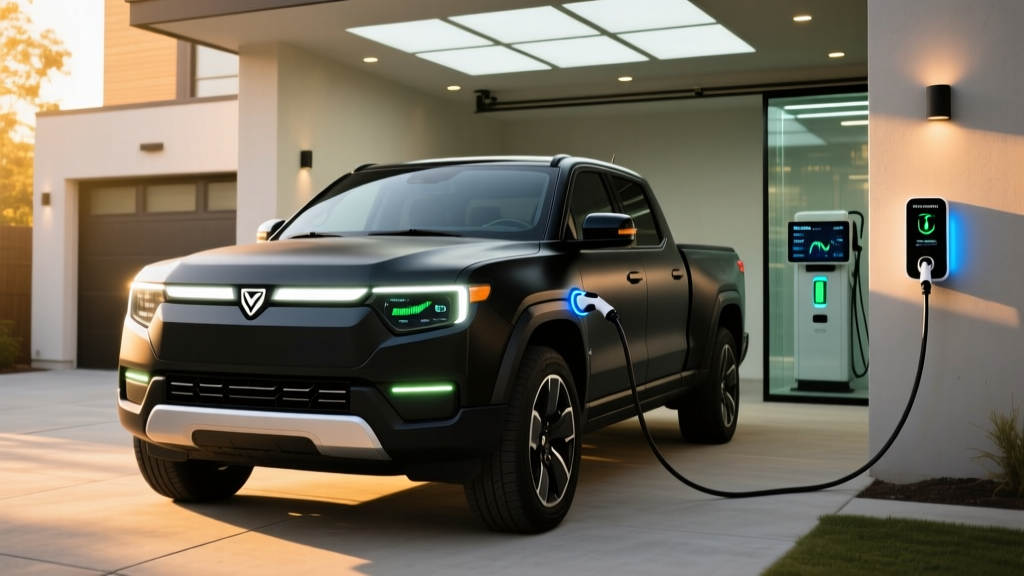
For home charging, the Rivian Wall Connector (or any J1772/NACS-compatible Level 2 EVSE at 48A on a 60A circuit) delivers a full overnight charge from 20–80% in approximately 5.5 hours for the Standard pack and 7 hours for the Max pack.
Performance and Drivetrain
The Dual-Motor R1T and R1S produce 533 hp and 610 lb-ft of torque in their standard output calibration. The 0–60 mph time of 4.5 seconds is genuinely quick for a vehicle with a 5,000+ lb curb weight and real off-road capability.
The Tri-Motor variant, introduced with the Gen 2 platform, adds a rear-axle dual-motor setup producing a combined 850 hp and 908 lb-ft. The 2.9-second 0–60 time places it in supercar territory, though the performance software mode is required to unlock it (standard Drive mode limits output for efficiency and tire preservation).
The latest Rivian software update also refined the torque-vectoring behavior on the Tri-Motor, improving on-road cornering feel without altering the off-road modes (Rock Crawl, Snow, Sand, All-Purpose). Rivian's gear tunnel (R1T) and front trunk (frunk) remain segment-defining storage solutions.
Pricing, Tax Credit Eligibility, and Total Cost
Rivian prices the R1T and R1S across several configurations. Prices below reflect 2026 model-year MSRP before destination charges.
| Configuration | Base MSRP | §30D Credit Eligible? | Effective Price (if eligible) |
|---|---|---|---|
| R1T Dual-Motor Standard | $69,900 | Yes (subject to income/sourcing) | ~$62,400 |
| R1T Dual-Motor Max | $79,900 | Yes | ~$72,400 |
| R1T Tri-Motor Max | $99,900 | No (exceeds $80K truck cap) | $99,900 |
| R1S Dual-Motor Standard | $74,900 | Yes (SUV cap: $80K) | ~$67,400 |
| R1S Dual-Motor Max | $84,900 | No (exceeds $80K SUV cap) | $84,900 |
- MSRP caps: $80,000 for SUVs (R1S), $80,000 for pickup trucks (R1T) — per IRS §30D guidelines.
- Income caps: AGI ≤ $150,000 (single), $225,000 (head of household), $300,000 (joint).
- Battery sourcing: Critical minerals and battery component requirements phase in annually — verify current-year compliance on Rivian's website or IRS guidance before purchase.
- Point-of-sale transfer: Eligible buyers may apply the credit as a down-payment reduction at the dealer, subject to dealer participation.
The Tri-Motor R1T and Max-pack R1S exceed MSRP caps and do not qualify. Consult a tax professional for your specific situation.
Cargo, Passenger Space, and Daily Practicality
The R1T (crew-cab pickup) offers a 4.5-foot bed with a unique gear tunnel (11 cu ft of enclosed, lockable pass-through storage behind the rear seats). Total bed + gear tunnel + frunk volume makes it one of the most storage-versatile vehicles in its class. The R1S (3-row SUV) seats up to seven and provides 104.7 cu ft of maximum cargo volume behind the front row.
- R1T front legroom: 41.3 in | rear legroom: 38.2 in
- R1S front legroom: 41.3 in | second row: 38.2 in | third row: 30.4 in
- R1T frunk: 11 cu ft | gear tunnel: 11 cu ft | bed: ~27 cu ft (to tonneau)
- R1S cargo (behind 3rd row): 14.4 cu ft | behind 2nd row: 46.7 cu ft
The third row in the R1S is best suited for children. Adults will find it tight on long trips. For two-row needs, the R1T's cabin and bed combination is hard to beat for active-lifestyle owners.
Tech, Driver Assistance, and Software-Defined Features
Rivian's infotainment runs on a proprietary 15.6-inch center display with a clean, tile-based interface. The latest Rivian software update introduced enhanced route planning with real-time charger availability overlays, improved voice recognition, and expanded Spotify/Apple Music integration. Wireless Apple CarPlay and Android Auto are not supported — Rivian uses its native system exclusively.
Standout tech features:
- Over-the-air updates (multiple per year, adding features post-purchase)
- Camp Kitchen accessory (slide-out induction kitchen for the gear tunnel)
- Powered tonneau cover with integrated bed lighting
- Vehicle-to-load (V2L) capability via bed outlets (up to 1,500W continuous)
- Digital key via phone, NFC card backup
Notable drawbacks:
- No Apple CarPlay or Android Auto
- Rear visibility in R1T is limited (bed walls are high; camera system compensates partially)
- Service center network is still expanding — some owners face long wait times for body/paint work
- Insurance premiums run 15–25% higher than comparable ICE trucks (per industry data)
Warranty Coverage
Rivian provides the following warranty for the 2026 R1 lineup:
- Battery & drivetrain: 8 years / 175,000 miles (whichever comes first), covering capacity retention above 70% of original.
- Vehicle (bumper-to-bumper): 5 years / 60,000 miles.
- Roadside assistance: 5 years / 60,000 miles.
The 175,000-mile battery warranty is competitive with Tesla (8yr/120K–150K mi depending on model) and exceeds Ford's 8yr/100,000-mi coverage on the F-150 Lightning. Rivian's 70% capacity retention threshold is industry-standard for NMC packs.
Who Should Buy the 2026 Rivian R1?
The Rivian R1 platform suits buyers who need genuine utility — towing, off-road capability, gear hauling — combined with daily EV commuting. The Standard pack is ideal for owners who can charge at home and rarely drive more than 200 miles between stops. The Max pack is worth the premium for frequent road-trippers and those who tow regularly (towing cuts range roughly in half, making the Max pack's ~160-mi towed range far more usable than the Standard's ~120-mi towed range).
The Tri-Motor is a performance statement — thrilling but expensive, and ineligible for the federal credit. It targets buyers who want supercar acceleration in a truck form factor and are less price-sensitive.
- Class-leading off-road capability with real ground clearance (up to 14.4 in)
- 11,000-lb tow rating with integrated trailer brake controller
- Active OTA software platform — vehicle improves post-purchase
- Strong DC fast-charge speeds (200–220 kW peak)
- Unique gear tunnel and frunk storage
- Competitive 8yr/175K-mi battery warranty
- No Apple CarPlay / Android Auto
- Tri-Motor and Max-pack R1S exceed §30D MSRP caps
- Real-world highway range drops significantly vs. EPA (especially when towing)
- Service network still maturing in rural areas
- Higher insurance costs than ICE equivalents
Rivian R1 vs. Key Competitors
The direct competitors are the Ford F-150 Lightning (starting ~$55K, up to 320 mi EPA), Tesla Cybertruck (starting ~$80K, up to 340 mi EPA), and Chevrolet Silverado EV (starting ~$55K, up to 440 mi EPA on Max Range). The Rivian differentiates on off-road capability, build quality perception, and software iteration speed. The F-150 Lightning wins on price and dealer network breadth. The Cybertruck offers stainless-steel exoskeleton styling and 800V architecture. The Silverado EV leads in maximum EPA range.
Frequently Asked Questions
What is the real-world range of the 2026 Rivian R1?
The EPA rates the Dual-Motor Max at 352 miles, but sustained 75-mph highway driving typically yields 300–320 miles. In freezing temperatures, expect 260–280 miles. Towing an enclosed trailer cuts range roughly in half.
How fast does the Rivian R1 charge at home and on the road?
At home on a 240V/48A Level 2 charger, the R1 adds approximately 25–30 miles of range per hour. On DC fast chargers, the Standard pack peaks at 200 kW (10–80% in ~30 minutes) and the Max pack at 220 kW (10–80% in ~35 minutes). Above 80% SoC, charging slows dramatically — plan to unplug at 80% on road trips for time efficiency.
Does the Rivian R1 qualify for the $7,500 federal EV tax credit?
The Dual-Motor Standard R1T ($69,900 MSRP) and R1S ($74,900 MSRP) fall under the IRS §30D MSRP caps and may qualify, subject to buyer income limits ($150K single / $300K joint) and current-year battery sourcing requirements. The Tri-Motor R1T ($99,900) and Max-pack R1S ($84,900) exceed the caps and are ineligible. Always verify on irs.gov before purchasing.
How does the Rivian software update improve the vehicle after purchase?
Rivian pushes multiple OTA updates per year. Recent updates have improved DC fast-charge preconditioning, added new drive modes, refined Highway Assist lane-centering, and introduced new infotainment features. Unlike some legacy automakers, Rivian's software stack is fully OTA — including battery management, motor calibration, and suspension tuning (where equipped with air suspension).
Is the Rivian R1 worth buying vs. the F-150 Lightning or Cybertruck?
Choose the R1 if you prioritize off-road capability, build quality, and a continuously improving software experience — and can absorb the higher starting price. Choose the F-150 Lightning for lower cost and broader dealer service access. Choose the Cybertruck for 800V charging architecture and distinctive styling. The R1's advantage is the combination of genuine trail capability with daily-driver refinement, something neither competitor fully matches.
What battery chemistry does the Rivian R1 use?
The 2026 R1 uses NMC (nickel manganese cobalt) lithium-ion cells in both Standard (106 kWh usable) and Max (141 kWh usable) configurations. NMC offers higher energy density than LFP, enabling the Max pack's 352-mile EPA range, but requires more careful charge-habit management (Rivian recommends daily charging to 80–85% and occasional 100% charges before long trips).