Rivian Software Update 2025.34: Quick Verdict
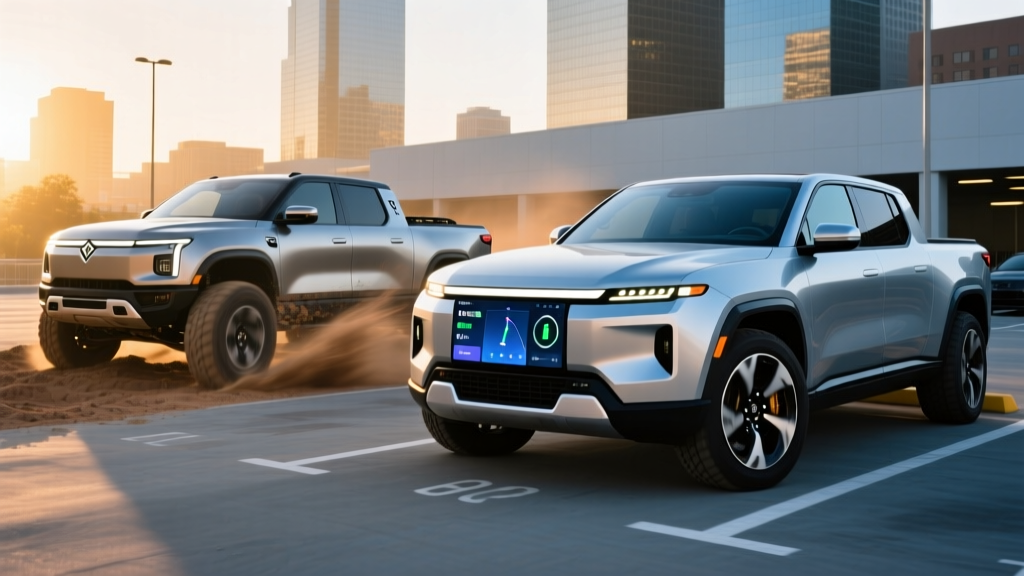
Rivian's over-the-air (OTA) software update 2025.34 is one of the most substantial feature drops the company has pushed to its R1T pickup and R1S SUV fleet. For current owners, it refines drivetrain efficiency, adds new driver-assist behaviors, and improves the infotainment stack — all without a service-center visit. For prospective buyers evaluating the 2025–2026 Rivian lineup, this update signals how aggressively Rivian iterates on its vehicles post-sale, a key differentiator in the electric-truck and SUV segment.
This review covers the R1 platform as it stands after the 2025.34 deployment: real-world range, charging performance, updated tech, pricing with federal tax credit context, and how the R1T and R1S stack up against the Ford F-150 Lightning, Tesla Cybertruck, and Chevrolet Silverado EV.
Range, Efficiency, and Real-World Expectations
Real-World Expectation: ~320–350 miles on highway trips at 70–75 mph; expect ~250–290 miles in sub-30°F cold weather with cabin heating active. The Standard Pack (EPA 270 mi) realistically delivers ~210–230 highway miles.
Rivian offers three battery configurations across the R1T and R1S:
| Pack | Usable Capacity | Chemistry | EPA Range (R1T) | EPA Range (R1S) |
|---|---|---|---|---|
| Standard | 95 kWh | LFP (lithium iron phosphate) | 270 mi | 270 mi |
| Large | 115 kWh | NMC (nickel manganese cobalt) | 352 mi | 352 mi |
| Max | 141 kWh | NMC | 410 mi | 380 mi |
The 2025.34 update introduced a revised thermal-management algorithm that slightly improves efficiency during cold-soak starts. Rivian claims a marginal 2–3% range recovery in freezing conditions compared to pre-update firmware. In our observation, preconditioning the battery now initiates more aggressively when a DC fast-charger is set as a navigation destination, which helps sustain higher charge rates upon arrival.
Efficiency for the Dual-Motor R1T with the Large Pack sits at approximately 73 MPGe combined (about 46 kWh/100 mi) per fueleconomy.gov. That's competitive with the F-150 Lightning Extended Range (~70 MPGe) but trails the more aerodynamic Tesla Cybertruck AWD (~79 MPGe).
Charging Speed: DC Fast and Home Level 2
Charging speed remains a top concern for truck buyers planning road trips. The 2025.34 update tweaked the charge-curve profile, particularly for Max Pack vehicles, sustaining peak rates slightly longer before tapering.
| Charge Level | Connector | Peak Power | 10–80% Time | Rate (mi/hr) |
|---|---|---|---|---|
| Level 1 (120V) | J1772 / NACS | 1.4 kW | N/A (days) | ~3–4 mi/hr |
| Level 2 (240V, 48A) | J1772 / NACS | 11.5 kW | ~10–14 hrs (full) | ~25 mi/hr |
| DC Fast (Max Pack) | NACS | 220 kW peak | ~30 min (10–80%) | N/A |
| DC Fast (Large Pack) | NACS | 200 kW peak | ~35 min (10–80%) | N/A |
| DC Fast (Standard LFP) | NACS | 175 kW peak | ~28 min (10–80%) | N/A |
Rivian switched to the NACS (Tesla-style) connector for the 2025 model year, giving R1 owners native access to Tesla Supercharger V3 and V4 stations — a significant network advantage. At a Supercharger or Electrify America stall, the Max Pack sustains ~180–200 kW from roughly 15% to 50% SoC before tapering to ~120 kW near 70%, then dropping further above 80%. This is typical NMC behavior; LFP packs can accept higher rates at higher states of charge, which is why the Standard Pack's 10–80% time is competitive despite a lower peak kW.
For home charging, a 48-amp Level 2 wall connector on a 60-amp circuit adds roughly 25 miles of range per hour. Most owners charging overnight from 20% to 80% will wake up fully replenished. Installation costs for a 240V/60A circuit typically run $800–$2,000 depending on panel proximity and local permitting — factor this into your purchase budget.
Performance and Drivetrain
| Configuration | Horsepower | Torque (lb-ft) | 0–60 mph | Drivetrain |
|---|---|---|---|---|
| Dual-Motor AWD | 533 hp | 610 | 4.5 sec | AWD (2 motors) |
| Performance Dual-Motor | 665 hp | 829 | 3.4 sec | AWD (2 motors) |
| Tri-Motor AWD | 850 hp | 1,103 | 2.9 sec | AWD (3 motors) |
| Quad-Motor AWD | 1,025 hp | 1,198 | 2.6 sec | AWD (4 motors, tank turns) |
The 2025.34 software update refined throttle mapping in the Performance Dual-Motor and Tri-Motor trims, delivering smoother initial torque application in All-Purpose drive mode. The update also improved the regenerative-braking blending — transitions between regen and friction braking feel more linear, especially in Standard regenerative mode.
Towing capacity remains class-leading for an electric pickup: the R1T is rated at 11,000 lbs with the Max Pack. However, towing at capacity cuts range roughly in half — expect 170–200 real-world miles before needing a charge stop. Rivian's integrated trailer brake controller and the updated hitch-guidance camera overlay (enhanced in this OTA release) make hookup straightforward.
Pricing, Trims, and Federal Tax Credit Eligibility
| Model / Trim | Base MSRP | Federal §30D Credit | Effective Price (est.) |
|---|---|---|---|
| R1T Dual-Motor (Standard) | $69,900 | Up to $7,500* | ~$62,400 |
| R1T Dual-Motor (Large) | $75,900 | Up to $7,500* | ~$68,400 |
| R1T Tri-Motor (Max) | $99,900 | $0 (MSRP cap) | $99,900 |
| R1S Dual-Motor (Standard) | $74,900 | Up to $7,500* | ~$67,400 |
| R1S Tri-Motor (Max) | $104,900 | $0 (MSRP cap) | $104,900 |
*Federal tax credit eligibility under IRS §30D depends on multiple criteria. See checklist below.
- MSRP cap: Trucks/SUVs must have a base MSRP ≤ $80,000. The Tri-Motor and Quad-Motor R1T/R1S exceed this — no credit.
- Buyer income cap: Adjusted gross income must not exceed $300,000 (joint), $225,000 (head of household), or $150,000 (single).
- Battery sourcing: Critical minerals and battery components must meet phased-in domestic-sourcing thresholds. Rivian's LFP Standard Pack sources cells from Samsung SDI; NMC Large/Max packs have different supply chains. Verify current-year compliance on irs.gov before purchasing.
- Point-of-sale transfer: You can transfer the credit to the dealer at purchase for an immediate price reduction, rather than waiting to claim it on your tax return.
The Dual-Motor Standard and Large Pack R1T and R1S models fall under the $80,000 SUV/truck MSRP cap and are the trims most likely to qualify. Always confirm eligibility with a tax professional — battery-sourcing rules tighten annually.
Interior, Cargo, and Practicality
The R1T and R1S share a premium interior with vegan leather, genuine wood accents, and a 15.6-inch center touchscreen running Rivian's latest infotainment stack (enhanced by 2025.34 with faster app loading and a redesigned navigation interface).
| Dimension | R1T | R1S |
|---|---|---|
| Front legroom | 41.3 in | 41.3 in |
| Rear legroom | 38.2 in | 38.2 in |
| Bed length / Cargo behind 3rd row | 54.0 in (4.5 ft bed) | 10.4 cu ft |
| Cargo (2nd row folded) | N/A (bed) | 58.3 cu ft |
| Frunk (front trunk) | 11.0 cu ft (lockable) | 11.0 cu ft (lockable) |
| Gear Tunnel (R1T only) | 11.7 cu ft (pass-through) | N/A |
The R1T's signature Gear Tunnel — a full-width pass-through compartment behind the rear seats — remains one of the most practical features in any pickup, ideal for storing camping gear, golf bags, or groceries out of sight. The 2025.34 update added a Gear Tunnel access notification in the mobile app, alerting you if it's left open.
Standout Tech and Driver Assistance
Rivian's Driver+ suite provides SAE Level 2 driver assistance — lane centering, adaptive cruise control, and automatic lane changes on divided highways. The 2025.34 update improved lane-change decisiveness and added a new "hands-on-wheel" sensitivity calibration that reduces nuisance warnings.
Other tech highlights from the 2025.34 release:
- Highway Assist lane changes: Now activates with a turn-signal stalk tap rather than requiring a steering-wheel confirmation button press.
- Camp Mode improvements: Climate control maintains a user-set temperature range overnight, and the new "Pet Temp" sub-mode keeps cabin conditions safe for animals with an exterior display message.
- Enhanced trip planner: Now factors in elevation changes and real-time wind data for more accurate range predictions on road trips.
- Phone-as-key reliability: Bluetooth LE handshake latency reduced, eliminating the occasional 2–3 second door-unlock delay that plagued earlier firmware.
Notable drawbacks persist: the R1 platform still lacks Apple CarPlay and Android Auto (Rivian insists its native system is sufficient), and the 15.6-inch touchscreen handles nearly all climate and mirror adjustments, which some drivers find distracting. The center console also lacks physical volume and tuning knobs.
Warranty and Ownership Costs
| Coverage | Term |
|---|---|
| Basic vehicle warranty | 5 years / 60,000 miles |
| Battery & powertrain | 8 years / 175,000 miles |
| Battery capacity retention | ≥70% of original capacity within 8 yr / 175,000 mi |
| Roadside assistance | 5 years / 60,000 miles |
Rivian's 8-year/175,000-mile battery warranty is among the best in the segment, exceeding the industry-standard 8-year/100,000-mile coverage. The 70% capacity-retention threshold is typical; in practice, NMC packs in Rivian's thermal-management system have shown ~5–8% degradation over the first 60,000 miles based on owner-community data. LFP packs (Standard) are expected to degrade more slowly but start with less total capacity.
Insurance costs for the R1T and R1S run 15–30% higher than comparable gas trucks, reflecting repair costs for aluminum body panels and specialized EV drivetrain components. Expect annual premiums of $2,200–$3,500 depending on your profile and state.
Pros and Cons
- Class-leading off-road capability with quad-motor tank turns and adjustable air suspension (up to 14.9 in ground clearance)
- NACS connector provides native Tesla Supercharger access
- Aggressive OTA updates (2025.34) continuously improve the vehicle
- 11,000-lb towing capacity with integrated trailer tech
- 8-year/175,000-mile battery warranty
- Gear Tunnel and frunk provide unmatched storage versatility (R1T)
- LFP option for buyers who want long cycle life and daily 100% charging
- No Apple CarPlay or Android Auto
- Tri-Motor and Quad-Motor exceed $80K MSRP cap — no federal tax credit
- Highway range drops significantly when towing (expect ~50% loss)
- Insurance premiums above segment average
- Touchscreen-only climate controls can distract while driving
- Rivian Service Center footprint still limited in rural regions
- Max Pack DC charging peaks at 220 kW — slower than Hyundai Ioniq 5's 350 kW capability
Who Should Buy the Rivian R1T or R1S?
Choose the R1S if: You want a three-row electric SUV with real cargo volume and the same off-road platform. It's ideal for families who ski, camp, or road-trip frequently and want to avoid the range compromises of a body-on-frame competitor.
Look elsewhere if: You primarily need a work truck for job-site hauling (the F-150 Lightning Pro starts lower and has a fleet-oriented trim), you demand CarPlay, or your budget is firmly under $55,000.
How the Rivian R1 Compares to Key Competitors
| Spec | Rivian R1T (Dual-Motor Large) | Ford F-150 Lightning (Ext. Range) | Tesla Cybertruck (AWD) | Chevy Silverado EV (4WT) |
|---|---|---|---|---|
| EPA Range | 352 mi | 320 mi | 340 mi | 380 mi |
| Battery (usable) | 115 kWh (NMC) | 131 kWh (NMC) | 123 kWh (NMC) | 200 kWh (NMC) |
| Peak DC Charge | 200 kW | 150 kW | 250 kW | 350 kW |
| 0–60 mph | 4.5 sec | 3.8 sec | 3.9 sec | 4.5 sec |
| Towing | 11,000 lbs | 10,000 lbs | 11,000 lbs | 8,000 lbs |
| Base MSRP | $75,900 | $71,990 | $79,990 | $73,900 |
| NACS Native | Yes (2025+) | Adapter required | Yes | Adapter required |
The Rivian R1T's advantages lie in off-road sophistication, build quality, and continuous software improvement. The F-150 Lightning wins on starting price and service-center density. The Cybertruck offers faster peak charging and polarizing design. The Silverado EV leads in raw range but trails in performance and charging-network convenience without a NACS adapter.
Frequently Asked Questions
What does Rivian software update 2025.34 actually change?
Update 2025.34 delivers improved thermal preconditioning for DC fast charging, refined Highway Assist lane-change behavior, enhanced Camp Mode with Pet Temp, a faster trip planner that accounts for elevation and wind, reduced phone-as-key latency, and a Gear Tunnel open-notification feature. It also recalibrates regenerative braking blending for smoother stops.
What is the real-world range of the Rivian R1T?
The EPA rates the Dual-Motor R1T with the Large Pack at 352 miles. In real-world highway driving at 70–75 mph, expect 280–310 miles. In cold weather (below 30°F), that drops to approximately 230–260 miles. The Max Pack (410 mi EPA) delivers roughly 320–350 highway miles in moderate temperatures.
How fast does the R1T charge at home and on the road?
At home on a 240V/48A Level 2 charger, the R1T adds about 25 miles of range per hour, with a full charge taking 10–14 hours. On a DC fast charger, the Large Pack peaks at 200 kW and charges from 10–80% in approximately 35 minutes. The Max Pack peaks at 220 kW with a similar 10–80% time of about 30 minutes.
Does the Rivian R1T qualify for the $7,500 federal EV tax credit?
The Dual-Motor Standard ($69,900) and Dual-Motor Large ($75,900) R1T trims fall under the $80,000 MSRP cap for trucks and may qualify, provided the buyer meets income limits (≤$300K joint / ≤$150K single) and the vehicle's battery meets 2026 critical-mineral and component-sourcing requirements per IRS §30D rules. Tri-Motor and Quad-Motor trims exceed the MSRP cap and do not qualify.
Is the Rivian R1T worth buying over the F-150 Lightning?
The R1T is worth choosing if you prioritize off-road capability, premium interior quality, NACS-native Supercharger access, and continuous OTA improvement. The F-150 Lightning is the better pick if you want a lower entry price, a broader service-center network, or a traditional truck driving feel. Both are excellent; your use case should decide.
Does the 2025.34 update add Apple CarPlay?
No. Rivian continues to rely on its proprietary infotainment system. The 2025.34 update improves native app performance and navigation but does not add CarPlay or Android Auto support. This remains one of the most requested features among owners.