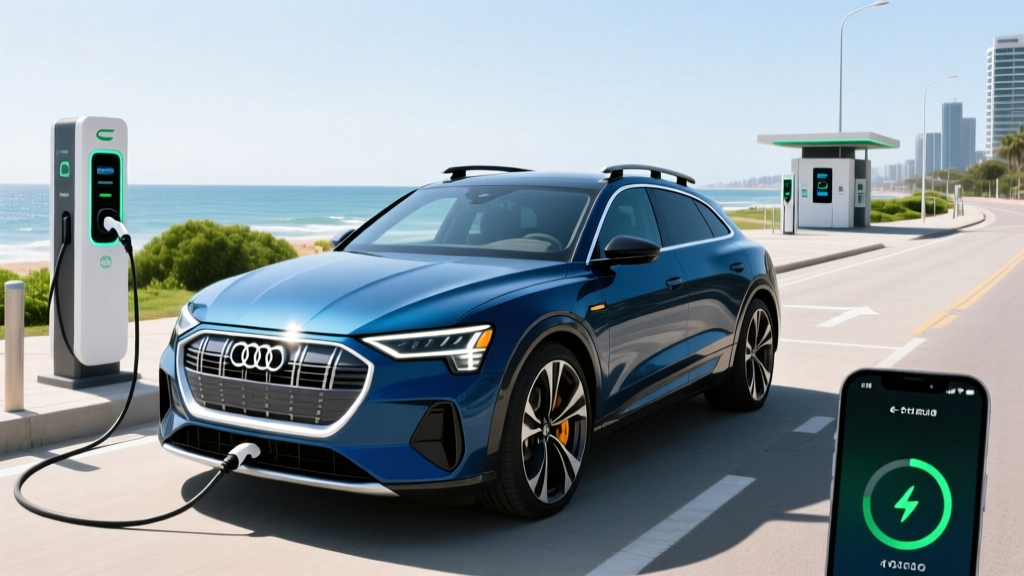
The Audi e-tron Quattro launched as Audi's first dedicated battery-electric SUV, blending the brand's signature luxury with a fully electric powertrain. While Audi has since rebranded its EV lineup under the Q8 e-tron nameplate for the 2025+ model years, the original e-tron Quattro remains a significant vehicle on the used EV market and a benchmark for how legacy automakers approached electrification. This review covers the e-tron Quattro's real-world range, charging behavior, ownership economics, and whether it still holds up against newer competitors.
Range and Efficiency: EPA vs. Reality
The Audi e-tron Quattro carries a 95 kWh gross battery pack (86.5 kWh usable) using NMC (nickel-manganese-cobalt) lithium-ion chemistry. Audi deliberately buffers a large portion of the pack — roughly 8.5 kWh — to preserve long-term battery health and reduce degradation, a conservative approach that sacrifices some range for longevity.
Real-World Highway (70 mph, 75°F): ~185–200 miles
Real-World Cold Weather (30°F, highway): ~150–170 miles
Efficiency: 74 MPGe combined / 47 kWh per 100 miles
The 220-mile EPA figure placed the e-tron Quattro behind rivals like the Tesla Model X and Jaguar I-PACE at launch. In real-world highway driving at sustained 70 mph speeds, expect between 185 and 200 miles on a full charge in mild conditions. Cold weather hits the e-tron harder than some competitors due to its weight (nearly 5,700 lbs) and the energy demands of its thermal management system. Plan for roughly 150–170 miles of range in freezing temperatures — a meaningful reduction that road-trippers should factor into charging stop planning.
The e-tron's efficiency of 47 kWh/100mi is on the higher side for the segment. For comparison, the Tesla Model Y consumes roughly 28 kWh/100mi. The e-tron trades efficiency for refinement: its cabin is whisper-quiet, and the ride quality is genuinely premium.
Charging Speed: Where the e-tron Quattro Shines
Where the original e-tron Quattro genuinely stands out — even against newer EVs — is DC fast charging. The vehicle supports a peak charge rate of 150 kW via CCS1 connector, but unlike many EVs that spike to peak and immediately taper, the e-tron sustains near-peak charging rates up to approximately 70% state of charge (SoC).
| Charging Level | Power | Time / Rate |
|---|---|---|
| Level 1 (120V) | ~1.4 kW | ~6 miles per hour |
| Level 2 (240V, 48A) | 11.5 kW | ~25 miles per hour / full charge in ~8.5 hours |
| DC Fast Charge (CCS1) | 150 kW peak | 10–80% in ~30 minutes |
The 10–80% DC fast charge time of approximately 30 minutes is competitive even by 2026 standards. The e-tron's charge curve is remarkably flat: it sustains 120–150 kW through the bulk of the session, only tapering significantly above 80% SoC. This means real-world charging stops feel faster than the raw peak-kW number suggests — a 150 kW peak that sustains beats a 200 kW peak that drops to 80 kW within minutes.
For home charging, the 11.5 kW onboard AC charger fills the battery from empty in roughly 8.5 hours on a 48-amp Level 2 circuit. Most owners will need a 60-amp dedicated circuit installed; budget $800–$2,000 for professional Level 2 installation depending on panel capacity and run length, according to data from fueleconomy.gov.
Performance and Drivetrain
The e-tron Quattro uses a dual-motor all-wheel-drive configuration — one asynchronous (induction) motor per axle. Combined output is 355 horsepower (402 hp in Boost Mode, activated via the kickdown switch or launch control). Torque reaches 414 lb-ft in standard mode and 490 lb-ft in Boost.
| Spec | Value |
|---|---|
| 0–60 mph | 5.5 seconds (Boost Mode) |
| Horsepower | 402 hp (Boost) |
| Torque | 490 lb-ft (Boost) |
| Drivetrain | Quattro AWD (dual-motor) |
| Top Speed | 124 mph (electronically limited) |
| Curb Weight | ~5,700 lbs |
| Towing Capacity | 4,000 lbs |
The 5.5-second 0–60 mph time is brisk but not thrilling by modern EV standards — a Tesla Model Y Performance hits 60 in 3.5 seconds. The e-tron Quattro prioritizes smooth, linear acceleration and composed handling over drag-strip numbers. The adaptive air suspension delivers a genuinely plush ride, and the cabin isolation is among the best in the segment. The 4,000-lb towing capacity is useful for light trailers or small boats.
Interior, Cargo, and Technology
The e-tron Quattro's interior is unmistakably Audi: premium materials, tight panel gaps, and a dual-touchscreen MMI infotainment system (10.1-inch upper, 8.6-inch lower). The virtual cockpit digital instrument cluster is standard, and the available head-up display projects navigation and speed clearly.
Cargo space is practical but not class-leading:
- Cargo behind rear seats: 28.5 cubic feet
- Cargo with rear seats folded: 57.0 cubic feet
- Front trunk (frunk): None — the space is occupied by electronics and HVAC components
- Rear legroom: 38.1 inches
- Front legroom: 41.6 inches
The lack of a frunk is a notable miss for an EV at this price point. Competitors like the Tesla Model X and Rivian R1S offer front cargo space. Rear-seat passengers are well accommodated, though the transmission tunnel hump (a vestige of the platform's ICE compatibility) intrudes on the middle-rear footwell.
Standard driver-assist features include adaptive cruise control with stop-and-go, lane-keeping assist, traffic sign recognition, and Audi's Pre Sense collision mitigation. These are SAE Level 2 driver-assist systems — the driver must remain fully engaged and hands-on at all times. This is not autonomous driving.
Pricing, Trims, and Federal Tax Credit
The Audi e-tron Quattro was offered in three primary trims. Original MSRP figures (before incentives) were:
| Trim | Original MSRP | Key Features |
|---|---|---|
| Premium Plus | ~$70,800 | 20-inch wheels, leather, dual-screen MMI, adaptive cruise |
| Prestige | ~$77,400 | Head-up display, Bang & Olufsen audio, matrix LED headlights |
| Chronos Edition | ~$81,000 | Limited-run styling package, unique wheels, black optics |
Federal Tax Credit (§30D): The Audi e-tron Quattro's eligibility for the $7,500 federal tax credit under IRS §30D has varied by model year and is subject to the current battery-sourcing and critical-minerals requirements, buyer income caps ($300K joint / $150K single AGI), and the SUV MSRP cap of $80,000. The Prestige and Chronos trims may exceed the MSRP threshold depending on options and model year. Always verify current eligibility on IRS.gov before purchasing. As of 2026, many used e-tron Quattros may qualify for the separate used-EV credit (up to $4,000 or 30% of sale price, whichever is lower) under §25E, subject to income caps and a $25,000 maximum vehicle sale price.
Battery Warranty and Longevity
Audi provides an 8-year / 100,000-mile battery warranty that guarantees the pack will retain at least 70% of its original capacity. If capacity drops below that threshold within the warranty period, Audi will repair or replace the battery at no cost. The general vehicle warranty covers 4 years / 50,000 miles.
The large 8.5 kWh buffer Audi engineers into the pack is a deliberate longevity strategy. By preventing the battery from operating at the extreme top and bottom of its SoC range, degradation is minimized. Real-world data from early high-mileage e-tron owners suggests degradation of approximately 5–8% over the first 100,000 miles — well within the 70% warranty threshold. This is consistent with NMC chemistry managed conservatively.
A full battery replacement out of warranty would cost an estimated $20,000–$28,000 including labor, based on industry parts pricing. However, module-level repairs (replacing individual degraded cells or modules rather than the entire pack) may be available at lower cost through specialized EV service centers.
Pros and Cons
Pros
- Exceptional DC fast-charge curve — sustains 150 kW longer than most rivals
- Premium cabin quality, quietness, and ride comfort
- Conservative battery buffer strategy supports long-term health
- 4,000-lb towing capacity for a luxury EV SUV
- Strong used-EV value — significant depreciation from original MSRP
Cons
- 220-mile EPA range lags behind competitors (Model X: 348 mi, I-PACE: 246 mi)
- High energy consumption (47 kWh/100mi) raises charging costs
- No front trunk (frunk)
- Heavy at 5,700 lbs — impacts efficiency and tire wear
- Rear center tunnel hump reduces middle-seat comfort
Is the Audi e-tron Quattro Worth Buying?
The e-tron Quattro occupies a specific niche: buyers who value ride quality, cabin silence, and brand prestige over maximum range or acceleration. On the used market, it depreciated significantly from its $70K+ MSRP, making it a compelling luxury EV value — often available in the $35,000–$50,000 range depending on mileage and model year.
Choose the e-tron Quattro if: You prioritize refinement and build quality, have reliable home charging, mostly drive under 180 miles daily, and value the Audi dealer network for service. It's well-suited as a luxury commuter or family hauler with occasional road trips where the 30-minute 10–80% charging time is acceptable.
Look elsewhere if: You need maximum range for frequent long-distance travel (consider the Tesla Model X or Rivian R1S), want the latest infotainment and over-the-air update capabilities, or require a third row for larger families.
Frequently Asked Questions
What is the real-world range of the Audi e-tron Quattro?
Expect roughly 185–200 miles in mild highway driving and 150–170 miles in freezing conditions. The EPA rates it at 220 miles combined, but real-world highway efficiency drops due to the vehicle's 5,700-lb weight and 47 kWh/100mi consumption.
How fast does the e-tron Quattro charge?
On a 150 kW DC fast charger, it charges from 10–80% in approximately 30 minutes. Its charge curve is notably flat, sustaining high power through 70% SoC. Home Level 2 charging at 11.5 kW takes about 8.5 hours for a full charge.
Does the Audi e-tron Quattro qualify for the federal EV tax credit?
Eligibility depends on the model year, buyer income, and current battery-sourcing requirements under IRS §30D. New purchases should be verified on IRS.gov. Many used e-tron Quattros may qualify for the up-to-$4,000 used-EV credit (§25E) if the sale price is $25,000 or less and the buyer meets income requirements.
How does the e-tron Quattro compare to the Tesla Model X?
The Model X offers significantly more range (348 miles EPA), faster acceleration (3.5s 0–60 Performance), a frunk, and access to the Supercharger network. The e-tron Quattro counters with superior cabin materials, a quieter ride, and a more traditional luxury SUV driving experience.
What battery chemistry does the e-tron Quattro use?
NMC (nickel-manganese-cobalt) lithium-ion, with a 95 kWh gross / 86.5 kWh usable capacity. The large buffer helps preserve long-term battery health.
Is the e-tron Quattro a good used EV buy in 2026?
Yes, for the right buyer. Heavy depreciation makes it a value play in the luxury EV segment. Prioritize vehicles with documented battery health reports and verify that the 8-year/100,000-mile battery warranty is still active based on the original in-service date.