Why Sacramento Drivers Are Eyeing Rivian
Sacramento sits at a geographic crossroads that makes electric-vehicle ownership uniquely rewarding — and occasionally challenging. You have the daily I-5 or US-50 commute, weekend escapes to Tahoe, and summer road trips down the Pacific Coast or across the Sierra to Reno. That mix of urban driving, mountain elevation, and extreme summer heat puts any EV to the test. Rivian's R1S SUV and R1T pickup have become two of the most discussed electric vehicles in the capital region, thanks to their blend of utility, range, and adventure capability. This guide breaks down exactly what Sacramento-area buyers need to know about specs, real-world range, charging infrastructure, pricing, and tax credits before signing on the dotted line.
2026 Rivian Lineup: R1S and R1T at a Glance
Rivian currently sells two core vehicles built on the same skateboard platform: the R1S three-row SUV and the R1T crew-cab pickup. Both are available with Standard, Large, and Max battery packs, and in dual-motor or quad-motor configurations. For the 2025–2026 model years, Rivian transitioned to its second-generation (Gen 2) architecture with improved thermal management, a more efficient drive unit, and the addition of NACS (Tesla-style) charge ports native on new builds, eliminating the need for a CCS-to-NACS adapter for Supercharger access.
| Spec | R1S Dual-Motor (Large) | R1T Dual-Motor (Large) | R1S Quad-Motor (Max) |
|---|---|---|---|
| EPA Range | 352 mi | 342 mi | 410 mi (est.) |
| Battery (usable) | 106 kWh (NMC) | 106 kWh (NMC) | 141 kWh (NMC) |
| Horsepower | 533 hp | 533 hp | 1,025 hp |
| 0-60 mph | 4.5 sec | 4.5 sec | 2.9 sec |
| Drivetrain | Dual-Motor AWD | Dual-Motor AWD | Quad-Motor AWD |
| Max DC Charge Rate | 220 kW | 220 kW | 220 kW |
| 10-80% DC Fast Charge | ~21 min | ~21 min | ~28 min |
| Level 2 Home Charging | 11.5 kW (~25 mi/hr) | 11.5 kW (~25 mi/hr) | 11.5 kW (~25 mi/hr) |
| MPGe (combined) | 69 MPGe | 70 MPGe | 65 MPGe (est.) |
| Towing Capacity | 7,700 lbs | 11,000 lbs | 7,700 lbs |
| Cargo (behind 3rd row / bed) | 10.6 cu ft (46.7 cu ft folded) | 54 cu ft bed + 11 cu ft frunk | 10.6 cu ft (46.7 cu ft folded) |
| Base MSRP | $75,900 | $69,900 | $99,900 |
Sources: fueleconomy.gov, Rivian Specifications. Max pack and Quad-Motor figures are estimated based on Rivian's published data for the 2025–2026 model year.
Real-World Range: What Sacramento Drivers Should Actually Expect
EPA Sticker: 352 miles (R1S Dual-Motor Large)
Real-World Expectations:
- City/suburban (Sacramento proper, Folsom, Elk Grove): ~320–340 miles — regenerative braking and lower speeds favor efficiency.
- Highway cruising (I-5 at 70–75 mph): ~270–300 miles — aerodynamic drag on a boxy SUV/pickup cuts range hard above 65 mph.
- Tahoe run (Sacramento → South Lake Tahoe, 100 mi, 6,300 ft elevation gain): Expect to use roughly 45–55% of the battery one way, depending on temperature and load. The climb up US-50 is punishing; regen on the descent recovers some energy.
- Summer heat (100°F+ in July/August): Battery preconditioning and cabin cooling consume additional energy. Expect a 5–8% range reduction versus spring/fall.
- Winter (December–February, 35–45°F): Expect 10–15% range loss due to battery chemistry resistance and cabin heating, even in the relatively mild Sacramento winter. At Tahoe, losses can reach 20–25%.
Rivian uses NMC (nickel manganese cobalt) chemistry across its battery packs. NMC offers higher energy density than LFP, which is essential for a vehicle this size, but it's more sensitive to sustained high state-of-charge. Rivian recommends daily charging to 85–90% and reserving 100% for road trips. The Gen 2 thermal management system is a meaningful upgrade — it handles Sacramento's extreme summer heat more gracefully than the Gen 1 system, reducing the frequency of thermal throttling during DC fast charging.
Charging in the Sacramento Region: Home and Public
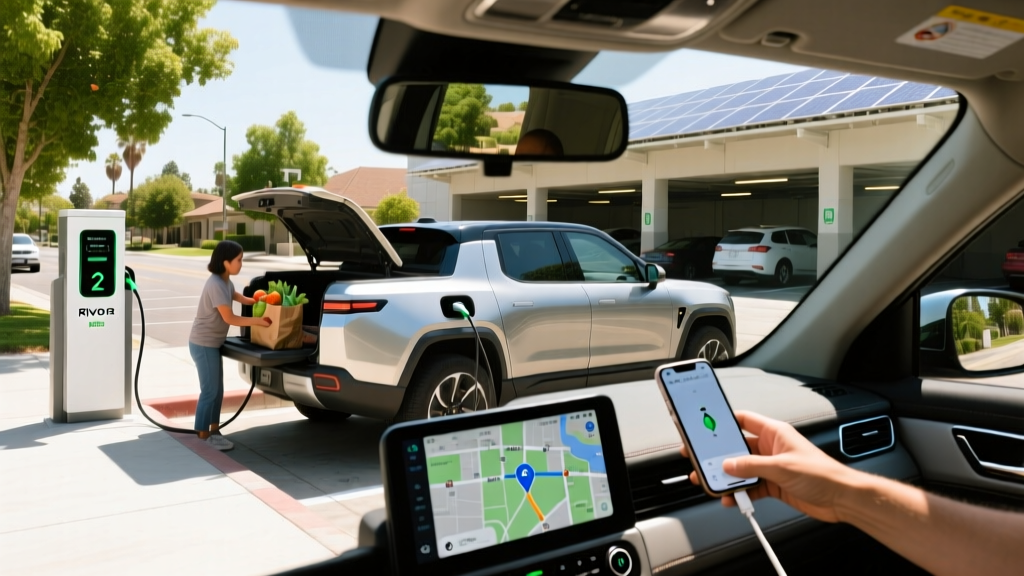
Charging access is the make-or-break factor for EV ownership, and Sacramento is one of the better-equipped metro areas in the U.S. for EV drivers. Here's what Rivian owners need to know:
Home Level 2 Charging
Rivian's onboard charger accepts up to 11.5 kW on Level 2 AC power. To achieve that, you need a 48-amp hardwired wall connector on a 60-amp dedicated circuit. Most Sacramento homes built after 2000 have 200-amp electrical panels with enough capacity, but older homes in neighborhoods like Midtown, East Sacramento, or Oak Park may require a panel upgrade ($1,500–$3,500) before adding a 60-amp EV circuit.
At 11.5 kW, a fully depleted Large pack (106 kWh usable) recharges in roughly 10–11 hours. For most owners who plug in nightly, that's more than sufficient — you'll rarely arrive home below 30% state of charge.
| Charging Level | Power | Miles Added per Hour | Full Charge Time (Large Pack) |
|---|---|---|---|
| Level 1 (120V outlet) | 1.4 kW | ~3 mi/hr | ~75 hours |
| Level 2 (240V, 48A) | 11.5 kW | ~25 mi/hr | ~10–11 hours |
| DC Fast Charge (peak) | 220 kW | ~500 mi/hr (peak) | 10-80% in ~21 min |
Public DC Fast Charging Around Sacramento
Sacramento has a growing network of DC fast chargers, including:
- Tesla Superchargers (NACS): With Rivian's native NACS port on Gen 2 vehicles, owners can use Tesla Superchargers directly. Key Sacramento-area stations include the Arden Fair Mall Supercharger (12 stalls, 250 kW), the Folsom Supercharger (8 stalls, 250 kW), and the Roseville Galleria station.
- Electrify America: Stations at the Westfield Galleria at Roseville and along I-5 corridor stops. Peak speeds up to 350 kW, though Rivian caps at 220 kW.
- SMUD Public Chargers: The Sacramento Municipal Utility District operates dozens of Level 2 and some DC fast-charging stations across the region, many at favorable residential electricity rates.
Charging curve reality: Rivian's 220 kW peak rate is achieved between roughly 15–40% state of charge. Above 60%, the rate tapers to ~120 kW; above 80%, it drops further to ~50–70 kW. This is normal for NMC chemistry — the 10-80% time of ~21 minutes is the practical metric that matters for road trips, not the peak number.
Pricing, Trims, and Federal Tax Credit Eligibility
| Model / Trim | Base MSRP | Destination | Est. As-Tested | §30D Credit Eligible? |
|---|---|---|---|---|
| R1T Dual-Motor Standard | $69,900 | $1,800 | $71,700 | Yes (under $80K SUV/truck cap) |
| R1T Dual-Motor Large | $75,900 | $1,800 | $77,700 | Yes |
| R1S Dual-Motor Standard | $75,900 | $1,800 | $77,700 | Yes (under $80K cap) |
| R1S Dual-Motor Large | $81,900 | $1,800 | $83,700 | No (exceeds $80K MSRP cap) |
| R1S Quad-Motor Max | $99,900 | $1,800 | $101,700 | No (exceeds $80K cap) |
The federal EV tax credit under IRS §30D offers up to $7,500 for qualifying new EVs, but eligibility hinges on several rules that bite many Rivian configurations:
- MSRP Cap: SUVs, pickups, and vans must have an MSRP at or below $80,000. Sedans are capped at $55,000. The R1T qualifies as a pickup, so the $80K cap applies — but higher-trim R1T and most R1S configurations exceed it.
- Buyer Income Cap: Modified adjusted gross income must not exceed $300,000 (joint filers), $225,000 (head of household), or $150,000 (single).
- Battery Sourcing Requirements: A portion of the credit depends on critical minerals and battery components sourced from the U.S. or free-trade-agreement countries. These requirements tighten annually. Check the latest eligibility on fueleconomy.gov before purchasing.
- Point-of-Sale Transfer: As of 2024, buyers can transfer the credit to the dealer at the point of sale, effectively reducing the purchase price by up to $7,500 at the time of transaction rather than waiting for a tax refund.
California Clean Fuel Rebate: California residents may also qualify for the state's Clean Fuel Rebate (historically up to $2,000 for income-qualified buyers), administered through your utility. SMUD and PG&E customers in the Sacramento area should check current availability, as funding is limited and program details shift annually.
Performance, Tech, and Daily Livability
Rivian's dual-motor setup delivers 533 hp and a 4.5-second 0-60 time — quick for a vehicle weighing over 7,000 pounds. The quad-motor variant (1,025 hp, 2.9 seconds) is supercar territory, but at a steep price premium and range penalty. For most Sacramento drivers, the dual-motor is the sweet spot: it handles merging onto Capital City Freeway effortlessly, and the instant torque makes the vehicle feel lighter than it is.
Tech and Driver Assistance
Rivian's 15.6-inch center touchscreen runs a custom, Linux-based operating system. It's responsive and visually clean, with native navigation that factors in charging stops on road trips — a critical feature for Tahoe or coastal runs. Wireless Apple CarPlay and Android Auto are not supported; Rivian's native system is the only interface. This is a deliberate choice that some buyers love and others find frustrating.
The Rivian Driver+ system provides adaptive cruise control and lane centering on highways. This is an SAE Level 2 driver-assistance system, meaning the driver must remain engaged with hands on the wheel and eyes on the road at all times. It works well on I-5 and I-80 but is not a hands-free or "self-driving" system. Rivian has been developing a more advanced hands-free highway assist feature, but availability depends on regulatory approval and model-year rollout.
Notable Drawbacks
- No Apple CarPlay/Android Auto: If phone-mirroring is a must-have, Rivian won't meet your needs.
- Third-row space (R1S): The third row is tight for adults — best suited for children. Cargo behind the third row is just 10.6 cu ft.
- Service center availability: Rivian has a service center in Sacramento (opened to support the growing Northern California owner base), but wait times for certain repairs can still stretch longer than legacy automakers.
- Insurance costs: Rivian insurance tends to run 15–25% higher than comparable gas vehicles, due to repair costs and parts availability. Get quotes before purchasing.
Who Is the Rivian Best Suited For?
- You need a pickup for work or recreation (towing boats, ATVs, trailers up to 11,000 lbs).
- You want the gear tunnel — a unique lockable, pass-through storage compartment behind the cab that's ideal for skis, camping gear, or tools.
- Your daily commute is under 80 miles round-trip, and you can charge at home.
- You need three rows for family duty (school runs, carpooling) but want electric.
- You take weekend trips to Tahoe, Lassen, or the coast and need genuine off-road capability.
- You prefer an SUV form factor over a pickup bed.
- You need maximum third-row comfort (consider the Kia EV9 or a three-row PHEV like the Toyota Grand Highlander Hybrid).
- Your budget is under $65,000 — Rivian doesn't currently compete in that segment.
- You rely on Apple CarPlay or Android Auto for your daily infotainment.
Warranty and Long-Term Ownership
Rivian provides a competitive warranty package:
- Battery warranty: 8 years / 175,000 miles, with a capacity retention threshold of 70% of original capacity. If the battery degrades below 70% within the warranty period, Rivian will repair or replace it.
- Powertrain warranty: 8 years / 175,000 miles.
- Bumper-to-bumper: 5 years / 60,000 miles.
- Roadside assistance: 5 years / 60,000 miles, including flat-tire service and out-of-charge towing.
The 175,000-mile battery warranty is above the industry minimum (which is 8 years / 100,000 miles under federal mandate) and signals confidence in long-term durability. NMC packs in Rivian's Gen 2 vehicles benefit from improved thermal management, which should reduce degradation in hot Sacramento summers compared to Gen 1.
Frequently Asked Questions
What is the real-world range of a Rivian on a Sacramento-to-Tahoe trip?
On the R1S Dual-Motor Large (EPA 352 mi), expect to arrive in South Lake Tahoe with roughly 45–55% battery remaining in summer conditions, using about 155–190 miles of range for the 100-mile trip due to the 6,300-foot elevation climb. Regen on the descent back to Sacramento recovers some energy. Plan to charge in Placerville or at the Tahoe destination — don't attempt a same-day round trip without charging.
How fast does a Rivian charge at home?
With a 48-amp Level 2 home charger (11.5 kW), a Rivian adds about 25 miles of range per hour. A full charge from near-empty takes 10–11 hours for the Large pack. Most Sacramento owners who plug in overnight wake up with a full battery every morning. A standard 120V outlet (Level 1) adds only ~3 miles per hour — adequate for topping off, not for daily use.
Does Rivian qualify for the $7,500 federal EV tax credit?
It depends on the specific configuration. The R1T Dual-Motor Standard ($69,900) and R1S Dual-Motor Standard ($75,900) fall under the $80,000 MSRP cap for pickups and SUVs and may qualify, provided the buyer meets income limits and battery-sourcing requirements are satisfied. Higher trims (Large, Max, Quad-Motor) typically exceed the MSRP cap and do not qualify. Always verify current eligibility at fueleconomy.gov and consult a tax professional.
Is Rivian worth buying over the Tesla Model X or Ford F-150 Lightning?
If you prioritize off-road capability, build quality, and a purpose-built adventure platform, Rivian holds an edge over both. The Tesla Model X offers more third-row room and access to the mature Supercharger network (though Rivian now has Supercharger access via NACS). The F-150 Lightning is a more traditional pickup experience at a lower starting price, but it's larger, less efficient, and lacks Rivian's gear tunnel and air suspension. For Sacramento buyers who split time between city commuting and Sierra adventures, Rivian occupies a unique niche.
What are the biggest pros and cons of owning a Rivian in Sacramento?
Pros: Genuine off-road and towing capability, excellent range with the Large/Max packs, NACS Supercharger access, strong community of Northern California owners, and Sacramento service center availability.
Cons: High starting price, no CarPlay/Android Auto, tight third row, insurance costs above average, and charging speeds that lag behind competitors like Hyundai/Kia's 800V architecture (which can charge 10-80% in ~18 minutes).
Bottom Line for Sacramento Buyers
Rivian's R1S and R1T are among the most capable electric vehicles for Northern California's specific demands — daily commuting in the Central Valley heat, mountain runs to Tahoe, and the practical need for a vehicle that can tow, haul, and handle dirt roads. The Gen 2 improvements to thermal management and NACS charging access address the most common Gen 1 complaints. The main barriers are price (most configurations won't qualify for the federal tax credit) and the reality that Rivian is still a young company scaling its service network. If your budget accommodates the $70K–$85K sweet spot and you can install a Level 2 charger at home, Rivian delivers a compelling ownership experience in the Sacramento region.