Can a Rivian Handle a Roof Tent? The Quick Verdict
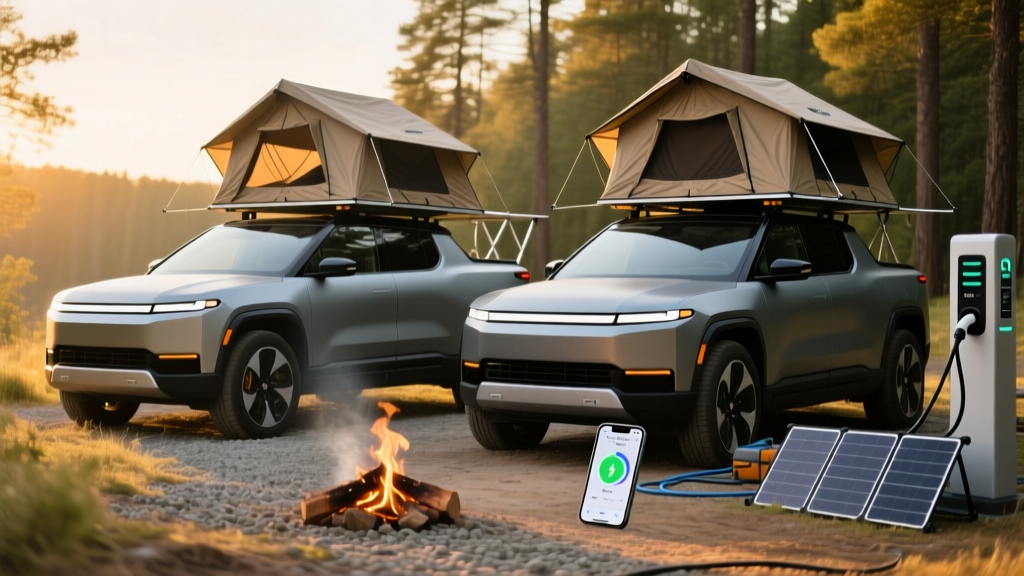
If you've been searching for the perfect Rivian roof tent setup, you're not alone. The R1T pickup and R1S SUV have become favorites among overlanders and car-campers thanks to their integrated gear tunnels, camp kitchen options, and available roof-rack systems rated for dynamic loads. But bolting a 130-pound rooftop tent to an electric vehicle raises questions that gas-truck owners never face: How much range do you lose? Can you still reach remote campsites without a charger nearby? And what happens to efficiency when you're loaded down with gear and driving 70 mph into a headwind?
We've analyzed the 2026 Rivian R1T and R1S specs, real-world efficiency data, and charging infrastructure to give you a complete picture of what a Rivian roof tent camping rig actually looks like in practice — not just in marketing photos.
Rivian R1T and R1S: 2026 Specs at a Glance
| Spec | R1T Dual-Motor (Standard) | R1T Dual-Motor (Max) | R1S Dual-Motor (Max) |
|---|---|---|---|
| EPA Range | 270 miles | 352 miles | 340 miles |
| Battery Capacity (usable) | ~95 kWh (NMC) | ~128 kWh (NMC) | ~128 kWh (NMC) |
| Drivetrain | Dual-Motor AWD | Dual-Motor AWD | Dual-Motor AWD |
| Horsepower | 533 hp | 533 hp | 533 hp |
| 0-60 mph | 4.5 sec | 4.5 sec | 4.6 sec |
| Max DC Fast Charge | 200 kW (peak) | 200 kW (peak) | 200 kW (peak) |
| 10-80% DC Charge Time | ~30 min | ~42 min | ~42 min |
| Level 2 Home Charge Rate | 11.5 kW (~25 mi/hr) | 11.5 kW (~25 mi/hr) | 11.5 kW (~25 mi/hr) |
| MPGe (combined) | 70 MPGe | 73 MPGe | 69 MPGe |
| Efficiency | 48 kWh/100 mi | 46 kWh/100 mi | 49 kWh/100 mi |
| Base MSRP | $69,900 | $79,900 | $79,900 |
| Battery/Powertrain Warranty | 8 yr / 175,000 mi | 8 yr / 175,000 mi | 8 yr / 175,000 mi |
Source: fueleconomy.gov and Rivian official specifications. Specs reflect 2026 model year Dual-Motor configurations. Tri- and Quad-Motor trims have different range and performance figures.
Real-World Range With a Roof Tent and Camping Gear
The aerodynamic penalty of a rooftop tent is significant on any vehicle, but it hits EVs harder because there's no fuel tank to buffer the loss. Testing by Rivian owners and independent EV reviewers consistently shows a 15-22% range reduction with a hard-shell roof tent deployed in the closed position, and up to 30% with a soft-shell tent that sits taller. The R1T's relatively efficient drag coefficient for a pickup (0.30 Cd) helps, but the blunt frontal area of a tent sitting 18+ inches above the roofline disrupts airflow substantially.
Here's how that translates to a typical camping trip scenario:
- Base efficiency (no tent, empty bed): ~2.1 mi/kWh (Max Pack)
- With hard-shell roof tent (closed) + 400 lbs gear: ~1.7 mi/kWh
- With tent + gear + 65 mph highway: ~1.8 mi/kWh
- With tent + gear + 75 mph highway + headwind: ~1.5 mi/kWh
For context, a 128 kWh Max Pack at 1.7 mi/kWh gives you roughly 218 miles before hitting the buffer reserve. Plan your charging stops accordingly — and always know where the next DC fast charger is before you leave cell service.
Charging on the Road and at the Campsite
Rivian uses the NACS (North American Charging Standard) connector natively on 2025+ models, giving direct access to Tesla Supercharger V3 and V4 stations — a massive advantage for campers heading into areas where Electrify America and EVgo coverage thins out. For older CCS-equipped Rivians, a NACS adapter is available.
| Charging Level | Power | Miles Added Per Hour | Typical Use Case |
|---|---|---|---|
| Level 1 (120V) | ~1.4 kW | ~3 mi/hr | Emergency / trickle at campsite |
| Level 2 (240V, 48A) | 11.5 kW | ~25 mi/hr | Home garage / campground pedestal |
| DC Fast Charge (peak) | 200 kW | ~500+ mi/hr (at peak) | Supercharger / highway stops |
The Charging Curve Reality
Rivian's peak 200 kW DC fast-charge rate is just that — a peak. The actual charge curve for the Max Pack (128 kWh NMC) looks roughly like this:
- 10-30% SoC: Sustains near 190-200 kW
- 30-60% SoC: Tapers to ~150-170 kW
- 60-80% SoC: Drops to ~90-120 kW
- 80-100% SoC: Slows dramatically to ~30-50 kW (avoid charging past 80% on road trips unless necessary)
The 10-80% charge time of approximately 42 minutes for the Max Pack assumes battery preconditioning is active (the R1T/R1S will automatically precondition when a charger is set as your navigation destination). Without preconditioning — say, pulling into a charger cold after a night at a campsite — add 5-10 minutes as the battery warms to optimal charging temperature.
Campsite Charging: What to Expect
Most developed campgrounds with 240V/50A outlets (NEMA 14-50) can deliver up to 11.5 kW to your Rivian using the mobile charger. That's roughly 25 miles of range per hour, or about 200 miles overnight in 8 hours. For dispersed camping without hookups, a Level 1 trickle from a standard 120V outlet adds only ~3 miles per hour — enough to offset vampire drain and power the campsite, but not meaningful for range recovery.
Rivian's built-in Camp Mode keeps climate control and 120V bed outlets active while parked, drawing from the traction battery. Expect roughly 1-2 kWh per hour of Camp Mode use depending on heating/cooling demand — that's about 10-15 kWh overnight, or roughly 20-30 miles of range consumed for a comfortable night's sleep.
Cargo, Roof Rack, and Roof Tent Compatibility
The R1T's roof rack system is rated for a dynamic load of 165 lbs (vehicle in motion) and a static load of 600+ lbs (vehicle parked). Most hard-shell rooftop tents from brands like Roofnest, iKamper, and Thule weigh between 110-150 lbs, placing them within the dynamic limit — but just barely. Add the weight of bedding and you're approaching the ceiling.
The R1S shares the same roof-rack architecture with similar ratings. However, the R1S's full-length roof gives you more flexibility in tent placement, while the R1T's shorter cab roof limits positioning options.
Cargo Volume Breakdown
| Cargo Area | R1T | R1S |
|---|---|---|
| Bed / Rear Cargo (behind 2nd row) | 54.1 cu ft (4.5-ft bed) | 46.7 cu ft |
| Gear Tunnel (R1T only) | 11.7 cu ft | N/A |
| Frunk (front trunk) | 11.0 cu ft | 11.0 cu ft |
| Total Enclosed Storage | 76.8 cu ft | 104.9 cu ft (all rows folded) |
| Rear Legroom | 38.2 in | 38.9 in |
The R1T's gear tunnel is a standout for camping — a full-width pass-through compartment behind the rear seats that's ideal for storing camp chairs, recovery boards, cooking gear, and other bulky items that would otherwise eat bed space. Rivian also offers an optional Camp Kitchen that slides out of the gear tunnel with an integrated induction cooktop and sink, though this $4,500+ option eliminates most of the tunnel's general storage.
Pricing, Trims, and Federal Tax Credit Eligibility
| Trim / Config | Base MSRP | As-Tested (typical) | §30D Credit Eligible? |
|---|---|---|---|
| R1T Dual-Motor Standard | $69,900 | $74,000-$78,000 | See rules below |
| R1T Dual-Motor Max | $79,900 | $84,000-$90,000 | Unlikely (MSRP cap) |
| R1S Dual-Motor Standard | $69,900 | $74,000-$78,000 | See rules below |
| R1S Dual-Motor Max | $79,900 | $84,000-$90,000 | Unlikely (MSRP cap) |
Federal Tax Credit (§30D) — Key Rules for Rivian Buyers
- MSRP Cap for trucks/SUVs/vans: $80,000. The R1T and R1S qualify as SUVs/trucks under IRS rules, so the $80,000 cap applies (not the $55,000 sedan cap).
- Buyer Income Limits (MAGI): $150,000 single / $225,000 head of household / $300,000 joint filers.
- Battery Sourcing Requirements: A portion of critical minerals and battery components must be sourced from the US or free-trade-agreement countries. Rivian has worked to localize its supply chain, but eligibility can shift by model year and battery pack size. Always verify current eligibility on IRS.gov's qualified vehicle list before purchasing.
- Point-of-Sale Transfer: If eligible, the up-to-$7,500 credit can be transferred to the dealer at purchase, reducing your out-of-pocket cost immediately rather than waiting for tax filing.
In practice, the R1T Dual-Motor Standard at $69,900 base is the most credit-friendly configuration. Once you add the Max Pack, premium paint, or the Camp Kitchen, you'll likely cross the $80,000 MSRP threshold and lose eligibility. Consult a tax professional for your specific situation.
Driver Assistance, Tech, and Camping Features
The 2026 R1T and R1S come equipped with Rivian's Driver+ suite, which includes adaptive cruise control, lane-centering assist, and automatic emergency braking. This is an SAE Level 2 driver-assistance system — meaning the driver must remain fully engaged, hands on or near the wheel, and eyes on the road at all times. It is not self-driving.
Standout Tech for Campers
- Camp Mode: Maintains cabin climate, keeps 120V outlets live, disables walk-up lighting and chimes so you aren't woken by animals (or campground neighbors) triggering sensors.
- 120V/240V Bed Outlets: The R1T offers integrated 120V outlets in the bed and gear tunnel, capable of powering laptops, portable fridges, lights, and small appliances directly from the traction battery.
- Over-the-Air Updates: Rivian regularly pushes software updates that add features, improve efficiency algorithms, and refine the navigation-based preconditioning for charging.
- Rivian Adventure Network: Rivian has been building its own charger network near outdoor recreation areas, including locations near national parks and popular trailheads — a unique differentiator for overlanders.
- 15.6-inch Center Display: Large, responsive infotainment screen with integrated trail maps, range planning, and charger routing.
Notable Drawbacks
- No Apple CarPlay / Android Auto: Rivian uses its own infotainment system. While functional, some users miss native phone mirroring for navigation apps they already trust on backcountry roads.
- Roof rack weight limit: At 165 lbs dynamic, you're close to the limit with many rooftop tents. Verify your tent's exact weight and factor in bedding.
- Charging time with Max Pack: The 128 kWh battery takes longer to charge (42 min 10-80%) than smaller EV batteries. Plan longer stops.
- Service center availability: Rivian's service network is growing but still sparse in rural and mountain-west areas where overlanders frequently travel.
- Insurance costs: Rivian insurance premiums tend to run 15-25% higher than comparable ICE trucks due to repair costs and aluminum-intensive construction.
Who the Rivian Roof Tent Setup Suits Best
- You want a multi-use vehicle that's a capable daily driver and a weekend overlander
- You have home Level 2 charging and can start every trip at 100% SoC
- Your typical camping trips are within 200-250 miles of a DC fast charger
- You value the gear tunnel and integrated camp kitchen for organized, self-contained setups
- You want 5,000+ lb towing capacity for a small trailer on non-camping trips
- You regularly camp 300+ miles from the nearest DC fast charger
- You need a full-size truck bed for hauling lumber, motorcycles, or large utility loads
- You want Apple CarPlay for trail navigation
- Your budget can't absorb the $75,000-$90,000 realistic purchase price plus $1,500-$3,000 for a quality roof tent and rack crossbars
Pros and Cons: Rivian as a Roof Tent Platform
Pros
- Max Pack range (352 mi EPA) provides meaningful buffer for loaded camping trips
- NACS native charging unlocks Tesla Supercharger network for remote travel
- Gear tunnel is a class-leading storage solution for camping gear
- Integrated 120V bed outlets eliminate the need for a separate power station
- Camp Mode optimizes the vehicle for overnight stays
- Dual-motor AWD handles forest service roads and light off-road with confidence
- Instant torque is excellent for steep, loaded climbs to elevation campsites
Cons
- Roof tent + gear reduces range by 15-22%, cutting into an already finite resource
- Max Pack 10-80% charge time (~42 min) means longer stops on multi-day road trips
- DC charging infrastructure near remote trailheads and dispersed camping remains limited
- MSRP quickly exceeds $80,000 tax-credit cap with options
- 165-lb dynamic roof rack limit constrains tent selection
- No Apple CarPlay/Android Auto for backup navigation in dead-zone areas
- Higher insurance premiums compared to ICE trucks in the same price range
Frequently Asked Questions
What is the real-world range of a Rivian R1T with a roof tent?
With a hard-shell roof tent (closed), camping gear, and highway driving at 70 mph, the R1T Max Pack delivers approximately 260-290 miles of real-world range, down from the 352-mile EPA sticker. The Standard Pack drops to roughly 200-230 miles under the same conditions. Cold weather further reduces these figures by 10-15%.
How fast does the Rivian R1T charge at a DC fast charger and at home?
At a DC fast charger, the R1T peaks at 200 kW and charges from 10-80% in approximately 30 minutes (Standard Pack) or 42 minutes (Max Pack), assuming battery preconditioning is active. On a home Level 2 charger at 11.5 kW (240V/48A), you'll add about 25 miles of range per hour, fully replenishing the Max Pack in roughly 11-12 hours.
Does the Rivian R1T qualify for the $7,500 federal EV tax credit?
It can, but eligibility depends on your income, the vehicle's final MSRP, and current battery-sourcing rules. The R1T qualifies under the $80,000 MSRP cap for trucks/SUVs. The Dual-Motor Standard at $69,900 base is the most likely configuration to remain eligible. Buyer income must not exceed $300,000 (joint) / $150,000 (single). Always verify on the IRS qualified vehicles list and consult a tax professional.
Is a Rivian worth buying for camping vs. a gas truck like the Tacoma or 4Runner?
If you have reliable home charging and your camping trips keep you within DC fast-charger range, the Rivian offers lower per-mile energy costs (~$0.06-$0.08/mi on home electricity vs. $0.20-$0.25/mi on gas for a Tacoma), integrated power outlets, Camp Mode, and the gear tunnel. However, if you frequently camp in remote areas far from charging infrastructure, a gas truck's 400+ mile range and 3-minute refueling still offer practical advantages that no EV has matched for deep-backcountry travel.
Can I run a rooftop tent and still tow a trailer with the Rivian?
Technically yes, but you'll compound the range penalty significantly. The R1T is rated to tow up to 11,000 lbs, but towing alone can reduce range by 30-50%. Adding a roof tent on top of a tow load could realistically cut your range to 150 miles or less with the Max Pack. For most campers, it's one or the other — roof tent for lightweight overlanding, or trailer for basecamp-style trips.
What roof tents fit the Rivian R1T roof rack?
Any roof tent that fits within the 165-lb dynamic load limit and mounts to standard crossbars will work. Popular choices include the Roofnest Condor (130 lbs), iKamper Skycamp 3.0 (155 lbs — near the limit), and Thule Tepui Explorer (130 lbs). Always confirm the tent's weight including mattress and bedding against Rivian's published dynamic rating before purchasing.