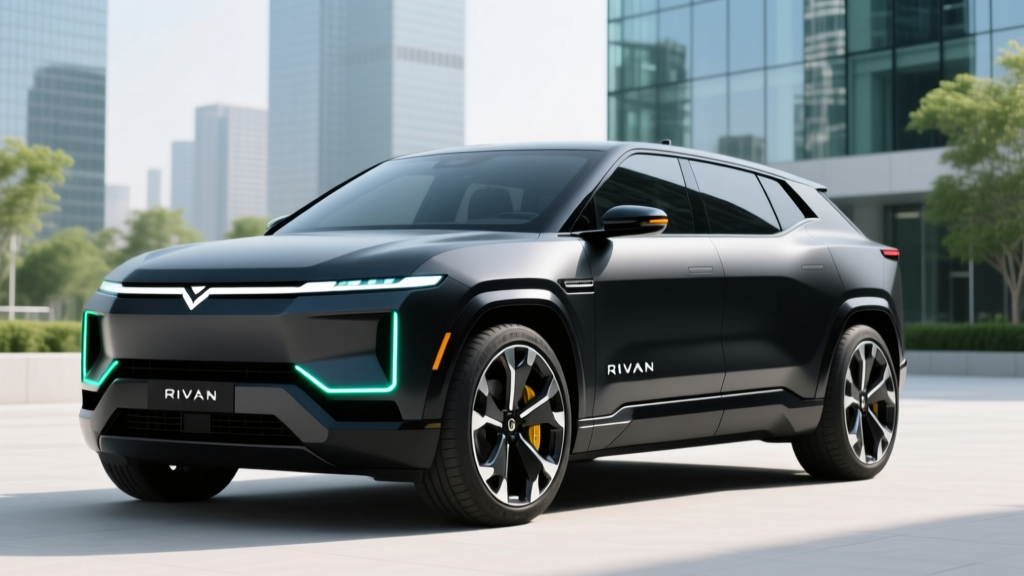
The Rivian R5 is the compact electric SUV that could define Rivian's next chapter. Announced alongside the R2 and R3, the R5 slots below the midsize R1S and the upcoming R2, targeting buyers who want Rivian's signature adventure-oriented design in a smaller, more affordable package. As of early 2026, Rivian has confirmed the R5 is in development at its upcoming Georgia production facility, with deliveries anticipated in late 2026 or 2027. Below, we break down every confirmed and projected specification, what the real-world ownership experience will likely look like, and whether the R5 deserves a spot on your shortlist.
Platform and Positioning: Where the R5 Fits
The R5 rides on a derivative of Rivian's midsize platform — the same architecture underpinning the R2. This means shared battery pack designs, drive unit technology, and software stack, but in a shorter wheelbase and overall length closer to a Tesla Model Y or Volvo EX40. Rivian CEO RJ Scaringe has described the R5 as designed to hit a lower price point than the R2, aiming for the high-volume compact SUV segment that represents the largest share of US new-vehicle sales.
Think of the R5 as Rivian's answer to the question: "What if the R1S adventure DNA could fit in a sub-$50,000 package?" It's positioned to compete directly with the Tesla Model Y, the forthcoming next-generation compact EVs from legacy automakers, and potentially the base trims of luxury compact electric SUVs.
Expected Battery, Range, and Efficiency
Rivian has confirmed that the R2 platform supports both NMC (nickel manganese cobalt) and LFP (lithium iron phosphate) battery chemistries. The R5, sharing this architecture, is expected to follow the same dual-chemistry strategy:
| Spec | Standard Range (Est.) | Long Range (Est.) |
|---|---|---|
| Battery Chemistry | LFP | NMC |
| Usable Capacity | ~65 kWh | ~85 kWh |
| EPA Range (Projected) | ~250 mi | ~310+ mi |
| Efficiency (Projected) | ~26 kWh/100mi | ~27 kWh/100mi |
The LFP chemistry choice for the base model is significant. LFP cells are less energy-dense than NMC, which is why the Standard Range model will have fewer miles, but they offer superior cycle life (3,000+ full cycles before meaningful degradation), tolerate regular charging to 100% without accelerated wear, and use no cobalt or nickel — reducing supply-chain risk and cost. For daily commuting, the LFP pack is arguably the better long-term ownership choice.
Charging Speed and Infrastructure
Rivian's R2 platform supports DC fast charging at up to approximately 200 kW peak on NMC-equipped Long Range models. The R5, sharing this architecture, should deliver similar performance. Here's what that looks like across charging levels:
| Charging Level | Power | Speed / Time |
|---|---|---|
| Level 1 (120V household) | ~1.4 kW | ~3–4 mi/hr |
| Level 2 (240V, 48A) | ~11.5 kW | ~28–32 mi/hr; 0–100% in ~8–9 hrs |
| DC Fast Charge (NMC Long Range) | Up to ~200 kW peak | 10–80% in ~25–28 min (projected) |
| DC Fast Charge (LFP Standard) | Up to ~150 kW peak | 10–80% in ~22–26 min (projected) |
Charging curve reality check: The ~200 kW peak rate applies only between roughly 10% and 35% State of Charge. Above 50%, expect the rate to taper to approximately 120 kW, and above 80%, it drops further to under 50 kW as the battery management system protects cell longevity. This means a 10–80% session at a 350 kW Electrify America or Tesla Supercharger station will average closer to 130–140 kW sustained — which is why the 10–80% time lands around 25–28 minutes rather than the theoretical minimum. Always precondition the battery (via the Rivian app or navigation routing to a charger) to hit peak rates.
The R5 is expected to ship with the NACS (North American Charging Standard) connector natively, giving it direct access to Tesla's Supercharger network — now exceeding 25,000 stalls across North America — without an adapter. This is a decisive infrastructure advantage over CCS-only competitors.
Performance and Drivetrain
Rivian's dual-motor AWD system is a brand hallmark, and the R5 is expected to offer both single-motor RWD (rear-wheel drive) and dual-motor AWD configurations:
| Configuration | Horsepower (Est.) | 0–60 mph (Est.) | Drivetrain |
|---|---|---|---|
| Single Motor | ~280 hp | ~6.5 sec | RWD |
| Dual Motor | ~500 hp | ~3.9 sec | AWD |
| Dual Motor Perf. (if offered) | ~600+ hp | ~3.2 sec | AWD |
Rivian's drive units use a proprietary oil-cooled motor design that delivers strong low-end torque without the thermal derating issues some competitors experience during repeated hard launches. The dual-motor system also enables Rivian's software-defined torque vectoring, which can brake individual wheels and redistribute torque for improved traction on loose surfaces — a feature that sets Rivian apart in the adventure-SUV space.
Interior Space, Cargo, and Practicality
The R5's compact footprint means interior space will be tighter than the three-row R1S but competitive with the segment. Based on the R2 platform dimensions and Rivian's packaging approach:
- Seating: 5 passengers across two rows
- Rear legroom (projected): ~37–39 inches
- Cargo behind rear seats (projected): ~28–32 cu ft
- Cargo with rear seats folded (projected): ~60–65 cu ft
- Frunk (front trunk): Expected, ~4–6 cu ft — a Rivian signature feature enabled by the skateboard platform's lack of a front motor in RWD trims, and still partially available on AWD trims due to compact drive unit packaging
The R5 is expected to feature Rivian's latest-generation infotainment system running on a custom operating system with a 15.4-inch center touchscreen, over-the-air update capability, and native integration with Rivian's adventure-focused navigation (which factors in terrain, elevation gain, and charging stops into route planning). A driver monitoring camera and Rivian's Driver+ assist system (adaptive cruise, lane centering, automatic lane changes on highways) will likely be standard.
Pricing, Trims, and Federal Tax Credit Eligibility
Rivian has targeted a starting MSRP in the low-to-mid $40,000 range for the R5, with fully loaded trims approaching $55,000. This pricing is critical because it positions the R5 squarely within federal tax credit eligibility thresholds:
| Trim (Projected) | Est. MSRP | After Max §30D Credit |
|---|---|---|
| Standard Range RWD | ~$42,000 | ~$34,500 |
| Long Range AWD | ~$49,000 | ~$41,500 |
| Dual Motor Adventure | ~$54,000 | ~$46,500 |
Federal tax credit (IRS §30D) eligibility requirements for 2026:
- MSRP cap: SUVs must be priced at or below $80,000 — the R5 clears this easily
- Buyer income cap: Adjusted gross income must not exceed $150,000 (single), $225,000 (head of household), or $300,000 (married filing jointly)
- Battery sourcing: A percentage of critical minerals and battery components must be sourced from the US or free-trade-agreement partners. This threshold increases annually and is the most volatile eligibility factor. Rivian's Georgia plant and domestic supply-chain investments are designed to meet these requirements, but eligibility can change mid-year as sourcing rules tighten
- Point-of-sale transfer: Under current rules, you can transfer the credit to the dealer at purchase, reducing your out-of-pocket cost immediately rather than waiting to claim it on your tax return
Consult IRS.gov §30D guidance and a tax professional before relying on credit eligibility, as battery-component and critical-mineral sourcing requirements are updated annually and can shift a vehicle from eligible to ineligible.
Warranty and Long-Term Ownership
Based on Rivian's existing warranty structure for the R1T and R1S, the R5 is expected to carry:
- Battery & drive unit warranty: 8 years / 120,000 miles (with a capacity retention threshold, typically 70% of original capacity)
- Bumper-to-bumper warranty: 5 years / 60,000 miles
- Corrosion warranty: Expected 5+ years, consistent with industry norms
Rivian's battery management system has demonstrated strong degradation performance in the R1 fleet, with most high-mileage R1T owners reporting less than 8% capacity loss after 60,000+ miles. The LFP-equipped Standard Range model should see even slower degradation, as LFP chemistry is inherently more resistant to calendar and cycle aging.
Driver Assistance and Technology
Driver+ includes adaptive cruise control with stop-and-go, lane centering, automatic lane changes when the turn signal is activated, and traffic sign recognition. Rivian has been developing a more advanced "hands-free" highway assist system, which may debut on the R2/R5 platform with enhanced sensor hardware including additional cameras and higher-resolution radar.
Unique tech features expected on the R5 include:
- Rivian Waypoints: Community-sourced adventure route planning with EV-specific range and charging integration
- Over-the-air updates: Continuous feature additions and performance improvements, as demonstrated across the R1 fleet
- Vehicle-to-load (V2L): The R5 platform is expected to support powering external devices (camping gear, tools) from the traction battery
- Phone-as-key: Bluetooth Low Energy-based keyless entry and start, with backup NFC card
Competition and Verdict: Is the R5 Worth Waiting For?
✓ Pros
- Projected 310+ mi EPA range (Long Range)
- Native NACS connector = direct Supercharger access
- LFP option for exceptional battery longevity
- Rivian's adventure ecosystem and OTA updates
- Likely full §30D tax credit eligibility
- Frunk + V2L utility
✗ Cons
- Not yet available — delivery timeline uncertain
- Peak DC charge rate (~200 kW) trails 800V competitors
- Rivian's production ramp history raises delivery risk
- Compact size means less cargo space than R1S
- Final specs, pricing, and credit eligibility unconfirmed
Decision Framework
Wait for the R5 if: You want a compact adventure-oriented EV SUV under $50,000, value native Supercharger access, and can defer your purchase into late 2026 or 2027.
Consider alternatives now if: You need a vehicle immediately, want proven production reliability (Tesla Model Y, Hyundai Ioniq 5), or need three-row seating (R1S, Kia EV9).
Frequently Asked Questions
What is the real-world range of the Rivian R5?
The Long Range R5 is projected at approximately 310+ miles EPA. Real-world highway driving at 70–75 mph in moderate temperatures will likely yield 260–280 miles. In cold weather (below 30°F), expect 215–245 miles. The LFP Standard Range model should deliver roughly 200–225 miles in real-world highway conditions.
How fast does the Rivian R5 charge?
At a DC fast charger, the Long Range NMC model is projected to peak at approximately 200 kW, achieving a 10–80% charge in roughly 25–28 minutes. Home Level 2 charging at 11.5 kW adds approximately 28–32 miles of range per hour, fully recharging overnight in about 8–9 hours.
How much does the Rivian R5 cost after tax credits?
The base Standard Range model is projected at approximately $42,000 MSRP, which could drop to around $34,500 after the maximum $7,500 federal §30D tax credit — assuming you meet income caps and the vehicle's battery sourcing qualifies at time of purchase. Final credit eligibility depends on evolving IRS critical-mineral and battery-component rules.
Does the Rivian R5 qualify for the federal EV tax credit?
Based on projected MSRP (well under the $80,000 SUV cap) and Rivian's domestic manufacturing and supply-chain strategy, the R5 is positioned to qualify for the full §30D credit. However, eligibility depends on your income, the vehicle's battery sourcing at time of delivery, and any legislative changes. Always verify at IRS.gov before purchasing.
Is the Rivian R5 worth buying vs. the Tesla Model Y?
The R5 offers a distinct value proposition: Rivian's adventure-focused design, likely LFP battery option, frunk utility, and V2L capability. The Model Y has a proven production track record, an established Supercharger network (which the R5 will also access via NACS), and immediate availability. If you need a car now, the Model Y wins on certainty. If you can wait and value Rivian's ecosystem, the R5 is compelling.
When can I buy the Rivian R5?
Rivian has not announced a firm on-sale date. Production is expected at Rivian's Georgia facility, with deliveries anticipated in late 2026 or 2027. Reservations may open before production begins — monitor Rivian.com for updates.