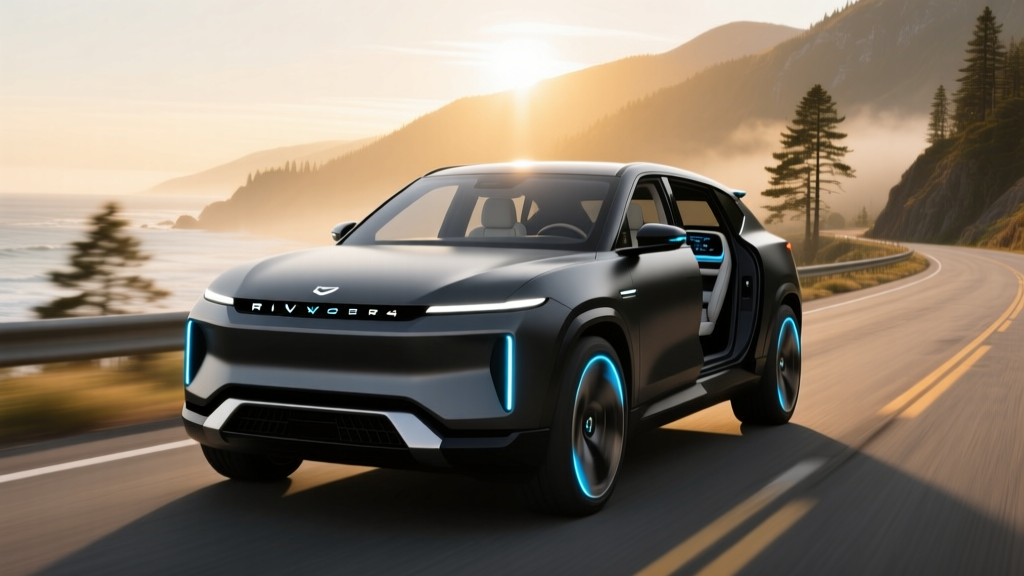
Rivian's R1S and R1T proved the brand can build compelling, adventure-ready EVs. Now, the automaker is pivoting to the mass market with the Rivian R4 — a compact electric SUV designed to undercut the Tesla Model Y and Hyundai Ioniq 5 on price while delivering the capability Rivian is known for. First announced in late 2024 and targeting a 2026 production start at Rivian's upcoming Georgia plant, the R4 represents the company's highest-stakes launch yet.
Because the R4 is not yet in customer hands, the specifications below are based on Rivian's official announcements, supply-chain reporting, and preliminary filings. Final EPA certification and MSRP will be confirmed closer to launch. We'll update this page as hard numbers arrive.
What Is the Rivian R4?
The Rivian R4 is a compact, five-passenger electric SUV positioned below the mid-size R1S. It rides on a new, cost-optimized platform that shares some architecture with the second-generation R1 lineup but is engineered for higher-volume, lower-cost production. Rivian CEO RJ Scaringe has confirmed the R4 will target a starting price in the mid-$40,000 range — placing it squarely in the hottest segment of the EV market.
Dimensions are expected to slot between the Hyundai Ioniq 5 and the Tesla Model Y, with a focus on interior packaging efficiency. The R4 will be built at Rivian's new manufacturing facility in Stanton, Georgia, a $5 billion investment that the company says will support up to 400,000 vehicles annually across the R4 and a planned R5 compact.
Estimated Range, Battery, and Efficiency
Rivian has not published final EPA range figures, but the company has indicated the R4 will offer multiple battery pack sizes. Based on platform disclosures and competitive positioning, here is what we anticipate:
| Specification | Standard Range (est.) | Extended Range (est.) |
|---|---|---|
| Battery Capacity (usable) | ~72 kWh | ~95 kWh |
| Chemistry | LFP (lithium iron phosphate) | NMC (nickel manganese cobalt) |
| EPA Range (est.) | ~250 mi | ~315 mi |
| Efficiency (est.) | ~3.4 mi/kWh (~115 MPGe) | ~3.3 mi/kWh (~112 MPGe) |
The use of LFP chemistry for the Standard Range pack is a strategic choice. LFP batteries sacrifice some energy density compared to NMC but offer significantly longer cycle life, lower cost, and no cobalt or nickel supply-chain risk. For daily commuting, LFP's ability to be charged to 100% regularly without accelerated degradation makes it arguably the better choice. The Extended Range NMC pack prioritizes maximum distance for road-trippers who need every mile.
Charging Speed: DC Fast and Level 2
Rivian has confirmed the R4 will support DC fast charging via the NACS (North American Charging Standard) connector — the Tesla-standard plug now adopted industry-wide. This means R4 owners will have native access to the Tesla Supercharger network without an adapter, a significant advantage for road-trip charging.
| Charging Method | Standard Range (est.) | Extended Range (est.) |
|---|---|---|
| Max DC Fast Charge | ~175 kW | ~220 kW |
| 10–80% DC Time | ~28 min | ~25 min |
| Level 2 (240V, 48A) | ~11.5 kW (~39 mi/hr) | ~11.5 kW (~38 mi/hr) |
| Level 2 (240V, 32A) | ~7.7 kW (~26 mi/hr) | ~7.7 kW (~25 mi/hr) |
| Connector | NACS (native) | |
A few important caveats on these numbers. Peak DC charge rate (the kW figure) is not sustained across the entire session. Like all EVs, the R4's charge curve will taper as the battery fills — the 10–80% time is the meaningful metric, and ~25 minutes for the Extended Range pack would be competitive with the Hyundai Ioniq 5 (which peaks at 240 kW and does 10–80% in ~18 minutes on its best trim). The R4 likely won't match Hyundai's 800-volt architecture charge speeds, but Rivian's thermal management in the R1 series has proven capable, and the R4 should deliver reliable, predictable charging sessions.
For home charging, a 48-amp Level 2 wall connector on a 60-amp circuit will add roughly 38–39 miles of range per hour — enough to fully replenish either pack overnight. A standard 32-amp portable charger on a 240V outlet adds about 25–26 miles per hour, which works for lower-mileage commuters. (Rivian charging guide)
Performance and Drivetrain
Rivian has built its reputation on dual- and quad-motor performance. The R4 will continue that tradition, though with a stronger emphasis on efficiency for the base model.
| Trim / Drivetrain | Horsepower (est.) | 0–60 mph (est.) | Drivetrain |
|---|---|---|---|
| Base (RWD) | ~280 hp | ~6.8 sec | Rear-Wheel Drive |
| Dual-Motor AWD | ~450 hp | ~4.5 sec | All-Wheel Drive |
| Performance AWD | ~550 hp | ~3.5 sec | All-Wheel Drive |
The base RWD variant is expected to be the price leader, targeting the sub-$45,000 mark. For buyers in snow-belt states, the Dual-Motor AWD version will be the pragmatic pick — Rivian's AWD system in the R1S has proven exceptionally capable in low-traction conditions, with independent torque vectoring at each axle. The Performance variant, if offered at launch, would give the R4 serious hot-hatch SUV credentials against the Tesla Model Y Performance.
Towing capacity has not been confirmed, but Rivian's platform engineering suggests a rating in the 3,500–4,500 lb range for AWD trims — adequate for small campers, jet skis, or utility trailers.
Interior Space, Cargo, and Technology
The R4 is a compact SUV, so interior dimensions will be tighter than the three-row R1S. Based on Rivian's packaging disclosures and competitive benchmarking, expect the following:
- Seating: 5 passengers across two rows
- Rear legroom: ~38 inches (estimated)
- Cargo behind rear seats: ~28–32 cu ft (estimated)
- Cargo with rear seats folded: ~62–68 cu ft (estimated)
- Front trunk (frunk): ~8–10 cu ft (estimated)
Technology highlights are expected to include:
- Infotainment: 15.6-inch center touchscreen running Rivian's proprietary OS, with wireless Apple CarPlay and Android Auto
- Driver display: Compact digital instrument cluster integrated into the steering column
- Driver assistance: Rivian's Driver+ system (SAE Level 2) with adaptive cruise, lane centering, and highway assist — note that this requires continuous driver supervision and is not autonomous driving
- Over-the-air updates: Full vehicle OTA capability for feature additions and performance improvements
- Connectivity: Built-in LTE/5G with Wi-Fi hotspot
- Adventure features: Integrated camp kitchen accessory compatibility, gear tunnel options (if platform allows), and Rivian's signature gear-guard cameras
Pricing, Trims, and Federal Tax Credit Eligibility
Rivian has stated the R4 will start in the mid-$40,000 range. Based on competitive positioning and production-cost targets, here is our estimated trim and pricing structure:
| Trim | Est. MSRP | §30D Credit Eligibility | Est. Net Price |
|---|---|---|---|
| Standard Range RWD | ~$44,000 | Potentially eligible (up to $7,500) | ~$36,500 |
| Standard Range AWD | ~$49,000 | Potentially eligible (up to $7,500) | ~$41,500 |
| Extended Range AWD | ~$54,000 | Eligible (under $80K SUV cap) | ~$46,500 |
| Performance AWD | ~$59,000 | Eligible (under $80K SUV cap) | ~$51,500 |
- MSRP cap: SUVs must be under $80,000 — all R4 trims should qualify.
- Buyer income cap: AGI must not exceed $150K (single), $225K (head of household), or $300K (joint).
- Battery sourcing: Critical minerals and battery components must meet escalating domestic-content thresholds. Rivian's Georgia production and supply-chain localization are designed to satisfy these requirements, but final eligibility depends on IRS certification at launch.
- Point-of-sale transfer: Eligible buyers can apply the credit as an immediate price reduction at the dealer, rather than waiting for a tax refund.
Always verify current-year eligibility on IRS.gov before purchasing. Rules are subject to legislative change.
Warranty and Ownership Costs
Rivian's current R1 vehicles carry an 8-year/175,000-mile battery and drive unit warranty — one of the most generous in the industry. The R4 is expected to maintain similar coverage, though the exact terms may adjust for the new platform:
- Battery warranty: 8 years / 175,000 miles (estimated), with a capacity retention threshold of at least 70%
- Drive unit (motor/inverter) warranty: 8 years / 175,000 miles (estimated)
- Bumper-to-bumper: 5 years / 60,000 miles (estimated)
- Roadside assistance: 5 years / 60,000 miles
For total cost of ownership, the R4's lower MSRP combined with the §30D credit, reduced maintenance (no oil changes, minimal brake wear thanks to regen), and home-charging economics should yield a compelling 5-year cost profile. Electricity at the national average of ~$0.16/kWh translates to roughly $0.047 per mile for the Extended Range pack — compared to ~$0.14/mile for a 25 MPG gas SUV at $3.50/gallon.
Rivian R4 vs. Key Competitors
| Attribute | Rivian R4 (ER AWD) | Tesla Model Y LR | Hyundai Ioniq 5 LR AWD |
|---|---|---|---|
| EPA Range | ~315 mi | 320 mi | 290 mi |
| Battery (usable) | ~95 kWh | 75 kWh | 77.4 kWh |
| Peak DC Charge | ~220 kW | ~250 kW | ~240 kW |
| 10–80% DC Time | ~25 min | ~22 min | ~18 min |
| 0–60 mph | ~4.5 sec | ~4.8 sec | ~5.1 sec |
| Est. Base MSRP (AWD) | ~$49,000 | ~$50,000 | ~$50,500 |
| Connector | NACS | NACS | NACS (2025+) |
| Cargo (behind 2nd row) | ~30 cu ft | 30 cu ft | 27 cu ft |
The R4's differentiation will likely come down to three factors: brand identity (outdoor/adventure positioning that Tesla and Hyundai don't replicate), LFP battery longevity for the base trim, and native Supercharger access with Rivian's proven software integration. Where it may trail is pure charging speed — Hyundai's 800V E-GMP platform still leads the segment in DC fast-charge times.
Pros, Cons, and Who Should Buy
Pros
- Targeted mid-$40K starting price — potentially the most affordable Rivian
- Native NACS connector for Supercharger network access
- LFP battery option for maximum longevity and daily-charge flexibility
- Rivian's adventure-ready brand DNA and accessory ecosystem
- Strong estimated range (315+ mi Extended Range)
- Generous battery/drive-unit warranty (expected)
- OTA-capable platform with continuous feature improvements
Cons
- Not yet in production — delivery timelines remain uncertain
- DC charge speeds may lag Hyundai/Kia 800V competitors
- Compact size means less cargo space than R1S or Model Y
- Rivian's service center network is still expanding — coverage gaps in some regions
- Final §30D tax credit eligibility unconfirmed until production begins
- Base RWD trim may have limited availability at launch
- Outdoor enthusiasts who want a compact EV with genuine adventure credentials but don't need the R1S's size and price.
- Commuters in the 30–80 mile daily range who can charge at home and want a lower-cost entry into the Rivian ecosystem.
- Young families who need two-row SUV practicality with strong safety engineering and modern driver-assist features.
- Tax-credit maximizers whose income falls under §30D caps and who want to apply the credit at point of sale.
Who should look elsewhere: If you need three rows, the R1S or Kia EV9 is the call. If you prioritize the absolute fastest DC charging, the Ioniq 5's 18-minute 10–80% time is hard to beat. And if you need a vehicle today, the R4 is not yet available — consider the Model Y or Ioniq 5 in the interim.
Frequently Asked Questions
What is the real-world range of the Rivian R4?
Based on preliminary estimates, the Extended Range R4 should deliver an EPA rating around 315 miles. In real-world highway driving at 70–75 mph, expect 260–280 miles. In cold weather (below 30°F), plan on 210–240 miles. The Standard Range variant should deliver roughly 200–220 miles in mixed real-world use. Final EPA figures will be published closer to launch.
How fast does the Rivian R4 charge?
The Extended R4 is estimated to peak at ~220 kW on DC fast charging, achieving a 10–80% charge in approximately 25 minutes. The Standard Range model should peak around 175 kW with a 10–80% time near 28 minutes. At home on a 48-amp Level 2 charger, both variants should add roughly 38–39 miles of range per hour.
How much does the Rivian R4 cost after tax credits?
The base Standard Range RWD is estimated at ~$44,000 MSRP. If the vehicle qualifies for the full $7,500 §30D federal credit (subject to income, MSRP, and battery-sourcing rules), the effective price drops to approximately $36,500. Higher trims with AWD and Extended Range will range from roughly $41,500 to $51,500 after the credit. Always confirm eligibility at IRS.gov before purchasing.
Does the Rivian R4 qualify for the federal EV tax credit?
All R4 trims should fall under the $80,000 MSRP cap for SUVs. However, full §30D credit eligibility also depends on buyer income limits ($150K single / $300K joint), battery critical-mineral sourcing thresholds, and final IRS certification at the time of production. Rivian is building the R4 in Georgia with domestic supply-chain localization designed to meet these requirements, but official confirmation will come when the vehicle enters production.
Is the Rivian R4 worth buying vs. the Tesla Model Y or Hyundai Ioniq 5?
The R4's value proposition centers on Rivian's brand identity, LFP battery longevity for the base trim, native Supercharger access, and competitive pricing. If you prioritize proven reliability and the largest charging network, the Model Y remains the benchmark. If you want the fastest DC charging available, the Ioniq 5's 800V platform leads. The R4 is the pick for buyers who want a Rivian's adventure ethos at a mass-market price — but you'll need to wait for production to begin.
When can I buy the Rivian R4?
Rivian targets production at its Georgia facility beginning in 2026. Reservations are expected to open ahead of production, with deliveries following in late 2026 or early 2027 depending on ramp-up pace. Check rivian.com for the latest timeline updates.