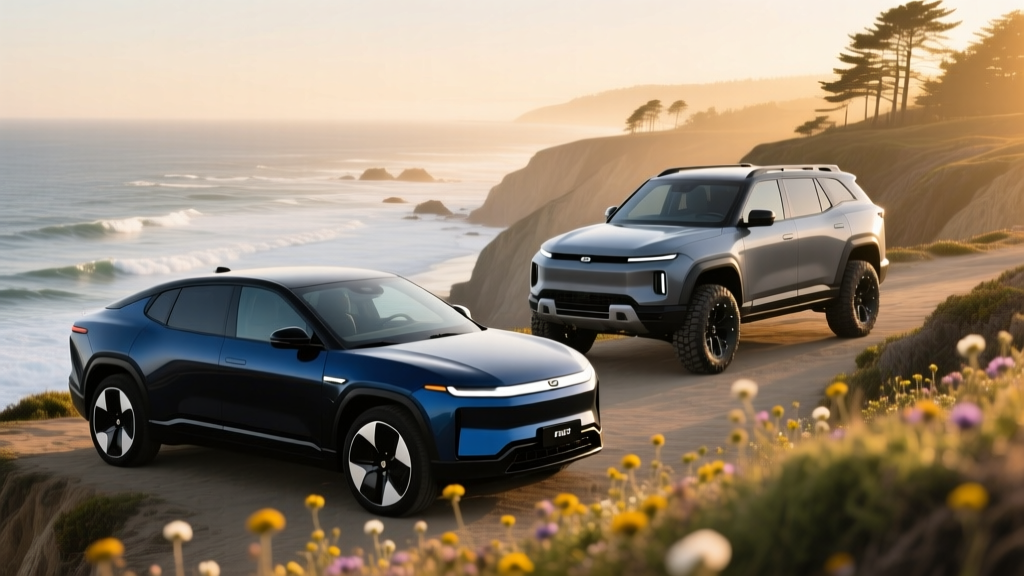
The Rivian R3 and R3X represent the automaker's long-awaited push into the compact electric crossover segment — a category where affordability, efficiency, and daily usability matter far more than off-road bragging rights. First unveiled in early 2024 alongside the midsize R2, these two models sit below the R1S and R1T in Rivian's lineup and target buyers who want the brand's design language and software experience in a smaller, more accessible package. As of early 2026, both the R3 and the adventure-oriented R3X remain in pre-production status, with customer deliveries expected to begin in late 2026 or early 2027. Here is every confirmed and estimated specification we have, along with the real-world context buyers need before putting down a reservation.
Rivian R3 and R3X: At-a-Glance Specifications
Because the R3 and R3X share a platform but target different use cases — urban commuter versus light adventure — their specs diverge in key areas. The table below compiles Rivian's announced figures alongside our analyst estimates where the company has not yet published final numbers.
| Specification | Rivian R3 (Base) | Rivian R3X (Adventure) |
|---|---|---|
| EPA Range (est.) | ~270 miles (Standard Battery) | ~300+ miles (Large Battery) |
| Battery Capacity (usable) | ~65 kWh (LFP est.) | ~85 kWh (NMC est.) |
| Drivetrain | Single-motor RWD / Dual-motor AWD | Dual-motor AWD (Tri-motor possible) |
| Horsepower | ~250 hp (RWD) / ~400 hp (AWD) | ~500–600+ hp (AWD/Tri) |
| 0–60 mph | ~6.5 sec (RWD) / ~4.5 sec (AWD) | ~3.5 sec (est.) |
| Peak DC Fast Charge | ~175 kW (est.) | ~200 kW (est.) |
| 10–80% DC Charge Time | ~25 min (est.) | ~28 min (est.) |
| Level 2 Home Charging | 11.5 kW (~37 mi/hr) | 11.5 kW (~37 mi/hr) |
| Starting MSRP (est.) | ~$39,900 | ~$49,900 |
| Battery/Powertrain Warranty | 8 yr / 100,000 mi (est.) | 8 yr / 100,000 mi (est.) |
Range and Efficiency: EPA Estimates vs. Real-World Expectations
Rivian has indicated the R3 will offer multiple battery pack sizes. The standard battery, likely an LFP (lithium iron phosphate) pack around 65 kWh usable, targets approximately 270 miles of EPA range. The R3X, with a larger NMC (nickel manganese cobalt) pack estimated at 85 kWh usable, aims for 300+ miles. These figures are preliminary and subject to final EPA certification.
EPA estimate: ~270 mi (R3 Standard) / ~300+ mi (R3X Large Battery)
Expect in real-world highway driving (70–80 mph): ~220–245 mi (R3) / ~255–280 mi (R3X)
Cold weather (below 32°F) with cabin heating: Reduce estimates by 20–30%. An R3 Standard could see ~190–215 mi in freezing conditions.
Why the gap? EPA test cycles include significant city/regenerative braking driving, which favors EVs. Sustained highway speeds and cold-weather battery conditioning consume more energy. Rivian's R1S and R1T have historically delivered real-world highway range within 85–90% of EPA — we expect similar for the R3 platform.
Efficiency-wise, we estimate the R3 single-motor at roughly 120–125 MPGe combined (about 27–29 kWh/100 mi), while the heavier, more powerful R3X will likely land around 105–110 MPGe combined (30–32 kWh/100 mi). For context, the Tesla Model Y Long Range AWD achieves 122 MPGe combined with 28 kWh/100 mi, setting the efficiency bar in this segment.
The LFP vs. NMC chemistry choice matters for long-term ownership. LFP batteries tolerate daily charging to 100% without accelerated degradation, making them ideal for commuters who need full range every morning. NMC packs offer higher energy density (more range in the same physical space) but perform best when daily charging is limited to 80–90%. If Rivian offers the R3 with LFP, it would be a significant practical advantage for high-mileage daily drivers.
Charging Speed: DC Fast Charging and Home Level 2
Charging speed is where compact EV buyers often face compromises. Based on Rivian's architecture announcements and the R2 platform details shared at their 2024 reveal, we expect the R3 to support peak DC fast charging around 175 kW on standard battery trims, with the R3X reaching approximately 200 kW. These are peak rates — sustained charging will taper as the battery fills, as is the case with all lithium-ion packs.
| Charging Level | Power / Rate | Miles Added per Hour | Notes |
|---|---|---|---|
| Level 1 (120V) | ~1.4 kW | ~4–5 mi/hr | Emergency/overnight trickle only |
| Level 2 (240V, 48A) | 11.5 kW | ~37 mi/hr | Full charge overnight (~7–8 hrs) |
| DC Fast Charge (R3) | Peak ~175 kW | N/A (10–80% in ~25 min) | Tapers significantly above 80% |
| DC Fast Charge (R3X) | Peak ~200 kW | N/A (10–80% in ~28 min) | Larger pack = slightly longer session |
A critical detail for road-trippers: the R3 and R3X are expected to ship with the NACS (North American Charging Standard) connector natively, giving them direct access to Tesla's Supercharger network — currently the most reliable and widespread DC fast-charging infrastructure in North America. Rivian confirmed NACS adoption for the R2 platform, and the R3 will share that architecture. No adapter will be needed at Superchargers.
For home charging, a 48-amp Level 2 wall connector on a 60-amp circuit will replenish the R3 Standard Battery from empty to full in roughly 7 hours, or the R3X Large Battery in about 8.5 hours. Plan on a home installation cost of $800–$2,000 for the charger and electrical work, depending on whether your panel needs an upgrade. Rivian's existing Wall Charger is rated at 11.5 kW and should carry over to the R3 lineup.
Performance, Drivetrain, and the R3X Adventure Edge
The R3 will be offered in both single-motor rear-wheel-drive and dual-motor all-wheel-drive configurations. The RWD variant, estimated at around 250 horsepower, will deliver a 0–60 mph time in the mid-6-second range — perfectly adequate for commuting and merging. The dual-motor AWD version bumps output to roughly 400 horsepower with a 0–60 time near 4.5 seconds, giving it genuine sporty character in a compact package.
The R3X is where Rivian's adventure DNA shows through. Expected to feature a dual-motor or possibly tri-motor setup producing 500–600+ horsepower, the R3X targets a 0–60 mph time around 3.5 seconds. Beyond straight-line speed, the R3X will differentiate itself with increased ground clearance (likely 9+ inches versus the R3's ~7.5 inches), underbody protection, all-terrain tires, and Rivian's software-defined drive modes including Snow, Sand, and Rock Crawl. Think of it as the R3 equivalent of the R1T's Adventure package — a compact EV that can genuinely handle trail use.
Towing capacity has not been officially published, but based on the R3's compact size and the R2's announced 4,500-pound rating, we estimate the R3 AWD at approximately 2,500–3,000 pounds and the R3X at 3,000–3,500 pounds. That's enough for a small boat trailer or lightweight camping trailer, but not a full-size camper.
Interior Space, Cargo, and Technology
The R3 is positioned as a subcompact-to-compact crossover, slotting below the R2 (which is itself smaller than the R1S). Rivian has described the R3 as roughly comparable in footprint to vehicles like the Volvo EX30 or the Hyundai Kona Electric. Expect the following approximate dimensions:
- Cargo volume (behind 2nd row): ~22–25 cu ft (est.)
- Cargo volume (2nd row folded): ~50–55 cu ft (est.)
- Front legroom: ~41 inches (est.)
- Rear legroom: ~35–37 inches (est.)
- Front trunk (frunk): ~5–7 cu ft (est.) — Rivian has confirmed a frunk on the R3 platform
Rear-seat space will be tighter than the R2 or R1S, making the R3 best suited for couples, small families, or as a second vehicle. Taller adults will find the rear seat adequate for shorter trips but cramped on long highway drives.
On the technology front, the R3 will run Rivian's latest software stack on a central touchscreen (likely 15–16 inches, consistent with the R2 reveal). Expect the full Rivian Driver+ suite — a Level 2 driver-assistance system offering adaptive cruise control, lane centering, and highway assist. As with all Level 2 systems per SAE classification, the driver must remain attentive and keep hands on or near the wheel at all times. This is not autonomous driving.
Additional tech highlights expected across the lineup:
- Over-the-air software updates
- Rivian's Gear Tunnel accessory port (on R3X)
- Camp Kitchen and Camp Speaker integration
- Wireless Apple CarPlay and Android Auto
- 360-degree camera system with trail views (R3X)
- Vehicle-to-load (V2L) capability for powering external devices
Pricing, Trims, and Federal Tax Credit Eligibility
Rivian CEO RJ Scaringe has stated publicly that the R3 will start under $40,000, making it the brand's most affordable vehicle. The R3X, with its larger battery and adventure hardware, will carry a premium. Here is our estimated pricing structure:
| Trim / Configuration | Est. MSRP | Est. After §30D Credit |
|---|---|---|
| R3 Standard (RWD, Standard Battery) | ~$39,900 | ~$32,400 (if eligible) |
| R3 AWD (Dual-Motor, Standard Battery) | ~$44,900 | ~$37,400 (if eligible) |
| R3X Adventure (AWD, Large Battery) | ~$49,900 | ~$42,400 (if eligible) |
| R3X Launch Edition (fully loaded) | ~$55,000+ | ~$47,500+ (if eligible) |
The IRS §30D Clean Vehicle Credit offers up to $7,500 for qualifying new EVs, but eligibility depends on several factors that may not be finalized until the R3 enters production:
- MSRP cap: SUVs/crossovers must be priced at or below $80,000 — all R3/R3X trims should clear this easily.
- Buyer income cap: AGI must not exceed $150,000 (single) / $300,000 (joint) / $225,000 (head of household).
- Battery sourcing: Critical minerals and battery components must meet phased-in domestic/free-trade-agreement sourcing percentages that tighten each year through 2030. Rivian's Georgia battery plant and supply chain agreements will determine compliance.
- Point-of-sale transfer: Eligible buyers can apply the credit as an immediate price reduction at the dealer rather than waiting for a tax refund.
- Final assembly: Must occur in North America — Rivian's Normal, Illinois plant satisfies this requirement.
R3 and R3X vs. the Competition
The compact electric crossover segment is increasingly crowded. Here is how the Rivian R3 and R3X stack up against key rivals on paper:
| Metric | Rivian R3 (est.) | Tesla Model Y | Volvo EX30 | Hyundai Kona Electric |
|---|---|---|---|---|
| EPA Range | ~270–300 mi | 310 mi (LR) | 265 mi (Extended) | 261 mi |
| Starting Price | ~$39,900 | ~$44,990 | ~$36,150 | ~$34,975 |
| Peak DC Charge | ~175–200 kW | 250 kW | 153 kW | 100+ kW |
| NACS Native | Yes | Yes | No (CCS) | No (CCS) |
| Adventure Variant | Yes (R3X) | No | Cross Country (mild) | No |
The R3's main competitive advantage will be the combination of Rivian's software ecosystem, native Supercharger access, and the R3X's genuine off-road capability — something no rival in this price range offers. The Tesla Model Y remains the efficiency and charging-speed benchmark, while the Volvo EX30 undercuts on price but sacrifices range and charging speed. The Kona Electric is the value pick but lacks AWD and fast DC charging.
- Sub-$40K starting price for base R3
- Native NACS / Supercharger access
- R3X offers real off-road capability in a compact EV
- LFP battery option for daily 100% charging
- Rivian's proven software and OTA update track record
- Frunk + Gear Tunnel (R3X) for extra storage
- Not yet available — deliveries expected late 2026 or 2027
- Real-world highway range may fall short of 270/300 mi targets
- DC charge speed (175–200 kW) trails Tesla's 250 kW
- Rear seat likely tight for tall adults
- Tax credit eligibility depends on unresolved battery-sourcing rules
- R3X price could approach R2 territory when optioned
Who Should Buy the Rivian R3 or R3X?
Choose the R3 if: You want a compact, efficient daily commuter EV under $45,000 with native Supercharger access and don't need maximum rear-seat space. The R3 Standard with LFP battery is ideal for urban and suburban drivers who charge at home and take occasional road trips.
Choose the R3X if: You want a compact EV that can handle genuine off-road trails, ski trips, and camping weekends without stepping up to the larger, more expensive R2 or R1S. The R3X fills a niche no competitor currently occupies — a truly adventure-capable small electric SUV.
Look elsewhere if: You need maximum range (Tesla Model Y Long Range still wins at 310+ miles), the fastest DC charging available, or a roomy rear seat for three adults. The R3 is a compact vehicle, and buyers who regularly carry full families should test the R2 instead.
Frequently Asked Questions
What is the real-world range of the Rivian R3 and R3X?
With EPA estimates of ~270 miles (R3 Standard) and ~300+ miles (R3X), expect real-world highway range of roughly 220–245 miles for the R3 and 255–280 miles for the R3X. In cold weather below freezing, reduce those figures by 20–30%. Final EPA certification will come closer to the vehicle's launch.
How fast does the R3 charge at home and on the road?
At home on a Level 2 (240V, 48A) charger, the R3 charges at 11.5 kW, adding approximately 37 miles of range per hour — enough for a full overnight charge. On DC fast chargers, the R3 peaks at an estimated 175 kW (10–80% in ~25 minutes) and the R3X at ~200 kW (10–80% in ~28 minutes). Both will feature native NACS connectors for Tesla Supercharger access.
How much will the Rivian R3 cost after tax credits?
If the base R3 starts around $39,900 and qualifies for the full $7,500 federal §30D credit, the effective price could drop to approximately $32,400. However, eligibility depends on your income, the vehicle's battery-sourcing compliance, and MSRP caps. Always verify eligibility on the IRS's official clean vehicle credit list before purchasing.
Is the Rivian R3 worth waiting for vs. buying a Model Y or EX30 now?
If you need a vehicle immediately, the Tesla Model Y and Volvo EX30 are available today with proven specs. The R3's advantage will be its lower starting price (vs. Model Y), native Supercharger access (vs. EX30), and the R3X's unique off-road capability. If you can wait until late 2026 or 2027 and want a compact EV with Rivian's design and software, the R3 is worth a reservation.
Does the Rivian R3 qualify for the $7,500 federal EV tax credit?
It likely will, but this is not guaranteed until production begins. The R3 will be assembled in Normal, Illinois (satisfying North American final assembly), and its MSRP will fall well below the $80,000 SUV cap. The determining factor will be battery component and critical mineral sourcing, which must meet IRS thresholds that tighten annually. Check irs.gov for the updated eligible vehicle list at time of purchase.
Will the R3X have the Gear Tunnel like the R1T?
Rivian has confirmed that the R3 platform will feature a front trunk (frunk) and has hinted at Gear Tunnel-style accessory integration on the R3X adventure variant, though exact dimensions and configurations have not been finalized. Expect more details as the vehicle approaches production.
This article reflects information available as of early 2026. Rivian R3 and R3X specifications, pricing, and availability are subject to change. Always confirm final figures with Rivian directly and consult a tax professional regarding credit eligibility. Sources: Rivian, fueleconomy.gov, IRS §30D.