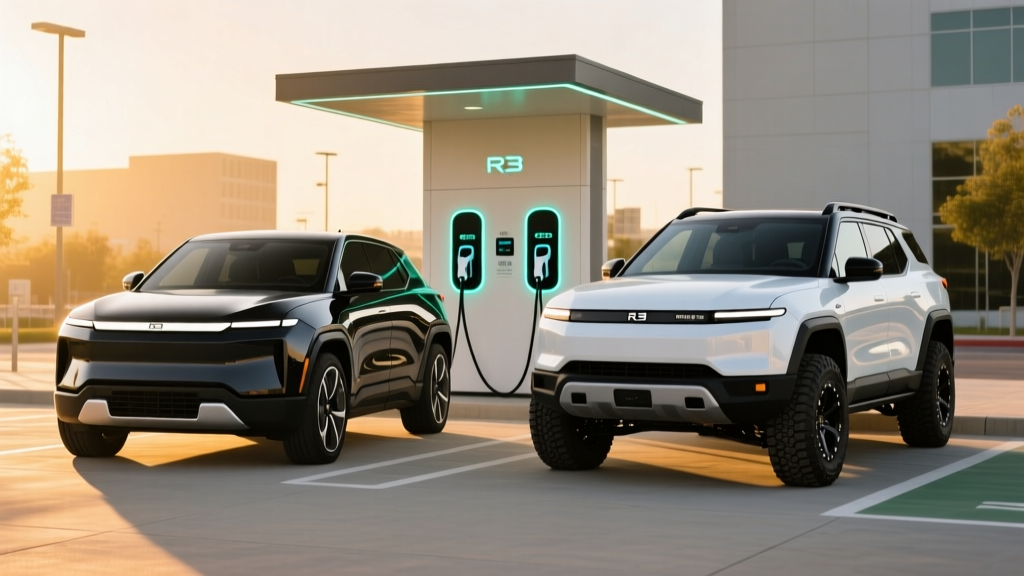
If you've been searching for "rx3 rivian," you're almost certainly looking for the Rivian R3 and its more rugged sibling, the R3X. Rivian has not released a model badged "RX3"; the R3 and R3X are the brand's upcoming compact electric crossover lineup, positioned below the R1S and R1T and aimed squarely at buyers who want Rivian's design language and adventure DNA in a smaller, more affordable package. As of 2026, the R3 is still in the pre-production/early-delivery phase, so the figures below are based on Rivian's most recent announced specifications and should be treated as preliminary until EPA certification and customer deliveries ramp up.
What the 'RX3 Rivian' Actually Is
Rivian unveiled the R3 family in March 2024 alongside the larger R2. The R3 is a compact, two-row electric crossover roughly the size of a Subaru Crosstrek or Mazda CX-5, while the R3X is a more off-road-oriented variant with higher ground clearance, more rugged body cladding, and likely a dual-motor AWD standard. Both ride on a new, smaller platform that shares Rivian's core electrical architecture with the R1 and R2 but is optimized for lower cost and higher production volume at Rivian's Normal, Illinois facility.
The confusion around "RX3" is understandable: Rivian's naming (R1S, R1T, R2, R3, R3X) doesn't follow the usual alphanumeric luxury-car logic, and the R3X badge is easy to misremember as "RX3." For this review, we'll cover both the R3 and R3X wherever data diverges.
Preliminary Specs: Rivian R3 / R3X at a Glance
| Spec | R3 (Standard / Long Range) | R3X |
|---|---|---|
| EPA Range (est.) | ~270 mi / ~330+ mi | ~300+ mi |
| Battery (usable, est.) | ~75 kWh / ~100 kWh | ~100 kWh |
| Chemistry | LFP (Standard) / NMC (Long Range) | NMC |
| Drivetrain | Single-motor FWD or Dual-motor AWD | Dual-motor AWD (Tri-motor possible) |
| Horsepower (est.) | ~280 hp / ~450 hp (AWD) | ~500+ hp |
| 0-60 mph (est.) | ~7.0s / ~4.5s (AWD) | ~3.5s |
| Peak DC Fast Charge | ~175-200 kW | ~200 kW |
| 10-80% DCFC (est.) | ~25-30 min | ~28-32 min |
| Level 2 Home Charge | ~11.5 kW (~35 mi/hr) | ~11.5 kW (~35 mi/hr) |
| Base MSRP (est.) | ~$45,000 / ~$52,000 | ~$55,000+ |
| Federal Tax Credit (§30D) | Likely eligible — subject to sourcing rules | Likely eligible — subject to sourcing rules |
Range and Efficiency: EPA Estimates vs. Real-World Expectations
Rivian has been conservative with its range claims on past models — the R1S and R1T generally met or slightly exceeded EPA stickers in mixed driving. The R3's smaller frontal area and lighter weight should help, but the boxy, adventure-oriented design still carries more drag than a sleek sedan. Expect efficiency in the neighborhood of 28-32 kWh/100 mi (roughly 100-120 MPGe combined) for the Long Range AWD, with the Standard Range FWD potentially reaching 120-130 MPGe.
The R3X, with its larger all-terrain tires, lifted suspension, and added weight, will trade range for capability. If you're planning regular off-road use or towing (expect a ~1,500-2,000 lb tow rating), subtract another 30-40% from the sticker range under load.
Charging: DC Fast, Level 2, and Connector Details
Rivian has standardized on the NACS (Tesla-style) connector across its entire lineup starting with the R2, and the R3/R3X will follow. That means native access to the Tesla Supercharger network (over 25,000 stalls in North America as of 2026) without an adapter — a major practical advantage over CCS-equipped competitors still reliant on adapters or Electrify America's sparser network.
| Charging Level | Power / Rate | Time / Miles Added |
|---|---|---|
| Level 1 (120V household) | ~1.4 kW | ~4-5 mi/hr |
| Level 2 (240V home, 48A) | ~11.5 kW | ~35 mi/hr; full charge ~9-10 hrs |
| DC Fast Charge (peak) | ~175-200 kW | 10-80% in ~25-32 min |
| DC Fast (sustained avg) | ~120-140 kW avg | ~180-220 mi in 30 min |
Remember: kW is power (how fast energy flows), kWh is energy (how much the battery holds). A 200 kW peak doesn't mean you charge at 200 kW the whole session — the charge curve tapers significantly above 80% State of Charge to protect battery health. That's why 10-80% time is the more useful metric, and ~25-32 minutes for the R3 family is competitive with the Hyundai Ioniq 5 and VW ID.4, though not class-leading (the Ioniq 5's 800V architecture still edges it out at ~18 minutes).
For home charging, a 48-amp Level 2 wall connector on a 60-amp circuit will fully replenish the Long Range battery overnight. Budget $800-$2,000 for installation depending on your panel capacity and run length — and confirm with a licensed electrician whether your home's 200-amp service can support it without an upgrade.
Performance and Drivetrain
The R3 will offer multiple powertrain configurations. The entry-level Standard Range is expected to use a single front motor with ~280 hp, adequate for commuting and light adventure use. The Long Range AWD adds a rear motor for ~450 combined hp and a ~4.5-second 0-60 time — quick for a compact crossover and more than enough for highway merging and mountain passes.
The R3X is the performance-and-capability halo: likely a dual-motor setup with ~500+ hp and a sub-4-second 0-60, plus Rivian's software-controlled torque vectoring, tank-turn capability (braking one side to pivot tightly), and the brand's signature quad-motor option if Rivian carries it down from the R1 platform. Ground clearance should exceed 8.5 inches, with approach/departure angles competitive with the Subaru Crosstrek Wilderness.
All versions will feature Rivian's latest Driver+ ADAS, which is an SAE Level 2 driver-assistance system — not self-driving. You must keep your hands on the wheel and eyes on the road. It includes adaptive cruise, lane centering, and automatic lane changes on mapped highways, similar in capability to Ford BlueCruise or GM Super Cruise but without the hands-free marketing.
Interior, Cargo, and Tech
The R3's cabin follows Rivian's minimalist, materials-forward approach: recycled microfiber, vegan leather, and real wood accents. Expect a 15-inch center touchscreen running Rivian's in-house OS (no Apple CarPlay or Android Auto — Rivian has stuck with its native software, which is a pro or con depending on your phone integration preference), a digital driver display, and a panoramic glass roof.
Cargo space is estimated at ~25 cubic feet behind the rear seats and ~55-60 cubic feet with seats folded — competitive with the Mazda CX-5 and larger than the Volvo EX30. A modest front trunk (frunk) of ~5-7 cubic feet adds space for charging cables or groceries. Rear legroom should land around 38-39 inches, adequate for adults on moderate trips.
Unique R3X features will likely include integrated roof-rail tie-downs, a built-in air compressor (a Rivian tradition), a tailgate work surface, and optional camp-kitchen integration. The R3 will also support V2L (vehicle-to-load), letting you power devices or small appliances from the traction battery — useful for camping or emergency backup.
Pricing, Trims, and Federal Tax Credit Eligibility
Rivian has targeted a starting MSRP of approximately $45,000 for the R3 Standard Range, with the Long Range AWD around $52,000 and the R3X starting near $55,000-$58,000. Fully optioned R3X models could push past $65,000.
Under current IRS §30D federal tax credit rules (as of 2026), new EVs can qualify for up to $7,500, but eligibility is complex:
- MSRP cap: SUVs/pickups must be under $80,000; sedans under $55,000. The R3 family, classified as an SUV/crossover, clears this easily.
- Buyer income cap: AGI must not exceed $150,000 (single), $225,000 (head of household), or $300,000 (joint).
- Battery sourcing: The $7,500 credit splits into two halves — $3,750 for critical-mineral sourcing and $3,750 for battery-component assembly, both with escalating domestic-content thresholds through 2026. Rivian's US-built vehicles and LG-Samsung battery partnerships position them well, but final credit amounts depend on the specific model year's sourcing certification.
- Point-of-sale transfer: Qualified buyers can apply the credit as an upfront discount at purchase rather than waiting for tax filing.
Always verify current-year eligibility at IRS.gov and consult a tax professional — rules tighten annually on critical-mineral and component sourcing.
Warranty and Ownership
Rivian's current warranty structure includes a 5-year/60,000-mile bumper-to-bumper warranty and an 8-year/175,000-mile battery and drive-unit warranty, with a guaranteed minimum capacity retention of 70% over that period. Expect the R3 to follow the same or a very similar structure. Rivian also offers mobile service for many repairs and a growing network of dedicated service centers, though coverage in rural areas still lags legacy brands.
Insurance costs for Rivian vehicles have historically run 15-25% above comparable ICE crossovers due to repair complexity and parts pricing. Get quotes before committing — your mileage will vary significantly by state, age, and driving record.
Who the R3 / R3X Is For — and Who Should Look Elsewhere
Pros, Cons, and Key Competitors
Pros
- Native NACS connector — full Supercharger access
- Class-leading off-road capability (especially R3X)
- Rivian's design, materials, and software UX
- V2L and adventure-ready features (frunk, air compressor, camp integration)
- Strong projected range on Long Range variants
- Likely §30D credit eligible at most trims
Cons
- Not yet in customer hands — deliveries expected late 2026
- No Apple CarPlay or Android Auto
- Peak DC charge rate (~200 kW) lags 800V competitors
- Rivian service network still expanding
- R3X pricing may push past $60k as-tested
- Insurance premiums likely above segment average
Frequently Asked Questions
What is the real-world range of the Rivian R3?
The R3 Long Range targets 330+ miles EPA, but expect ~270-290 miles on highway trips and ~220-250 miles in cold weather. The Standard Range LFP version (~270 mi EPA) will deliver ~215-240 miles in real-world highway use.
How fast does the R3 charge at home and on DC fast chargers?
At home on a 48A Level 2 charger (~11.5 kW), expect ~35 miles of range per hour and a full overnight charge. On DC fast chargers, peak rate is ~175-200 kW with a 10-80% session taking approximately 25-32 minutes.
Does the Rivian R3 qualify for the $7,500 federal tax credit?
It is expected to qualify, as MSRP is well under the $80,000 SUV cap and Rivian's US production and battery sourcing align with §30D requirements. However, final credit amount ($3,750 or $7,500) depends on the specific model year's critical-mineral and component-sourcing certification. Verify at IRS.gov.
Is the R3 worth buying vs. the Tesla Model Y, Ioniq 5, or VW ID.4?
The R3 wins on off-road capability, adventure features, and design differentiation. The Model Y still wins on charging infrastructure breadth and efficiency, the Ioniq 5 on DC charge speed and interior space, and the ID.4 on value and availability. If you need a car today, those are all buyable now; if you can wait and want trail-ready, the R3/R3X is compelling.
Is the Rivian R3 self-driving?
No. Rivian's Driver+ is an SAE Level 2 driver-assist system — you must remain engaged with hands on the wheel and eyes on the road at all times. It is not autonomous.
What's the difference between the R3 and R3X?
The R3 is the standard compact crossover, optimized for daily driving with optional AWD. The R3X is the off-road/performance variant with standard AWD (possibly tri-motor), more ground clearance, all-terrain tires, rugged body cladding, and adventure-specific features.
When can I actually buy the Rivian R3?
Rivian targets late 2026 for initial R3 deliveries, with broader availability into 2027. Reservations are open on Rivian's website with a refundable deposit.
Sources: Rivian official announcements (rivian.com), EPA fuel economy data (fueleconomy.gov), IRS clean vehicle credit guidance (irs.gov). All figures preliminary and subject to change at production.