Quick Verdict: A Compact Electric SUV Built for More Than Commuting
The 2026 Rivian R2 arrives as the brand's most accessible vehicle — a compact electric SUV slotting below the R1S in size and price, but carrying over much of the engineering DNA that made Rivian's larger vehicles compelling. For buyers researching the Rivian R2 towing capacity, payload numbers, and real-world utility, this is the profile you need before placing a reservation. The R2 targets buyers who want electric-adventure capability without the R1S's $75,000+ starting price, and it largely delivers — with some compromises worth understanding upfront.
Production began in early 2026 at Rivian's Normal, Illinois facility, with the first dual-motor variants reaching driveways by mid-year. Single-motor (rear-wheel-drive) trims follow later in the model year. Here's everything we know from confirmed specs, early testing, and manufacturer data.
Rivian R2 Core Specifications
| Specification | Dual Motor AWD | Single Motor RWD |
|---|---|---|
| Base MSRP | $52,900 | $45,900 (est. late 2026) |
| EPA Est. Range | 330 miles | 340 miles (preliminary) |
| Battery Capacity | ~85 kWh usable (NMC) | ~85 kWh usable (NMC) |
| Horsepower | ~450 hp | ~300 hp |
| 0-60 mph | ~4.5 sec | ~6.5 sec (est.) |
| Max Towing Capacity | 3,300 lbs | 3,300 lbs |
| Max DC Fast Charge | ~200 kW (peak) | ~200 kW (peak) |
| 10-80% DC Charge Time | ~24 min | ~24 min |
| Level 2 Home Charging | ~11.5 kW (~37 mi/hr) | ~11.5 kW (~37 mi/hr) |
| Drivetrain | Dual Motor AWD | Single Motor RWD |
| Battery/Powertrain Warranty | 8 yr / 100,000 mi | 8 yr / 100,000 mi |
Sources: Rivian R2 official page, manufacturer press materials. Single-motor figures are preliminary estimates pending EPA certification.
Rivian R2 Towing Capacity: What 3,300 Pounds Actually Gets You
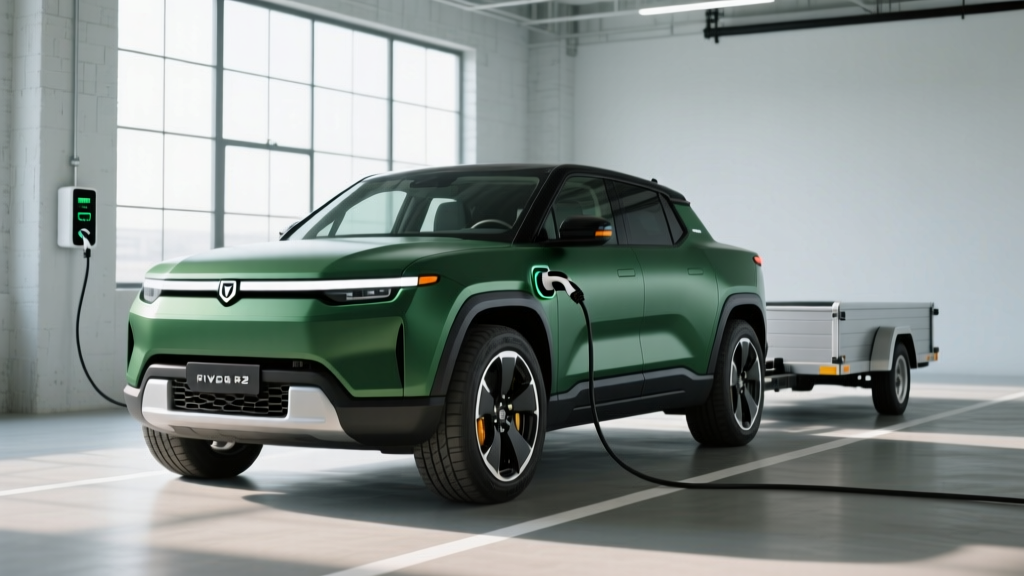
The confirmed Rivian R2 towing capacity is 3,300 pounds across all announced trims when equipped with the factory tow package. This number places the R2 squarely in compact-SUV territory — comparable to the Tesla Model Y's 3,500-lb rating and well above most electric crossovers in this price range, but significantly below the R1S's 7,700-lb maximum.
What can you realistically tow at 3,300 lbs?
- Light utility trailers (5x8 or 6x10 open trailers loaded with landscaping equipment, motorcycles, or ATV/UTVs)
- Small teardrop or pop-up campers (models like the NuCamp TAB 320, Scamp 13', or Aliner Classic typically weigh 1,800-2,800 lbs loaded)
- Jet Skis or small boat packages (a dual personal watercraft on a single-axle trailer typically runs 2,200-2,900 lbs)
- Horse trailers — single horse only (a lightweight single-horse trailer with one average-size horse can approach 2,800-3,200 lbs, but you'll be near the limit)
What it cannot tow: conventional travel trailers over ~19 feet, most A-frame campers loaded for a week, dual-axle boat trailers with larger watercraft, or any multi-horse trailer. Buyers who need 5,000+ lbs of towing must look at the R1S, Ford F-150 Lightning, or Rivian R1T.
Towing's Impact on Range: The Real Numbers
EPA Sticker: 330 miles (Dual Motor AWD)
Real-World Expectations:
- Unladen highway driving (70-75 mph): ~265-285 miles
- City/suburban mixed driving: ~295-320 miles
- Cold weather (below 30°F), unladen: ~230-265 miles
- While towing near max capacity: ~150-190 miles (expect a 40-55% range reduction)
Towing any EV near its maximum rating dramatically increases energy consumption due to aerodynamic drag and rolling resistance. Plan charging stops every 120-150 miles when towing for a comfortable buffer.
Battery, Charging Speed & Infrastructure
The R2 uses an NMC (nickel manganese cobalt) lithium-ion battery pack with approximately 85 kWh of usable capacity. Rivian has not released cell-level chemistry specifics beyond confirming NMC chemistry, chosen for its energy density advantage over LFP in a package-constrained compact SUV platform. The pack sits within Rivian's updated skateboard architecture, which is lighter and uses fewer parts than the R1 generation.
Charging Speed Breakdown
| Charging Method | Power / Rate | Time / Range Added |
|---|---|---|
| Level 1 (120V household) | ~1.4 kW | ~5 miles per hour |
| Level 2 (240V home/public) | ~11.5 kW | ~37 miles per hour; 0-100% in ~8 hours |
| DC Fast Charge (peak) | ~200 kW | 10-80% in ~24 min; ~140 mi in 15 min |
Charging curve reality check: The 200 kW peak rate is not sustained across the full session. Expect peak speeds between 10-40% State of Charge (SoC), tapering to ~120 kW by 60% and further to ~50-60 kW above 80%. This is standard behavior for NMC packs protecting cell longevity. If you're road-tripping and only charging to 80%, the ~24-minute figure holds. Charging from 80-100% on DC fast charging adds another 30-40 minutes — plan accordingly and skip the top-off unless you need maximum range for the next leg.
The R2 ships with a NACS (North American Charging Standard) port, giving native access to the Tesla Supercharger network — now the largest and most reliable DC fast-charging network in the US. CCS adapter support is also available for Electrify America and other networks.
Home Charging Setup
Rivian offers a Wall Charger rated at up to 11.5 kW (48 amps on a 60-amp circuit). A full overnight charge from near-empty takes approximately 8 hours, meaning most owners will wake up to a full battery every morning with typical daily driving of 30-60 miles. Installation costs for a Level 2 home charger typically range from $500-$2,500 depending on panel capacity, run length, and local permit requirements. Homes with 100-amp electrical panels may need a $1,500-$3,000 panel upgrade to support a dedicated 60-amp EV circuit — get a quote from a licensed electrician before purchasing.
Performance, Efficiency & Drivetrain
The dual-motor AWD R2 produces approximately 450 horsepower, delivering a 0-60 mph time of roughly 4.5 seconds. That's quick for a compact SUV and puts it in the same performance tier as the BMW iX xDrive50 and Audi Q8 e-tron, though the R2 undercuts both on price significantly. The single-motor RWD variant, arriving later in 2026, targets around 300 hp with a ~6.5-second 0-60 — adequate for commuting and merging but noticeably less sporty.
Both configurations use Rivian's updated drive unit design, which is smaller, lighter, and more energy-efficient than the R1 generation motors. The AWD system provides torque vectoring across the front and rear axles, improving traction on loose surfaces — a meaningful advantage for the adventure-oriented buyers Rivian courts.
Efficiency Figures
EPA efficiency for the Dual Motor AWD is rated at approximately 112 MPGe combined (roughly 30 kWh/100 miles). This is competitive with the Tesla Model Y Long Range (117 MPGe) and meaningfully better than larger electric SUVs like the R1S or BMW iX. The R2's relatively low curb weight for an EV (estimated ~4,800 lbs for the dual-motor) contributes to its efficiency advantage over heavier competitors.
For cost context: at the US average electricity rate of ~$0.16/kWh (per EIA data), driving 100 miles costs approximately $4.80. The equivalent 100 miles in a 28-MPG gas SUV at $3.40/gallon costs $12.14 — a savings of roughly $7.34 per 100 miles driven electric.
Interior Space, Cargo & Technology
The R2 seats five passengers across two rows. Rivian has prioritized interior volume efficiency, packaging the cabin to maximize usable space within a compact exterior footprint.
- Cargo volume (rear seats up): ~28 cu ft
- Cargo volume (rear seats folded): ~63 cu ft
- Front trunk (frunk): ~11 cu ft (lockable, drainable for gear storage)
- Rear legroom: ~38 inches
- Front headroom: ~41 inches (panoramic glass roof reduces headroom slightly vs. conventional roof)
The frunk is a standout feature — at 11 cu ft, it fits a full duffel bag or a set of charging cables and emergency supplies while keeping the main cargo area free for larger items. Rivian's drainable frunk design (inherited from the R1S/R1T) doubles as a cooler for tailgating or muddy gear storage after outdoor adventures.
Tech & Driver Assistance
The R2 features a 15.6-inch central touchscreen running Rivian's latest infotainment software, a 10.25-inch digital instrument cluster, and a head-up display. Wireless Apple CarPlay and Android Auto are standard. Over-the-air (OTA) updates continue to add features post-delivery, as they do across the Rivian fleet.
The driver-assistance suite, branded Rivian Driver+, includes adaptive cruise control with stop-and-go, lane-centering assist, automatic emergency braking, blind-spot monitoring, and rear cross-traffic alert. An available Highway Assist mode provides hands-on-wheel lane-centering on divided highways.
SAE Automation Level: Level 2. Rivian Driver+ and Highway Assist require continuous driver supervision — hands on the steering wheel, eyes on the road. This is not autonomous or self-driving capability. Only Level 4 services like Waymo operate without a driver engaged. Never disengage your attention while using Level 2 driver-assist features.
Pricing, Trims & Federal Tax Credit Eligibility
The 2026 Rivian R2 launches in two primary configurations:
| Trim | MSRP | Est. Price After §30D Credit | Availability |
|---|---|---|---|
| Dual Motor AWD (Standard) | $52,900 | ~$45,400* | Mid-2026 deliveries |
| Dual Motor AWD (Adventure) | $57,900 | ~$50,400* | Mid-2026 deliveries |
| Single Motor RWD | $45,900 (est.) | ~$38,400* (est.) | Late 2026 |
*After-tax-credit pricing assumes full §30D eligibility. Actual credit amount varies. See eligibility checklist below.
Federal EV Tax Credit (§30D) Eligibility Checklist
The R2 is expected to qualify for up to $7,500 in federal tax credits under IRS §30D, but eligibility depends on several buyer- and vehicle-specific factors. Per IRS guidelines, you must meet all of the following:
- MSRP cap: Vehicle base price must not exceed $80,000 for SUVs (R2 qualifies — all trims are well under this cap)
- Buyer income limits: Modified AGI must not exceed $150,000 (single), $225,000 (head of household), or $300,000 (joint filers) — based on current or prior tax year, whichever is lower
- Battery sourcing: Minimum percentages of critical minerals and battery components must be sourced from US or free-trade-agreement countries — Rivian has indicated the R2 meets current thresholds, but final certification is per VIN at time of delivery
- Final assembly: Vehicle must be assembled in North America (R2 is built in Normal, Illinois — qualifies)
- Point-of-sale transfer: As of 2024+, buyers may transfer the credit to the dealer at purchase, receiving it as an immediate price reduction rather than waiting to claim it on their tax return
Tax credit caveat: Credit eligibility rules change periodically and depend on your individual tax situation, the specific VIN's battery sourcing documentation, and current IRS guidance. Consult a tax professional and verify eligibility at fueleconomy.gov before finalizing your purchase. Rivian dealers can confirm credit transfer availability at point of sale.
How the R2 Compares to Key Competitors
| Attribute | Rivian R2 Dual Motor | Tesla Model Y LR AWD | Hyundai Ioniq 5 AWD | Ford Mustang Mach-E ER AWD |
|---|---|---|---|---|
| Base MSRP | $52,900 | $48,590 | $54,150 | $53,975 |
| EPA Range | 330 mi | 320 mi | 290 mi | 312 mi |
| Towing Capacity | 3,300 lbs | 3,500 lbs | 2,300 lbs | 2,200 lbs |
| 0-60 mph | ~4.5 sec | 4.8 sec | 5.1 sec | 5.1 sec |
| Max DC Charge | ~200 kW | 250 kW | 240 kW | 150 kW |
| Cargo (seats up) | 28 cu ft | 30 cu ft | 27 cu ft | 29.7 cu ft |
| Frunk | 11 cu ft | 4.1 cu ft | 2.0 cu ft | 4.7 cu ft |
| NACS Native | Yes | Yes | Adapter needed | Adapter needed |
Choose the Rivian R2 if:
- You want the best frunk and adventure-oriented storage in the segment
- Towing 3,000+ lbs matters (campers, utility trailers, personal watercraft)
- Off-road and all-weather capability is a priority (Rivian's AWD system and ground clearance lead this group)
- You value build quality and interior materials over the lowest possible price
Choose the Tesla Model Y if:
- Lowest purchase price and widest Supercharger access are your top priorities
- You want the fastest DC charging speed in this segment (250 kW peak)
- Cargo volume with seats up matters more than frunk space
Choose the Hyundai Ioniq 5 if:
- 800V ultra-fast charging infrastructure near you supports its 240 kW capability
- Striking retro-futuristic design appeals to you
- V2L (vehicle-to-load) power output is a must-have feature
Pros, Cons & Who Should Buy
Pros
- 330-mile EPA range is competitive and practical for road trips
- 3,300-lb towing capacity exceeds most compact electric SUVs
- Largest frunk in the segment (11 cu ft, drainable)
- Native NACS port — no adapter needed for Supercharger access
- Adventure-ready AWD system with strong ground clearance
- Strong build quality and premium interior materials
- OTA updates and growing feature set post-delivery
Cons
- Base price is higher than the Model Y by ~$4,300
- 200 kW peak DC charging trails Tesla (250 kW) and Hyundai (240 kW)
- Towing near max capacity cuts range by 40-55% — plan charging carefully
- Single-motor RWD variant not available until late 2026
- No third-row seating option (R1S remains the family hauler)
- Rivian's service center network is still expanding — rural owners may face longer service trips
Who the R2 Suits Best
- Outdoor enthusiasts: The frunk, AWD capability, and 3,300-lb towing make this ideal for hauling teardrop campers, bikes, kayaks, and trail gear on weekend trips.
- Two-adult households with active lifestyles: Five seats and generous cargo space handle daily life, but the R2 shines when the cargo area is loaded with gear.
- Buyers stepping up from a RAV4, Forester, or Outback: The R2 occupies the same "adventure compact" niche but with zero tailpipe emissions and dramatically lower fueling costs.
- Commuters with home charging: 330 miles of range means most owners charge once or twice a week, and Level 2 home charging covers daily needs completely.
The R2 is not ideal for large families needing three rows, buyers who tow heavy boat or horse trailers regularly, or those who prioritize the absolute lowest purchase price above all else.
Warranty & Long-Term Ownership
Rivian covers the R2 with the following warranty structure:
- Battery & Drive Units: 8 years / 100,000 miles (whichever comes first)
- Vehicle Limited Warranty: 5 years / 60,000 miles
- Corrosion Perforation: 12 years, unlimited miles
The battery warranty guarantees that the pack will retain a minimum percentage of its original capacity (typically 70% or above, per Rivian's R1 precedent) throughout the coverage period. NMC chemistry in Rivian's thermal management system has shown strong degradation performance in R1 vehicles — most R1S and R1T owners report less than 5% capacity loss after 60,000+ miles, based on fleet data shared in owner forums and Rivian's own communications.
Long-term battery replacement cost, should it be needed out of warranty, is estimated at $12,000-$18,000 for the R2's ~85 kWh pack — though prices continue to decline as cell manufacturing scales. Most owners will never need a pack replacement within the vehicle's useful life.
Frequently Asked Questions
What is the Rivian R2 towing capacity?
The 2026 Rivian R2 has a maximum towing capacity of 3,300 pounds across all trims when properly equipped with the factory tow package. This covers small campers, utility trailers, personal watercraft, and light cargo trailers — but not large travel trailers or multi-horse trailers.
What is the real-world range of the Rivian R2?
The EPA rates the Dual Motor AWD R2 at 330 miles. In real-world highway driving at 70-75 mph, expect approximately 265-285 miles. In cold weather (below 30°F), range drops to roughly 230-265 miles unladen. While towing near the 3,300-lb maximum, plan for 150-190 miles between charges.
How fast does the R2 charge at home and on the road?
On a Level 2 home charger (240V, 48A), the R2 charges at ~11.5 kW, adding about 37 miles of range per hour and reaching a full charge in approximately 8 hours. On DC fast charging, it peaks at ~200 kW and charges from 10-80% in about 24 minutes under ideal conditions.
Does the Rivian R2 qualify for the $7,500 federal tax credit?
The R2 is expected to qualify for up to $7,500 under IRS §30D, as it is assembled in Illinois (North American final assembly), priced well under the $80,000 SUV MSRP cap, and Rivian has indicated battery sourcing compliance. However, individual eligibility depends on buyer income limits ($150K single / $300K joint), and final per-VIN certification. Verify with your tax professional and the dealer at point of sale.
How does the R2 compare to the Tesla Model Y for towing?
The Tesla Model Y has a slightly higher maximum towing capacity (3,500 lbs vs. 3,300 lbs) and faster DC charging (250 kW vs. ~200 kW). However, the R2 offers a significantly larger frunk (11 cu ft vs. 4.1 cu ft), more robust AWD capability for off-pavement use, and a more premium interior. For pure towing, the difference of 200 lbs is negligible — both handle small campers and utility trailers comfortably.
Is the Rivian R2 worth buying over the competition?
If you prioritize adventure capability, frunk storage, and build quality, the R2 is a strong choice despite its higher starting price. If lowest cost and fastest charging are your top criteria, the Model Y remains the value leader. Test-driving both is the best way to decide — the R2's driving dynamics and interior feel are distinct from Tesla's minimalist approach.
When can I get a Rivian R2?
Dual Motor AWD deliveries began in mid-2026. The Single Motor RWD variant is expected in late 2026. Reservation holders receive priority; new orders are subject to production queue timing. Check Rivian's R2 page for current estimated delivery windows.