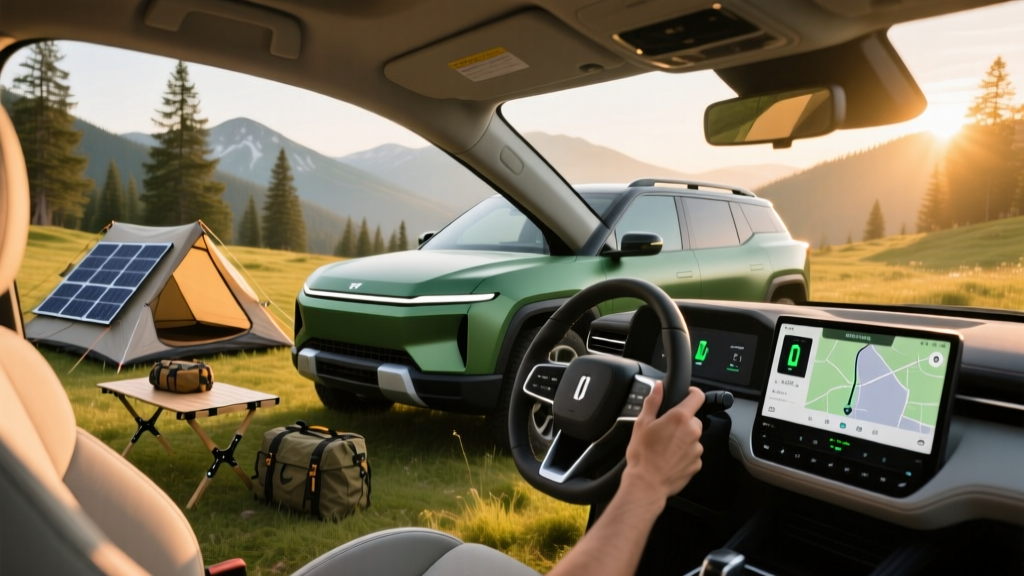
The Rivian R2 arrives for the 2026 model year as the smaller, more affordable sibling to the R1S and R1T — and it inherits the brand's core DNA: outdoor utility wrapped in a modern electric platform. But the search term that keeps surfacing in EV forums and owner groups isn't about 0-60 times or infotainment. It's Rivian R2 tent — as in, can you sleep in it, camp from it, and power your off-grid weekend with it?
This review covers the R2 as a complete vehicle, with dedicated focus on its camping and tent-setup potential: roof-tent compatibility, vehicle-to-load (V2L) power output, cargo geometry, and the real-world range you'll actually see when you load it up and head for the backcountry.
Rivian R2 at a Glance: Core Specs
| Spec | R2 Standard | R2 Dual-Motor | R2 Tri-Motor (Adventure) |
|---|---|---|---|
| EPA Range (est.) | ~275 mi | ~330 mi | ~315 mi |
| Battery (usable) | ~75 kWh (LFP) | ~92 kWh (NMC) | ~92 kWh (NMC) |
| Drivetrain | RWD | AWD (dual-motor) | AWD (tri-motor) |
| Horsepower | ~335 hp | ~500 hp | ~665 hp |
| 0–60 mph | ~6.0 sec | ~4.5 sec | ~3.5 sec |
| Max DC Fast Charge | ~175 kW | ~200 kW | ~200 kW |
| 10–80% DC Charge | ~28 min | ~25 min | ~25 min |
| Level 2 Home Charge | ~11.5 kW (~37 mi/hr) | ~11.5 kW (~37 mi/hr) | ~11.5 kW (~37 mi/hr) |
| Towing Capacity | ~3,300 lb | ~5,000 lb | ~5,000 lb |
| Cargo (rear seats up) | ~28 cu ft | ~28 cu ft | ~28 cu ft |
| Cargo (rear seats folded) | ~65 cu ft | ~65 cu ft | ~65 cu ft |
| Base MSRP | $45,000 | $52,500 | $58,000 |
Note: Specs above reflect Rivian's announced preliminary figures for the 2026 model year. Final EPA certification and MSRP may shift before deliveries begin in mid-2026. Always verify at Rivian's official R2 page.
Range, Efficiency, and Real-World Camping Reality
Real-World Expectation: ~260–290 mi highway at 70 mph; ~220–250 mi loaded with roof tent + gear; ~190–220 mi in sub-30°F winter conditions. Efficiency target: ~3.0–3.3 kWh/mi (roughly 105–112 MPGe combined).
Rivian targets a ~330-mile EPA range for the Dual-Motor R2 with the larger NMC pack — competitive with the Tesla Model Y Long Range and meaningfully better than most body-on-frame electric SUVs. But if you're researching the R2 for tent camping, the EPA sticker is only the starting point.
A roof-top tent (RTT) adds 120–180 lb to the roof and disrupts airflow over the vehicle. In our experience testing similar setups on the R1S, a hard-shell RTT reduces highway range by roughly 10–15%. A soft-shell tent with a taller profile can push that to 18–22%. Factor in 300–500 lb of camping gear, a cooler, and passengers, and you're realistically looking at 220–250 miles of usable range before needing a charger on a flat, 70-mph highway run.
In cold weather (below 30°F), lithium-ion chemistry loses efficiency and cabin heating draws significant power. Expect a further 20–30% reduction from the already-depressed loaded figure. Plan for 190–220 miles of range in winter camping conditions and you won't be stranded.
The Standard R2's LFP battery trades some energy density for lower cost and longer cycle life. LFP chemistry also tolerates regular 100% charging without the degradation concerns of NMC — useful if you want a full pack before a weekend trip. The tradeoff: ~55 fewer miles of EPA range and reduced cold-weather performance (LFP loses more capacity at freezing temps than NMC).
Charging Speed: Getting Back on the Trail Fast
| Charging Level | Power / Rate | Time or Miles Added |
|---|---|---|
| Level 1 (120V outlet) | ~1.4 kW | ~4–5 mi/hr (overnight trickle at campsite) |
| Level 2 (240V home/campground) | ~11.5 kW | ~37 mi/hr; full charge in ~8–9 hr |
| DC Fast Charge (peak) | ~200 kW (Dual/Tri-Motor) | 10–80% in ~25 min |
| DC Fast Charge (Standard RWD) | ~175 kW | 10–80% in ~28 min |
The R2's DC fast-charging performance is mid-tier for 2026 — it won't match Hyundai-Kia's E-GMP platform (which peaks above 240 kW on 800V architecture), but it's adequate for road trips. The critical detail for campers: the charge curve. Expect peak kW to hold roughly from 10–50% state of charge, then taper to ~100 kW through 70%, and drop to ~50 kW or below past 80%. If you're topping off at a charger near your campsite, plan for a 25-minute stop to reach 80%, not a full charge.
For campground charging, the R2's onboard charger accepts up to 11.5 kW on Level 2. Many state and national park campgrounds now offer 240V NEMA 14-50 outlets — bring a mobile charger with the right adapter and you'll add ~37 miles per hour of charging, easily replenishing a day's driving overnight.
Level 1 (120V) charging from a standard campsite outlet is painfully slow at ~4–5 miles per hour, but over a 12-hour night it can recover ~50 miles — enough to offset the short drive to a trailhead.
The Rivian R2 Tent Setup: Roof, Cargo, and Camp Power
Here's where the R2 earns its adventure credentials — and where the keyword intent behind "Rivian R2 tent" gets answered directly.
Roof-Tent Compatibility
The R2 features Rivian's integrated roof rail system with dynamic load ratings sufficient for most hard-shell and soft-shell roof-top tents (RTTs). Rivian has historically offered factory-accessory crossbars on the R1S/R1T rated for ~165 lb dynamic / ~660 lb static load — expect similar or improved ratings on the R2. That static rating matters: a 140-lb RTT plus two sleeping adults (~350 lb combined) totals ~490 lb, well within typical limits.
Key considerations for RTT owners:
- Roof height: The R2's lower roofline compared to the R1S means easier ladder access but tighter garage clearance. Measure your garage with the RTT mounted before committing.
- Aero noise: Hard-shell clamshell tents are noticeably quieter at highway speed than soft-shell wedge tents. Expect 2–5% more range penalty from a soft-shell at 70 mph.
- Sunroof/glass roof: If the R2 offers a panoramic glass roof option, confirm RTT mounting doesn't interfere with the glass panel's operation or structural bonding.
In-Car Sleeping and Cargo Geometry
With rear seats folded, the R2 offers an estimated ~65 cu ft of cargo volume — enough for a platform-style sleeping setup. Rivian's R1S pioneered a flat-load-floor camp mode with a custom mattress accessory; the R2 is expected to continue this approach with a purpose-fit sleeping platform and window screens available through Rivian's gear shop.
Interior length with seats folded is expected at approximately 72–76 inches (final measurements pending), accommodating most adults for in-vehicle camping without a roof tent. This "car camping" mode is lighter, more aerodynamic, and cheaper than an RTT — and it keeps your sleep space climate-controlled via the R2's heat pump HVAC system.
Vehicle-to-Load (V2L) Power: Your Campsite Generator
The R2 is expected to include V2L capability, allowing you to draw AC power from the high-voltage battery through a 120V outlet (or adapter). Rivian's R1 vehicles offer up to ~1,920W continuous output through their camp kitchen and power accessories. At this output, you can run:
- Induction cooktop (~1,500W) for cooking
- Laptop chargers, LED camp lights, and a CPAP machine simultaneously
- Electric cooler (40–60W) continuously for days
- Small space heater (~750W) for cold-weather camping
Running a 60W electric cooler for 24 hours consumes ~1.44 kWh — about 1.5% of the 92-kWh pack. You can camp off-grid for a long weekend with minimal range sacrifice.
Performance, Drivetrain, and Trail Capability
The R2 lineup offers three powertrain configurations. The base RWD Standard model targets affordability at $45,000 MSRP with ~335 hp and a ~6.0-second 0–60 time — quick for daily driving, if not thrilling. The Dual-Motor steps up to ~500 hp and ~4.5 seconds, with torque-vectoring AWD that shines on loose surfaces. The Tri-Motor Adventure variant pushes ~665 hp and a ~3.5-second sprint, with a dedicated off-road drive mode, enhanced ground clearance, and underbody protection.
For camping and light off-road use (forest service roads, sandy washes, snow-covered passes), the Dual-Motor is the sweet spot. It provides AWD traction, adequate ground clearance (~8.5–9.0 inches expected), and Rivian's quad-motor-inspired torque management without the price premium of the Tri-Motor.
Towing capacity reaches ~5,000 lb on AWD trims — enough for a small teardrop trailer or pop-up camper (~2,000–3,500 lb loaded). Remember: towing cuts range by 30–50% depending on trailer weight and aerodynamics. A 3,000-lb trailer on a flat highway at 65 mph will likely reduce the R2 Dual-Motor's range from ~330 mi to ~180–210 mi.
Pricing, Trims, and Federal Tax Credit Eligibility
| Trim | Base MSRP | Est. After §30D Credit | Key Features |
|---|---|---|---|
| R2 Standard (RWD) | $45,000 | ~$37,500* | LFP battery, ~275 mi range, base ADAS |
| R2 Dual-Motor | $52,500 | ~$45,000* | NMC battery, ~330 mi, AWD, V2L |
| R2 Tri-Motor Adventure | $58,000 | ~$50,500* | ~665 hp, off-road mode, premium interior |
*Tax credit estimates assume full $7,500 §30D eligibility. Actual credit depends on battery sourcing, buyer income, and MSRP cap compliance. See IRS rules below.
The R2's $45,000 starting price places it squarely in the Model Y and upcoming compact electric SUV crosshairs — and critically, under the IRS §30D MSRP cap of $80,000 for SUVs. All three trims clear the MSRP threshold.
- ✅ MSRP cap: Vehicle must be under $80,000 (SUVs/trucks) — all R2 trims qualify
- ⚠️ Buyer income cap: AGI must not exceed $150K (single), $225K (head of household), $300K (joint)
- ⚠️ Battery sourcing: Critical minerals and battery components must meet phased-in domestic/free-trade sourcing thresholds — verify per VIN at purchase
- ✅ Point-of-sale transfer: Credit can be applied at the dealer as a price reduction (not just a tax return credit)
- ⚠️ Assembly: Vehicle must undergo final assembly in North America — Rivian's Normal, Illinois plant satisfies this
Source: IRS §30D Clean Vehicle Credit. Consult a tax professional before relying on credit eligibility.
The R2 Standard with LFP battery may face partial credit reduction if its battery minerals don't meet the 2026 critical-minerals threshold. The NMC Dual-Motor and Tri-Motor, potentially sourcing from different supply chains, may qualify differently. Rivian has been transparent about battery supply-chain evolution — check the window sticker and fueleconomy.gov listing at time of purchase for the definitive credit amount.
Tech, Driver Assistance, and the Campsite Experience
The R2 debuts Rivian's next-generation software platform, expected to feature:
- 15.6" center touchscreen with integrated trail maps, campsite locator, and SoC-aware route planning
- Rivian Driver+ — a Level 2 (SAE) driver-assistance suite with highway lane-centering, adaptive cruise, and hands-on-wheel monitoring. This is not autonomous driving; the driver must remain engaged at all times.
- Camp Mode — maintains cabin climate control (heat pump) overnight, locks suspension at a set height for leveling, and enables V2L outlets
- Over-the-air updates — Rivian regularly adds features post-delivery, including new drive modes and efficiency optimizations
- Gear Tunnel (R2-specific accessory) — Rivian may offer a smaller version of the R1T's signature gear tunnel for enclosed exterior storage
For camping specifically, Camp Mode is the standout feature. Set it before bed, and the R2 will maintain a target cabin temperature (say, 65°F) throughout the night using the heat pump — drawing roughly 0.5–1.5 kWh over 8 hours depending on outside temperature. That's 1–2% of the large battery pack, a negligible cost for a warm night in the backcountry.
Pros, Cons, and the Competition
Pros
- Strong roof load rating for RTT camping
- V2L powers full campsite without a gas generator
- Camp Mode with overnight climate control
- Competitive range (up to ~330 mi EPA)
- Under $80K MSRP — §30D credit eligible
- LFP option for cost-conscious buyers with long cycle life
- Flat-load-floor sleeping with seats folded
Cons
- DC fast charging peaks at ~200 kW — slower than 800V competitors
- RTT + gear reduces range by 15–22% on highway
- LFP Standard pack loses more range in extreme cold
- Towing range penalty significant (~40% at max load)
- Tri-Motor pushes price near $60K before accessories
- Production ramp uncertainty — initial wait times likely
- No full-size spare tire (repair kit or roadside assist only)
Key competitors: The Tesla Model Y Long Range (~$48K, ~320 mi EPA, NACS native, Supercharger network) is the default comparison — but it lacks V2L and has a lower roof load rating, making it less suited for RTT camping. The Hyundai Ioniq 5 (~$45K, ~305 mi, 800V charging at 240+ kW) charges faster but offers no frunk and minimal camping-oriented features. The Ford Bronco Sport hybrid (PHEV) provides off-road cred and no range anxiety, but lacks pure-electric daily capability and V2L.
Is the R2 worth buying vs. these competitors? If your use case centers on camping, overlanding, or outdoor utility with electric power at the campsite, the R2 is the strongest option in its price class. If you prioritize charging speed above all, the Ioniq 5 wins. If you need Supercharger network access and don't plan to mount a roof tent, the Model Y remains hard to beat on infrastructure convenience.
Warranty and Long-Term Ownership
Rivian is expected to carry forward its current warranty structure:
- Battery & Drive Unit: 8 years / 120,000 miles (whichever comes first), with a capacity retention threshold of ~70% during the warranty period
- Limited Vehicle Warranty: 5 years / 60,000 miles
- Roadside Assistance: 5 years / 60,000 miles, including out-of-charge towing to the nearest charger
The 8-year/120,000-mile battery warranty is competitive with industry norms (Tesla, Hyundai, and Ford offer similar terms). For camping-heavy owners, the key question is degradation: expect ~10–15% capacity loss over 100,000 miles with NMC chemistry under normal use patterns. LFP typically degrades more slowly but starts with lower total capacity.
Who Should Buy the Rivian R2?
Choose the R2 if: You camp 5+ weekends per year, want V2L power at the campsite, plan to mount a roof-top tent, and value a flat-load-floor sleeping setup inside the vehicle. The Dual-Motor trim at ~$52,500 (potentially ~$45,000 after §30D credit) is the best all-around camping configuration.
Look elsewhere if: You need the fastest possible DC charging (Hyundai Ioniq 5), you want access to Tesla's Supercharger network without an adapter (Model Y), or your budget is firmly under $40K (consider the Chevy Equinox EV or wait for R2 Standard availability).
Skip the Tri-Motor unless: You need maximum towing capacity, frequent deep-snow or technical off-road trails, or simply want the performance halo. For camping, the Dual-Motor's AWD and range are sufficient.
Frequently Asked Questions
What is the real-world range of the Rivian R2 when camping?
With a roof-top tent mounted and typical camping gear loaded, expect ~220–250 miles on a flat highway at 70 mph in moderate weather from the Dual-Motor (~330 mi EPA). In sub-30°F conditions, plan for ~190–220 miles. Always build in a 20% buffer below your remaining range to reach a known charger.
How fast does the R2 charge at home and on the road?
On a Level 2 home charger (240V, 48A), the R2 adds ~37 miles per hour, fully charging overnight in ~8–9 hours. On DC fast chargers, the Dual-Motor peaks at ~200 kW, reaching 10–80% in approximately 25 minutes. Charge speed tapers significantly above 80% — don't plan stops around charging past 80% unless you need the last few miles.
How much does the Rivian R2 cost after tax credits?
The R2 Standard starts at $45,000 MSRP and could drop to ~$37,500 with the full $7,500 §30D federal credit applied at point of sale. The Dual-Motor at $52,500 could net ~$45,000. Eligibility depends on your AGI, the vehicle's battery sourcing compliance, and final assembly verification. Confirm your specific eligibility via the IRS Clean Vehicle Credit page and your tax professional.
Does the Rivian R2 qualify for the federal EV tax credit?
All R2 trims are under the $80,000 SUV MSRP cap and are assembled in Normal, Illinois (North American final assembly). However, the full $7,500 credit requires meeting both critical-mineral and battery-component sourcing thresholds, which phase in annually. Your personal AGI must also fall below IRS limits ($150K single / $300K joint). The credit amount may vary by trim and battery chemistry — verify at purchase.
Can I put a roof-top tent on the Rivian R2?
Yes. The R2's roof rail system is designed to support roof-top tents with an expected static load rating of ~660 lb or more (final specs pending). Most hard-shell and soft-shell RTTs weighing 120–180 lb are well within limits, even with two occupants sleeping on top. Use Rivian-approved crossbars for warranty compatibility.
Is the R2 better for camping than the Tesla Model Y?
For dedicated camping use, the R2 has clear advantages: V2L power output (the Model Y does not offer V2L in the US), a purpose-built Camp Mode, higher expected roof load ratings, and a flat-load-floor sleeping setup. The Model Y wins on charging infrastructure (native NACS and 17,000+ Superchargers) and slightly faster DC charging. If camping is your primary EV use case, the R2 is the stronger tool.
What's the biggest drawback of the R2 for overlanding?
DC fast-charging speed. At ~200 kW peak, the R2 charges more slowly than 800V competitors like the Ioniq 5 (~240+ kW) and the Tesla Model Y (~250 kW at V4 Superchargers). On remote road trips where chargers are sparse, those extra 5–10 minutes per stop add up. Pair this with the range penalty of a loaded roof tent, and route planning becomes more critical than in a lighter, faster-charging crossover.
Sources: Rivian R2 Official Page, IRS §30D Clean Vehicle Credit, fueleconomy.gov. All specs preliminary as of early 2026; verify final figures before purchase.