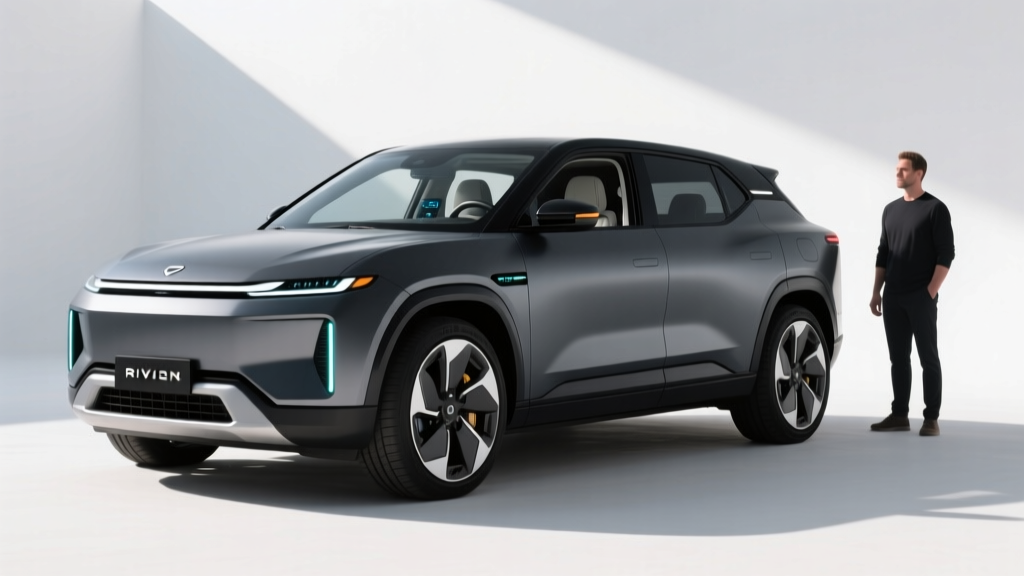
Rivian's R1S proved the brand can build a compelling three-row electric SUV, but its $75,000+ starting price locked out most buyers. The Rivian R2 arrives as the answer: a smaller, more affordable compact electric SUV built on an entirely new platform at Rivian's upcoming Georgia production facility. If you've been searching for details on the Rivian R2 size, range, and real-world usability, this profile covers every confirmed spec, pricing tier, and ownership consideration you need before reservations convert to deliveries.
As of early 2026, Rivian has published preliminary specifications and begun the reservation-to-order pipeline. Below, we break down what's confirmed, what's estimated, and where the R2 fits against the Tesla Model Y, Hyundai Ioniq 5, and Ford Mustang Mach-E.
Rivian R2 Dimensions: How It Sizes Up
The R2 slots below the R1S in Rivian's lineup, targeting the compact luxury EV SUV segment. Rivian has confirmed the R2 rides on a shorter wheelbase and narrower track than the R1S, prioritizing urban maneuverability and lower manufacturing cost while retaining signature Rivian design cues like the stadium headlights and gear-tunnel-inspired storage.
| Vehicle | Length (in) | Width (in) | Wheelbase (in) | Est. Curb Weight (lbs) |
|---|---|---|---|---|
| Rivian R2 (2026) | ~183 | ~76 | ~113 | ~4,600 |
| Rivian R1S (2025) | 200.8 | 81.8 | 121.1 | ~6,800 |
| Tesla Model Y (2025) | 187.0 | 75.6 | 113.8 | ~4,400 |
| Hyundai Ioniq 5 (2025) | 182.7 | 74.4 | 118.1 | ~4,500 |
At roughly 183 inches long, the R2 is slightly shorter than the Model Y but wider than the Ioniq 5. The shorter wheelbase compared to the R1S trims turning radius, making it better suited for tight city parking. Rivian hasn't published exact cargo volume yet, but based on the platform dimensions, expect approximately 28–32 cubic feet behind the second row and 60+ cubic feet with seats folded — competitive with the Model Y's ~30 cu ft rear cargo area (plus the Model Y's front trunk).
Interior space note: The R2 is strictly a two-row, five-passenger SUV. Rivian has confirmed the R2 will not offer a third row, unlike the R1S. Rear legroom is estimated at 38–40 inches, adequate for adults on longer trips. Headroom benefits from the skateboard platform's flat floor, which eliminates the transmission tunnel hump found in converted ICE architectures.
Range, Battery, and Real-World Efficiency
Rivian has confirmed the R2 will use a next-generation battery pack with an estimated usable capacity of approximately 85 kWh. The base configuration uses LFP (lithium iron phosphate) chemistry for the Standard Range model, while the Long Range variant is expected to use an NMC (nickel manganese cobalt) pack for higher energy density.
EPA Range vs. Real-World Expectation
EPA estimated range: Up to 330 miles (Long Range AWD, preliminary)
Real-world expectation: Plan for 270–300 miles in mixed highway/city driving at moderate temperatures. Highway-only driving at 75+ mph typically reduces range 10–15% below EPA. In sub-freezing winter conditions (below 30°F), expect a 20–30% reduction, bringing effective range to roughly 230–265 miles. The LFP Standard Range model (EPA est. ~260 miles) will see winter range drop to approximately 180–210 miles.
The LFP vs NMC distinction matters for long-term ownership:
| Factor | LFP (Standard Range) | NMC (Long Range) |
|---|---|---|
| Energy density | Lower (heavier pack for same kWh) | Higher (more range in lighter pack) |
| Charge to 100% daily? | Yes — LFP tolerates full SoC well | No — daily limit 80% recommended |
| Cold-weather performance | Greater range loss in freezing temps | Better low-temp energy delivery |
| Cycle life | 3,000+ cycles typical | 1,500–2,000 cycles typical |
| Cobalt/nickel sourcing | None — simpler supply chain | Requires critical mineral sourcing |
Efficiency target: Rivian hasn't published official MPGe figures, but based on the R2's weight and aero profile, expect approximately 110–120 MPGe combined (roughly 28–31 kWh/100 miles) for the AWD Long Range. This trails the Ioniq 5's 114 MPGe but is in the same neighborhood as the Model Y Long Range AWD at ~117 MPGe. Check fueleconomy.gov once EPA certifies the R2 for official numbers.
Charging Speed: DC Fast Charge and Home Level 2
Charging speed is where the R2's new platform should deliver meaningful gains over the first-generation R1S/R1T architecture. Rivian has confirmed the R2 supports NACS (North American Charging Standard) natively — no adapter required — granting direct access to Tesla's Supercharger network, the most reliable DC fast-charging network in the U.S.
| Charging Level | Power / Rate | Speed / Time |
|---|---|---|
| Level 1 (120V household) | ~1.4 kW | ~3–4 miles per hour |
| Level 2 (240V home, 48A) | ~11.5 kW | ~33–37 miles per hour (~9 hrs for 10–80%) |
| DC Fast Charge (peak) | Up to ~220 kW | 10–80% in approximately 22–25 minutes |
| DC Fast Charge (sustained avg) | ~150 kW average | ~200 miles added in 20 minutes |
Charging curve reality check: The "up to 220 kW" peak rate applies only between roughly 10–35% state of charge. Above 50%, the charge rate tapers significantly — expect 80–100 kW through the 50–70% range, and below 50 kW past 80%. This is standard for all lithium-ion packs to protect cell longevity. For road trips, plan stops around the 20–80% window to maximize time at peak charging speed.
Home charging setup: A Level 2 home charger (like the Rivian Wall Connector or a ChargePoint Home Flex) on a 60-amp circuit delivers ~11.5 kW, replenishing the R2's full battery overnight in about 8–9 hours. Most owners who charge nightly at home will rarely need public charging except on road trips. Budget $500–$1,500 for professional Level 2 installation depending on your electrical panel capacity and run distance — a 200-amp panel upgrade can add $1,500–$3,000 if needed.
Performance and Drivetrain
Rivian has confirmed the R2 will offer multiple drivetrain configurations, continuing the brand's dual-motor and tri-motor philosophy but adapted for the compact platform:
- Dual-Motor AWD (base): ~350 horsepower, 0–60 mph in approximately 5.5 seconds. This is the volume seller, balancing performance and efficiency.
- Performance Dual-Motor AWD: ~500 horsepower, 0–60 mph in approximately 3.8 seconds. Targets buyers who want Model Y Performance-level acceleration.
- Single-Motor RWD (planned): ~280 horsepower, 0–60 mph in approximately 6.5 seconds. Lowest price point, maximum efficiency, best range.
All configurations use Rivian's in-house-developed drive units. The dual-motor models feature torque vectoring between front and rear axles, which improves both on-road handling and off-road traction. Yes — the R2 retains meaningful off-road capability, with Rivian confirming approach/departure angles competitive with the Subaru Outback Wilderness, though ground clearance is lower than the R1S at approximately 8.0 inches.
Towing: Rivian has targeted a 3,500-pound maximum towing capacity for the dual-motor AWD, sufficient for a small camper trailer, a pair of dirt bikes, or a light boat. This trails the R1S's 7,700-pound rating but matches the segment norm for compact SUVs. Keep in mind that towing at max capacity will cut range roughly in half — plan for 150–170 miles between charging stops when towing.
Pricing, Trims, and Federal Tax Credit Eligibility
The R2's pricing is the headline. Rivian has announced a base MSRP starting at $45,000 for the single-motor RWD (when it becomes available), with the dual-motor AWD starting at approximately $52,000 and the Performance variant near $58,000.
| Trim | Base MSRP | Est. Federal Credit (§30D) | Effective Price |
|---|---|---|---|
| Single-Motor RWD | $45,000 | Up to $7,500* | ~$37,500 |
| Dual-Motor AWD | $52,000 | Up to $7,500* | ~$44,500 |
| Performance AWD | $58,000 | Up to $7,500* | ~$50,500 |
*Federal tax credit eligibility caveats (2026 IRS §30D rules):
- MSRP cap: SUVs must be below $80,000 MSRP — all R2 trims qualify.
- Buyer income cap: Modified AGI must not exceed $150,000 (single), $225,000 (head of household), or $300,000 (joint). Above these thresholds, you are ineligible.
- Battery sourcing requirements: The credit is split into two $3,750 halves — one for critical minerals sourcing and one for battery component manufacturing. The LFP Standard Range model (using iron and phosphate, primarily sourced from China) may face challenges meeting the critical-minerals requirement depending on supply-chain shifts by delivery date. The NMC Long Range variant has a clearer path to the full $7,500 if Rivian sources nickel and cobalt from FTA-partner nations.
- Point-of-sale transfer: As of 2024, you can transfer the credit to the dealer at purchase, reducing your out-of-pocket cost immediately rather than waiting for a tax refund.
For the latest eligibility rules, always verify with the IRS clean vehicle credit page before placing an order. Battery sourcing requirements tighten annually, and a vehicle that qualifies in January may not in December.
Tech, Driver Assistance, and Interior Features
The R2 debuts Rivian's next-generation software stack, running on a centralized compute architecture that reduces wiring harness weight and enables faster over-the-air updates. Key technology features include:
- 15.4-inch center touchscreen with a redesigned Rivian OS — faster response, better navigation with integrated charging route planning.
- Driver+ ADAS: Rivian's Level 2 driver-assistance system (SAE Level 2 — not self-driving; hands-on-wheel supervision required at all times). Includes adaptive cruise control, lane-centering, automatic emergency braking, and blind-spot intervention.
- Highway Assist (expected): A hands-on, eyes-on lane-centering + adaptive cruise feature for interstate driving, similar in concept to Ford BlueCruise or GM Super Cruise but requiring continuous driver engagement.
- Camp Kitchen and gear-tunnel accessories: Rivian has hinted at a scaled-down version of the R1T's gear tunnel for the R2, potentially accessible from the rear cargo area, plus compatibility with the Rivian Camp Kitchen (sold separately).
- V2L (Vehicle-to-Load): Confirmed — the R2 can power external devices (laptops, camp appliances, power tools) via built-in 120V/240V outlets, a Rivian brand staple.
SAE Automation Level Reminder
The Rivian R2's Driver+ and Highway Assist systems are SAE Level 2 — partial driving automation. The driver must remain fully attentive, keep hands on the steering wheel (or demonstrate engagement per system prompts), and be prepared to take over instantly. This is fundamentally different from SAE Level 4 driverless systems like Waymo, which operate without any human driver in geofenced areas. No consumer vehicle sold in 2026 offers Level 3 or above without significant geographic or conditional restrictions.
Warranty Coverage
Rivian is expected to carry forward warranty terms similar to the R1S/R1T, which are competitive with the EV segment standard:
- Battery pack: 8 years / 100,000 miles (minimum 70% capacity retention guaranteed)
- Drive units (powertrain): 8 years / 100,000 miles
- Bumper-to-bumper: 5 years / 60,000 miles
- Roadside assistance: 5 years / 60,000 miles
The 70% capacity retention threshold is standard across the industry (Tesla, Hyundai, Ford all use similar benchmarks). In practice, modern EV battery packs — especially LFP chemistry — typically retain 85–90% capacity at 100,000 miles under normal use. The warranty protects against the outlier case of accelerated degradation. Rivian's battery replacement cost out of warranty is not yet published for the R2, but industry benchmarks for packs in the 80–90 kWh range fall between $12,000 and $18,000 including labor — a figure worth considering if you plan to own the vehicle well past the warranty period.
Who the Rivian R2 Is For — and Who Should Look Elsewhere
Choose the Rivian R2 if:
- You want an adventure-capable compact EV SUV with genuine off-road chops and V2L for camping or job-site use.
- You prefer a brand outside the Tesla ecosystem and value Rivian's design language and community.
- You need a NACS-native vehicle for seamless Supercharger access without adapters.
- Five-passenger seating is sufficient and you don't need a third row.
- You can charge at home and your daily commute is under 80 miles round-trip.
Look elsewhere if:
- You need three rows — the R1S, Kia EV9, or Hyundai Ioniq 9 are better fits.
- You want the longest possible range for under $50K — the Hyundai Ioniq 6 (361 mi EPA) or Tesla Model Y Long Range may edge out the R2.
- You can't install a home charger and rely entirely on public infrastructure in a charging-desert area.
- You need immediate delivery — R2 production ramps through 2026, and early reservation holders get priority.
Pros, Cons, and the Competitive Verdict
Pros
- Adventure-ready design with real ground clearance and V2L
- NACS native — no adapter for Superchargers
- LFP battery option for daily 100% charging without degradation worry
- Strong estimated range (330 mi Long Range) for the segment
- Qualifies for up to $7,500 federal credit (trim/sourcing dependent)
- Competitive starting price at $45,000 base
Cons
- Two-row only — no third-row option
- New Georgia production facility — early-production ramp risk
- LFP Standard Range may not qualify for full $7,500 credit due to mineral sourcing
- Rivian service center network still expanding in many states
- Final EPA certification and real-world range TBD at launch
- Towing limited to ~3,500 lbs (half the R1S)
Competitive verdict: The R2 enters one of the most competitive segments in the EV market. Against the Tesla Model Y, the R2 trades some efficiency and Supercharger network maturity (Tesla still has the edge in reliability per J.D. Power and PlugShare data) for better build quality perception, more adventurous design, and V2L capability. Against the Hyundai Ioniq 5, the R2 offers more ground clearance and off-road potential but likely at a slight efficiency penalty. The Ford Mustang Mach-E undercuts on price in some trims but lacks the R2's NACS-native charging and adventure features.
If you're placing a reservation, prioritize the dual-motor AWD Long Range for the best balance of range, performance, and tax-credit eligibility. The single-motor RWD is the value play but will arrive later in the production cycle and may face sourcing challenges for the full credit.
Frequently Asked Questions
What is the real-world range of the Rivian R2?
The EPA-estimated range for the Long Range AWD is approximately 330 miles (preliminary). In real-world mixed driving, expect 270–300 miles. Highway-only driving at 75+ mph reduces this to roughly 250–280 miles, and winter conditions below 30°F can drop range to 230–265 miles. The LFP Standard Range model (est. 260 miles EPA) will deliver approximately 180–210 miles in cold weather.
How fast does the Rivian R2 charge?
On a DC fast charger, the R2 peaks at approximately 220 kW and charges from 10–80% in about 22–25 minutes. Sustained average rate is around 150 kW. At home on a Level 2 charger (240V, 48A), it charges at ~11.5 kW, adding about 33–37 miles of range per hour — a full overnight charge replenishes the battery in roughly 8–9 hours.
How much does the Rivian R2 cost after tax credits?
The dual-motor AWD starts at approximately $52,000 MSRP. If you qualify for the full $7,500 federal tax credit under IRS §30D (income below $150K single / $300K joint, and battery sourcing requirements met), the effective price drops to roughly $44,500. The base single-motor RWD at $45,000 could reach as low as $37,500 with the credit, though LFP battery sourcing may limit eligibility to $3,750 (half credit) depending on supply-chain compliance at time of delivery.
Is the Rivian R2 worth buying vs. the Tesla Model Y or Hyundai Ioniq 5?
It depends on your priorities. The R2 excels if you want adventure capability, distinctive design, NACS-native charging, and V2L functionality. The Model Y still wins on efficiency, Supercharger reliability, and software polish. The Ioniq 5 wins on 800V ultra-fast charging (10–80% in ~18 min) and interior space relative to its footprint. Test-drive all three before deciding — the R2's ride quality and build perception may sway you, but only once reviewer drive impressions are published post-launch.
What are the biggest pros and cons of the Rivian R2?
Top pros: NACS-native charging, V2L capability, LFP battery option, genuine off-road clearance, competitive pricing, strong estimated range. Top cons: no third row, new factory ramp-up risk, limited Rivian service network in some regions, LFP trims may not get full tax credit, final EPA numbers not yet certified.
Does the Rivian R2 qualify for the federal EV tax credit?
It is expected to qualify, but with important caveats. All trims fall under the $80,000 SUV MSRP cap. Buyer income must not exceed $150,000 (single) or $300,000 (joint filing). The $7,500 credit is split into two $3,750 components — one for battery component manufacturing and one for critical minerals sourcing. The NMC Long Range model has the strongest path to the full credit. The LFP Standard Range model's eligibility depends on iron/phosphate sourcing from FTA-partner countries at time of delivery. Always verify current eligibility at irs.gov before ordering.
When can I actually buy the Rivian R2?
Rivian targets production start in the first half of 2026 at its new Georgia facility, with initial deliveries to reservation holders. General retail availability will follow as production ramps. If you haven't placed a reservation, expect delivery timelines stretching into late 2026 or early 2027 depending on demand and production yield.