The Rivian R2 is the brand's long-awaited compact electric SUV, designed to bring Rivian's adventure-oriented formula to a more accessible price point. Announced in early 2024 with production targeted for the first half of 2026 at Rivian's Normal, Illinois facility, the R2 has generated intense interest — particularly around its interior packaging, seat configuration, and how it compares to the Tesla Model Y and Hyundai Ioniq 5 on space and comfort. This profile breaks down everything confirmed about the R2's seating, cabin dimensions, powertrain, range, charging, and pricing, while flagging what remains preliminary ahead of first deliveries.
Rivian R2 Seat Layout and Interior Configuration
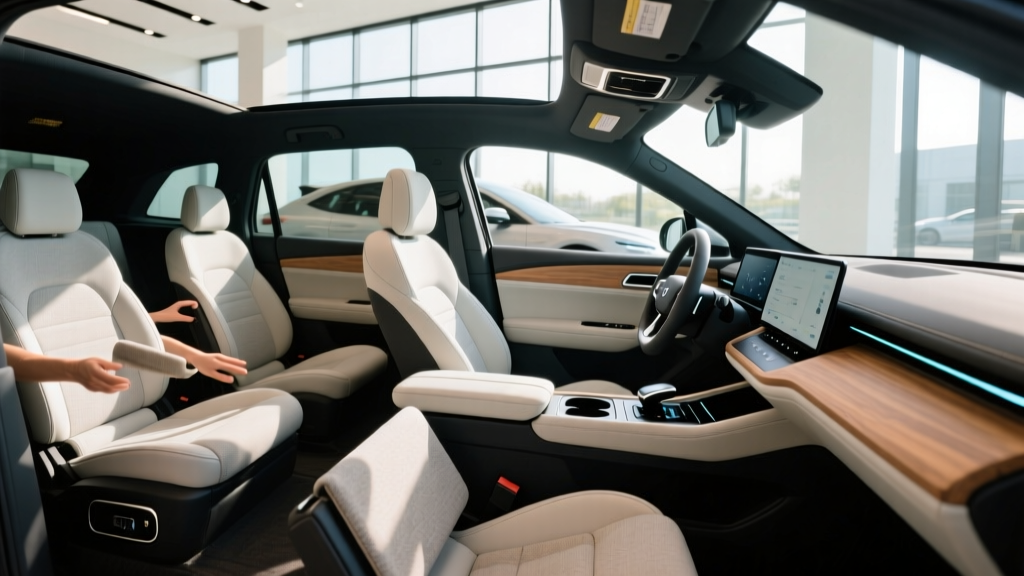
The most searched question around this vehicle is the Rivian R2 seat configuration. Unlike the three-row R1S, the R2 is a compact two-row SUV with seating for five passengers. Rivian has confirmed a 2+3 seating layout — two front seats and a three-passenger second-row bench. There is no third-row option, which is a deliberate choice to keep the vehicle's footprint compact (approximately 185 inches in length) while maximizing cargo versatility.
Key interior dimensions and seat features based on Rivian's published specifications and preview events:
- Front headroom: ~40.5 inches (estimated, competitive with Model Y's 40.9 in)
- Front legroom: ~41.5 inches (estimated)
- Rear legroom: ~38 inches (estimated — a notable improvement over the R1S's tight second row)
- Rear seat fold: 60/40 split-folding rear bench, creating a near-flat load floor
- Front seat features: Heated front seats standard; ventilated front seats available on higher trims; heated rear seats expected on Premium/Adventure trims
- Upholstery: Vegan leatherette standard; no animal-derived leather offered, consistent with Rivian's brand positioning
The rear seat is a particular area of focus for R2 shoppers cross-shopping the Tesla Model Y. The Model Y's second row is notoriously upright with limited thigh support. Rivian's preview materials suggest a more reclined seat-back angle and improved cushion length in the R2, though we'll reserve final judgment until extended seat-time in a production vehicle.
Cargo Space, Frunk, and the Gear Tunnel
Rivian made its name on clever storage, and the R2 continues that tradition with several cargo areas:
- Rear cargo (behind second row): Approximately 26–28 cubic feet (estimated, pending final certification)
- Maximum cargo (rear seats folded): Approximately 60–65 cubic feet (estimated)
- Front trunk (frunk): Yes — Rivian has confirmed a front trunk, a feature absent from the R1S but expected on the R2 thanks to its dedicated mid-size platform
- Gear Tunnel: The R2 features a smaller version of Rivian's signature Gear Tunnel — a pass-through storage compartment accessible from either side of the vehicle, ideal for long items like skis, fishing rods, or camping gear
- Camp Kitchen compatibility: Rivian has hinted at accessory compatibility, though the R2's smaller tunnel may require a redesigned, compact Camp Kitchen module
For context, the Tesla Model Y offers 30.2 cu ft behind the second row and 76.2 cu ft with seats folded (Tesla Model Y specs). The R2 sacrifices some maximum cargo volume to accommodate the Gear Tunnel and a more compact exterior footprint.
Battery, Range, and Powertrain Specifications
The R2 rides on Rivian's new mid-size platform, distinct from the R1T/R1S architecture. Rivian has confirmed multiple battery and motor configurations:
| Specification | Standard Range | Large Battery | Max Pack (if offered) |
|---|---|---|---|
| Battery capacity (usable) | ~65 kWh (est.) | ~85 kWh (est.) | ~100 kWh (est.) |
| Battery chemistry | LFP (Lithium Iron Phosphate) | NMC (Nickel Manganese Cobalt) | NMC |
| EPA range (target) | ~270 mi | 330+ mi | ~380 mi (est.) |
| Drivetrain | RWD or Dual-Motor AWD | Dual-Motor AWD | Dual-Motor or Tri-Motor AWD |
| Horsepower | ~280 hp (RWD) / ~450 hp (AWD) | ~450–500 hp | ~600+ hp (Tri-Motor) |
| 0–60 mph | ~6.5 sec (RWD) / ~4.5 sec (AWD) | ~4.0 sec | ~3.0 sec |
| Efficiency (target) | ~3.0–3.2 mi/kWh | ~3.3–3.5 mi/kWh | TBD |
| MPGe (est. combined) | ~105–110 MPGe | ~115–120 MPGe | TBD |
LFP vs. NMC — what it means for R2 buyers: The Standard Range model is expected to use an LFP (lithium iron phosphate) battery. LFP cells offer excellent cycle life, tolerate regular 100% charging without accelerated degradation, and avoid cobalt — but they are heavier and have lower energy density than NMC. This means the Standard Range R2 will likely be slightly heavier and offer less range per kWh. The Large Battery and Max Pack models should use NMC chemistry for higher energy density, though Rivian recommends daily charging to 80–90% for long-term NMC health.
Real-world range caveat: The 330+ mile target for the Large Battery AWD is promising, but real-world highway driving at 75 mph typically yields 85–90% of EPA range. In cold weather (below 32°F), expect an additional 15–25% reduction due to cabin heating demand and reduced battery efficiency — bringing a 330-mile EPA rating down to roughly 225–260 miles in winter highway conditions. A heat pump is expected to be standard, which mitigates some cold-weather loss.
Charging Speed: DC Fast Charge and Home Level 2
Charging speed is often the deciding factor for EV buyers. Here's what Rivian has confirmed and what we can reasonably project based on the platform's 800V-class architecture:
| Charging Level | Power / Rate | Time / Miles Added |
|---|---|---|
| Level 1 (120V household) | ~1.4 kW | ~4–5 miles per hour of charging |
| Level 2 (240V home, 48A) | ~11.5 kW | ~32–38 miles per hour; full charge in ~8–9 hours (Large Battery) |
| DC Fast Charge (peak) | ~200–250 kW (peak, NACS connector) | 10–80% in approximately 20–25 minutes |
| DC Fast Charge (sustained) | ~150–180 kW average to 80% | ~180+ miles added in 15 minutes |
Charging curve reality: Like all EVs, the R2 will not sustain peak kW for the entire session. Expect peak charge rates in the 10–40% state-of-charge window, with a progressive taper above 60% and a significant slowdown above 80%. For road trips, the practical strategy is charging from 10–80% and driving on — a ~20–25 minute stop for the Large Battery pack.
Connector: The R2 will ship with the NACS (North American Charging Standard) connector natively, giving it direct access to Tesla's Supercharger network — now the largest and most reliable DC fast-charging network in the U.S. with over 25,000 stalls. This is a significant advantage over CCS-equipped vehicles that require adapters and may face limited CCS infrastructure in rural areas.
Home charging setup: Rivian is expected to offer a branded Wall Connector or recommend compatible Level 2 units (e.g., ChargePoint Home Flex, Emporia Vue). A 48-amp Level 2 charger on a 60-amp circuit will deliver roughly 32–38 miles of range per hour, meaning an overnight charge (8–10 hours) easily replenishes the Large Battery pack. Installation costs for a 240V/60A circuit typically range from $800–$2,500 depending on panel proximity and whether a panel upgrade (to 200A service) is needed.
Pricing, Trims, and Federal Tax Credit Eligibility
The R2's pricing is central to its value proposition. Rivian has targeted a starting MSRP around $45,000 for the base Standard Range RWD model, with higher trims and battery options pushing the price upward:
| Trim / Config | Est. Base MSRP | §30D Credit (max) | Est. Net Price |
|---|---|---|---|
| Standard Range RWD | $45,000 | Up to $7,500* | ~$37,500 |
| Standard Range AWD | $49,000 | Up to $7,500* | ~$41,500 |
| Large Battery AWD | $52,500 | Up to $7,500* | ~$45,000 |
| Adventure / Premium AWD | $57,000+ | Up to $7,500* | ~$49,500+ |
*Federal tax credit (§30D) eligibility caveats: The $7,500 credit is NOT guaranteed for every buyer. Under current IRS rules (IRS §30D guidelines), eligibility depends on:
- MSRP cap: SUVs must have a base MSRP at or below $80,000 — all R2 trims should clear this threshold
- Buyer income cap: Modified Adjusted Gross Income (MAGI) must not exceed $150,000 (single), $225,000 (head of household), or $300,000 (married filing jointly)
- Battery sourcing requirements: A percentage of critical minerals and battery components must be sourced from the U.S. or free-trade-agreement countries. These thresholds increase annually and could affect eligibility for certain battery packs — Rivian has not confirmed full compliance for all R2 configurations
- Point-of-sale transfer: As of 2024, buyers can transfer the credit to the dealer at purchase, reducing the purchase price directly rather than waiting for a tax refund
Consult a tax professional and check the latest IRS guidance before relying on the credit. State and local incentives may also apply — check AFDC's incentive database for your jurisdiction.
Technology, Driver Assistance, and Software
The R2 will feature Rivian's latest software stack, building on the well-reviewed system in the refreshed R1S and R1T:
- Infotainment: 15.6-inch center touchscreen running Rivian's proprietary OS, plus a smaller driver display. Wireless Apple CarPlay and Android Auto are expected, though Rivian has historically favored its native interface
- Driver assistance: Rivian's Driver+ suite includes adaptive cruise control, lane-centering assist, automatic emergency braking, blind-spot monitoring, and rear cross-traffic alert. This is an SAE Level 2 system — the driver must remain attentive with hands on or near the wheel at all times. It is NOT autonomous or self-driving
- Highway assist: An enhanced Highway Assist feature offers lane-centering on divided highways but does not support hands-free operation like GM's Super Cruise or Ford's BlueCruise
- Over-the-air updates: Full vehicle OTA capability for performance, software, and feature additions — a Rivian strength since launch
- Unique features: Expected to include the Rivian "Gear Guard" security camera system, camp mode (maintains cabin climate while parked), and pet mode. The R2 may also debut a new "Adventure Network" of curated trail and campsite routes integrated into the navigation system
Warranty Coverage
Rivian's warranty structure for the R2 is expected to mirror the R1 series:
- Battery warranty: 8 years / 175,000 miles (whichever comes first), with a minimum 70% capacity retention threshold — among the most generous mileage limits in the segment
- Powertrain warranty: 8 years / 175,000 miles
- Bumper-to-bumper: 5 years / 60,000 miles
- Roadside assistance: 5 years / 60,000 miles
The 175,000-mile battery warranty is a standout. For comparison, Tesla covers its Model Y battery for 8 years / 120,000 miles at 70% retention. The extra 55,000 miles of coverage on the Rivian provides meaningful peace of mind for high-mileage drivers and should support long-term resale value.
How the R2 Compares: Key Competitors
The compact electric SUV segment in 2026 is crowded. Here's how the R2 stacks up on paper against its primary rivals:
| Attribute | Rivian R2 (Large Battery AWD) | Tesla Model Y LR AWD | Hyundai Ioniq 5 AWD |
|---|---|---|---|
| EPA Range | 330+ mi (target) | 308 mi | 290 mi |
| Battery (usable) | ~85 kWh (est.) | 75 kWh | 77.4 kWh |
| Peak DC Charge | ~200–250 kW | ~250 kW | ~235 kW |
| 10–80% DCFC | ~20–25 min | ~20 min | ~18 min |
| 0–60 mph | ~4.0 sec | 4.8 sec | 4.5 sec |
| Cargo (rear seats up) | ~26–28 cu ft | 30.2 cu ft | 27.2 cu ft |
| Gear Tunnel / Frunk | Both | Frunk only | Frunk (small) |
| Base MSRP (AWD) | ~$49,000 | ~$48,990 | ~$50,500 |
| Battery Warranty | 8 yr / 175,000 mi | 8 yr / 120,000 mi | 10 yr / 100,000 mi |
The R2's projected range advantage and Gear Tunnel differentiate it for outdoor-oriented buyers, while the Model Y retains a cargo-volume edge and access to the most mature service network. The Ioniq 5's 800V architecture enables the fastest 10–80% charging times but trails on total range.
✅ Pros
- Class-leading target range (330+ mi) for the Large Battery AWD
- Gear Tunnel storage is unique in the segment — no competitor offers this
- Native NACS connector with full Supercharger access from day one
- 175,000-mile battery warranty exceeds Tesla and most rivals
- Strong off-road and adventure capability (ground clearance, approach/departure angles expected to lead segment)
- LFP option on Standard Range allows daily 100% charging without degradation concerns
❌ Cons
- Not yet in production — deliveries expected mid-2026; early buyers face ramp-up risk
- Rear cargo volume trails the Tesla Model Y
- No third-row option (by design, but limits family flexibility vs. R1S)
- Driver+ is competent but not class-leading — no hands-free highway mode like Super Cruise
- Rivian's service center network is still expanding; rural owners may face longer service travel
- Federal tax credit eligibility for specific battery packs not yet confirmed by IRS sourcing data
Who the Rivian R2 Is For
The R2 is best suited for buyers who:
- Outdoor enthusiasts: The Gear Tunnel, expected high ground clearance (~8.5+ inches), and available all-terrain tires make the R2 the segment's most trail-capable compact EV
- Two-row families: Five seats with a comfortable rear bench and ample cargo for weekend trips, sports gear, or groceries
- Range-prioritized commuters: The 330+ mile target means most daily commutes and errands require only 2–3 charges per week, even without home charging
- Current R1 owners downsizing: R1S/R1T owners who want a smaller daily driver with the same software ecosystem and Rivian brand experience
The R2 is less ideal for buyers who need three rows, prioritize maximum cargo volume (Model Y wins), want hands-free highway driving (look at GM Super Cruise vehicles), or need immediate availability with an established service network.
Frequently Asked Questions
What is the real-world range of the Rivian R2?
Rivian targets 330+ miles EPA for the Large Battery AWD. Real-world highway driving at 70–75 mph should yield approximately 270–300 miles in moderate temperatures, and 225–260 miles in cold winter conditions. The Standard Range model is expected to deliver roughly 220–250 real-world highway miles. Final EPA numbers will be confirmed before deliveries.
How fast does the R2 charge at home and on the road?
At home on a 240V Level 2 charger (48A), the R2 should add approximately 32–38 miles of range per hour, fully charging the Large Battery overnight in about 8–9 hours. On DC fast chargers, peak rates of 200–250 kW should deliver a 10–80% charge in approximately 20–25 minutes, though sustained rates taper above 60% SoC.
Does the Rivian R2 qualify for the $7,500 federal EV tax credit?
It likely will for most trims, but eligibility is not guaranteed. The R2's MSRP is well under the $80,000 SUV cap. Buyer income must fall under IRS MAGI limits ($150K single / $300K married filing jointly). Battery critical-mineral and component sourcing requirements must also be met — Rivian has not confirmed compliance for all pack configurations. Always verify current eligibility at IRS.gov and consult a tax professional.
Is the Rivian R2 worth buying vs. the Tesla Model Y?
If you prioritize range, adventure features (Gear Tunnel, ground clearance), a more comfortable rear seat, and a native NACS connector, the R2 is a compelling alternative. If you need maximum cargo space, the most mature service and Supercharger network, and immediate availability, the Model Y remains the benchmark. The R2's 175,000-mile battery warranty also provides stronger long-term coverage.
How many seats does the Rivian R2 have?
The Rivian R2 has five seats in a 2+3 configuration — two front seats and a three-passenger second-row bench. There is no third-row option. The rear seat features a 60/40 split-fold for cargo flexibility.
When will the Rivian R2 be available to buy?
Rivian has targeted the first half of 2026 for the start of R2 production at its Normal, Illinois factory. Reservation holders will receive deliveries first, with general availability expected to follow. Exact timing may shift — Rivian's R1T launch experienced delays, so flexibility on delivery windows is advisable.
What connector does the R2 use — NACS or CCS?
The Rivian R2 will use the NACS (North American Charging Standard) connector natively, the same connector used by Tesla. This provides direct access to the Tesla Supercharger network without an adapter. CCS adapters may be available for legacy public chargers, but NACS is becoming the dominant standard in North America.
Note: As of this writing, the Rivian R2 has not yet entered production. Specifications, pricing, and feature availability cited in this article are based on Rivian's official announcements, preview events, and reasonable projections. Final EPA-certified range, IRS tax credit eligibility, and production specifications will be confirmed closer to delivery. Auto Edge View will update this profile as official data becomes available.