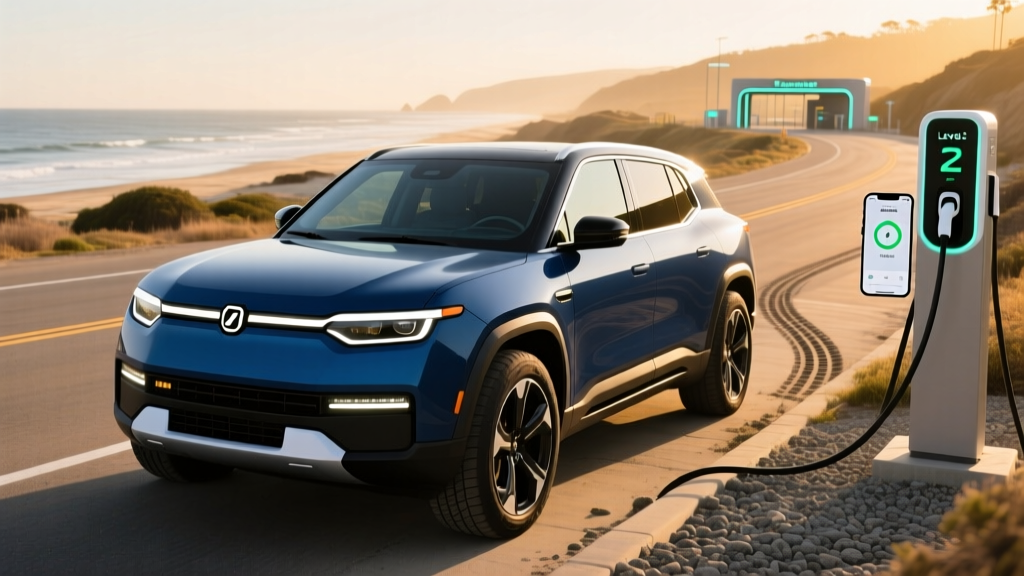
The Rivian R2 is the compact electric SUV designed to bring Rivian's adventure-ready formula to a mainstream price point. Announced in early 2024 and entering production at Rivian's Normal, Illinois facility in the first half of 2026, the R2 targets buyers who want the R1S's capability in a smaller, more affordable package. We've compiled everything confirmed about the 2026 Rivian R2 — from preliminary EPA range estimates and battery chemistry to charging speeds and federal tax credit eligibility — so you can decide whether to reserve one or look to competitors.
Rivian R2 Specs at a Glance
| Specification | R2 Standard AWD (Dual-Motor) |
|---|---|
| EPA Est. Range (target) | 300+ miles (preliminary) |
| Battery Capacity | ~75 kWh usable (Standard); ~100 kWh (Max, optional) |
| Battery Chemistry | LFP (Standard); NMC (Max Pack) |
| DC Fast Charge (peak) | ~200 kW (Standard); ~250 kW (Max) |
| 10-80% DC Charge Time | ~25-30 min (Standard); ~22-27 min (Max) |
| Level 2 Home Charge Rate | 11.5 kW (~35-40 mi/hr) |
| 0-60 mph | ~4.5 sec (Dual-Motor AWD, est.) |
| Horsepower | ~450 hp (Dual-Motor, est.) |
| Drivetrain | AWD (Dual-Motor standard; Single-Motor RWD available later) |
| Towing Capacity | ~4,500 lbs (target) |
| Cargo Volume (rear seats up) | ~35 cu ft (est.) |
| Cargo Volume (rear seats folded) | ~70 cu ft (est.) |
| Base MSRP | $45,000 (Single-Motor RWD, when available) |
| Dual-Motor AWD MSRP | ~$50,000-$52,000 (est.) |
| Battery Warranty | 8 years / 100,000 miles (minimum 70% capacity retention) |
| Basic Warranty | 5 years / 60,000 miles |
Note: As of early 2026, the R2 is in initial production ramp. Specs above reflect Rivian's announced targets and preliminary data. Final EPA certification and official MSRP by trim will be confirmed as vehicles reach customers. Source: Rivian
Range, Efficiency & Real-World Expectations
Rivian's stated 300+ mile target for the R2 positions it squarely against the Tesla Model Y Long Range (EPA 320 miles) and the Hyundai Ioniq 5 (EPA 305 miles with the larger battery). But EPA stickers are tested under specific lab conditions that don't always mirror your commute or road trip.
Highway driving: At sustained speeds of 70-80 mph, most dual-motor AWD EVs in this class lose 10-15% of their EPA range. Expect roughly 255-275 miles from the R2 Standard on a long interstate run.
Cold weather: Lithium-ion batteries lose efficiency in freezing temperatures, and cabin heating draws significant energy. LFP chemistry (used in the Standard pack) is somewhat more resilient to cold-induced degradation over time but still suffers range loss in the moment. Plan for 210-240 miles of effective range in sub-32°F conditions.
Efficiency target: Rivian has not published an official MPGe or kWh/100mi figure yet. Based on the R2's estimated weight (~5,000 lbs) and battery size, a reasonable projection is approximately 110-120 MPGe combined, or roughly 28-32 kWh/100 miles. We'll update this once fueleconomy.gov publishes official data.
Charging Speed: DC Fast Charge & Home Level 2
Charging speed is where compact EV SUVs live or die for road-trip buyers. The R2 uses the NACS (North American Charging Standard) connector natively, giving it direct access to Tesla's Supercharger network — the most reliable and extensive DC fast-charging infrastructure in North America.
| Charging Level | Power / Rate | Miles Added per Hour | Notes |
|---|---|---|---|
| Level 1 (120V household) | ~1.4 kW | ~4-5 mi/hr | Emergency/trickle only |
| Level 2 (240V home) | 11.5 kW | ~35-40 mi/hr | Full overnight charge in ~7-9 hrs |
| DC Fast Charge (Standard pack) | Peak ~200 kW | ~180 mi in 15 min | 10-80% in ~25-30 min |
| DC Fast Charge (Max pack) | Peak ~250 kW | ~200 mi in 15 min | 10-80% in ~22-27 min |
Charge curve reality: Peak kW figures are just that — a peak. The R2's charge rate will taper as the battery passes 50-60% State of Charge, and more sharply above 80%. This is normal for all lithium-ion packs and is managed by the battery management system to protect longevity. On a road trip, plan your stops around 10-80% increments for the fastest overall travel time.
Preconditioning: Like the R1S and R1T, the R2 is expected to offer battery preconditioning when you navigate to a charger. This warms the battery to optimal temperature before you arrive, enabling faster charge acceptance — especially critical in cold weather.
Home charging setup: The R2's 11.5 kW onboard charger requires a 240V / 60-amp circuit (NEMA 14-50 or hardwired wall connector). Budget $500-$2,000 for professional installation depending on your electrical panel's capacity and the distance from panel to garage. If your home has a 100-amp service panel, a panel upgrade to 200 amps could add $1,500-$3,000.
Performance & Drivetrain
The R2 launches with a dual-motor AWD configuration producing an estimated 450 horsepower, targeting a 0-60 mph time in the mid-4-second range. A single-motor RWD variant is expected to follow, likely bringing the base price down to the $45,000 target Rivian announced.
The dual-motor setup provides torque vectoring across the rear axle and standard AWD traction — useful for rain, snow, and light off-road trails. Rivian's quad-motor architecture from the R1S/R1T is not offered on the R2, keeping complexity and cost in check for this segment.
Towing: Rivian targets approximately 4,500 lbs of towing capacity, competitive with the Model Y (3,500 lbs) and slightly below the Ford Mustang Mach-E (which isn't rated for towing in most trims). This makes the R2 viable for small boat trailers, bike racks, and light utility trailers.
Pricing, Trims & Federal Tax Credit Eligibility
| Trim / Config | Est. MSRP | §30D Credit Potential | Est. Net Price |
|---|---|---|---|
| Single-Motor RWD (Standard) | $45,000 | Up to $7,500* | ~$37,500 |
| Dual-Motor AWD (Standard) | ~$50,000-$52,000 | Up to $7,500* | ~$42,500-$44,500 |
| Dual-Motor AWD (Max Pack) | ~$57,000-$60,000 | Up to $7,500* | ~$49,500-$52,500 |
*§30D Federal Tax Credit Rules (2026): The IRS Section 30D credit of up to $7,500 is subject to multiple requirements:
- MSRP cap: SUVs must have an MSRP at or below $80,000 (sedans: $55,000). All R2 trims fall well under this limit.
- Buyer income cap: Modified adjusted gross income (MAGI) must not exceed $150,000 (single), $225,000 (head of household), or $300,000 (married filing jointly).
- Battery sourcing: A percentage of critical minerals and battery components must be sourced from the US or free-trade-agreement countries. These thresholds tighten annually. Rivian's US-based manufacturing and supply chain partnerships position the R2 favorably, but final eligibility per trim must be confirmed at point of sale.
- Point-of-sale transfer: As of 2024, buyers can transfer the credit to the dealer at purchase, effectively reducing the purchase price upfront rather than waiting for a tax refund. This applies in 2026.
Critical caveat: Tax credit eligibility depends on the specific vehicle's VIN, battery component sourcing at time of manufacture, and your personal tax situation. Always verify with the IRS's official list and consult a tax professional before purchasing.
Interior, Cargo & Technology
The R2 is smaller than the three-row R1S but larger than most compact crossovers. Expect seating for five with approximately 38-40 inches of rear legroom. Cargo volume is estimated at roughly 35 cubic feet behind the rear seats and approximately 70 cubic feet with the rear seats folded — competitive with the Model Y.
A front trunk (frunk) is confirmed, providing additional sealed storage for gear or groceries — a practical advantage over competitors like the Mach-E that lack a usable frunk.
Infotainment: The R2 will run Rivian's in-house software on a large central touchscreen (estimated 15+ inches), with wireless Apple CarPlay and Android Auto expected. Over-the-air (OTA) updates will continue to add features post-purchase, following the pattern established by the R1S and R1T.
Driver assistance: Rivian's Driver+ system is expected to carry over, offering adaptive cruise control, lane-centering, and highway driving assist. This is an SAE Level 2 system — meaning the driver must remain engaged and hands on (or near) the steering wheel at all times. It is not autonomous or "self-driving."
Standout features:
- Native NACS port for direct Supercharger access (no adapter needed)
- Integrated roof rack mounting points (Rivian's adventure DNA)
- Vehicle-to-load (V2L) capability expected — power devices or a campsite from the battery
- Underbody protection for light off-road use
Pros & Cons
Pros
- Native NACS connector — seamless Supercharger access
- Strong projected range (300+ mi EPA target)
- US-built, likely qualifies for full §30D credit
- Adventure-ready features (roof rack, V2L, light off-road)
- Competitive starting price for dual-motor AWD
- Spacious frunk + cargo area for the class
Cons
- First model year — expect early-production quirks
- LFP Standard pack may charge slower than NMC competitors
- Single-motor RWD not available at launch
- Rivian's service center network still expanding
- Final EPA and pricing data not yet confirmed
- No quad-motor option (unlike R1S/R1T)
R2 vs. Key Competitors: Is It Worth Buying?
The R2 enters one of the most competitive EV segments in 2026. Here's how it stacks up on paper against the most relevant alternatives:
| Attribute | Rivian R2 (Dual-Motor AWD) | Tesla Model Y LR AWD | Hyundai Ioniq 5 AWD |
|---|---|---|---|
| EPA Range | ~300+ mi (target) | 320 mi | 290 mi |
| Starting MSRP (AWD) | ~$50,000 | ~$48,000 | ~$50,500 |
| DC Fast Charge (peak) | ~200 kW | ~250 kW | ~240 kW |
| 10-80% Charge Time | ~25-30 min | ~20-25 min | ~18-22 min |
| Charging Network | NACS (Supercharger native) | NACS (Supercharger native) | CCS (adapter for Supercharger) |
| Cargo (rear seats up) | ~35 cu ft | 30 cu ft | 27 cu ft |
| Towing | ~4,500 lbs | 3,500 lbs | Not rated |
| Battery Warranty | 8 yr / 100,000 mi | 8 yr / 120,000 mi | 10 yr / 100,000 mi |
Who Should Buy the Rivian R2?
Choose the R2 if: You want a US-built AWD EV with adventure features (roof rack, V2L, frunk, light off-road capability), native Supercharger access, and strong tax credit eligibility — and you're willing to accept first-model-year risk.
Choose the Tesla Model Y if: You prioritize the longest proven range, the fastest charging speeds, the most mature Supercharger network experience, and the lowest starting price for AWD.
Choose the Hyundai Ioniq 5 if: You want the fastest DC charging in the segment, a longer battery warranty (10 years), and prefer a more car-like crossover driving feel over adventure-oriented features.
Ownership Considerations & Warranty
Rivian provides an 8-year / 100,000-mile battery and powertrain warranty with a minimum 70% capacity retention guarantee — consistent with industry norms. The basic vehicle warranty covers 5 years / 60,000 miles.
Service network: Rivian operates a growing network of service centers and mobile service vans. As of early 2026, coverage is expanding but still thinner than legacy automakers or Tesla in many regions. Buyers in rural areas should check Rivian's service map before committing.
Insurance: EVs typically carry 15-25% higher insurance premiums than comparable gas vehicles due to higher repair costs and parts pricing. Get a quote before ordering to factor this into your total cost of ownership.
Depreciation: First-year models from newer brands carry depreciation risk. However, the R2's price point and feature set should support reasonable resale value if Rivian maintains production quality and OTA support.
Frequently Asked Questions
What is the real-world range of the Rivian R2?
Rivian targets 300+ miles EPA for the Standard AWD model. In real-world highway driving at 70-80 mph, expect approximately 250-275 miles. In cold weather (below freezing), plan for 210-240 miles of effective range. These are preliminary estimates pending official EPA certification.
How fast does the R2 charge at home and on the road?
At home on a Level 2 (240V / 11.5 kW) charger, the R2 adds approximately 35-40 miles of range per hour, fully charging overnight in 7-9 hours. On DC fast chargers, the Standard pack peaks at roughly 200 kW, achieving a 10-80% charge in approximately 25-30 minutes. The Max pack peaks at approximately 250 kW with a 10-80% time of roughly 22-27 minutes.
How much does the Rivian R2 cost after tax credits?
The dual-motor AWD R2 is estimated at $50,000-$52,000 MSRP. If you qualify for the full $7,500 federal §30D tax credit (income, MSRP, and battery-sourcing requirements apply), the effective price drops to approximately $42,500-$44,500. The upcoming single-motor RWD at $45,000 MSRP could reach as low as ~$37,500 after credit.
Does the Rivian R2 qualify for the federal EV tax credit?
The R2 is expected to qualify for up to $7,500 under IRS §30D, given its US manufacturing, MSRP well below the $80,000 SUV cap, and Rivian's supply chain sourcing. However, eligibility depends on battery component and critical-mineral sourcing thresholds that tighten annually, plus your personal income. Verify with the IRS official guidance and your tax professional before purchasing.
Is the Rivian R2 worth buying over a Tesla Model Y?
The R2 offers advantages in cargo space, towing capacity, adventure features (frunk, roof rack, V2L), and a more distinctive design. The Model Y counters with a lower starting price, longer EPA range, faster peak charging, and a more mature service network. If adventure utility and US manufacturing matter to you, the R2 is compelling. If range, charging speed, and price are your top priorities, the Model Y remains a strong choice.
When can I actually buy the Rivian R2?
R2 production began at Rivian's Normal, IL facility in early 2026, with initial deliveries to reservation holders expected in the first half of the year. The $45,000 single-motor RWD variant is expected to follow later in 2026 or early 2027. Check Rivian's official R2 page for current availability and reservation status.
What is the battery warranty on the R2?
Rivian covers the R2's battery and powertrain for 8 years or 100,000 miles, whichever comes first, guaranteeing a minimum of 70% capacity retention over that period. This matches Tesla's coverage and is standard for the segment.
This article reflects announced and preliminary specifications for the 2026 Rivian R2 as of early 2026. Final EPA figures, MSRP by trim, and tax credit eligibility will be confirmed as production vehicles are delivered and certified. Always verify with Rivian and the IRS before making a purchase decision.