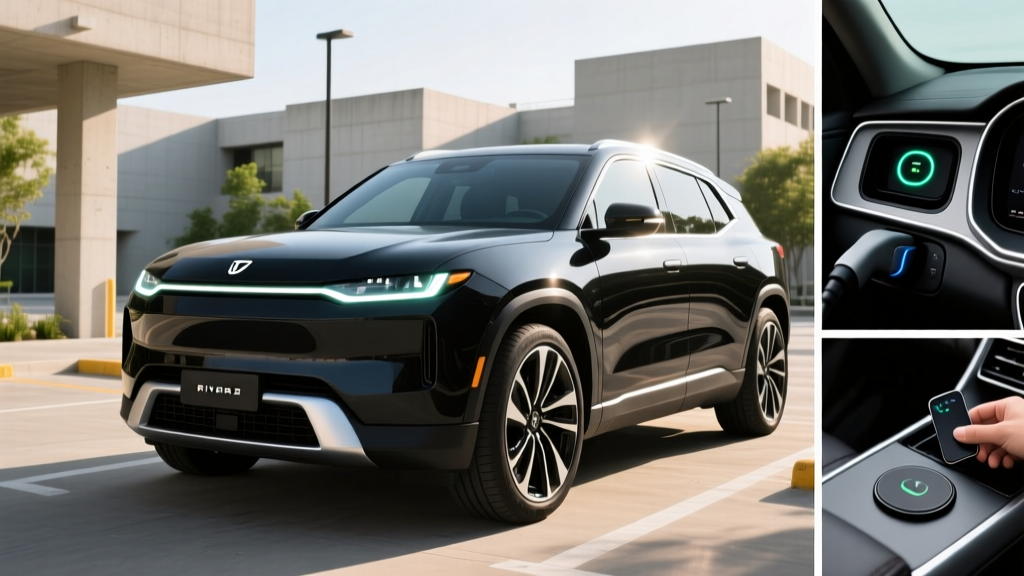
The compact electric SUV segment just got a serious new contender. Following the highly anticipated Rivian R2 launch event, the California-based automaker has finally pulled the curtain back on its smaller, more affordable sibling to the R1S. Slated for production in early 2026 at Rivian's new Georgia facility, the R2 aims to bring the brand's signature adventure-ready ethos to a mainstream price point. But with a starting MSRP of $45,000 and a targeted EPA range of up to 330 miles, does the R2 have the specs to compete against the Tesla Model Y, Hyundai Ioniq 5, and Ford Mustang Mach-E? Here's our deep-dive analysis of every critical number, feature, and ownership factor revealed.
Quick Verdict: What the Rivian R2 Launch Event Tells Us
Rivian's R2 is positioned as a premium compact SUV that undercuts the R1S by roughly $25,000 while retaining the brand's design DNA and outdoor capability. The headline numbers — 330 miles of EPA-estimated range on the dual-motor AWD variant, an 80 kWh usable LFP battery pack, and a starting price that lands squarely in the heart of the EV mainstream — suggest Rivian has engineered a compelling package. However, buyers should note that these are preliminary figures from an unreleased vehicle; final EPA certification and production specs may shift before customer deliveries begin in mid-2026. For shoppers who can wait, the R2 could be one of the most well-rounded compact EVs on the market.
Range, Battery & Efficiency: The Numbers That Matter
| Specification | Single-Motor RWD | Dual-Motor AWD |
|---|---|---|
| EPA Est. Range | ~315 miles | ~330 miles |
| Battery Capacity (Usable) | 80 kWh | 80 kWh |
| Battery Chemistry | LFP (Lithium Iron Phosphate) | LFP |
| Efficiency (Est.) | ~26 kWh/100 mi | ~24 kWh/100 mi |
| MPGe (Est. Combined) | ~128 MPGe | ~138 MPGe |
The decision to use LFP chemistry is strategic. LFP cells are less expensive than nickel-manganese-cobalt (NMC) alternatives, contain no cobalt or nickel (simplifying supply-chain and tax-credit sourcing requirements), and offer a longer cycle life — typically 3,000+ cycles before significant degradation. The trade-off is lower energy density, which is why Rivian needed a relatively large 80 kWh pack in a compact vehicle to hit 330 miles. For daily commuting and moderate road trips, LFP is arguably the better choice for most buyers.
Charging Speed: DC Fast, Level 2 & Home Setup
| Charging Level | Power / Rate | Time / Miles Added |
|---|---|---|
| DC Fast Charge (Peak) | 200 kW | 10-80% in ~25 minutes |
| DC Fast Charge (Sustained Avg.) | ~150 kW | ~180 miles in 20 minutes |
| Level 2 (Home / Public AC) | 11.5 kW (48A) | ~34 miles per hour of charging |
| Level 1 (120V Outlet) | 1.4 kW (12A) | ~4 miles per hour of charging |
The 200 kW peak DC fast-charge rate puts the R2 in the middle of the pack — behind the Hyundai Ioniq 5's 240 kW (via its 800V architecture) but ahead of the Tesla Model Y's ~170 kW peak on non-V3 chargers. The critical detail is the charge curve: LFP batteries typically sustain their peak charge rate longer than NMC cells before tapering, which means the R2's 25-minute 10-80% estimate is realistic for a well-preconditioned battery at a 350 kW-capable station like an Electrify America or Tesla Supercharger (via the NACS port Rivian has confirmed for the R2).
For home charging, the 11.5 kW Level 2 rate means a full 0-100% charge takes roughly 7-8 hours on a hardwired 48-amp Wall Connector or equivalent. Most owners will need a 60-amp dedicated circuit installed by a licensed electrician — budget $500-$1,500 for the installation on top of the $400-$700 charger unit, depending on your panel's proximity to the garage and whether a panel upgrade (to 200A service) is needed.
Performance & Drivetrain
| Metric | Single-Motor RWD | Dual-Motor AWD |
|---|---|---|
| Horsepower | ~335 HP | ~500 HP |
| 0-60 mph | ~6.0 seconds | ~4.5 seconds |
| Drivetrain | Rear-Wheel Drive | All-Wheel Drive |
| Towing Capacity (Est.) | 3,300 lbs | 3,300 lbs |
Rivian confirmed both a single-motor rear-wheel-drive base variant and a dual-motor AWD performance option. The dual-motor's estimated 4.5-second 0-60 time is brisk for a compact SUV and should satisfy most enthusiasts, though it's not quite in Tesla Model Y Performance territory (3.5 seconds). The 3,300-pound towing estimate is modest — adequate for a small trailer or a pair of dirt bikes, but not for a full-size camping trailer. Rivian's torque-vectoring AWD system, borrowed in concept from the R1T/R1S, should provide genuine off-road capability that rivals like the Model Y simply can't match.
Pricing, Trims & Federal Tax Credit Eligibility
| Trim / Configuration | Est. MSRP | After Potential §30D Credit |
|---|---|---|
| Base (Single-Motor RWD) | $45,000 | ~$37,500* |
| Dual-Motor AWD | $52,500 | ~$45,000* |
| Adventure / Off-Road Package | $57,000 | ~$49,500* |
*Tax credit amounts are estimates based on current IRS §30D rules. Actual eligibility depends on buyer income, battery component sourcing, and MSRP caps. Consult a tax professional.
The R2's sub-$80,000 MSRP (the SUV cap under §30D) means it clears the vehicle-price threshold for the federal clean vehicle credit. However, the full $7,500 credit requires meeting two separate battery-sourcing tests: critical minerals (sourced from the US or FTA partners) and battery components (manufactured in North America). Rivian's LFP cell sourcing — likely from a mix of suppliers — will determine whether the R2 qualifies for the full $7,500, a partial $3,750, or potentially nothing at launch. The company has indicated it is optimizing for full credit eligibility, but buyers should verify the specific VIN on fueleconomy.gov before purchasing.
Income caps also apply: modified adjusted gross income cannot exceed $150,000 (single filers), $225,000 (head of household), or $300,000 (joint filers). The credit can now be transferred to the dealer at point of sale, effectively reducing the purchase price upfront rather than waiting for tax-season reconciliation.
Interior, Cargo & Technology
Rivian has confirmed the R2 will seat five adults, with rear legroom targeted at approximately 38 inches — competitive with the Model Y and slightly better than the Ioniq 5's 35.6 inches. Cargo volume behind the second row is estimated at 28-30 cubic feet, expanding to roughly 65 cubic feet with the rear seats folded. A front trunk (frunk) is confirmed, adding an estimated 8-10 cubic feet of secure, weatherproof storage — a meaningful advantage for muddy gear or groceries.
The infotainment system will run Rivian's proprietary software on a 15.4-inch landscape touchscreen, with wireless Apple CarPlay and Android Auto confirmed. The R2 will ship with Rivian's Driver+ system, a Level 2 SAE driver-assist suite offering adaptive cruise control, lane-centering, and hands-free highway driving on mapped roads. Importantly, this is not a self-driving system — the driver must remain attentive with hands on or near the wheel at all times. Rivian has not announced plans for a higher-level autonomy system on the R2.
Warranty & Long-Term Ownership
| Component | Coverage |
|---|---|
| Battery Pack | 8 years / 100,000 miles (min. 70% capacity retention) |
| Powertrain (Motors, Inverter) | 8 years / 100,000 miles |
| Bumper-to-Bumper | 5 years / 60,000 miles |
| Roadside Assistance | 5 years / 60,000 miles |
Rivian is expected to match or slightly exceed the industry-standard 8-year/100,000-mile battery and powertrain warranty mandated by the EPA for EVs. The LFP chemistry provides additional peace of mind: LFP cells typically retain 80%+ capacity after 2,000-3,000 full charge cycles, which translates to roughly 500,000+ miles of driving before hitting the 70% warranty threshold. In practical terms, the battery should outlast the vehicle's useful life for most owners.
Pros, Cons & Who the R2 Is For
Pros
- 330-mile EPA range covers most road trips without mid-charge stops
- LFP battery = daily 100% charging, superior longevity, no cobalt
- NACS connector = native Tesla Supercharger network access
- Frunk + 30 cu ft cargo = best-in-class utility for a compact SUV
- Genuine off-road capability with torque-vectoring AWD
- Starting at $45K before potential $7,500 credit
Cons
- 200 kW peak DC charging trails Hyundai/Kia's 800V architecture
- 3,300-lb towing is limited for adventure users with larger trailers
- LFP energy density = heavier pack, potentially affecting efficiency
- Production at new Georgia plant = early ramp-up quality risks
- Not available until mid-2026; long reservation-to-delivery timeline likely
- Tax credit eligibility not yet confirmed at VIN level
Frequently Asked Questions
What is the real-world range of the Rivian R2?
Rivian targets 330 miles EPA for the dual-motor AWD variant. In real-world highway driving at 70-80 mph, expect 280-300 miles. In cold weather (below freezing), LFP range can drop 20-30%, yielding roughly 230-265 miles. The single-motor RWD is estimated at 315 miles EPA, with similar real-world reductions.
How fast does the Rivian R2 charge?
At a DC fast charger, the R2 peaks at 200 kW and should charge from 10-80% in approximately 25 minutes when the battery is preconditioned. At home on a 48-amp Level 2 charger (11.5 kW), you'll add roughly 34 miles of range per hour, with a full charge taking 7-8 hours. On a standard 120V outlet (Level 1), expect about 4 miles per hour — suitable only for overnight top-ups.
How much does the Rivian R2 cost after tax credits?
The base single-motor RWD starts at an estimated $45,000 MSRP. If the vehicle qualifies for the full $7,500 federal §30D credit and you meet income requirements ($150K single / $300K joint), the effective price drops to approximately $37,500. The dual-motor AWD at $52,500 would net to ~$45,000. However, credit eligibility depends on battery sourcing rules that Rivian has not yet confirmed at the VIN level — verify before ordering.
Does the Rivian R2 qualify for the federal EV tax credit?
The R2's MSRP is well under the $80,000 SUV cap, and its LFP chemistry may help with critical-minerals sourcing requirements. However, the §30D credit requires both critical minerals and battery components to meet phased-in North American/FTA-partner thresholds. Rivian has stated it is engineering for full credit eligibility, but final determination depends on the specific battery supply chain at production time. Check fueleconomy.gov for the definitive answer once production VINs are listed.
Is the Rivian R2 worth buying vs. the Tesla Model Y or Hyundai Ioniq 5?
The R2's 330-mile range, LFP battery longevity, frunk, and off-road capability give it a unique value proposition that neither the Model Y nor Ioniq 5 fully matches. However, the Ioniq 5 charges significantly faster (240 kW, 10-80% in ~18 minutes), and the Model Y benefits from Tesla's mature Supercharger network and proven production scale. If you prioritize off-road utility and design, wait for the R2. If charging speed and immediate availability matter more, the Ioniq 5 and Model Y are excellent alternatives available today.
Sources: Rivian R2 Official Page, IRS §30D Clean Vehicle Credit Rules, EPA Fuel Economy.