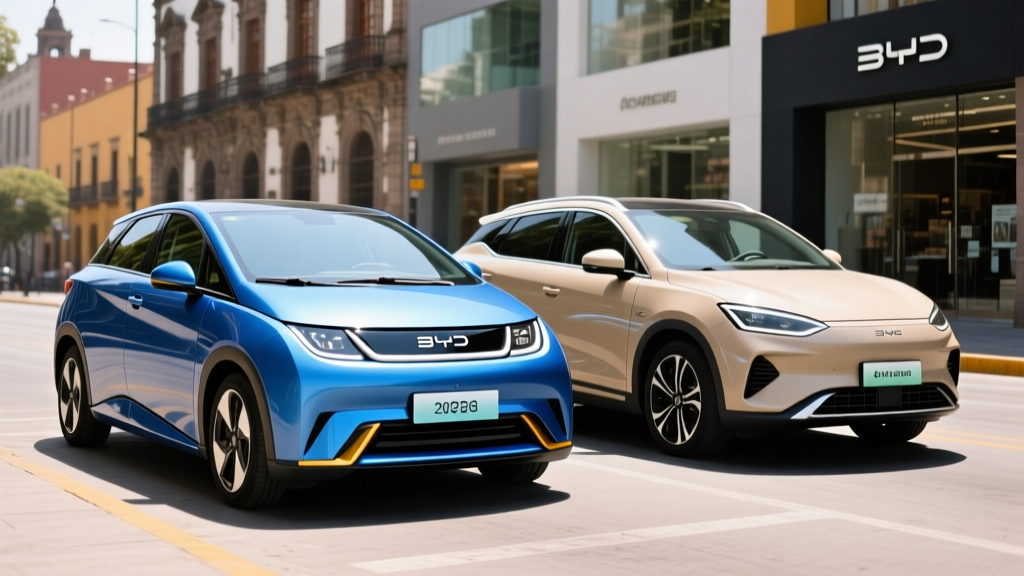
Mexico's electric vehicle market is expanding rapidly, and BYD has positioned itself as the price leader. If you've searched "buy BYD Mexico" and landed here, you're likely weighing whether these Chinese-market EVs — which don't carry EPA stickers in the U.S. — are worth importing or buying south of the border. This review covers the two most popular BYD models available in Mexico for the 2026 model year: the BYD Dolphin (compact hatchback) and the BYD Atto 3 (compact SUV, also known as the Yuan Plus in some markets). We'll break down range, charging, pricing, and the critical tax-credit question for U.S. buyers.
BYD's Mexico Lineup: Dolphin and Atto 3 at a Glance
BYD entered Mexico in 2023 and quickly became one of the top-selling EV brands by undercutting legacy automakers on price. As of early 2026, the core lineup centers on two models built on BYD's e-Platform 3.0 with its proprietary Blade Battery (LFP chemistry). Here's the spec comparison:
| Spec | BYD Dolphin (Extended Range) | BYD Atto 3 (Standard) |
|---|---|---|
| Battery (usable) | 60.4 kWh, LFP Blade | 58.56 kWh, LFP Blade |
| WLTP Range | 427 km (~265 mi) | 420 km (~261 mi) |
| EPA-equivalent est.* | ~225 mi | ~220 mi |
| Motor | 150 kW (201 hp), FWD | 150 kW (201 hp), FWD |
| 0-100 km/h (0-62 mph) | 7.0 sec | 7.3 sec |
| Max DC Charge | 88 kW | 88 kW |
| 10-80% DCFC Time | ~29 min | ~29 min |
| Level 2 AC Charge | 11 kW (~37 mi/hr) | 11 kW (~35 mi/hr) |
| Base MSRP (Mexico) | ~689,000 MXN (~$38,500 USD) | ~799,000 MXN (~$44,600 USD) |
| Warranty (Mexico) | 6 yr / 150,000 km vehicle; 8 yr / 160,000 km battery | 6 yr / 150,000 km vehicle; 8 yr / 160,000 km battery |
*EPA-equivalent estimates derived from WLTP figures using a typical 0.85 conversion factor. BYD does not sell these models in the U.S., so no official EPA ratings exist. Source: BYD Mexico official specs.
Real-World Range: What to Expect Beyond the Sticker
BYD Dolphin (WLTP 427 km / ~265 mi): Expect roughly 225 miles in mixed driving at moderate temperatures. At sustained highway speeds of 75+ mph, plan for ~185-195 miles. In cold weather (below 40°F / 4°C), LFP batteries lose less capacity than NMC but still drop 10-15%, putting real range around 190-200 miles mixed.
BYD Atto 3 (WLTP 420 km / ~261 mi): The taller, heavier SUV shape costs a few miles. Expect ~220 miles mixed, ~180-190 highway, and ~185-195 in cold conditions.
BYD's Blade Battery uses lithium iron phosphate (LFP) chemistry, which trades energy density for longevity and thermal stability. The practical upside: LFP cells tolerate regular 100% charging better than NMC, meaning you can charge to full daily without the same degradation concerns. The downside: slightly heavier packs for the same kWh, and a steeper drop-off in performance below freezing compared to NMC cells with active thermal preconditioning.
Mexican driving conditions — warm climate, moderate highway speeds — are actually favorable for these range figures. If you're buying in Mexico City, Guadalajara, or Monterrey, the real-world range will track closer to the WLTP number than a buyer in Canada would experience.
Charging Speed: DC Fast and Home Level 2
Charging is where budget EVs often reveal compromises, and the Dolphin and Atto 3 are no exception. Both peak at 88 kW on DC fast charging — functional, but well below the 150-250 kW peaks of competitors like the Hyundai Ioniq 5 or Tesla Model Y.
| Charging Level | Power / Rate | Time / Miles Added | Notes |
|---|---|---|---|
| Level 1 (120V) | ~1.4 kW | ~5 mi/hr | Emergency/trickle only |
| Level 2 (240V, home) | 11 kW | ~36 mi/hr; 0-100% in ~6 hr | Requires 48A+ circuit |
| DC Fast Charge | 88 kW peak | 10-80% in ~29 min | Tapers significantly above 80% |
The 88 kW peak means a 10-80% session takes about 29 minutes at a compatible station. However, BYD's charge curve tapers early — expect sustained rates closer to 60-65 kW through the middle of the curve, with a steep drop above 80%. For road trips, this means planning 30-35 minute stops rather than the 18-20 minute stops that 150+ kW vehicles achieve.
At home on a Level 2 charger, the 11 kW onboard charger is competitive. A full overnight charge adds roughly 220+ miles of range in six hours, more than enough for daily commuting.
Performance and Driving Dynamics
Both models use a single front-mounted motor producing 150 kW (201 hp) and 310 Nm (229 lb-ft) of torque. The Dolphin, being lighter (~1,650 kg), hits 0-62 mph in 7.0 seconds. The Atto 3 (~1,750 kg) takes 7.3 seconds. Neither offers AWD.
For context, 7 seconds to 60 mph is quicker than most gas-powered compact crossovers and perfectly adequate for highway merging and city driving. These are not performance EVs — there's no dual-motor variant, and the suspension tuning prioritizes comfort over sportiness. The regenerative braking offers two levels (standard and high) but does not enable true one-pedal driving to a full stop like some competitors.
Pricing in Mexico and the U.S. Tax Credit Question
This is where the "buy BYD Mexico" search gets complicated. BYD prices aggressively in Mexico:
| Model / Trim | MSRP (MXN) | Approx. USD |
|---|---|---|
| Dolphin Mini (base) | ~439,000 MXN | ~$24,500 |
| Dolphin Extended Range | ~689,000 MXN | ~$38,500 |
| Atto 3 Standard | ~799,000 MXN | ~$44,600 |
Does It Qualify for the U.S. Federal EV Tax Credit (§30D)?
Short answer: No. As of 2026, BYD does not sell vehicles in the United States, and vehicles purchased in Mexico cannot be claimed under the IRS §30D New Clean Vehicle Credit. The credit requires the vehicle to be placed in service in the U.S., purchased from a U.S. dealer, and meet battery sourcing and critical mineral requirements under IRS §30D rules. Additionally, BYD is a Chinese-headquartered manufacturer, and its battery components and critical minerals would likely fail the Foreign Entity of Concern (FEOC) restrictions that phase in through 2025-2026. If you are a U.S. resident, importing a BYD from Mexico would not only disqualify you from the credit but also create significant homologation, safety (NHTSA/FMVSS), and customs hurdles.
For Mexican residents, there is no federal EV purchase incentive comparable to the U.S. §30D credit, though some states offer reduced registration fees or HOV-lane access. Mexico's ISR (income tax) deduction for EV purchases may apply — consult a Mexican tax professional (contador) for specifics.
Interior, Cargo, and Technology
BYD Dolphin: A compact hatchback with surprisingly generous interior space. Rear legroom measures approximately 37.4 inches, and cargo volume behind the rear seats is ~12.4 cu ft (345 liters), expanding to ~46 cu ft with seats folded. The 12.8-inch rotating center touchscreen is the cabin's centerpiece, running BYD's DiLink infotainment with wireless Apple CarPlay and Android Auto. A 5-inch digital instrument cluster sits behind the steering wheel.
BYD Atto 3: The compact SUV offers ~38 inches of rear legroom and ~15.8 cu ft (440 liters) of cargo space, expanding to ~48 cu ft folded. The interior design is more distinctive (the guitar-string door pockets and muscle-fiber-inspired dashboard are polarizing). The same 12.8-inch rotating screen and DiLink system carry over.
Driver Assistance: Both models include BYD's DiPilot suite — adaptive cruise control, lane-keeping assist, automatic emergency braking, and blind-spot monitoring. This is a SAE Level 2 driver-assist system, meaning the driver must remain fully engaged with hands on the wheel and eyes on the road. It is not autonomous driving.
Notable Drawbacks:
- No Apple/Google native EV route planning with charging stops (unlike Tesla or Hyundai's integrated navigation)
- Infotainment can lag; software updates in Mexico have been inconsistent
- No front trunk (frunk) — the space under the hood houses conventional electronics
- Service network in Mexico is growing but still sparse outside major metros
- No V2L (vehicle-to-load) on the Dolphin; Atto 3 offers optional V2L adapter
Pros and Cons
- Aggressive pricing — undercuts most rivals by $5,000-$10,000 USD
- LFP Blade Battery: excellent longevity, safe chemistry, daily 100% charging OK
- Quick enough for real-world driving (7.0 sec to 62 mph)
- Spacious interiors for the vehicle class
- Generous warranty: 8 yr / 160,000 km on battery
- 88 kW DC fast charging is slow vs. 150-250 kW competitors
- No U.S. availability or federal tax credit eligibility
- Service/parts network in Mexico still developing
- Infotainment software can be sluggish
- No AWD option; FWD only limits traction in adverse conditions
- Resale value in Mexico unproven long-term
Who Should Buy a BYD in Mexico?
Choose the BYD Dolphin if: You're a Mexican resident seeking an affordable daily commuter EV with low running costs, mostly city/suburban driving under 100 miles per day, and access to home Level 2 charging. The Dolphin's price and efficiency make it an excellent first EV.
Choose the BYD Atto 3 if: You need SUV cargo space and ground clearance for a small family, want the same LFP battery durability, and can accept the 88 kW charging limitation on occasional road trips.
Look elsewhere if: You're a U.S. resident (importing is impractical and credit-ineligible), you take frequent road trips requiring fast DC charging, you need AWD for mountain or rainy-season driving, or you want access to Tesla's Supercharger network (BYD uses CCS2 in Mexico, though adapters exist for NACS stations).
Frequently Asked Questions
What is the real-world range of the BYD Dolphin and Atto 3?
In warm Mexican conditions, expect approximately 225 miles (Dolphin) and 220 miles (Atto 3) in mixed driving. Highway-only driving at 75 mph reduces this to ~185-195 miles. Cold weather (below 40°F) drops range by 10-15%.
How fast do BYD models charge?
Both peak at 88 kW DC fast charging, achieving 10-80% in approximately 29 minutes. At home on Level 2 (11 kW), a full charge takes about 6 hours. These rates are slower than Hyundai/Kia's E-GMP platform (150-240 kW) but adequate for daily use.
Can a U.S. resident buy a BYD in Mexico and claim the $7,500 tax credit?
No. The IRS §30D credit requires the vehicle to be purchased from a U.S. dealer and placed in service in the United States. BYD does not have U.S. dealerships. Additionally, BYD's Chinese battery sourcing would likely fail FEOC (Foreign Entity of Concern) restrictions under current rules. See IRS.gov §30D guidelines for full eligibility details.
Is the BYD Blade Battery reliable long-term?
LFP chemistry is among the most durable in production EVs, with cycle life rated for 3,000+ full charge cycles before reaching 80% capacity. BYD warranties the battery for 8 years or 160,000 km (whichever comes first) with a capacity retention floor typically set at 70%. Real-world degradation data from early Chinese-market adopters shows approximately 5-8% loss over the first 100,000 km.
What connector does BYD use in Mexico?
BYD Mexico models use the CCS2 (Combined Charging System Type 2) connector for both AC and DC charging. This is the European/Asian standard, different from the CCS1 (Type 1) used by most U.S. EVs and the NACS (Tesla) connector. Adapters are available but add cost and complexity if you plan to use diverse charging networks.
Is it worth buying a BYD vs. competitors in Mexico?
Against the MG4 (also Chinese, similar price), the BYD Dolphin offers a more mature LFP battery and better build quality. Against the Nissan Leaf (available in Mexico, CHAdeMO connector), the BYD's liquid-cooled battery and modern platform are superior — the Leaf's air-cooled pack degrades faster in hot climates. Against the JAC E-Sei 4 or Zotye options, BYD is the safer bet for parts availability and software support. The main trade-off vs. a Hyundai Kona Electric or Kia Niro EV (if imported) is charging speed and dealer network maturity.
Sources: BYD Mexico Official Site, IRS §30D Clean Vehicle Credits. Pricing and specifications are based on 2026 model-year data available at publication and may vary by dealer and trim.