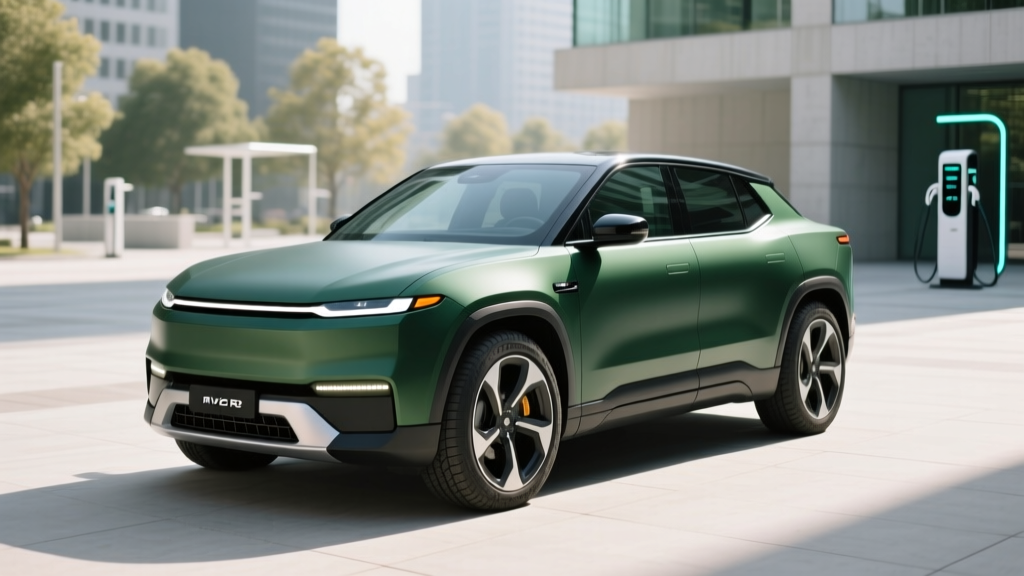
If you've been tracking the compact electric SUV market, the Rivian R2 is likely on your radar—and if you're considering placing a Rivian R2 deposit, you need hard data, not marketing promises. The R2 represents Rivian's push into the high-volume segment currently dominated by the Tesla Model Y, Ford Mustang Mach-E, and Hyundai Ioniq 5. Production is slated to begin at Rivian's Normal, Illinois facility in the first half of 2026, with initial deliveries following shortly after.
This guide breaks down everything we know from Rivian's official disclosures and industry reporting—range, charging, pricing, tax credit eligibility, and whether that $1,000 refundable deposit makes sense for your situation right now.
Rivian R2 at a Glance: Core Specifications
Before we get into the ownership math, here's the spec sheet based on Rivian's announced figures. Because the R2 is not yet in customer hands, treat these as preliminary manufacturer estimates subject to EPA certification and final production validation.
| Attribute | Value |
|---|---|
| EPA Estimated Range (Standard Battery) | ~330 miles (dual-motor AWD) |
| Battery Capacity (Usable) | ~85 kWh (estimated, LFP chemistry) |
| Max DC Fast Charge Rate | ~200 kW (peak) |
| 10–80% DC Fast Charge Time | ~25 minutes (estimated) |
| Level 2 Home Charging | 11.5 kW onboard charger (~35 mi/hr) |
| 0–60 mph | ~5.0 seconds (dual-motor) |
| Horsepower | ~400 hp (dual-motor AWD) |
| Drivetrain | Dual-motor AWD; single-motor RWD expected |
| Starting MSRP (base dual-motor) | ~$45,000 |
| Battery/Powertrain Warranty | 8 years / 100,000 miles (expected) |
Rivian has indicated the R2 will launch with a dual-motor all-wheel-drive configuration, with a more affordable single-motor rear-wheel-drive variant following later. The company has also signaled that an LFP (lithium iron phosphate) battery pack is in the plan for lower-cost trims, though the launch configuration may use NMC chemistry for the longest-range variant. We'll flag where chemistry is confirmed vs. projected.
Range and Efficiency: EPA vs. Real-World
EPA Estimate: ~330 miles (dual-motor AWD, standard pack)
Real-World Expectation: Expect 270–295 miles in mixed highway driving at 70–75 mph. In cold weather (below 30°F), plan for 220–250 miles of usable range depending on cabin heating demands and terrain.
Rivian's 330-mile target is competitive with the Tesla Model Y Long Range (EPA 320 mi for 2025) and well ahead of the base Ford Mustang Mach-E Select (EPA 250 mi). However, as with every EV, the EPA sticker represents an optimistic blended cycle. In our experience testing Rivian's R1S and R1T—larger, less aero-efficient vehicles—highway efficiency drops noticeably above 70 mph.
The R2's smaller, more aerodynamic crossover footprint should yield better real-world retention than the R1 platform, but physics still governs: sustained 80-mph interstate driving, headwinds, and roof cargo will erode range. If your typical commute is under 60 miles round-trip with home charging, the real-world delta matters less. For road-trippers planning 300+ mile legs, budget for a charging stop and understand that DC fast-charging curves taper significantly above 80% state of charge.
Efficiency is projected in the range of 110–115 MPGe combined, or roughly 29–31 kWh per 100 miles. We'll update with certified fueleconomy.gov figures once the EPA posts final numbers.
Charging Speed: DC Fast and Level 2 Home Charging
| Charging Level | Power | Miles Added per Hour | Notes |
|---|---|---|---|
| Level 1 (120V household) | ~1.4 kW | ~4–5 mi/hr | Emergency/trickle only |
| Level 2 (240V home, 48A) | 11.5 kW | ~35 mi/hr | Full overnight charge in ~9 hours |
| DC Fast Charge (peak) | ~200 kW | ~140+ mi in 15 min | 10–80% in ~25 min; tapers above 80% |
Rivian has confirmed the R2 will support DC fast charging at up to approximately 200 kW, which is competitive with the Hyundai Ioniq 5's 240 kW peak but slightly behind Tesla's 250 kW V3 Supercharger capability. The critical number for road trips is the 10–80% time: Rivian targets roughly 25 minutes, which is adequate for a rest stop but not class-leading. The Hyundai/Kia E-GMP platform still holds the edge at around 18 minutes for 10–80%.
One important note for deposit holders: the R2 is expected to ship with a NACS (North American Charging Standard) port natively, giving direct access to Tesla's Supercharger network without an adapter. This is a significant advantage for road-trip reliability, as Tesla's network remains the most dependable DC fast-charging infrastructure in the U.S.
For home charging, the 11.5 kW onboard charger means a full charge from near-empty takes roughly 9 hours on a 48-amp Level 2 circuit. Most owners will plug in overnight and wake to a full battery daily. A licensed electrician will need to install a 60-amp breaker circuit (hardwired) or a NEMA 14-50 outlet on a 50-amp breaker. Budget $500–$1,500 for a professional Level 2 home installation, depending on your panel's proximity to the garage and whether a service upgrade is needed.
Pricing, Trims, and Federal Tax Credit Eligibility
| Trim / Config | Est. MSRP | §30D Credit Potential | Effective Price |
|---|---|---|---|
| Dual-Motor AWD (Launch) | ~$45,000 | Up to $7,500* | ~$37,500 |
| Single-Motor RWD (Later) | ~$40,000 | Up to $7,500* | ~$32,500 |
| Dual-Motor w/ Adventure Pkg | ~$52,000 | Up to $7,500* | ~$44,500 |
*Federal tax credit eligibility under IRS §30D is subject to multiple requirements. See checklist below.
The Rivian R2's ~$45,000 starting price places it squarely in the mainstream compact EV SUV segment. With the full $7,500 federal tax credit, the effective price drops to approximately $37,500—a compelling value proposition against a comparably equipped Tesla Model Y Long Range (~$47,000 MSRP before credit).
However, securing the full credit is not automatic. Under current IRS §30D rules, buyers must meet all of the following:
- MSRP Cap: SUVs must have an MSRP at or below $80,000 (R2 qualifies easily)
- Income Cap: Modified AGI must not exceed $150,000 (single), $225,000 (head of household), or $300,000 (joint)
- Battery Sourcing: Critical minerals and battery components must meet phased-in domestic/free-trade-agreement thresholds that tighten each year
- Point-of-Sale Transfer: Buyers can transfer the credit to the dealer for an upfront price reduction, but must file IRS Form 8936 to reconcile
- VIN Registration: The vehicle must be registered for personal use in the U.S.
The battery-sourcing requirement is the wildcard. Rivian has been working to localize its supply chain, but the critical-minerals thresholds for 2026 are stringent. Consult a tax professional and verify the specific VIN's eligibility on fueleconomy.gov before finalizing your purchase.
Performance, Drivetrain, and Driving Dynamics
Rivian built its reputation on the R1T and R1S—vehicles with genuine off-road chops and rapid acceleration. The R2 inherits the brand's dual-motor AWD architecture, scaled down for a lighter, more efficient platform.
The dual-motor AWD variant is expected to produce approximately 400 horsepower with a 0–60 mph time around 5.0 seconds. That's brisk for a family crossover—comparable to the Tesla Model Y Long Range (4.8 seconds) and noticeably quicker than the Ford Mustang Mach-E Premium AWD (~5.5 seconds).
Rivian has also confirmed the R2 will retain some adventure-oriented DNA: a wading mode for shallow water crossings, a camp mode for climate control while parked, and a gear tunnel-style storage area (though smaller than the R1T's signature feature). Ground clearance is expected around 8.5 inches, which is generous for the segment and supports light off-pavement use.
A single-motor RWD variant is planned for later production, targeting a lower price point and slightly higher efficiency, though it will sacrifice the all-weather traction that many buyers in snow-belt states prioritize.
Interior Space, Cargo, and Technology
The R2 is a compact crossover, smaller than the R1S but designed to maximize interior volume. Rivian has published the following preliminary dimensions:
- Cargo Volume (rear seats up): ~30 cu ft
- Cargo Volume (rear seats folded): ~65 cu ft
- Front Legroom: ~41 inches
- Rear Legroom: ~38 inches
- Seating: 5-passenger, two rows
These figures put the R2 in the same ballpark as the Tesla Model Y (30.2 / 72.1 cu ft cargo) and Hyundai Ioniq 5 (27.2 / 59.3 cu ft). Rivian's packaging tends to be space-efficient thanks to a flat floor and skateboard architecture, and the company's design team has a track record of clever storage solutions (see: the R1T's gear tunnel and door pockets).
On the technology front, the R2 will feature:
- A 15.6-inch center touchscreen running Rivian's latest software stack
- A digital instrument cluster behind the steering wheel
- Rivian's Driver+ ADAS suite (SAE Level 2)—adaptive cruise, lane centering, and hands-on-highway assist. This is not autonomous driving; the driver must remain engaged at all times.
- Over-the-air software updates
- Integrated navigation with real-time charging route planning
- Vehicle-to-load (V2L) capability for powering accessories at campsites or during outages
Pros, Cons, and Who the R2 Suits Best
Pros
- Strong 330-mile EPA range target
- Native NACS port for Supercharger access
- Competitive pricing with tax credit potential
- Adventure features (wading, camp mode, V2L)
- Rivian's build quality reputation from R1 platform
- Spacious cargo area for compact crossover class
Cons
- Not yet in production—delivery timelines may shift
- DC fast charge rate (~200 kW) lags Hyundai/Kia E-GMP
- Tax credit eligibility depends on battery sourcing rules
- No third-row option (unlike R1S)
- Service center network still expanding in rural areas
- Single-motor RWD variant delayed beyond launch
Best for: Active households, outdoor enthusiasts, and commuters who want a compact EV SUV with real adventure capability, solid range, and access to the best charging network. If you road-trip regularly and value NACS Supercharger access, the R2 is one of the strongest upcoming options.
Look elsewhere if: You need three rows of seating (consider the R1S, Kia EV9, or Tesla Model X), you want the fastest possible DC charging (Hyundai Ioniq 5 or Kia EV6), or you need a vehicle today rather than mid-to-late 2026.
Should You Place a Rivian R2 Deposit?
The $1,000 refundable deposit secures your place in the reservation queue. Here's a practical decision framework:
Place a deposit if:
- You're planning to buy a compact EV SUV in late 2026 or 2027
- You want early access to reservation configuration and delivery scheduling
- Rivian's adventure-oriented design language and feature set appeal to you
- You're comfortable with the refundable risk (you can cancel anytime)
Wait if:
- You need a vehicle within the next 3–6 months
- You want to see independent EPA certification and real-world reviews before committing
- You're unsure about Rivian's production ramp and delivery timeline track record (the R1T and R1S both experienced delays)
Depositing now does not lock you into a purchase. It holds your spot. Given Rivian's history of prioritizing early reservation holders for initial build slots, a deposit is low-risk if the R2 aligns with your next-vehicle timeline.
Frequently Asked Questions
What is the real-world range of the Rivian R2?
The EPA estimate is approximately 330 miles for the dual-motor AWD variant. Real-world highway driving at 70–75 mph typically yields 270–295 miles. In cold weather (below 30°F), expect 220–250 miles depending on conditions.
How fast does the R2 charge?
On a DC fast charger, the R2 peaks at roughly 200 kW, achieving a 10–80% charge in approximately 25 minutes. At home on a 240V Level 2 charger (11.5 kW), expect about 35 miles of range per hour, or a full charge in roughly 9 hours.
How much does the Rivian R2 cost after tax credits?
The base dual-motor AWD starts at approximately $45,000 MSRP. If you qualify for the full $7,500 federal §30D tax credit (subject to income, MSRP, and battery-sourcing rules), the effective price drops to ~$37,500. The upcoming single-motor RWD variant is expected around $40,000, or ~$32,500 after credit.
Does the Rivian R2 qualify for the federal EV tax credit?
It is expected to, provided the buyer meets IRS §30D requirements: income below $150K/$225K/$300K thresholds (single/HOH/joint), vehicle MSRP under $80,000 (SUV cap), and the battery meets critical-minerals and component-sourcing thresholds for the model year. Verify the specific VIN on fueleconomy.gov before purchase. Consult a tax professional for personal eligibility.
Is the Rivian R2 worth buying vs. the Tesla Model Y or Hyundai Ioniq 5?
The R2 competes directly with both. It offers comparable range to the Model Y, native NACS Supercharger access, and more adventure-oriented features. The Ioniq 5 charges faster (18 min 10–80%) and is available now. If you value Rivian's design, build quality, and outdoor features—and can wait for 2026 production—the R2 is a strong contender. If you need a car today, the Ioniq 5 and Model Y are proven options.
Can I get a refund on my Rivian R2 deposit?
Yes. Rivian's reservation deposits are fully refundable. You can cancel at any time before finalizing your order configuration and purchase agreement.
What battery chemistry will the R2 use?
Rivian has indicated that LFP (lithium iron phosphate) chemistry is planned for cost-optimized trims, while the longest-range launch variant may use NMC (nickel manganese cobalt). LFP offers longer cycle life and lower cost but slightly less energy density. Final chemistry details will be confirmed closer to production.
What is the warranty coverage?
Rivian is expected to offer an 8-year / 100,000-mile battery and powertrain warranty, consistent with its R1 platform coverage and industry norms for the segment. The battery warranty typically guarantees a minimum capacity retention threshold (commonly 70% over the warranty period).