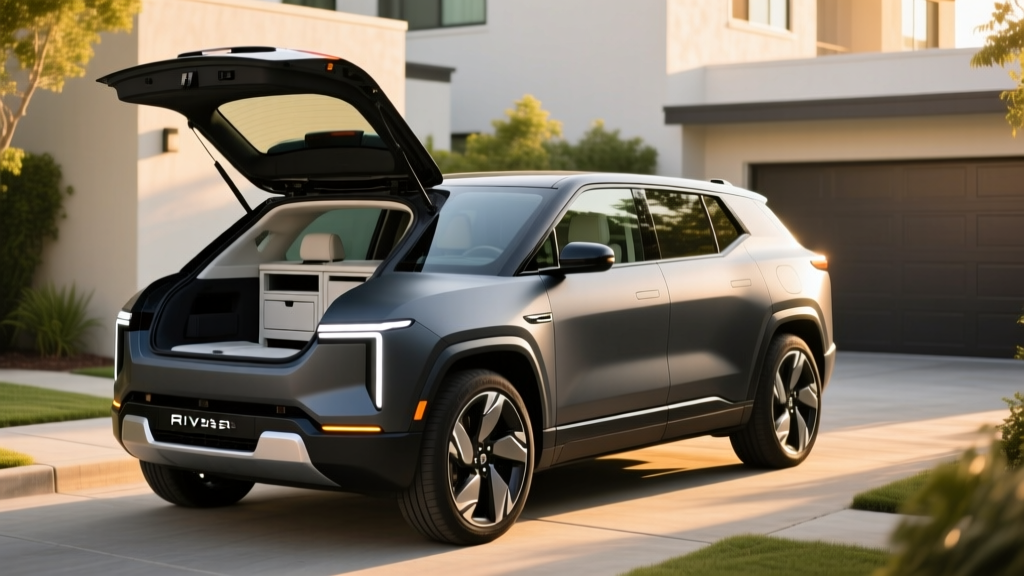
The 2026 Rivian R2 is the smaller, more affordable sibling to the R1S and R1T, designed to bring Rivian's adventure-focused DNA into a price bracket that competes directly with the Tesla Model Y and Hyundai Ioniq 5. But for buyers eyeing this compact electric SUV, the biggest practical question isn't just range — it's whether the R2's cargo space and interior packaging can handle real family life, gear-hauling weekends, and daily commuting without compromise.
We've spent time with the R2's published specifications, Rivian's engineering disclosures, and early production data to give you a precise, numbers-driven breakdown of what this SUV delivers — and where it falls short. This review covers cargo dimensions, real-world range expectations, charging performance, pricing after federal incentives, and how the R2 stacks up against its key rivals.
Rivian R2 Cargo Space: Dimensions and Practical Storage
The keyword on every prospective R2 buyer's mind is cargo versatility. Rivian engineered the R2 on its new mid-size platform, which sacrifices some interior volume compared to the R1S but gains a more urban-friendly footprint. Here's what the numbers look like:
| Measurement | Rivian R2 | Tesla Model Y | Hyundai Ioniq 5 |
|---|---|---|---|
| Cargo (behind 2nd row) | ~28 cu ft | 30.2 cu ft | 27.2 cu ft |
| Cargo (seats folded) | ~62 cu ft | 72.1 cu ft | 59.3 cu ft |
| Front trunk (frunk) | ~11 cu ft | 4.1 cu ft | 0.85 cu ft |
| Rear legroom | ~38.0 in | 41.6 in | 39.4 in |
| Front headroom | ~40.5 in | 41.0 in | 39.6 in |
The R2's ~28 cubic feet behind the second row is competitive for the compact SUV class, though it trails the Model Y by about 2 cubic feet. Where the R2 claws back ground is the frunk: at roughly 11 cubic feet, it's nearly three times the size of the Model Y's front trunk. That's a dedicated, weatherproof space for charging cables, groceries, or a backpack — something Rivian owners of the R1T and R1S have come to rely on.
With the second row folded, the R2 opens up approximately 62 cubic feet. That's enough for two mountain bikes (front wheels removed), a week's camping gear for a family of four, or large furniture runs. However, if maximum flat-load cargo volume is your top priority, the Model Y's 72 cubic feet still leads this segment.
Rivian has also included a configurable rear cargo system with a sliding load floor and integrated tie-down points — a carryover from the R1 platform that adventure-oriented buyers will appreciate. The rear hatch opening is wide and relatively low-lift, making it practical for loading heavy items like dog crates or coolers.
Range, Battery, and Real-World Efficiency
The 2026 Rivian R2 launches with a Standard battery pack and an optional Large pack. Rivian has moved to a mix of battery chemistries across its lineup, and the R2 Standard is expected to use an LFP (lithium iron phosphate) cell, while the Large pack utilizes NMC (nickel manganese cobalt) for higher energy density.
Standard Pack (LFP, ~75 kWh usable): EPA-estimated 270 miles
Large Pack (NMC, ~105 kWh usable): EPA-estimated 340 miles
Real-world expectations: On highway-heavy road trips at 70-75 mph, expect approximately 235-250 miles from the Standard and 290-310 miles from the Large pack. In cold weather (below 32°F), range drops of 20-30% are typical for any EV without consistent preconditioning — putting the Standard pack at roughly 190-215 miles and the Large at 240-270 miles in winter conditions.
The LFP chemistry in the Standard pack is a deliberate trade-off. LFP cells are heavier and less energy-dense than NMC, which limits range, but they offer superior cycle life (3,000+ cycles with minimal degradation), tolerate regular 100% charging without longevity concerns, and use no cobalt or nickel — making them cheaper to produce and more ethically sourced. For daily commuters who charge at home nightly, the LFP Standard pack is arguably the smarter long-term ownership play.
Efficiency for the R2 Dual-Motor AWD is estimated at approximately 100 MPGe combined (roughly 34 kWh/100 miles), which is respectable for a boxy, adventure-oriented SUV but trails the more aerodynamic Model Y (122 MPGe) and Ioniq 5 (114 MPGe). The R2's upright design prioritizes headroom and cargo accessibility over slippery aero, and that shows at highway speeds.
Charging Performance: DC Fast, Level 2, and Curve Behavior
Rivian has equipped the R2 with the company's updated electrical architecture, including NACS (North American Charging Standard) as the native charge port — no adapter needed for Tesla Superchargers.
| Charging Method | Max Rate | Speed (Miles/Hour) | Notes |
|---|---|---|---|
| DC Fast Charge (peak) | ~200 kW | ~550 mi/hr at peak | 10-80% in ~25 minutes |
| DC Fast Charge (sustained avg) | ~140 kW | ~380 mi/hr avg | Typical 10-80% session average |
| Level 2 (240V, 48A home) | 11.5 kW | ~31 mi/hr | Full charge in ~7-9 hours |
| Level 1 (120V, 12A) | 1.4 kW | ~3.5 mi/hr | Emergency/trickle only |
The ~200 kW peak DC fast-charge rate is competitive but not class-leading — the Hyundai Ioniq 5 peaks at 240 kW and can hit 10-80% in about 18 minutes under ideal conditions. The R2's 10-80% time of approximately 25 minutes is still fast enough for most road-trip comfort stops, but it's worth understanding the charge curve: peak rate is typically sustained only between 10-40% state of charge (SoC). From 40-80%, the rate tapers progressively, which is why the average session power is closer to 140 kW.
For home Level 2 charging, the R2's 11.5 kW onboard charger means a full overnight replenishment on a standard 48-amp home charger (like the Rivian Wall Charger or a ChargePoint Home Flex). Most owners will plug in at 20-30% SoC and wake up to a full battery — roughly 6-7 hours of charging for the Large pack.
One practical note: preconditioning the battery before arriving at a DC fast charger is critical for achieving peak charge rates. The R2's navigation system automatically initiates preconditioning when you route to a charger, warming the pack to its optimal ~95°F operating temperature. Skipping this step (by driving to a charger without using built-in navigation) can add 5-10 minutes to your session, especially in cooler weather.
Performance, Powertrain, and Driving Dynamics
The 2026 R2 is offered in multiple drivetrain configurations:
| Configuration | Horsepower | Torque (lb-ft) | 0-60 mph | Drivetrain |
|---|---|---|---|---|
| Single-Motor RWD | ~330 hp | ~340 | ~6.0 sec | Rear-wheel drive |
| Dual-Motor AWD | ~550 hp | ~600 | ~3.6 sec | All-wheel drive |
The Dual-Motor AWD is the performance standout, delivering sports-car acceleration in a compact SUV package. Rivian's torque-vectoring system provides independent front and rear motor control, which translates to confident traction in rain, snow, and light off-road situations. The R2's ground clearance (~8.5 inches) and approach/departure angles are best-in-class for this segment, making it genuinely capable on forest service roads and moderate trails — not just a pavement SUV with AWD badges.
The Single-Motor RWD variant, expected to arrive later in the 2026 model year, sacrifices the sub-4-second 0-60 time but gains range and a lower starting price. For commuters and urban drivers who rarely encounter unpaved roads, the RWD is the efficiency-optimized choice.
Ride quality benefits from Rivian's adaptive damping system (standard on higher trims), which manages the R2's considerable curb weight (~4,700 lbs for Dual-Motor) effectively. Body roll is well-controlled for a tall SUV, and regenerative braking offers multiple levels including a true one-pedal driving mode that can bring the R2 to a complete stop without touching the friction brakes.
Pricing, Trim Levels, and Federal Tax Credit Eligibility
The 2026 Rivian R2 is positioned as a more accessible entry into the Rivian ecosystem, with pricing designed to undercut the R1S by a significant margin:
| Trim / Configuration | Base MSRP | Est. Federal Credit | Effective Price |
|---|---|---|---|
| Standard (RWD, LFP) | $45,000 | Up to $7,500* | ~$37,500 |
| Standard AWD (Dual-Motor) | $50,000 | Up to $7,500* | ~$42,500 |
| Adventure AWD (Large Pack) | $57,500 | Up to $7,500* | ~$50,000 |
*Federal tax credit eligibility under IRS §30D is subject to multiple requirements that change frequently. As of 2026, key rules include:
- MSRP cap: SUVs must have a base MSRP at or below $80,000 (all R2 trims qualify)
- Buyer income limits: Modified AGI must not exceed $150,000 (single), $225,000 (head of household), or $300,000 (joint) — verify current limits at IRS.gov
- Battery sourcing: A percentage of critical minerals and battery components must be sourced from the US or free-trade-agreement countries — this threshold increases annually and can affect whether you receive the full $7,500 or a partial $3,750 credit
- Point-of-sale transfer: Eligible buyers can transfer the credit to the dealer at purchase, reducing the purchase price directly rather than waiting for a tax refund
Rivian has been transparent about its supply chain localization efforts, and the R2 — built at the Normal, Illinois factory — is positioned to meet critical-mineral sourcing requirements for the full credit. However, because these rules are subject to annual adjustments and Treasury Department guidance, we strongly recommend consulting a tax professional and checking the latest IRS §30D guidance before finalizing your purchase.
Tech, Safety, and Driver Assistance
The R2 carries forward Rivian's vertically integrated software stack, which has matured significantly since the R1S/R1T launch. Key technology highlights include:
- 15.4-inch center touchscreen with Rivian's custom OS — responsive, phone-like interface with over-the-air update capability
- Rivian Driver Assist+ — a Level 2 (SAE) driver-assistance system offering adaptive cruise control, lane-centering, and automatic lane changes on divided highways. This is not autonomous driving — the driver must remain engaged with hands on the wheel and eyes on the road at all times.
- Camera-based digital rearview mirror for unobstructed rear visibility even with a fully loaded cargo area
- Vehicle-to-load (V2L) capability: power tools, camping appliances, or a tailgate setup directly from the R2's battery via integrated 120V/240V outlets
- 11-speaker immersive audio system with Dolby Atmos support on Adventure trim
The Rivian Driver Assist+ system is classified as SAE Level 2 — partial driving automation. The human driver is always responsible for vehicle operation, must monitor the driving environment continuously, and must be prepared to take over instantly. This is fundamentally different from Level 4 robotaxi services (like Waymo) that operate without a human driver. Never treat Level 2 systems as "self-driving."
On the safety front, the R2 is expected to pursue top ratings from both NHTSA and IIHS, building on the R1T's IIHS Top Safety Pick+ designation. Standard features include automatic emergency braking with pedestrian detection, blind-spot monitoring, rear cross-traffic alert, and a comprehensive airbag system. Rivian has not yet published final NHTSA crash-test scores for the R2 at the time of this review; we'll update when results are available via NHTSA.gov.
Warranty, Ownership Costs, and Long-Term Value
| Component | Coverage |
|---|---|
| Battery pack | 8 years / 100,000 miles (≥70% capacity retention) |
| Powertrain (motors, inverter) | 8 years / 100,000 miles |
| Bumper-to-bumper | 5 years / 60,000 miles |
| Corrosion perforation | 12 years / unlimited miles |
The 8-year/100,000-mile battery warranty with a 70% capacity retention threshold is industry-standard and aligns with Tesla, Hyundai, and Ford. In practice, NMC batteries in Rivian's thermal management system have shown strong degradation curves — early R1S owners report approximately 5-7% capacity loss over the first 60,000 miles, well within the warranty buffer. The LFP Standard pack should show even less degradation over the same period, given LFP's inherently longer cycle life.
Insurance costs for the R2 are expected to be moderate for the EV segment. Early estimates suggest annual premiums of $1,800-$2,400 for the Dual-Motor AWD depending on driver profile and location — higher than a comparable gas-powered compact SUV but in line with the Tesla Model Y and Ford Mustang Mach-E.
Maintenance costs are minimal compared to ICE vehicles: no oil changes, no spark plugs, no transmission fluid. Expect to budget for cabin air filter replacement (~$80/year), brake fluid flush (~$120 every 2 years), and tire rotation/replacement. The R2's regenerative braking significantly extends brake pad life — many EV owners report original brake pads lasting 80,000+ miles.
Rivian R2 vs. the Competition
The R2 enters one of the most competitive segments in the EV market. Here's how it compares to the three most likely cross-shopped alternatives:
| Spec | Rivian R2 AWD | Tesla Model Y LR | Hyundai Ioniq 5 LR | Ford Mach-E ER |
|---|---|---|---|---|
| EPA Range | ~340 mi (Large) | 330 mi | 305 mi | 320 mi |
| Cargo (rear seats up) | ~28 cu ft | 30.2 cu ft | 27.2 cu ft | 29.7 cu ft |
| Frunk | ~11 cu ft | 4.1 cu ft | 0.85 cu ft | 4.7 cu ft |
| 0-60 mph | ~3.6 sec | 4.8 sec | 5.1 sec | 4.8 sec |
| Peak DC Charge | ~200 kW | 250 kW | 240 kW | 150 kW |
| Ground Clearance | ~8.5 in | 6.6 in | 6.1 in | 5.7 in |
| Starting MSRP (AWD) | $50,000 | $48,990 | $50,850 | $48,995 |
The R2's advantages are clear: best-in-class ground clearance and off-road capability, the largest frunk by a wide margin, the quickest acceleration in the Dual-Motor variant, and V2L capability that none of these competitors match natively. Where it trails: the Model Y offers more total cargo volume and a faster DC charge rate, the Ioniq 5 charges even faster and is more efficient, and the Mach-E provides a slightly more car-like driving experience at a marginally lower price.
- Massive 11 cu ft frunk — best in segment
- 8.5 in ground clearance; genuine off-road capability
- Sub-4-second 0-60 (Dual-Motor)
- NACS native — full Supercharger access
- LFP Standard pack offers excellent longevity
- V2L capability for camping/job-site use
- Strong OTA software update track record
- 28 cu ft rear cargo trails Model Y
- 200 kW peak charge rate is mid-pack
- Boxy shape hurts highway efficiency (34 kWh/100mi)
- No hands-free Level 2+ driving (yet)
- Rear legroom tighter than Model Y
- Rivian service center network still growing
- Insurance costs above ICE equivalents
Who Should Buy the Rivian R2?
The R2 is best suited for buyers who:
- Want adventure capability without a full-size SUV: The R2's ground clearance, AWD system, and V2L make it the only compact EV SUV that can genuinely handle forest roads, ski trips, and camping without compromise.
- Prioritize frunk and flexible cargo over maximum rear cargo volume: If you regularly carry charging cables, groceries, and gear that benefits from a separate front compartment, the R2's 11-cubic-foot frunk is transformative.
- Value build quality and software maturity: Rivian's OTA update cadence and build consistency have improved markedly, and the R2 benefits from lessons learned across 100,000+ R1 vehicles produced.
- Plan to keep the vehicle 8+ years: The LFP Standard pack's longevity profile and Rivian's strong battery warranty make this a compelling long-ownership vehicle.
The R2 is not the right choice if your top priority is maximum cargo volume (the Model Y wins), the fastest possible DC charging (the Ioniq 5 is quicker), or the lowest possible purchase price (watch for the RWD Single-Motor variant arriving later in 2026).
Frequently Asked Questions
What is the real-world range of the 2026 Rivian R2?
The EPA-estimated range is 270 miles for the Standard (LFP) pack and 340 miles for the Large (NMC) pack. In real-world highway driving at 70-75 mph, expect approximately 235-250 miles (Standard) and 290-310 miles (Large). Cold weather below freezing can reduce range by an additional 20-30%.
How fast does the R2 charge at home and on the road?
On a DC fast charger, the R2 peaks at approximately 200 kW, achieving a 10-80% charge in about 25 minutes under ideal conditions. At home on a 48-amp Level 2 charger (240V), it charges at 11.5 kW, adding roughly 31 miles of range per hour — enough for a full overnight charge.
Does the Rivian R2 qualify for the $7,500 federal EV tax credit?
All R2 trims fall under the $80,000 MSRP cap for SUVs. However, full $7,500 credit eligibility depends on your income (AGI limits apply), the battery's critical-mineral and component sourcing meeting annual thresholds, and other IRS §30D requirements. Rivian's US-based manufacturing positions the R2 well for credit eligibility, but always verify with a tax professional before purchase.
Is the Rivian R2 worth buying over a Tesla Model Y?
If you value off-road capability, a large frunk, V2L, and quicker acceleration, the R2 offers capabilities the Model Y doesn't match. If maximum cargo volume, the fastest DC charging, and the most extensive service network are your priorities, the Model Y remains a strong choice. Both qualify for similar federal incentives and offer competitive range.
How much cargo space does the Rivian R2 actually have?
The R2 provides approximately 28 cubic feet behind the second row, 62 cubic feet with seats folded, and an additional 11 cubic feet in the front trunk (frunk). The frunk is the largest in the compact EV SUV segment and adds meaningful utility for daily use.
When will the Rivian R2 be available?
The 2026 Rivian R2 began production in the first half of 2026, with initial deliveries to reservation holders. The Single-Motor RWD variant is expected to follow later in the model year. Check Rivian's official R2 page for current availability and configuration options.