The Rivian R1T already sits at the top of the electric truck segment for off-road capability and adventure utility. But the Rivian R1T X concept design — unveiled as a halo tri-motor variant — signals where the company is heading with more range, more power, and a larger battery pack. This profile breaks down what we know about the R1T X's design philosophy, projected specifications, and how it compares to the current R1T lineup and key competitors.
Important note: As of early 2026, the R1T X remains an announced concept. Rivian has confirmed a production-intent tri-motor R1T variant for the 2027 model year, but final EPA ratings, pricing, and availability have not been published. Specs below reflect Rivian's announced targets and current R1T platform data. We'll update this piece as confirmed figures emerge.
R1T X Concept Design: What Sets It Apart
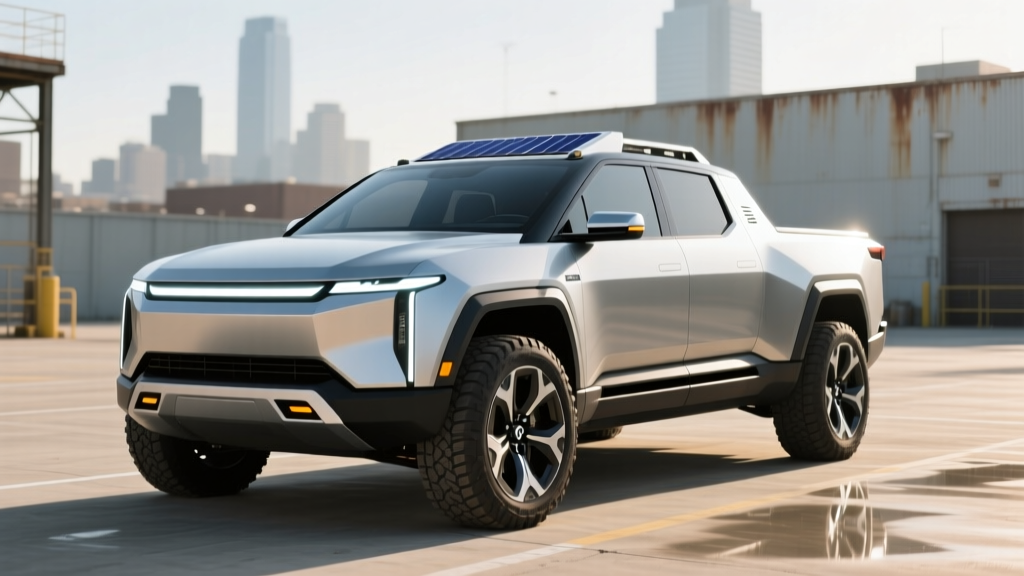
The R1T X concept design language builds on the second-generation R1T platform introduced for the 2025 model year, but pushes the truck's proportions and stance further into performance-truck territory. Key design differentiators include:
- Tri-motor powertrain layout: A single front motor paired with dual rear motors, delivering torque-vectoring capability across the rear axle.
- Wider fender flares and track width: Accommodating larger 35-inch all-terrain tires as standard equipment.
- Reinforced underbody: Full-length titanium skid plates replacing the current aluminum units for improved trail durability.
- Active aero elements: A deployable rear spoiler and active front air dam designed to reduce drag coefficient at highway speeds — critical for range preservation in a boxy truck profile.
- Integrated camp system: Redesigned Gear Tunnel with modular slide-out kitchen and integrated power distribution for off-grid camping.
The design intent is clear: Rivian is targeting buyers who want the overland capability of a fully built-out adventure truck without resorting to aftermarket modifications that compromise range and warranty coverage.
Projected Specs: Battery, Range, and Performance
| Specification | R1T X (Projected) | Current R1T Dual-Motor (2026) | Current R1T Quad-Motor (2026) |
|---|---|---|---|
| Battery Capacity (usable) | ~140 kWh (NMC) | 106 kWh (NMC) | 149 kWh (NMC) |
| Drivetrain | Tri-Motor AWD | Dual-Motor AWD | Quad-Motor AWD |
| Horsepower (est.) | ~850 hp | 533 hp | 1,025 hp |
| 0-60 mph (est.) | ~3.2 sec | 4.5 sec | 2.6 sec |
| EPA Range (target) | ~410+ mi | 352 mi (Max Pack) | 328 mi (Max Pack) |
| Towing Capacity | 11,000 lb (est.) | 11,000 lb | 11,000 lb |
| Ground Clearance | 14.9 in (est.) | 14.9 in | 14.9 in |
The R1T X's projected ~140 kWh battery pack would use next-generation NMC (nickel manganese cobalt) cells — likely with a higher silicon-anode content for improved energy density. Rivian has not confirmed a shift to LFP (lithium iron phosphate) for the X variant, and given the range and performance targets, NMC remains the logical chemistry choice. LFP offers longer cycle life and lower cost but sacrifices energy density, which matters in a truck where pack volume is already at a premium.
Charging Speed: DC Fast and Home Level 2
Charging infrastructure compatibility is where the R1T X concept design shows its most significant evolution. Rivian's second-generation platform adopted the NACS (North American Charging Standard) connector natively, and the R1T X is expected to leverage the company's latest 800-volt electrical architecture for faster DC charging.
| Charging Level | Connector | Max Power (kW) | Rate (mi/hr added) | Notes |
|---|---|---|---|---|
| Level 1 (120V) | NACS | 1.4 kW | ~3 mi/hr | Emergency/trickle only |
| Level 2 (240V, 48A) | NACS / J1772 adapter | 11.5 kW | ~28 mi/hr | Full charge in ~13 hr |
| Level 2 (240V, 80A) | NACS | 19.2 kW | ~47 mi/hr | Requires 100A circuit; full charge ~8 hr |
| DC Fast Charge | NACS (Tesla Supercharger compatible) | ~220-250 kW (peak) | ~500+ mi/hr (peak) | 10-80% in ~28-35 min (est.) |
The 800V architecture is the critical upgrade here. The current R1T operates on a ~400V system, which limits peak DC charge rates to around 200 kW. Moving to 800V allows the R1T X to accept higher charge power without proportionally increasing current — reducing heat generation and cable weight. Expect the charge curve to peak near 250 kW between 10-40% State of Charge (SoC), then taper progressively. The 10-80% time of roughly 28-35 minutes is competitive with the fastest-charging trucks, though the massive battery pack means absolute charge times will be longer than smaller-battery EVs.
For home charging, Rivian's Wall Connector (NACS native) at 48 amps will add about 28 miles of range per hour — adequate for daily commuting if you plug in overnight. Owners with 200-amp electrical panels can upgrade to an 80-amp hardwired charger for nearly 50 mi/hr, but expect $1,500-$3,500 in electrician costs including a potential panel upgrade.
Pricing, Trims, and Federal Tax Credit Eligibility
Rivian has not published official MSRP for the R1T X, but based on the current R1T pricing ladder and the X's position as a halo model, here's a reasonable projection:
| Trim / Variant | Base MSRP (2026) | Federal §30D Credit Eligible? |
|---|---|---|
| R1T Dual-Motor (Standard Pack) | $69,900 | Yes — if income & sourcing rules met |
| R1T Dual-Motor (Max Pack) | $83,900 | Yes — under $80K truck cap? No; over cap |
| R1T Quad-Motor | $99,000 | No — exceeds $80,000 truck MSRP cap |
| R1T X (Projected) | ~$105,000-$115,000 | No — expected to exceed $80K truck cap |
Under IRS §30D rules, new electric trucks must have an MSRP at or below $80,000 to qualify for the federal tax credit (up to $7,500). The R1T X, as a premium halo model, will almost certainly exceed this cap — meaning buyers should not plan their budget around the federal credit. Additionally, the §30D credit carries adjusted gross income limits ($150,000 single / $300,000 joint) and battery critical-mineral sourcing requirements that change annually.
Some buyers may qualify for a state-level incentive or utility rebate to offset cost. Check your state energy office and local utility for current programs — these vary widely by jurisdiction.
Cargo, Passenger Space, and Practicality
The R1T X retains the R1T's core dimensions — a 4.5-foot bed (extending to ~6 feet with the Gear Tunnel door open) and a five-passenger crew cab. Key interior and cargo figures from the current platform (expected to carry over):
- Bed length: 54.2 inches (bed); 72+ inches with Gear Tunnel access
- Bed payload: ~1,760 lb
- Gear Tunnel volume: 11 cu ft (pass-through storage behind cab)
- Front trunk (frunk): 11 cu ft, lockable, with drain plug
- Front legroom: 41.3 inches
- Rear legroom: 38.2 inches
- Total enclosed cargo: ~67 cu ft (bed + Gear Tunnel + frunk combined)
The R1T X concept design adds a redesigned Gear Tunnel with a slide-out camp kitchen module (available as an accessory), integrated 120V/240V power outlets for tools and appliances, and a reinforced composite bed floor rated for heavier concentrated loads. The R1T's unique four-door-plus-Gear-Tunnel layout remains one of the most practical designs in the truck segment for adventure use — though the short bed limits traditional truck utility compared to a full-size 6.5-foot bed.
Technology, Driver Assistance, and Software
Rivian's software-defined vehicle approach means the R1T X will ship with the company's latest ADAS suite and infotainment stack. Expect:
- Rivian Driver+ (Level 2 ADAS): Adaptive cruise control, lane-centering assist, and highway driving assist on mapped roads. This is an SAE Level 2 system — the driver must remain engaged with hands on the wheel and eyes on the road at all times. It is not self-driving.
- 15.6-inch central touchscreen with native navigation, over-the-air (OTA) updates, and integrated trip planning with charging stops.
- Digital driver display: 12.3-inch instrument cluster with real-time range estimation, elevation profiling, and battery thermal status.
- Vehicle-to-load (V2L): Up to 7.2 kW of bidirectional power output — enough to run power tools, camp appliances, or provide limited home backup during an outage.
- Off-road software modes: Rock Crawl, Sand, Snow, and All-Terrain with adjustable ride height (up to 14.9 inches ground clearance) and individual wheel torque vectoring on the tri-motor rear axle.
How the R1T X Compares to Competitors
| Attribute | Rivian R1T X (Projected) | Tesla Cybertruck AWD | Ford F-150 Lightning (Ext. Range) | Chevrolet Silverado EV 4WT |
|---|---|---|---|---|
| EPA Range | ~410 mi | 340 mi | 320 mi | 440 mi |
| Battery (kWh) | ~140 (NMC) | ~123 (NMC) | 131 (NMC) | ~200 (NMC) |
| Peak DC Charge (kW) | ~250 | 250 | 150 | 350 |
| 0-60 mph | ~3.2 sec | 3.9 sec | 3.8 sec | 4.5 sec |
| Towing (lb) | 11,000 | 11,000 | 10,000 | 10,000 |
| Base MSRP | ~$110,000 | $79,990 | $69,995 | $74,800 |
| §30D Credit Eligible | No (over cap) | Borderline ($80K cap) | Yes (select trims) | Yes (select trims) |
The R1T X targets a different buyer than the Lightning or Silverado EV. It's a premium adventure truck, not a fleet workhorse. The closest comparison is the Cybertruck, but the R1T X emphasizes overland touring and camp integration over the Cybertruck's angular utility and stainless-steel novelty. The Silverado EV's 440-mile range and 350 kW charging are formidable, but it's a much larger vehicle without the R1T's trail-friendly dimensions.
Pros, Cons, and Who Should Wait for the R1T X
Pros
- 410+ mile range target leads the adventure-truck segment
- Tri-motor torque vectoring for superior off-road traction
- 800V architecture for faster DC charging
- NACS native — full Tesla Supercharger network access
- Integrated camp/overland features without aftermarket mods
- 7.2 kW V2L for off-grid power
- OTA software updates continuously improve the vehicle
Cons
- Projected $110K+ price — no federal tax credit
- Not yet in production — 2027 model year target
- Short 4.5-ft bed limits traditional truck utility
- Large battery = long home charge times without 80A circuit
- Rivian's service center network is still expanding
- Real-world towing range will likely drop below 220 miles
- Insurance costs for high-value EVs remain elevated
Who the R1T X Is For
The R1T X is best suited for adventure-oriented buyers who regularly drive 250+ miles to trailheads, camp off-grid, and want a single vehicle that replaces both a daily driver and a built-out overland rig. It's not the right pick for fleet buyers, budget-conscious commuters, or anyone who needs a full-size 6.5-foot bed for job-site work. If your daily commute is under 40 miles and you tow rarely, the current R1T Dual-Motor with Max Pack (352 mi EPA, ~$84K) delivers most of the capability at significantly lower cost.
Warranty and Long-Term Ownership
Rivian's current warranty structure (expected to carry to the R1T X):
- Battery & drive unit: 8 years / 175,000 miles (whichever comes first), with a minimum 70% capacity retention guarantee over the warranty period
- Vehicle limited warranty: 5 years / 60,000 miles
- Corrosion perforation: 5 years / unlimited miles
Rivian's 175,000-mile battery warranty is among the most generous in the EV truck segment. For a ~140 kWh NMC pack, a 70% retention threshold at 175,000 miles means the battery should still hold roughly 98 kWh of usable energy — enough for approximately 287 miles of real-world range. Battery replacement costs for packs of this size currently run $20,000-$30,000 out of warranty, though prices are expected to decline as cell costs continue to drop.
Frequently Asked Questions
What is the real-world range of the Rivian R1T X?
Rivian targets 410+ miles EPA. In real-world highway driving at 70 mph in moderate temperatures, expect roughly 310-340 miles. Cold weather (below freezing) can reduce this to 250-290 miles. Towing a trailer will cut range further — plan for 180-220 miles when towing 5,000+ lb.
How fast does the R1T X charge?
Projected peak DC fast-charge rate is approximately 250 kW on an 800V-compatible charger, with a 10-80% charge in roughly 28-35 minutes. Home Level 2 charging at 48A adds about 28 miles per hour; at 80A (with electrical panel upgrade), it adds approximately 47 miles per hour.
Does the R1T X qualify for the federal EV tax credit?
Almost certainly not. Under IRS §30D rules, electric trucks must have an MSRP at or below $80,000 to be eligible. The R1T X is projected to start well above $100,000, exceeding the cap. It will also likely exceed buyer income limits for many potential purchasers.
Is the R1T X worth waiting for vs. buying a current R1T?
If you need a truck now and your daily driving is under 300 miles, the current R1T Dual-Motor Max Pack (352 mi EPA, $83,900) is an excellent vehicle available today. Wait for the R1T X only if you need 400+ mile range for long overland routes, want the tri-motor performance, and are comfortable with a $110K+ price tag and a 2027 delivery timeline.
When will the Rivian R1T X be available?
Rivian has indicated a production-intent tri-motor R1T variant for the 2027 model year. Reservations and configurator access have not yet opened. Final EPA ratings, pricing, and delivery timelines will be confirmed closer to production.
Can the R1T X use Tesla Superchargers?
Yes. Rivian's second-generation platform uses the NACS connector natively, giving the R1T X direct access to the Tesla Supercharger network without an adapter — currently the largest and most reliable DC fast-charging network in North America.