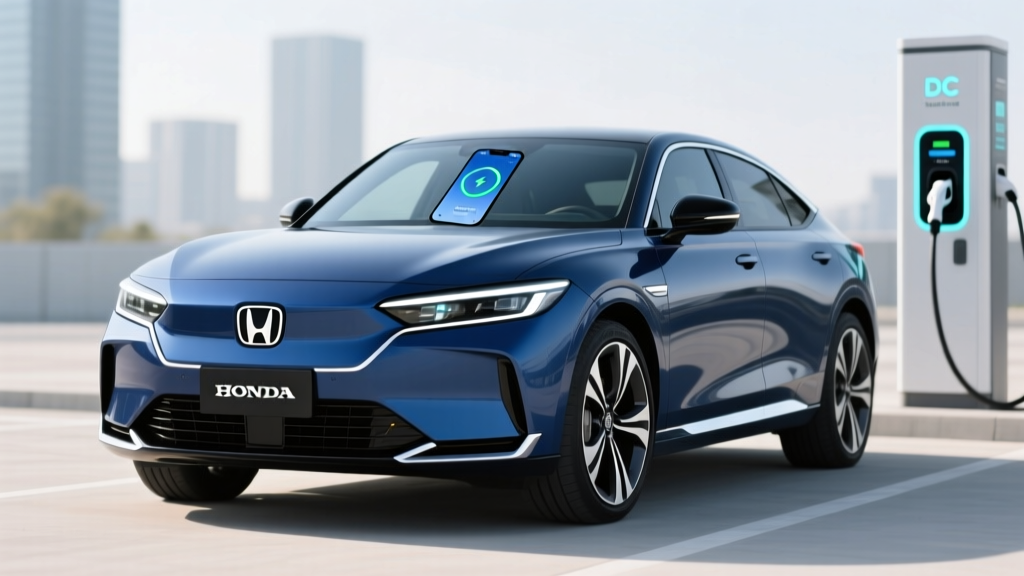
Honda Prologue Dimensions and Quick Specs at a Glance
The Honda Prologue slots into the midsize electric SUV segment as Honda's first mass-market BEV, built on General Motors' Ultium platform. For buyers researching Honda Prologue dimensions, cargo capacity, and real-world electric usability, the numbers tell a practical story: this is a family-oriented crossover with competitive interior volume, respectable but not class-leading range, and a charging profile that demands some planning on road trips.
| Spec | EX (FWD) | Touring (AWD) |
|---|---|---|
| EPA Range | 296 miles | 272 miles |
| Battery (usable) | 85 kWh, NMC lithium-ion (Ultium) | |
| Motor / Drivetrain | Single motor FWD, 213 hp | Dual motor AWD, 288 hp |
| 0–60 mph | ~8.1 sec | ~6.2 sec |
| MPGe (combined) | 99 MPGe | 94 MPGe |
| Efficiency | 34 kWh/100 mi | 36 kWh/100 mi |
| Max DC Fast Charge | 150 kW peak | |
| 10–80% DC Charge Time | ~35 minutes (est.) | |
| Level 2 Home Charge | 11.5 kW (~37 mi/hr) | |
| Length | 192.0 in | |
| Width (no mirrors) | 78.3 in | |
| Height | 64.7 in | |
| Wheelbase | 121.8 in | |
| Cargo (rear seats up) | 25.2 cu ft | |
| Cargo (rear seats folded) | 57.7 cu ft | |
| Rear Legroom | 38.6 in | |
| Front Legroom | 41.4 in | |
| Towing Capacity | 1,500 lb | |
| Battery Warranty | 8 yr / 100,000 mi | |
| Base MSRP | $47,400 | $57,900 |
Sources: EPA fueleconomy.gov, Honda Prologue official page.
Real-World Range vs. EPA Estimates
Real-world highway (70 mph, 72°F): expect ~245–265 mi
Cold weather (below 32°F, mixed driving): expect ~200–230 mi
The Prologue's 85 kWh usable NMC battery delivers competitive EPA numbers, but the Ultium platform's efficiency trails Hyundai-Kia's E-GMP and Tesla's powertrain. At highway speeds, the Prologue consumes roughly 34–36 kWh per 100 miles — higher than the Hyundai Ioniq 5's ~30 kWh/100 mi. This means road-trip range drops noticeably above 70 mph.
Cold-weather degradation is significant for any NMC pack without a robust heat-pump system. In sub-freezing temperatures, expect a 20–30% reduction from the EPA figure. Honda includes battery preconditioning for DC fast charging, which helps preserve charge speed in cold weather, but cabin heating still draws heavily from the pack. If your commute involves brutal winters and highway speeds, budget for ~200 effective miles between charges.
Charging Speed: DC Fast, Level 2, and Level 1
| Charge Level | Power | Speed (approx.) | Notes |
|---|---|---|---|
| Level 1 (120V) | 1.4 kW | ~4 mi/hr | Emergency/trickle only; full charge in ~60+ hrs |
| Level 2 (240V, 48A) | 11.5 kW | ~37 mi/hr | Full charge in ~8.5 hrs; ideal for home overnight |
| DC Fast Charge | 150 kW peak | 10–80% in ~35 min | Tapers significantly above 80%; avg ~90 kW sustained |
The Prologue's 150 kW peak DC charge rate is its most debated spec. Competitors like the Hyundai Ioniq 5 (350 kW peak, 10–80% in ~18 min) and Tesla Model Y (250 kW peak, ~20 min) outperform it substantially on long road trips. The Prologue's charge curve holds near peak only between roughly 10–40% state of charge, then tapers progressively. From 80–100%, expect very slow charging — plan your stops to stay in the 10–80% window.
At home, the 11.5 kW Level 2 rate is solid. A full overnight charge is easily achievable with a hardwired 48-amp Level 2 station on a 60-amp circuit. Honda includes a dual-level charge cord (Level 1/Level 2 capable) with 240-volt NEMA 14-50 plug support, though a dedicated wall charger is recommended for daily use. Installation costs for a 240V circuit typically range from $500 to $2,000 depending on panel proximity and local permit requirements — consult a licensed electrician for a site-specific quote.
Interior Dimensions, Cargo, and Practicality
The Prologue's 121.8-inch wheelbase — longer than the Honda CR-V's — translates directly to generous rear-seat legroom at 38.6 inches. Front legroom measures 41.4 inches, putting it on par with the Chevrolet Blazer EV (its platform sibling). The cabin feels airy, helped by a relatively low beltline and available panoramic roof on upper trims.
Cargo space is where dimensions matter most for SUV buyers:
- Behind second row: 25.2 cu ft — adequate for weekly groceries, two large suitcases, or a double stroller, but trails the Tesla Model Y's 30.2 cu ft and the Kia EV9's 43.5 cu ft.
- Rear seats folded: 57.7 cu ft — enough for a full Costco haul or camping gear, but again, not class-leading.
- Frunk (front trunk): The Prologue has no front trunk. The Ultium platform's front subframe packaging leaves no cargo space under the hood.
Ground clearance is 8.0 inches, suitable for light snow and gravel but not off-roading. The 1,500-lb towing capacity is light-duty only — fine for a small utility trailer or a pair of dirt bikes, but insufficient for any camper or boat. If towing is a priority, the Ford F-150 Lightning or Rivian R1S are far more capable.
Pricing, Trims, and Federal Tax Credit Eligibility
| Trim | Drivetrain | MSRP | Est. After §30D Credit* |
|---|---|---|---|
| EX | FWD | $47,400 | $39,900 |
| EX | AWD | $50,400 | $42,900 |
| Touring | AWD | $57,900 | $50,400 |
| Elite | AWD | $62,400 | $54,900 |
*Assumes full $7,500 federal tax credit eligibility. Actual credit depends on buyer income, MSRP caps, and battery-component/critical-mineral sourcing requirements under IRS §30D rules. The Prologue's MSRP falls under the $80,000 SUV cap. Point-of-sale transfer is available if the dealer is registered.
The Prologue qualifies for the federal clean vehicle credit provided the buyer meets income thresholds ($150,000 single / $300,000 joint modified AGI) and the vehicle's battery components and critical minerals satisfy phase-in sourcing requirements. Because Honda manufactures the Prologue on GM's Ultium platform in Mexico, battery-sourcing compliance can shift year-to-year. Always verify current eligibility with your dealer and a tax professional before purchase. The credit can be transferred at the point of sale as a price reduction, effectively lowering your out-of-pocket cost at signing.
Performance, Ride, and Tech Highlights
The dual-motor AWD Touring model's 288 horsepower and ~6.2-second 0–60 time provide confident highway merging and passing. It won't pin you to the seat like a Tesla Model Y Performance (3.5 sec), but it's brisk for a family crossover. The single-motor FWD at 213 hp is adequate for commuting but feels leisurely when fully loaded with passengers and cargo.
Ride quality is a strength. The Prologue's suspension tuning prioritizes comfort over sportiness — it absorbs potholes and expansion joints with a composure that feels more premium than its price suggests. Steering is light and numb, which suits urban driving but disappoints on back roads.
Standout Tech
- Google Built-In infotainment: Google Maps, Google Assistant, and Play Store apps run natively on the 11.3-inch touchscreen (Touring/Elite). Navigation integrates real-time DC charger availability.
- Honda Sensing suite: Adaptive cruise control with low-speed follow, lane-keeping assist, collision mitigation braking, and traffic sign recognition. This is SAE Level 2 driver assistance — the driver must remain engaged at all times.
- Wireless Apple CarPlay / Android Auto on all trims.
- 11-inch digital driver display with customizable drive information.
Notable Drawbacks
- DC fast-charge speed trails key competitors by a wide margin.
- No front trunk (frunk) reduces total utility.
- Energy efficiency is below segment average, cutting real-world highway range.
- Regenerative braking lacks true one-pedal driving on the base EX trim; steering-wheel paddles adjust regen level but don't bring the car to a complete stop.
- Rear visibility is compromised by thick C-pillars; a digital rearview mirror is not available.
Who Should Buy the Honda Prologue?
Choose the Prologue if:
- You're a loyal Honda/Acura buyer who wants a familiar dealership experience and proven reliability support.
- Your daily driving is under 80 miles round-trip and you can charge at home overnight.
- Rear-seat passenger comfort matters more than maximum cargo volume.
- You value ride comfort and quiet over sporty handling.
Look elsewhere if:
- You take frequent road trips over 300 miles and need fast DC charging to minimize stops.
- You need maximum cargo space — consider the Kia EV9, Tesla Model Y, or Hyundai Ioniq 5.
- You want one-pedal driving as standard — Hyundai/Kia and Tesla execute this better.
- Towing is a priority — look at trucks or larger SUV platforms.
Pros and Cons Summary
Pros
- Spacious rear seat (38.6 in legroom) and comfortable ride
- Google Built-In infotainment is responsive and useful
- Competitive MSRP after federal tax credit
- Strong Honda dealer network for service and support
- Standard Honda Sensing ADAS suite on all trims
- Available AWD with respectable 288 hp
Cons
- 150 kW DC fast-charge peak is slow for 2026 standards
- No frunk; cargo volume trails segment leaders
- Efficiency (34–36 kWh/100 mi) reduces real-world range
- One-pedal driving is incomplete on base trims
- Steering feel is numb and detached
- 1,500-lb tow rating limits utility
2026 Honda Prologue FAQ
What is the real-world range of the Honda Prologue?
The EPA rates the FWD EX at 296 miles and the AWD Touring at 272 miles. In real-world highway driving at 70 mph, expect 245–265 miles. In cold weather below freezing, plan for 200–230 miles. The NMC battery's efficiency at 34–36 kWh/100 mi means range drops more sharply at high speeds than more efficient rivals.
How fast does the Honda Prologue charge at home and on the road?
At home on a Level 2 (240V, 48A) charger, the Prologue charges at 11.5 kW, adding roughly 37 miles per hour — a full charge takes about 8.5 hours. On DC fast chargers, it peaks at 150 kW and reaches 10–80% in approximately 35 minutes. The charge curve tapers heavily above 80%, so plan road-trip stops to stay in the 10–80% window.
Does the Honda Prologue qualify for the $7,500 federal EV tax credit?
The Prologue is eligible for up to $7,500 under IRS §30D, subject to buyer income limits ($150K single / $300K joint MAGI), the $80,000 SUV MSRP cap, and battery-component/critical-mineral sourcing requirements that phase in annually. The credit can be applied at the point of sale as a direct price reduction. Verify current-year eligibility with your dealer and a tax professional, as sourcing rules change.
Is the Honda Prologue worth buying over the Hyundai Ioniq 5 or Tesla Model Y?
It depends on your priorities. The Prologue wins on ride comfort, Honda brand familiarity, and dealership support. The Ioniq 5 wins on DC fast-charge speed (350 kW, ~18 min 10–80%), efficiency, and cargo versatility. The Model Y wins on range, Supercharger network access, and tech. If you charge at home and rarely road-trip, the Prologue is a strong value after the tax credit. If you drive long distances frequently, the Ioniq 5 or Model Y are better tools.
What are the Honda Prologue's exterior dimensions?
The Prologue measures 192.0 inches long, 78.3 inches wide (excluding mirrors), and 64.7 inches tall, with a 121.8-inch wheelbase. It is slightly shorter than the Chevrolet Blazer EV but rides on a longer wheelbase than the Honda CR-V, giving it proportionally more interior passenger room and a smoother ride over bumps.
Does the Prologue have a front trunk (frunk)?
No. The Ultium platform's front subframe and power electronics packaging leaves no under-hood cargo space. Total cargo capacity is limited to the rear cargo area: 25.2 cu ft behind the second row and 57.7 cu ft with the rear seats folded.