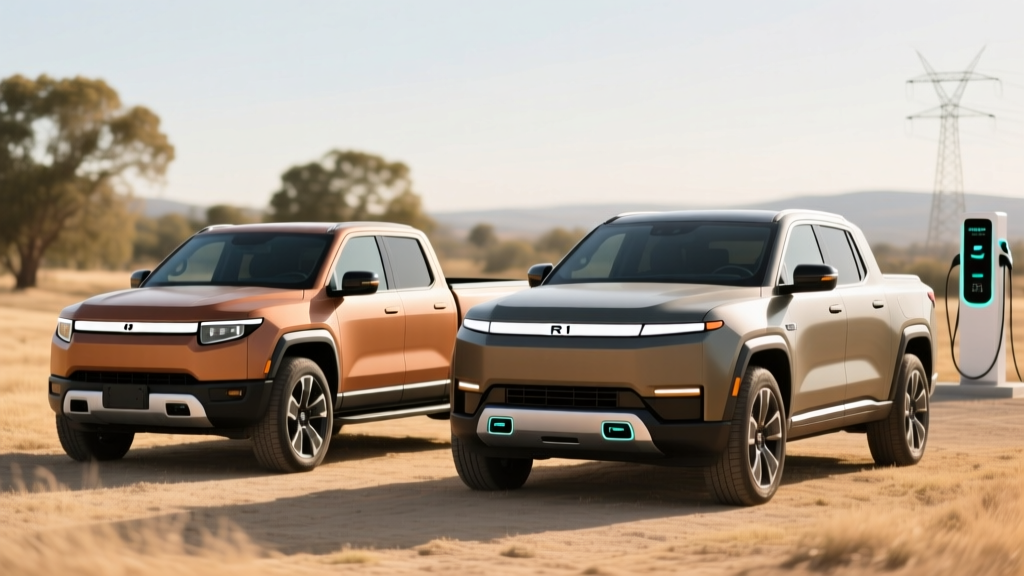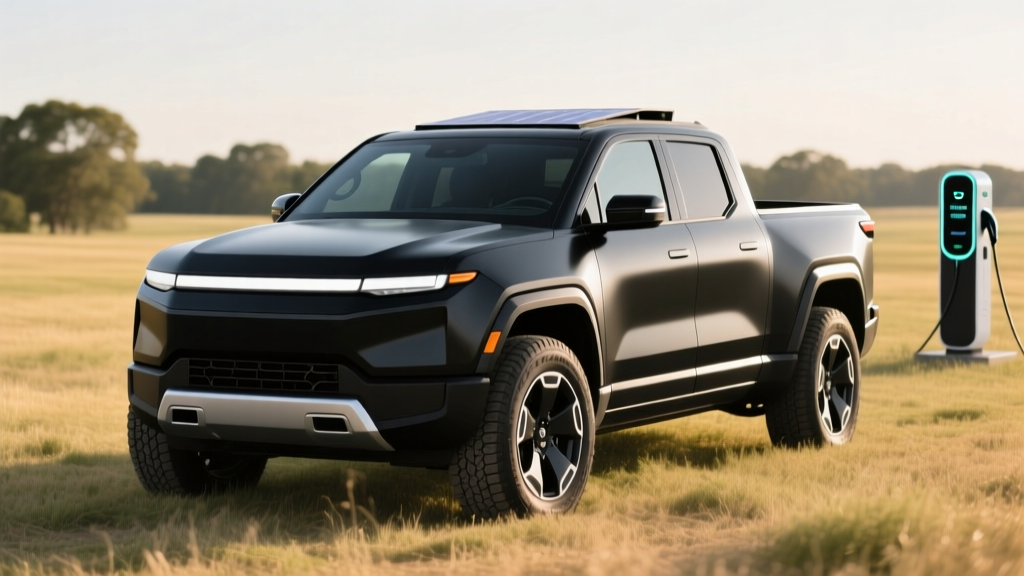
The Rivian R1T remains one of the only all-electric pickup trucks that blends genuine off-road capability with daily-driver refinement. For 2026, the second-generation R1T arrives with a redesigned battery architecture, faster charging, and a revised interior — but its footprint, bed utility, and cabin packaging are what buyers cross-shop most against the Ford F-150 Lightning and Chevrolet Silverado EV. Below, we break down every Rivian truck dimension that matters, pair them with real-world range and charging data, and evaluate whether the R1T earns its premium price tag.
2026 Rivian R1T at a Glance: Core Specifications
| Spec | Value |
|---|---|
| EPA Range (Max Pack) | 420 miles |
| EPA Range (Standard Pack) | 270 miles |
| Battery Usable Capacity | 92 kWh (Standard) / 149 kWh (Max) |
| Battery Chemistry | NMC (Nickel Manganese Cobalt) — 46mm cylindrical cells |
| Peak DC Fast Charge | 200 kW (Standard) / 220 kW (Max) |
| 10–80% DC Charge Time | ~21 min (Standard) / ~30 min (Max) |
| Level 2 Home Charging | 11.5 kW (~25 mi/hr) |
| Horsepower (Dual-Motor) | 533 hp / 610 lb-ft torque |
| Horsepower (Tri-Motor) | 850 hp / 1,100 lb-ft torque |
| 0–60 mph (Dual-Motor) | 4.5 seconds |
| 0–60 mph (Tri-Motor) | 2.9 seconds |
| Drivetrain | AWD (dual-motor or tri-motor) |
| Max Towing Capacity | 11,000 lbs |
| MPGe (Dual-Motor Std Pack) | 70 MPGe combined |
| Efficiency | 48 kWh/100 mi (Dual-Motor Std) |
| Base MSRP (Dual-Motor Std) | $69,900 |
| As-Tested (Tri-Motor Max) | ~$105,000 |
| Battery/Powertrain Warranty | 8 years / 175,000 miles |
Exterior Truck Dimensions: Bed, Wheelbase, and Clearance
Understanding Rivian truck dimensions starts with the exterior envelope. The R1T rides on a 135.8-inch wheelbase and stretches 217.1 inches bumper to bumper — roughly the length of a mid-size crew-cab truck like the Toyota Tacoma, but with a uniquely short 54-inch bed (4.5 feet). That abbreviated bed is the R1T's most polarizing dimension and the single biggest factor separating it from full-size competitors.
Width comes in at 81.8 inches (without mirrors), and height stands at 73.0 inches on the standard air suspension setting. The air suspension offers 6.5 inches of adjustability, dropping to a 6.7-inch ground clearance for highway efficiency or raising to a maximum 14.9 inches for off-road use — more clearance than a Ford Raptor.
Bed and Cargo Dimensions
- Bed length (floor): 54.0 inches (4 ft 6 in)
- Bed width (between wheel wells): 50.0 inches
- Bed width (max): 60.0 inches
- Bed volume: ~29.9 cu ft
- Gear Tunnel (transverse storage): 11.0 cu ft, accessible from both sides
- Front Trunk (Frunk): 11.0 cu ft, lockable, with drain plug
- Total enclosed cargo: ~51.9 cu ft across bed, tunnel, and frunk
The Gear Tunnel — a pass-through compartment behind the rear seats spanning the full width of the truck — is the R1T's party trick. It swallows long items like skis, fishing rods, or camp chairs that won't fit in the short bed. Combined with the frunk, the R1T offers enclosed storage that rivals some mid-size SUVs, even though the open bed itself is the shortest in the pickup segment.
Cabin Interior Dimensions
- Front headroom: 40.8 inches
- Front legroom: 41.3 inches
- Rear headroom: 38.2 inches
- Rear legroom: 37.3 inches
- Seating capacity: 5 passengers
Rear-seat space is adequate for adults on shorter trips, though the upright seatback angle and 37.3 inches of legroom trail what you'll find in a Ford F-150 Lightning's back row. The R1T cabin feels more like a premium mid-size SUV than a full-size truck — cozy rather than cavernous.
Range and Efficiency: EPA vs. Real-World Expectations
EPA Estimated Range: 420 miles (Max Pack, Dual-Motor) | 270 miles (Standard Pack, Dual-Motor)
Real-World Expectation: On highway trips at 70–75 mph, expect approximately 330–360 miles from the Max Pack and 210–230 miles from the Standard Pack. In freezing temperatures (below 30°F), reduce those figures by 20–30%. The R1T's boxy shape and 6,800+ lb curb weight penalize highway efficiency more than city driving, where regenerative braking recovers energy.
The 2026 R1T's second-generation battery uses 46mm cylindrical NMC cells manufactured in a form factor similar to Tesla's 4680 design. Rivian quotes 149 kWh usable for the Max Pack — among the largest usable battery capacities in any production EV. The Standard Pack uses a 92 kWh pack.
Efficiency lands at 48 kWh per 100 miles for the Dual-Motor Standard, translating to 70 MPGe combined per fueleconomy.gov. That is competitive with the F-150 Lightning Extended Range (70 MPGe) but trails the more aerodynamic Tesla Cybertruck AWD (79 MPGe). The R1T's bluff front end and 7,000-lb mass work against it at sustained highway speeds.
For buyers who tow, expect range to drop 40–50% when pulling a 5,000–8,000 lb trailer at highway speeds. That puts a Max Pack R1T at roughly 170–200 miles of real-world towing range — functional for short hauls but requiring route planning for longer trips.
Charging Speed: DC Fast Charge and Home Level 2
| Charging Level | Max Power (kW) | Speed / Notes |
|---|---|---|
| Level 1 (120V / 12A) | 1.4 kW | ~3 mi/hr — emergency trickle only |
| Level 2 (240V / 48A) | 11.5 kW | ~25 mi/hr — full charge overnight (~6–12 hrs depending on pack) |
| DC Fast Charge (Standard Pack) | 200 kW peak | 10–80% in ~21 minutes |
| DC Fast Charge (Max Pack) | 220 kW peak | 10–80% in ~30 minutes |
The Gen 2 R1T charges significantly faster than its predecessor, which peaked around 190 kW. The 200–220 kW peak is competitive with the Ford F-150 Lightning (150 kW) and approaching the Tesla Cybertruck (250 kW on V3 Superchargers).
A critical nuance: kW is power (the rate of energy flow), while kWh is energy (total battery capacity). The R1T Max Pack's 149 kWh battery takes longer to fill from 10–80% than the Standard Pack's 92 kWh battery, despite a slightly higher peak charge rate. In practice, the charge curve tapers significantly above 80% SoC — charging from 80–100% can add another 25–40 minutes, so plan to charge to 80% on road trips and keep moving.
At home on a Level 2 Wall Connector or Rivian Wall Charger (240V, 48A), the R1T adds roughly 25 miles of range per hour. A full Standard Pack charge takes about 6–7 hours overnight; the Max Pack requires 10–12 hours. Most owners will need a 60-amp dedicated circuit with a NEMA 14-50 outlet or hardwired installation — budget $800–$2,500 for professional electrician installation depending on panel proximity and local permit requirements. Homes with older 100-amp electrical panels may need a panel upgrade ($1,500–$3,000) to support simultaneous EV charging and household loads.
The R1T uses the NACS (North American Charging Standard) connector for 2026, giving it native access to the Tesla Supercharger network — over 20,000 stations across North America — without an adapter. This is a significant advantage over CCS-equipped competitors that still require adapters for Supercharger access.
Performance, Drivetrain, and Towing
Every 2026 R1T ships with all-wheel drive. The Dual-Motor configuration pairs one motor on each axle for 533 hp and 610 lb-ft of torque, delivering a 4.5-second 0–60 mph time — quick for a truck that weighs nearly 7,000 lbs. The Tri-Motor variant adds a second rear motor for 850 hp and an astonishing 2.9-second 0–60 mph, putting it in supercar territory.
The quad-motor configuration from the first-generation R1T has been discontinued for 2026, simplified into the dual- and tri-motor lineup. Rivian's torque vectoring still operates brake-based on the dual-motor and adds true independent motor control on the tri-motor rear axle.
Towing capacity maxes at 11,000 lbs — competitive with the F-150 Lightning (10,000 lbs) and Silverado EV (10,000 lbs). The R1T includes an integrated trailer brake controller and a trailer-assist hitch system. However, towing at or near max capacity compresses real-world range to 150–200 miles and generates substantial battery heat, which can temporarily reduce charge acceptance on subsequent DC fast-charge stops.
Off-Road Capability
With 14.9 inches of maximum ground clearance, a wading depth of 36 inches, approach/departure angles of 35.5°/30°, and a four-corner air suspension, the R1T is the most capable off-road electric truck available. Rivian's "Tank Turn" feature (tri-motor only) can spin the truck in place by driving the left and right wheels in opposite directions — useful in tight trail situations.
Pricing, Trims, and Federal Tax Credit Eligibility
| Trim / Config | MSRP | Est. §30D Credit | Effective Price |
|---|---|---|---|
| Dual-Motor Standard Pack | $69,900 | $3,750–$7,500* | $62,400–$66,150 |
| Dual-Motor Large Pack | $75,900 | $3,750–$7,500* | $68,400–$72,150 |
| Dual-Motor Max Pack | $85,900 | $3,750–$7,500* | $78,400–$82,150 |
| Tri-Motor Max Pack | $99,900 | $3,750–$7,500* | $92,400–$96,150 |
*Federal tax credit amounts depend on battery-sourcing compliance, buyer income, and MSRP caps under IRS §30D. Rivian vehicles are assembled in Normal, Illinois (US-built), but critical-mineral and battery-component sourcing requirements may limit the full $7,500. Some buyers may qualify for $3,750 (partial credit). Check current eligibility at irs.gov.
Key §30D eligibility factors for the R1T:
- MSRP cap: Pickup trucks must have an MSRP at or below $80,000 to qualify. This eliminates the Tri-Motor Max Pack ($99,900) from credit eligibility entirely. The Dual-Motor Max Pack at $85,900 also exceeds the cap.
- Buyer income cap: Modified adjusted gross income (MAGI) must not exceed $300,000 (joint filers), $225,000 (head of household), or $150,000 (single).
- Battery sourcing: A percentage of critical minerals must be sourced from the US or free-trade-agreement countries, and battery components must be manufactured or assembled in North America. These thresholds tighten annually.
- Point-of-sale transfer: Eligible buyers can transfer the credit to the dealer at purchase, reducing the out-of-pocket price immediately rather than waiting for a tax refund.
The Dual-Motor Standard ($69,900) and Large ($75,900) Pack trims fall under the $80,000 MSRP cap and are the configurations most likely to benefit from the credit. Consult a tax professional to verify your personal eligibility before relying on the credit in your purchase budget.
Technology, Safety, and Driver Assistance
The 2026 R1T features a 15.6-inch center touchscreen running Rivian's proprietary infotainment OS, a 12.3-inch digital instrument cluster, and a 6.8-inch rear-seat touchscreen for climate and media controls. Wireless Apple CarPlay and Android Auto are not supported — Rivian uses its own native app ecosystem, which has drawn criticism from some buyers accustomed to phone mirroring.
The R1T includes Rivian's Driver+ suite as standard: adaptive cruise control, lane-centering assist, blind-spot monitoring, rear cross-traffic alert, and automatic emergency braking. Driver+ is an SAE Level 2 system, meaning the driver must remain fully attentive with hands on or near the wheel at all times. It is not a self-driving system. Hands-free driving (comparable to GM's Super Cruise or Ford's BlueCruise) is not available on the R1T as of the 2026 model year.
Safety ratings from the NHTSA show the R1T earned a 5-Star Overall rating. The IIHS has not yet published a full evaluation for the Gen 2 model.
Standout tech includes:
- Camp Kitchen accessory: A slide-out kitchen module that fits the Gear Tunnel (sold separately, ~$5,000)
- Powered tonneau cover: Available as an option, integrates with the bed rail system
- Vehicle-to-load (V2L): The R1T can output up to 7.2 kW of 120V/240V power from its battery, enough to run power tools at a job site or appliances during an outage (with appropriate transfer equipment)
- Over-the-air updates: Rivian regularly pushes software updates improving range estimation, charging curves, and feature additions
Who Should Buy the 2026 Rivian R1T?
Choose the R1T if:
- You need a lifestyle truck for camping, biking, skiing, or light hauling — not heavy commercial work
- Off-road capability matters (14.9" clearance, 36" wading depth)
- You value the Gear Tunnel and frunk for enclosed gear storage
- You want NACS-native Supercharger access for road trips
- Your towing needs stay under 8,000 lbs for reasonable range
Look elsewhere if:
- You need a full 6-foot or 8-foot bed for lumber, motorcycles, or pallets (consider F-150 Lightning or Silverado EV)
- You regularly tow over 8,000 lbs long distances — range while towing is a real constraint
- Rear-seat space is a priority for tall passengers on long trips
- You want Apple CarPlay/Android Auto integration
- Budget is under $65,000 — the R1T's entry price is steep even with tax credits
Pros and Cons
Pros
- Class-leading off-road capability with air suspension and 14.9" clearance
- Gear Tunnel + Frunk give ~52 cu ft total enclosed storage
- NACS connector for native Tesla Supercharger access
- Up to 420 miles EPA range (Max Pack) — best in the EV truck segment
- V2L capability at 7.2 kW for job-site or backup power
- Tri-Motor variant delivers supercar-level 2.9-sec 0–60 mph
- Strong build quality and OTA update cadence
Cons
- Short 4.5-ft bed limits utility for large cargo vs. full-size trucks
- Pricing starts at $69,900; higher trims exceed §30D tax-credit MSRP cap
- No Apple CarPlay or Android Auto
- Rear seat is tighter than F-150 Lightning or Silverado EV
- Highway efficiency (48 kWh/100 mi) trails more aerodynamic EVs
- No hands-free driving system (Level 2 only)
- Max Pack charging takes ~30 min (10–80%) due to large battery
Frequently Asked Questions
What is the real-world range of the 2026 Rivian R1T?
The Max Pack Dual-Motor carries a 420-mile EPA rating, but real-world highway driving at 70–75 mph typically yields 330–360 miles. The Standard Pack's 270-mile EPA rating translates to roughly 210–230 miles on the highway. Cold weather (below 30°F) reduces range by 20–30% across all packs. Towing a 5,000+ lb trailer cuts range by 40–50%.
How fast does the R1T charge at home and on the road?
On a DC fast charger, the Standard Pack peaks at 200 kW (10–80% in ~21 minutes) and the Max Pack at 220 kW (10–80% in ~30 minutes). At home on Level 2 (240V, 48A, 11.5 kW), the R1T adds approximately 25 miles of range per hour — a full Standard Pack charge takes 6–7 hours, while the Max Pack needs 10–12 hours.
How much does the R1T cost after federal tax credits?
The Dual-Motor Standard Pack starts at $69,900 MSRP. If you qualify for the full $7,500 §30D credit (income under cap, battery sourcing compliance met), the effective price drops to approximately $62,400. However, trims above $80,000 MSRP (Max Pack, Tri-Motor) are ineligible for the federal credit due to the truck MSRP cap. State and local incentives may stack on top — check afdc.energy.gov for your area.
Does the 2026 R1T qualify for the $7,500 federal EV tax credit?
It depends on trim, buyer income, and battery-sourcing compliance. The Dual-Motor Standard ($69,900) and Large ($75,900) Pack trims fall under the $80,000 pickup MSRP cap. Buyer MAGI must not exceed $300,000 (joint), $225,000 (HOH), or $150,000 (single). Battery critical-mineral and component sourcing rules apply and change annually. Verify current eligibility at irs.gov and with a tax professional.
Is the Rivian R1T worth buying vs. the Ford F-150 Lightning or Chevy Silverado EV?
The R1T wins on off-road capability, enclosed storage (Gear Tunnel + frunk), and NACS Supercharger access. The F-150 Lightning wins on bed length (5.5 or 6.5 ft), rear-seat space, and lower starting price (~$55,000). The Silverado EV offers a longer bed and competitive range but lacks the R1T's off-road prowess. If you need a work truck with a big bed, look at Ford or Chevy. If you want an adventure-lifestyle truck, the R1T is the segment leader.
What are the key Rivian truck dimensions I should know?
Overall length: 217.1 in. Wheelbase: 135.8 in. Width: 81.8 in. Height: 73.0 in (standard). Bed length: 54.0 in. Bed width between wells: 50.0 in. Ground clearance: 6.7–14.9 in (adjustable). Frunk: 11.0 cu ft. Gear Tunnel: 11.0 cu ft. Total enclosed cargo: ~51.9 cu ft. Front legroom: 41.3 in. Rear legroom: 37.3 in.