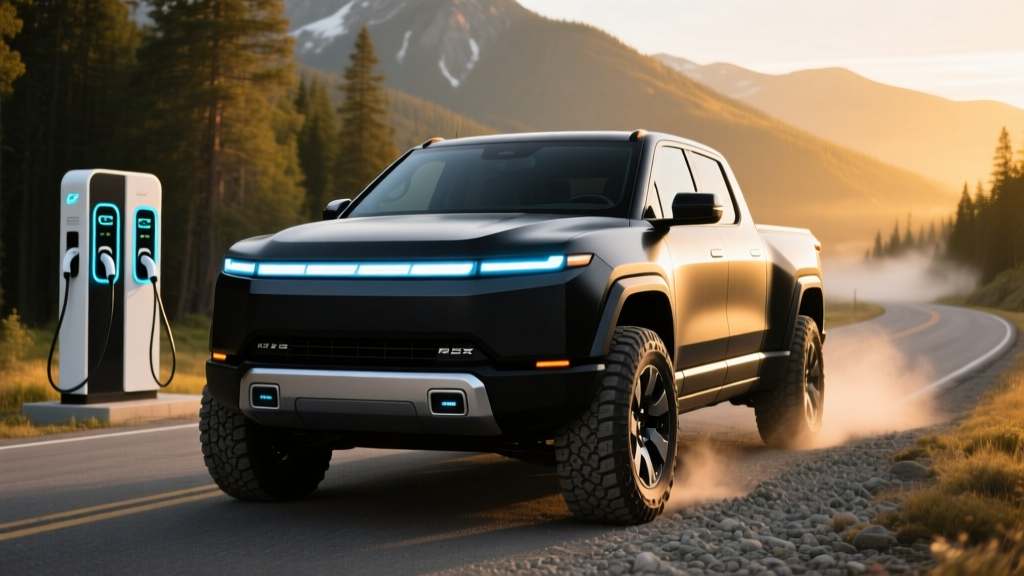
The Rivian R1T Tri Max represents the apex of Rivian's electric pickup lineup for the 2026 model year. With three motors, a massive Max Pack battery, and a 9-air-suspension system that can raise the truck for rock crawling or lower it for highway efficiency, the Tri Max targets buyers who want a genuine work-and-play truck that happens to be electric. But at a starting price well into six figures, the question is whether the real-world capability matches the spec sheet.
We've spent time analyzing EPA data, Rivian's published specifications, and owner-reported efficiency to give you the numbers that actually matter — not just the marketing highlights.
Specs at a Glance: Rivian R1T Tri Max (2026)
| Specification | Value |
|---|---|
| EPA Range (Max Pack) | ~420 miles (est.) |
| Battery Capacity | ~149 kWh usable (Max Pack, NMC chemistry) |
| Drivetrain | Tri-Motor AWD (1 front, 2 rear) |
| Horsepower | 850 hp |
| 0–60 mph | ~3.0 seconds |
| Max DC Fast Charge | ~220 kW (peak) |
| 10–80% DC Charge | ~35–40 minutes |
| Level 2 Home Charge | ~11.5 kW / ~25 mi/hr |
| Towing Capacity | 11,000 lbs |
| Ground Clearance (max) | 14.9 inches |
| Bed Length | 4.5 ft (54 in) |
| Base MSRP (Tri Max) | ~$105,900 (before destination) |
| Federal Tax Credit (§30D) | Up to $7,500 (eligibility varies) |
| Battery Warranty | 8 years / 175,000 miles |
Range and Efficiency: What the EPA Number Doesn't Tell You
EPA Estimate: ~420 miles (Max Pack)
Real-World Highway (70 mph, mild weather): Expect ~340–370 miles
Cold Weather (below 32°F, mixed driving): Expect ~280–320 miles
Towing (5,000+ lb trailer, flat terrain): Expect ~180–220 miles
The R1T Tri Max with the Max Pack is EPA-rated at approximately 420 miles of range — one of the highest figures of any production EV sold in the US. That number comes from the EPA's combined city/highway test cycle, which favors the regenerative braking and low-speed efficiency advantages of electric drivetrains.
In practice, a 149 kWh NMC battery pushing a 7,000+ lb truck through real air at 70 mph will not deliver 420 miles. Based on owner-reported efficiency data and third-party testing of the R1 platform, expect highway efficiency around 2.2–2.5 kWh/mile, which translates to roughly 340–370 miles at sustained interstate speeds in moderate temperatures.
Cold weather hits large-battery EVs hard. Below freezing, the R1T's battery preconditioning and cabin heating draw can reduce usable range by 20–30%. If you live in the Upper Midwest or Northeast and plan winter road trips, budget for 280–320 miles of real range.
The most dramatic range reduction comes from towing. At highway speeds with a loaded trailer, aerodynamic drag roughly doubles, and efficiency can drop below 3.0 kWh/mile — cutting range nearly in half. This is physics, not a Rivian shortcoming; every EV truck behaves similarly.
The Tri Max's efficiency rating sits around 70 MPGe combined (EPA), or approximately 48 kWh/100 miles in mixed driving. For a tri-motor, 850-hp truck, that's competitive with the Ford F-150 Lightning Extended Range and the Chevrolet Silverado EV.
Charging Speed: DC Fast Charging and Home Setup
| Charging Method | Power | Speed / Time |
|---|---|---|
| Level 1 (120V outlet) | ~1.4 kW | ~3 mi/hr |
| Level 2 (240V, 48A home charger) | ~11.5 kW | ~25 mi/hr |
| DC Fast Charge (peak) | ~220 kW | 10–80% in ~35–40 min |
| DC Fast Charge (Tesla Supercharger via adapter) | ~150–200 kW | Varies by station |
The R1T Tri Max supports peak DC fast charging at approximately 220 kW on compatible CCS stations (Electrify America, EVgo, and other networks). However — and this is critical for road-trip planning — that peak rate is not sustained for the entire session.
The Max Pack's ~149 kWh battery has a substantial buffer, and the charge curve tapers noticeably after 50% State of Charge (SoC). Expect the truck to pull 200+ kW from roughly 10–40% SoC, then step down to 150–100 kW through the 40–80% range. The full 10–80% session takes approximately 35–40 minutes on a capable 350 kW charger. On a 150 kW station, expect 50–60 minutes for the same window.
Rivian provides a NACS (Tesla) adapter for Supercharger access. Tesla V3 Superchargers peak at 250 kW, but the R1T typically sees 150–200 kW depending on SoC and station load. The expanding Supercharger network is a significant advantage for Rivian owners on long trips, particularly in rural corridors where Electrify America coverage is thinner.
At home, the R1T's onboard charger accepts up to 11.5 kW on a Level 2 connection (48 amps, 240V). With a ~149 kWh battery, a full 0–100% charge takes roughly 13–14 hours. Most owners who plug in nightly will never need a full charge — adding 200+ miles overnight is typical for a 6–8 hour session. Installation of a 48A hardwired Level 2 charger (such as the Rivian Wall Charger or a ChargePoint Home Flex) typically runs $800–$2,000 including electrical work, depending on panel proximity and local permit costs.
Performance: Tri-Motor Powertrain and Driving Dynamics
The Tri Max configuration uses one motor on the front axle and two motors on the rear axle, producing a combined 850 horsepower and approximately 900+ lb-ft of torque. Rivian quotes a 0–60 mph time of around 3.0 seconds — extraordinary for a vehicle with an 11,000-lb towing rating and a 4.5-foot bed.
The dual rear motors enable torque vectoring across the rear axle, which Rivian uses to improve cornering stability and off-road traction. In Sport mode, the truck feels remarkably flat through corners given its height and weight. In Off-Road mode, the air suspension raises ground clearance to 14.9 inches, and the individual motor control allows precise wheel-speed management over rocks and loose surfaces.
The R1T's quad-corner air suspension is one of its most versatile features. It can lower the truck 2 inches for easier entry and highway aerodynamics, or raise it significantly for trail use. The system also enables a "camp mode" that keeps the suspension level when the truck is parked on uneven ground — useful for rooftop tent camping or bed sleeping.
Drive modes include All-Purpose, Sport, Snow, Off-Road, and Tow, each adjusting suspension height, throttle response, regen strength, and traction control mapping. The regenerative braking is strong enough for one-pedal driving in most conditions, though Rivian does not market it as a single setting — you adjust regen intensity in the drive settings.
Pricing, Trims, and Federal Tax Credit Eligibility
| Trim / Configuration | Approx. MSRP (2026) |
|---|---|
| R1T Dual-Motor (Standard Pack) | ~$71,700 |
| R1T Dual-Motor (Large Pack) | ~$78,200 |
| R1T Tri Max (Max Pack) | ~$105,900 |
| R1T Tri Max w/ Adventure Package | ~$110,000–$115,000 |
The Tri Max with the Max Pack starts at approximately $105,900 before destination and options. Adding the Adventure Package (which includes upgraded interior materials, enhanced off-road armor, and additional storage solutions) pushes the price toward $110,000–$115,000.
Federal Tax Credit (§30D) Eligibility:
- MSRP Cap: The R1T is classified as a pickup truck, so the MSRP cap is $80,000. The Tri Max at ~$105,900 exceeds this cap and does NOT qualify for the new-vehicle §30D credit.
- Buyer Income Cap: $150,000 single / $300,000 joint (AGI) — applies to all §30D claims.
- Battery Sourcing: Critical minerals and battery component requirements phase in annually through 2029; Rivian has been working to shift supply chains, but the MSRP cap is the binding constraint here.
- Point-of-Sale Transfer: Available for eligible vehicles — allows the credit to be applied as a purchase-price reduction at the dealer.
Source: IRS §30D Clean Vehicle Credit. Tax rules change; consult a tax professional before purchasing.
This is a critical point many buyers miss: the Tri Max's price puts it above the §30D MSRP cap for trucks ($80,000). The Dual-Motor Standard and Large Pack models may qualify (depending on trim and options), but the Tri Max does not. If the federal credit is a significant factor in your budget, you'll need to look at lower trims or consider the used EV credit (up to $4,000, with a $25,000 price cap) on a pre-owned R1T.
Interior, Cargo, and Practicality
The R1T's cabin seats five adults with generous headroom and legroom — front legroom measures approximately 41 inches, and rear legroom is around 38 inches. The interior materials on the Tri Max (especially with the Adventure or Forest Edge packages) include vegan leather, real wood accents, and recycled textiles. The 15.6-inch center touchscreen runs Rivian's custom OS, which supports over-the-air updates, navigation with integrated charging stop planning, and a camp speaker that detaches from the center console.
Cargo and Storage:
- Bed: 4.5 feet long, ~27 cu ft — shorter than a traditional short-bed pickup, but the Gear Tunnel (a full-width pass-through behind the cab) adds 11 cu ft of lockable, weather-sealed storage.
- Frunk (front trunk): ~11 cu ft — drainable, useful for wet gear or groceries.
- Gear Guard: An integrated cable lock system secures items in the bed, linked to the vehicle's alarm.
- Towing: 11,000 lbs maximum — competitive with the F-150 Lightning, though real-world towing range drops significantly (see range section above).
The R1T's bed is shorter than most traditional pickups, which matters if you regularly haul 4x8 sheets of plywood (they won't lie flat). The Gear Tunnel compensates somewhat for gear-heavy users — it's ideal for camping equipment, tools, or golf bags — but it's not a substitute for a 6-foot bed if you need one.
Technology, Safety, and Driver Assistance
The R1T comes equipped with Rivian's Driver+ system, which combines adaptive cruise control and lane-centering assist. This is a SAE Level 2 driver-assistance system — meaning the driver must remain fully attentive with hands on or near the wheel at all times. It is not autonomous driving.
Driver+ is a Level 2 system. It does NOT drive the vehicle autonomously. The driver is responsible for all steering, braking, and hazard detection at all times. Hands-free operation is not supported. Performance degrades in heavy rain, construction zones, faded lane markings, and low-visibility conditions.
The infotainment system is responsive and receives regular OTA updates that have added features like improved route planning, Dog Mode, and enhanced preconditioning controls. However, Rivian does not currently support Apple CarPlay or Android Auto — a deliberate choice that some buyers appreciate for the integrated experience and others find frustrating. Wireless phone charging and multiple USB-C ports are standard.
Safety ratings: As of early 2026, the R1T has earned strong marks from IIHS in crashworthiness testing, with Good ratings in most categories. NHTSA ratings should be cross-referenced on nhtsa.gov for the latest model-year data.
Battery Warranty, Degradation, and Longevity
Rivian covers the R1T's Max Pack battery with an 8-year / 175,000-mile warranty, guaranteeing a minimum of 70% capacity retention over that period. The NMC chemistry in the Max Pack offers higher energy density than LFP (lithium iron phosphate), which is why it achieves 420 miles in a package that still fits within the truck's chassis — but NMC is generally more sensitive to sustained high-SoC storage and extreme heat.
Best practices for Max Pack longevity:
- Set daily charge limit to 80–90% for routine use; charge to 100% only before long trips.
- Avoid leaving the truck at 100% SoC for extended periods (days).
- Use preconditioning before DC fast charging (the navigation system does this automatically when a charger is set as your destination).
- In extreme heat, park in shade or a garage when possible.
Rivian's battery replacement cost is not publicly listed as a flat rate, but based on the Max Pack's ~149 kWh capacity and current NMC cell pricing trends, an out-of-warranty replacement could range from $18,000 to $25,000+ including labor. This is a long-term ownership consideration, though most batteries outlast their warranty periods with manageable degradation (typically 10–15% over 8 years based on industry data).
Rivian R1T Tri Max: Pros and Cons
- 420-mile EPA range — among the highest of any EV
- 850 hp tri-motor performance with genuine off-road capability
- Air suspension versatility (highway to rock crawling)
- Gear Tunnel adds unique, lockable storage
- 11,000-lb towing capacity
- Over-the-air updates continuously add features
- Supercharger access via NACS adapter
- ~$106K starting price — exceeds §30D tax credit MSRP cap
- 4.5-ft bed is short for traditional pickup users
- No Apple CarPlay or Android Auto
- Towing cuts range roughly in half
- Heavy vehicle — high tire and brake wear costs
- Insurance premiums above average for the segment
- Service center network still expanding in some regions
Who Should Buy the Rivian R1T Tri Max?
Choose the R1T Tri Max if: You want a luxury electric truck that can genuinely off-road, tow a camper on weekends, and serve as a daily driver — and your budget accommodates a $105K+ vehicle without relying on the federal tax credit. You value range above all else and regularly drive 300+ miles between charging opportunities.
Choose the R1T Dual-Motor (Large Pack) if: You want most of the R1T's capability at ~$78K, potentially qualifying for the §30D credit, and can accept ~330 miles of EPA range. For most buyers, the Dual-Motor is the sweet spot.
Choose the Ford F-150 Lightning if: You need a full-size bed (5.5 or 6.5 ft), a lower starting price (~$55K), and a broader dealer/service network — and can accept 230–320 miles of range depending on battery pack.
Choose the Chevrolet Silverado EV if: You need maximum range (up to ~440 miles on the 4WT trim) and a longer bed, and prefer GM's Ultium platform and dealer network.
Frequently Asked Questions
What is the real-world range of the Rivian R1T Tri Max?
The EPA estimates ~420 miles for the Max Pack. In real-world highway driving at 70 mph, expect 340–370 miles. In cold weather (below 32°F), expect 280–320 miles. When towing a loaded trailer, range drops to approximately 180–220 miles.
How fast does the R1T Tri Max charge?
On a 350 kW DC fast charger, the Tri Max peaks at ~220 kW and charges from 10–80% in approximately 35–40 minutes. On a home Level 2 charger (11.5 kW), it adds about 25 miles per hour, taking roughly 13–14 hours for a full charge from empty.
Does the Rivian R1T Tri Max qualify for the federal EV tax credit?
No. The §30D credit has an MSRP cap of $80,000 for trucks, vans, and SUVs. The Tri Max starts at ~$105,900, exceeding this cap. Lower-trim Dual-Motor R1T models may qualify, depending on final MSRP and buyer income. Always verify current rules at irs.gov.
Is the Rivian R1T worth it vs. the F-150 Lightning or Silverado EV?
The R1T excels in off-road capability, driving dynamics, and unique features like the Gear Tunnel and air suspension. The F-150 Lightning offers a more traditional truck experience with a longer bed, lower price, and wider service network. The Silverado EV leads in maximum range and offers a longer bed. Your choice depends on whether you prioritize adventure capability (R1T), value and familiarity (Lightning), or range and bed length (Silverado EV).
Does Rivian support Apple CarPlay or Android Auto?
No. Rivian uses its own proprietary infotainment system and does not offer CarPlay or Android Auto as of the 2026 model year. The native system includes navigation, streaming apps, and OTA updates, but phone projection is not available.
What is the battery warranty on the R1T Max Pack?
Rivian covers the Max Pack battery for 8 years or 175,000 miles, whichever comes first, with a guaranteed minimum of 70% capacity retention over that period.
Can the R1T Tri Max tow a camper?
Yes — it's rated for up to 11,000 lbs. However, towing significantly reduces range (expect roughly 180–220 miles with a loaded 5,000+ lb trailer at highway speeds). Plan charging stops accordingly, and use the truck's integrated towing range estimator in the navigation system.
Sources: fueleconomy.gov (EPA range and efficiency data), IRS §30D Clean Vehicle Credit, Rivian R1T official specifications. All pricing and specifications are based on 2026 model-year information available at time of publication and are subject to change. Verify current pricing and credit eligibility with Rivian and a qualified tax professional before purchasing.