If you've searched for a rivian tent setup lately, you already know the R1T isn't just an electric truck — it's a rolling basecamp. The 2026 Rivian R1T (second-generation Dual-Motor and Tri-Motor variants) blends genuine truck utility with the kind of off-grid power delivery that makes rooftop tents, bed tents, and full overlanding builds dramatically more practical than in any gas pickup. But before you mount a tent and head for the backcountry, you need to understand the R1T's real-world range, charging network realities, and what happens to your battery when you're running camp loads overnight.
This review covers the 2026 Rivian R1T as a daily driver, a tow rig, and — critically — a camping platform. We'll run the exact EPA numbers, the real-world range you should plan for, charging speeds at home and on the road, and whether the federal tax credit still applies.
2026 Rivian R1T: Quick Specs at a Glance
| Spec | Dual-Motor (Standard Battery) | Dual-Motor (Large Battery) | Tri-Motor (Max Battery) |
|---|---|---|---|
| EPA Range | 270 mi | 352 mi | 420 mi |
| Battery (usable) | 92 kWh (LFP) | 112 kWh (NMC) | 141 kWh (NMC) |
| Horsepower | 533 hp | 533 hp | 850 hp |
| 0–60 mph | 4.5 sec | 4.5 sec | 2.9 sec |
| Max DC Fast Charge | 200 kW | 220 kW | 220 kW |
| 10–80% DC Time | ~28 min | ~25 min | ~30 min |
| Level 2 Home Rate | 11.5 kW (~30 mi/hr) | 11.5 kW (~30 mi/hr) | 11.5 kW (~30 mi/hr) |
| Towing Capacity | 11,000 lbs | 11,000 lbs | 11,000 lbs |
| Base MSRP | $69,900 | $75,900 | $99,900 |
| MPGe (combined) | 73 MPGe | 70 MPGe | 65 MPGe |
Source: EPA / fueleconomy.gov, Rivian official specifications.
Real-World Range: What the EPA Sticker Doesn't Tell You
Real-World Highway (70 mph, 75°F): Expect ~220–240 mi (Standard), ~290–310 mi (Large), ~350–370 mi (Max)
Cold Weather (30°F, highway): Subtract 25–35% — plan for ~160–180 mi (Standard) and ~250–270 mi (Max)
With Roof-Top Tent Deployed (aerodynamic drag): Subtract ~8–12% from highway range
Range is where most rivian tent builds live or die. The R1T is a brick aerodynamically, and strapping a rooftop tent or even a hard-shell topper on top makes it brickier. In our experience and consistent with third-party highway tests, the Large Battery Dual-Motor delivers roughly 300 miles at highway speeds in mild weather — enough for most single-day drives to trailheads without a charge stop. The Max Battery pushes that to a genuinely comfortable 350+.
The LFP chemistry in the Standard Battery pack is a smart pick for daily-driven trucks that rarely need full range. LFP handles repeated 100% charges better than NMC, meaning you can top off every night without accelerated degradation. The trade-off: less total range and slightly slower DC charging.
For camping-specific range planning, factor in overnight climate control. Running the R1T's heat pump in camp mode at 40°F draws roughly 1–2 kW continuous, which translates to about 15–25 miles of range lost over an 8-hour night. That's manageable on the Large and Max packs but worth budgeting on the Standard.
Charging Speed: Home, Road, and Backcountry
| Charging Level | Power | Miles Added per Hour | Notes |
|---|---|---|---|
| Level 1 (120V outlet) | 1.4 kW | ~3–4 mi/hr | Emergency/trickle; usable at remote cabins with standard outlets |
| Level 2 (240V, 48A home) | 11.5 kW | ~30 mi/hr | Full charge in ~10–14 hours depending on pack |
| DC Fast Charge (peak) | 200–220 kW | ~550 mi/hr (peak) | 10–80% in 25–30 min; tapers significantly above 80% |
| NACS / Tesla Supercharger | Up to 250 kW (V3/V4) | Varies | R1T ships with NACS port as of 2025 model year; full Supercharger network access |
The 2026 R1T's shift to the NACS charge port is the single biggest practical upgrade for campers. Access to Tesla's Supercharger network — which includes many locations near national parks and outdoor recreation corridors — fundamentally changes road-trip planning versus the CCS-only era.
At home, a 48-amp Level 2 wall connector on a 60-amp circuit is the sweet spot. Budget $800–$1,400 for the unit and licensed electrician installation (more if your panel needs a 200A upgrade). For overlanders who boondock frequently, the R1T's 120V bed outlet (standard) and optional bed power panel let you run camp appliances directly from the traction battery — effectively turning the truck into a 92–141 kWh portable power station.
One charging-curve reality worth internalizing: the R1T holds peak charge rate only up to roughly 50–60% SoC, then tapers. A "25-minute" 10–80% charge often stretches to 35–40 minutes if you're starting from a very low state of charge and the battery is cold. Always precondition using the Rivian app's departure timer before hitting a fast charger.
Performance and Drivetrain: More Than Enough for the Trail
Every 2026 R1T ships with all-wheel drive. The Dual-Motor setup (one motor per axle) delivers 533 hp and a 4.5-second 0–60 time — quick for any truck, absurd for one rated to tow 11,000 lbs. The Tri-Motor adds a second rear motor for 850 hp and a 2.9-second sprint, which is genuinely supercar territory in a vehicle with a 5.5-foot bed.
For the overlanding and tent-camping use case, what matters more than straight-line speed is the R1T's off-road hardware: adjustable air suspension (up to 14.9 inches of ground clearance in Max mode), four-corner independent motors enabling tank turns on the Tri-Motor, and a wading depth rated to over 3 feet. The gear tunnel — a full-width pass-through behind the rear seats — is a 1.7 cu ft lockable storage space perfectly sized for camping gear, recovery boards, or a compact kitchen box.
The Rivian Tent Ecosystem: What Actually Fits
The search term rivian tent covers three main categories, and the R1T accommodates all of them better than most trucks thanks to its integrated bed power and flat load floor:
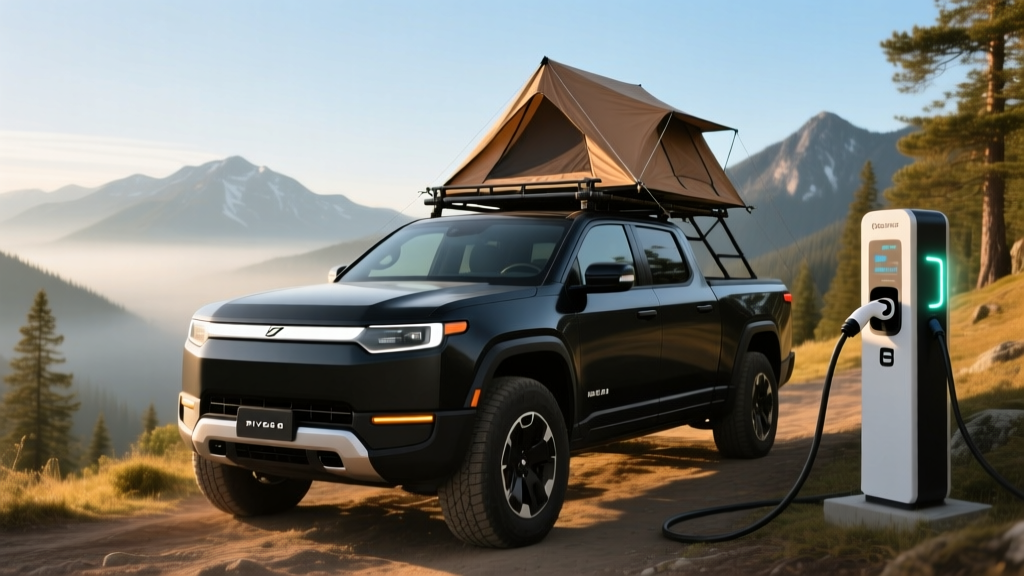
- Rooftop tents (RTT): The R1T's roof rails and optional crossbars support most hard-shell and soft-shell rooftop tents up to ~165 lbs dynamic / 600+ lbs static. Popular pairings include the iKamper Skycamp and Roofnest Falcon. The truck's air suspension can self-level when parked on uneven ground — a genuine advantage over leaf-spring trucks that lean under asymmetric tent weight.
- Bed tents and truck toppers: The 54-inch bed (with the gate down, it extends to ~82 inches) fits standard short-bed truck tents from brands like Napier and Rightline. For a more permanent setup, the AT Overland Summit topper or Four Wheel Camper pop-up creates a full sleeping platform while retaining the gear tunnel for storage.
- Ground tents with vehicle integration: Rivian's own Camp Kitchen accessory (a slide-out galley in the gear tunnel) pairs with any standard ground tent, and the truck's bed power outlets let you run LED camp lights, charge devices, and power an electric cooler without separate battery systems.
The R1T's biggest camping advantage over gas trucks: silent, emission-free overnight climate control. You can run the cabin heat or AC all night without idling an engine, which matters both for comfort and for dispersed camping etiquette.
Cargo, Passenger Space, and Daily Practicality
| Dimension | Measurement |
|---|---|
| Bed Length (gate up / down) | 54.0 in / 82.0 in |
| Bed Width (between wheel wells) | 50.5 in |
| Gear Tunnel Volume | 11.0 cu ft |
| Frunk (front trunk) | 11.0 cu ft |
| Rear Seat Legroom | 38.6 in |
| Total Interior Passenger Volume | 107 cu ft |
| Max Payload | 1,760 lbs |
The R1T is a full-size crew cab with a mid-size bed. Rear seat space comfortably fits adults on long drives, and the flat floor (no transmission tunnel) makes the middle seat usable. The frunk — lockable, drainable, and weatherproof — is where most owners store charging cables and recovery gear.
Pricing, Tax Credits, and Total Cost
| Trim | Base MSRP | As-Tested (typical options) | Federal §30D Credit Eligibility |
|---|---|---|---|
| Dual-Motor Standard | $69,900 | $73,000–$76,000 | Eligible up to $7,500 (subject to income + sourcing rules) |
| Dual-Motor Large | $75,900 | $80,000–$86,000 | Eligible up to $7,500 (subject to income + sourcing rules) |
| Tri-Motor Max | $99,900 | $105,000–$115,000 | Eligible up to $7,500 (subject to income + sourcing rules) |
The federal EV tax credit under IRS §30D remains available for the R1T, but with critical caveats. The truck qualifies as a light-duty pickup (under the $80,000 MSRP cap for trucks/vans/SUVs), but only if the specific build configuration stays under that cap. A fully optioned Dual-Motor Large can cross $80K, eliminating credit eligibility. The Tri-Motor Max always exceeds the cap and does not qualify.
Additionally, the buyer must meet income limits ($300,000 joint / $150,000 single MAGI) and the vehicle's battery must meet critical-mineral and component-sourcing thresholds that tighten annually. As of 2026, Rivian's US-built battery packs generally qualify, but always verify on IRS.gov before purchase. The credit can now be transferred at point-of-sale, reducing your purchase price directly rather than waiting for tax filing.
Warranty and Long-Term Ownership
Rivian covers the R1T with a 5-year/60,000-mile bumper-to-bumper warranty and an 8-year/175,000-mile battery and drive unit warranty. That battery warranty is notably generous in mileage compared to the industry-standard 8yr/100K, reflecting Rivian's confidence in its pack durability — important for a truck that owners drive hard and tow with.
The R1T's battery management system includes active thermal preconditioning, which is critical for longevity if you're DC fast-charging frequently on road trips. For LFP Standard Battery owners, Rivian recommends periodic 100% charges for cell balancing — the opposite of NMC best practice. Follow the in-app guidance for your specific chemistry.
Pros, Cons, and the Competition
- Gear tunnel is a class-unique, lockable 11 cu ft storage space — ideal for camp kitchens
- 54-inch bed is short for full-size truck buyers used to 66–72 inches
- Aerodynamics hurt highway range significantly with rooftop tents
- Tri-Motor price eliminates federal tax credit eligibility
- Service center network still limited outside major metros
- Insurance premiums run 15–25% higher than comparable gas trucks
Versus the Ford F-150 Lightning, the R1T is pricier and has a shorter bed but offers superior off-road capability, the gear tunnel, and a more refined software experience. Against the Tesla Cybertruck, the R1T is more conventionally practical (standard bed, conventional mirrors, proven build quality) but lacks the Cybertruck's stainless-steel durability claims and polarizing design. For pure camping utility, the R1T currently holds the edge thanks to integrated power and the gear tunnel.
Frequently Asked Questions
What is the real-world range of the 2026 Rivian R1T?
Expect roughly 220–310 highway miles depending on battery pack (Standard to Large) in mild weather. The Max Battery delivers around 350 highway miles. Subtract 25–35% in freezing temperatures and another 8–12% if you're running a rooftop tent that increases drag.
How fast does the R1T charge at home and on the road?
At home on a 48-amp Level 2 charger, the R1T adds about 30 miles of range per hour — a full overnight charge from 20% to 100%. On DC fast chargers, it peaks at 200–220 kW, reaching 10–80% in 25–30 minutes with a preconditioned battery. Charging tapers noticeably above 80% SoC.
Does the Rivian R1T qualify for the $7,500 federal tax credit?
The Dual-Motor Standard and Large trims can qualify if the final MSRP stays under the $80,000 truck cap and the buyer meets income limits ($300K joint / $150K single). The Tri-Motor Max exceeds the cap and never qualifies. Verify current sourcing requirements at IRS.gov before purchasing.
What kind of tent works best with the Rivian R1T?
All three categories work well: rooftop tents (hard-shell preferred for aerodynamics), bed tents with toppers (AT Overland, Four Wheel Camper), and ground tents paired with the Rivian Camp Kitchen gear-tunnel accessory. The truck's bed power outlets and air-suspension leveling give it an advantage over gas trucks in any tent configuration.
Is the R1T worth buying over the F-150 Lightning or Cybertruck?
If camping, off-roading, and gear storage are priorities, yes — the gear tunnel, air suspension, and integrated bed power are unmatched. If bed length and lowest cost are your top criteria, the F-150 Lightning is more practical. The Cybertruck appeals to buyers prioritizing design and payload but has a less mature service and accessory ecosystem.
Can I run camp appliances directly from the R1T's battery?
Yes. The R1T has 120V outlets in the bed and cabin, plus optional bed power panels. You can run electric coolers, induction cooktops, LED lights, and device chargers directly from the traction battery. Budget roughly 1–3 kWh per day for typical camp loads — a small fraction of even the Standard Battery's 92 kWh capacity.
Who Should Buy the 2026 Rivian R1T?
The R1T is the right truck if you need a daily-drivable crew cab that transforms into a self-contained camping rig on weekends — without bolting on a separate power system or idling a gas engine overnight. The Large Battery Dual-Motor at ~$76K (before credit) is the value sweet spot, offering 352 EPA miles and full tax-credit eligibility. Budget-conscious buyers who rarely tow or road-trip beyond 200 miles should consider the Standard Battery's LFP pack for its superior long-term charge-cycle durability. Skip the Tri-Motor unless performance is a genuine priority — the weight and price penalties don't serve the camping use case.
For the rivian tent searcher ready to pull the trigger: pair a Large Battery R1T with a low-profile hard-shell rooftop tent, add a bed mat and cargo dividers, and you've got one of the most capable electric overlanding platforms on the road in 2026.