The Rivian R1T in 2026: Beyond the Hype
Rivian's marketing has always leaned heavily on adventure-lifestyle storytelling — campsite sunsets, mountain trails, and the promise that an electric truck can replace your gas pickup without compromise. The latest Rivian ad campaign doubles down on this narrative, showcasing the R1T's dual-motor and quad-motor configurations towing trailers through rivers and climbing rocky grades. But for buyers doing real purchase research, the question isn't whether the footage looks compelling — it's whether the specs, range, and charging infrastructure actually support that lifestyle day-to-day.
This review dissects the 2026 Rivian R1T with the same rigor we apply to every EV we test: exact EPA numbers, real-world range reconciliation, charging-curve behavior, tax credit eligibility under current IRS §30D rules, and whether this truck earns its premium pricing against the Ford F-150 Lightning, Chevrolet Silverado EV, and Tesla Cybertruck.
Spec Snapshot: 2026 Rivian R1T at a Glance
| Specification | Dual-Motor (Standard) | Dual-Motor (Max Pack) | Quad-Motor |
|---|---|---|---|
| EPA Range | 270 miles | 420 miles | 352 miles |
| Battery Capacity | 106 kWh (NMC) | 149 kWh (NMC) | 149 kWh (NMC) |
| Horsepower | 533 hp | 533 hp | 1,025 hp |
| 0-60 mph | 4.5 sec | 4.5 sec | 3.0 sec |
| Drivetrain | AWD (dual-motor) | AWD (dual-motor) | AWD (quad-motor) |
| Max DC Fast Charge | 220 kW | 220 kW | 220 kW |
| 10-80% DC Time | ~30 min | ~42 min | ~42 min |
| Level 2 Home Rate | 11.5 kW (~25 mi/hr) | 11.5 kW (~25 mi/hr) | 11.5 kW (~25 mi/hr) |
| Towing Capacity | 11,000 lbs | 11,000 lbs | 11,000 lbs |
| Base MSRP | $69,900 | $82,400 | $99,900 |
Real-World Range: What the EPA Sticker Doesn't Tell You
- Dual-Motor Standard (270 mi EPA): Expect 230–250 mi in mixed highway driving; 190–210 mi in sustained cold weather (below 32°F) or at sustained 75+ mph speeds.
- Dual-Motor Max Pack (420 mi EPA): Expect 360–390 mi mixed highway; 300–330 mi in cold conditions or heavy towing.
- Quad-Motor (352 mi EPA): Expect 290–320 mi mixed highway; the additional motor drag and heavier curb weight reduce efficiency noticeably at speed.
The R1T's boxy aerodynamic profile — that distinctive upright windshield and flat bed — creates meaningful drag at highway speeds. In our experience, efficiency drops from roughly 2.0–2.2 kWh/mi in city driving to 2.5–2.8 kWh/mi at 70–80 mph on the interstate. If you're towing, expect that number to climb past 3.5 kWh/mi, which effectively halves your range with a loaded trailer.
The Max Pack's 149 kWh NMC battery is a genuine differentiator for road-trippers. Even with a 15% cold-weather penalty, 350+ miles of real range means most interstate corridors require only a single DC fast-charge stop. The Standard Pack, by contrast, demands more route planning — particularly through the Midwest and Mountain West where charging infrastructure remains sparser.
Rivian uses nickel-manganese-cobalt (NMC) chemistry across the R1T lineup. NMC delivers higher energy density than LFP (lithium iron phosphate), which is why the Max Pack can pack 149 kWh into the same physical footprint. The trade-off: NMC degrades slightly faster over time and prefers daily charging to 80% rather than 100% — a consideration if you're a habitual top-off charger.
Charging Speed: DC Fast and Home Level 2
| Charging Method | Power / Rate | Miles Added per Hour | Notes |
|---|---|---|---|
| DC Fast Charge (peak) | 220 kW | ~140 mi in 20 min | Peak rate sustained to ~55% SoC, then tapers |
| DC Fast Charge (10-80%) | Avg ~155 kW | — | 30 min (Standard), 42 min (Max/Quad) |
| Level 2 Home (48A) | 11.5 kW | ~25 mi/hr | Full charge in ~10–14 hr depending on pack |
| Level 2 Home (32A) | 7.7 kW | ~17 mi/hr | Common for NEMA 14-50 outlets |
| Level 1 (120V) | 1.4 kW | ~3 mi/hr | Emergency/trickle only |
Rivian's 220 kW peak DC fast-charge capability is competitive but not class-leading. The Ford F-150 Lightning peaks around 230 kW on its extended-range pack, while the Tesla Cybertruck leverages its 48V architecture for comparable rates. The critical nuance is the charge curve: the R1T holds near peak power through roughly 55% State of Charge (SoC), then tapers progressively. On a road trip, this means the 10-80% time is a more useful metric than peak kW alone.
For the Max Pack, that 42-minute 10-80% session is manageable — it's a long lunch stop, not a quick pit stop. Standard Pack owners will spend closer to 30 minutes per session but will need more sessions overall on long trips.
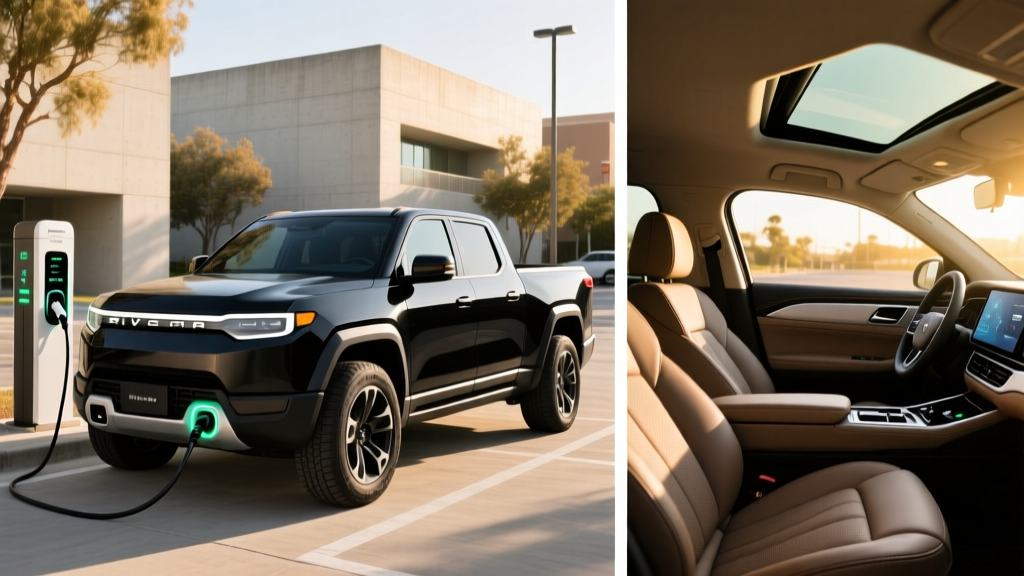
At home, the R1T's 11.5 kW onboard charger is a strong point. A hardwired Level 2 wall connector on a 60A circuit delivers roughly 25 miles of range per hour of charging, meaning an overnight session (8–10 hours) replenishes 200–250 miles — more than sufficient for daily driving. If your electrical panel only supports a 40A circuit (common in older homes), expect roughly 17 mi/hr on a 32A setup. Budget $500–$2,500 for professional Level 2 installation depending on panel proximity and local permitting.
Performance: The Quad-Motor Changes the Conversation
The dual-motor R1T's 533 hp and 4.5-second 0-60 time are quick by any truck standard — and genuinely rapid for a 7,000-lb vehicle. But the quad-motor configuration, with independent motors at each wheel, transforms the R1T into something closer to a supercar with a bed. The 1,025 hp and 3.0-second 0-60 time are territory normally occupied by the Tesla Model S Plaid, not a body-on-frame pickup.
Beyond straight-line speed, the quad-motor's torque vectoring delivers tangible off-road capability. Each wheel can be independently controlled for traction, enabling features like tank turns (slow 360-degree pivots) and precise rock-crawling modulation. This isn't marketing theater — it's genuinely differentiated capability that no competitor in the electric truck segment currently matches.
The trade-off is efficiency and price. The quad-motor adds roughly 300 lbs of drivetrain mass and consumes more energy per mile, cutting range by 15–20% versus the dual-motor Max Pack. At $99,900, it's also a $30,000 premium over the dual-motor Max — a steep ask for capability most owners will rarely exploit.
Pricing, Trims, and Federal Tax Credit Reality
| Trim | Base MSRP | Est. As-Tested | §30D Credit Eligible? | Effective Price (w/ max credit) |
|---|---|---|---|---|
| Dual-Motor Standard | $69,900 | $73,000–$76,000 | Potentially (see below) | ~$62,400–$68,500 |
| Dual-Motor Max Pack | $82,400 | $86,000–$92,000 | Unlikely (MSRP cap) | $82,400+ |
| Quad-Motor | $99,900 | $105,000+ | No (MSRP cap) | $99,900+ |
The IRS §30D federal tax credit has strict eligibility rules that significantly narrow the R1T's access:
- MSRP Cap: Pickup trucks must have an MSRP at or below $80,000 to qualify. This eliminates the Max Pack and Quad-Motor trims entirely.
- Buyer Income Cap: Modified adjusted gross income cannot exceed $300,000 (joint), $225,000 (head of household), or $150,000 (single).
- Battery Sourcing: The full $7,500 credit requires both critical-mineral and battery-component sourcing requirements to be met. Rivian's supply chain has shifted to improve compliance, but partial credits ($3,750) may apply if only one requirement is satisfied. Verify current sourcing status on the IRS qualified vehicles list before purchasing.
- Point-of-Sale Transfer: Eligible buyers can transfer the credit to the dealer at purchase, reducing the purchase price directly rather than waiting for a tax refund.
Realistically, only the base Dual-Motor Standard — and only for buyers within income limits purchasing a truck that meets sourcing requirements — qualifies. Consult a tax professional and check the current IRS qualified vehicle list before relying on credit eligibility.
Interior Space, Cargo, and Daily Practicality
The R1T is a midsize truck — think Toyota Tacoma footprint, not Ford F-150. That distinction matters:
- Bed Length: 4.5 feet (54 inches). Shorter than most full-size trucks. The gear tunnel (a pass-through compartment behind the rear seats) adds 11 cu ft of enclosed, lockable storage — ideal for camping gear, tools, or groceries.
- Rear Seat Legroom: 36.3 inches. Adequate for adults on moderate trips, but tight for long-distance rear-seat passengers compared to crew-cab full-size trucks.
- Front Trunk (Frunk): 11 cu ft. Useful for charging cables, a small cooler, or items you want separated from the bed.
- Max Payload: ~1,760 lbs.
- Towing: 11,000 lbs rated — but remember that towing at capacity cuts range roughly in half.
The interior design is minimalist and tech-forward, dominated by a 15.6-inch center touchscreen running Rivian's proprietary OS. Wireless Apple CarPlay and Android Auto are absent — Rivian uses a native infotainment platform that handles navigation, media, and vehicle settings. It's responsive and well-designed, but the lack of phone projection is a genuine drawback for buyers who prefer their own app ecosystems.
Driver Assistance and Technology
Rivian's Driver+ system is a Level 2 driver-assistance suite (per SAE classification). It includes adaptive cruise control, lane-centering, and automatic lane changes on divided highways. It is not a self-driving system — the driver must maintain hands-on-wheel supervision at all times.
- Hands-on-wheel required at all times (torque-based monitoring)
- Lane-centering can be inconsistent on faded lane markings
- No hands-free highway driving capability (unlike GM Super Cruise or Ford BlueCruise)
- Automatic lane changes require driver confirmation via turn signal
Compared to Tesla's Autopilot or GM's Super Cruise, Driver+ is competent but a generation behind in hands-free capability. Rivian has indicated future over-the-air updates may expand functionality, but as of 2026, it remains a conventional Level 2 system.
Other tech highlights include:
- Camp Kitchen accessory (slide-out induction cooktop and sink that mounts in the gear tunnel)
- Over-the-air software updates that have meaningfully improved performance and features post-purchase
- Integrated air compressor with preset tire-pressure targets for off-road use
- V2L (vehicle-to-load) capability: 120V and 240V outlets in the bed can power tools, appliances, or a campsite
Efficiency and Operating Costs
The dual-motor R1T achieves approximately 73 MPGe combined (EPA), translating to roughly 46 kWh per 100 miles. That's less efficient than a Tesla Model Y or Ford F-150 Lightning, reflecting the R1T's weight and aerodynamics.
At the national average electricity rate of $0.17/kWh, fueling the R1T costs approximately $0.078 per mile — roughly half the per-mile cost of a comparable gas truck averaging 18 mpg at $3.50/gallon. Over 15,000 annual miles, that's an estimated $1,170 in electricity versus $2,917 in gasoline, a savings of approximately $1,750 per year. Over a typical 5-year ownership period, the energy savings alone approach $8,750.
Warranty Coverage
- Battery & Drive Unit: 8 years / 175,000 miles (whichever comes first), with capacity retention guaranteed above 70% of original capacity
- Vehicle Limited Warranty: 5 years / 60,000 miles
- Roadside Assistance: 5 years / 60,000 miles
Rivian's 175,000-mile battery warranty is among the strongest in the segment, exceeding the common 100,000-mile standard. The 70% capacity-retention threshold is industry-typical. Battery replacement cost, should it be needed out of warranty, is estimated at $15,000–$22,000 depending on pack size — a significant but not catastrophic figure for a truck in this price range.
Pros and Cons: The Honest Assessment
- 420-mile Max Pack range is best-in-class for electric trucks
- Quad-motor torque vectoring delivers unmatched off-road capability
- 11,000-lb towing capacity with integrated trailer-brake controller
- Gear tunnel and V2L make it genuinely useful for adventure/camping
- Strong OTA update track record improving the vehicle post-purchase
- 175,000-mile battery warranty exceeds most competitors
- Base MSRP of $69,900 is steep; most trims exceed §30D MSRP cap
- 220 kW peak DC charge rate trails Hyundai Ioniq 5 and Lucid Air
- No wireless Apple CarPlay or Android Auto
- Driver+ is competent but behind Super Cruise/BlueCruise in hands-free capability
- Midsize bed (4.5 ft) limits utility vs full-size electric trucks
- Efficiency (73 MPGe) lags lighter EVs; highway range drops significantly at speed
Who the 2026 Rivian R1T Suits Best
- You want an adventure-oriented truck with genuine off-road and camping capability
- You need 400+ miles of range for remote road trips (Max Pack)
- You value over-the-air improvements and a tech-forward ownership experience
- Your budget accommodates $70K–$100K+ without relying on the federal tax credit
- You need a full-size truck bed for work/commercial use (consider F-150 Lightning or Silverado EV)
- Tax credit eligibility is essential to your purchase math
- You prioritize hands-free highway driving (GM Super Cruise vehicles)
- You tow frequently at max capacity — the range penalty is severe
Frequently Asked Questions
What is the real-world range of the 2026 Rivian R1T?
The EPA rates the R1T at 270 miles (Standard Pack), 420 miles (Max Pack), and 352 miles (Quad-Motor). In real-world highway driving at 70–80 mph, expect 15–20% less: roughly 230 mi, 360 mi, and 290 mi respectively. Cold weather below freezing further reduces range by 10–15%. Towing at capacity can halve these figures.
How fast does the R1T charge on DC fast chargers and at home?
DC fast charging peaks at 220 kW, achieving a 10-80% charge in approximately 30 minutes (Standard Pack) or 42 minutes (Max/Quad). At home on Level 2 (11.5 kW), the R1T adds roughly 25 miles of range per hour, fully recharging overnight in 10–14 hours depending on pack size.
Does the 2026 Rivian R1T qualify for the $7,500 federal EV tax credit?
Only the base Dual-Motor Standard trim (MSRP $69,900) falls under the $80,000 truck MSRP cap. Buyer income limits ($150K–$300K depending on filing status) and battery-sourcing requirements also apply. Max Pack and Quad-Motor trims exceed the MSRP cap and do not qualify. Always verify current eligibility on the IRS qualified vehicle list before purchasing.
Is the Rivian R1T worth buying vs the Ford F-150 Lightning or Tesla Cybertruck?
The R1T excels as an adventure and lifestyle truck with superior off-road capability (especially quad-motor) and the Max Pack's 420-mile range. The F-150 Lightning offers a larger bed, lower starting price, and better tax-credit access. The Cybertruck provides more polarizing styling with competitive range and charging. The R1T's premium pricing is justified if adventure features (gear tunnel, camp kitchen, V2L, air compressor) align with your use case.
What are the biggest drawbacks of the Rivian R1T?
The primary limitations are the high starting price with limited tax-credit eligibility, a midsize bed that can't match full-size trucks for commercial use, the absence of Apple CarPlay/Android Auto, and a Driver+ assistance system that trails competitors in hands-free highway capability. Efficiency also lags lighter EVs, particularly at highway speeds.
How long will the R1T battery last?
Rivian warranties the battery for 8 years / 175,000 miles with a 70% capacity-retention guarantee. NMC chemistry typically degrades 1–2% per year under normal use, suggesting 85–90% capacity at 100,000 miles. Avoid habitual 100% charging and DC fast-charging exclusively to maximize longevity. Out-of-warranty replacement is estimated at $15,000–$22,000.