The Quick Answer on Infiniti Electric Vehicles
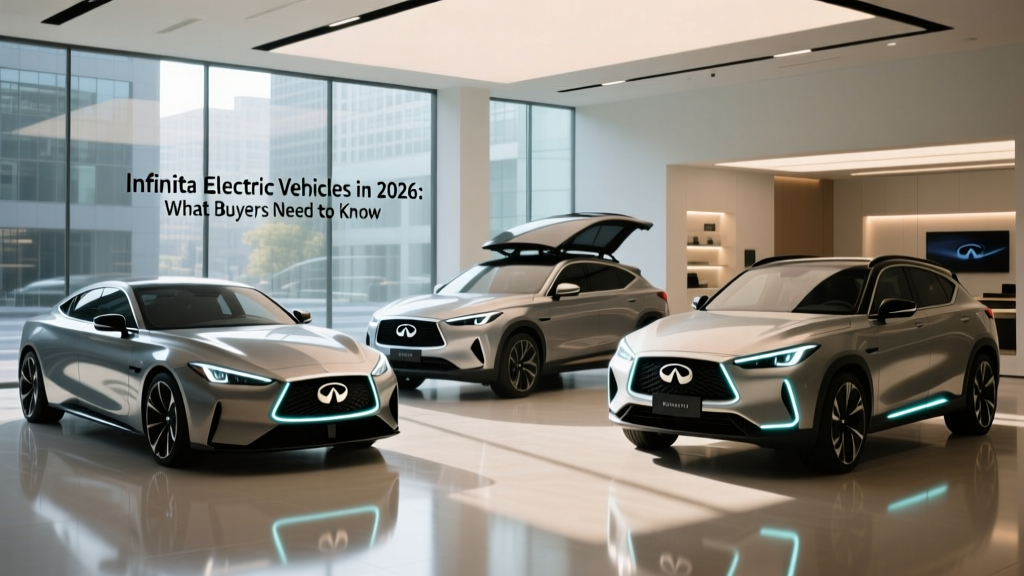
As of early 2026, Infiniti does not sell a fully electric vehicle in the United States. The brand's first dedicated EV — a production version of the Infiniti QX Inspiration concept — has been announced but remains unreleased, with no firm on-sale date or finalized EPA specifications. Infiniti currently offers no battery-electric (BEV) or plug-in hybrid (PHEV) models domestically. If you need an electrified luxury SUV today, competitors like the Genesis Electrified GV70, BMW iX, and Cadillac Lyriq are available now with EPA-rated ranges between 230 and 320 miles. If you're committed to the Infiniti brand, the closest electrified option is the hybrid-only QX60, which uses a conventional HEV system with no plug and no electric-only range.
Where Infiniti Stands in the EV Market Right Now
Infiniti has been promising electric vehicles for years. The QX Inspiration concept debuted at the 2019 Detroit Auto Show, followed by the QX55 e-Power concept and various statements about an electrified future. Nissan's corporate strategy — Infiniti's parent company — committed to launching 23 electrified models globally by fiscal year 2030, including several full EVs on the new CMF-EV platform shared with the Nissan Ariya.
Yet as of 2026, none of that has translated into a production Infiniti EV on American dealership floors. The brand has focused its U.S. lineup on conventional gasoline models (Q50, QX55, QX60, QX80) and the e-Power series-hybrid system used in some markets but not widely deployed in the U.S.
This puts Infiniti well behind its luxury rivals. By comparison:
- BMW sells the iX (EPA 309-324 mi), i4 (up to 307 mi), and i7 (318 mi)
- Genesis offers the Electrified GV70 (236 mi) and Electrified G80 (282 mi)
- Cadillac has the Lyriq (314 mi) and Optiq (300+ mi est.)
- Mercedes-Benz fields the EQE SUV (279-305 mi) and EQS SUV (305-330 mi)
- Audi offers the Q8 e-tron (255-285 mi) and Q6 e-tron (308+ mi)
If an Infiniti EV does arrive in the 2027-2028 timeframe, it will enter a market where competitors have already established charging infrastructure relationships, software maturity, and real-world reliability track records over multiple model years.
What We Know About Infiniti's Upcoming EV Plans
Here is what has been publicly confirmed or strongly indicated by Infiniti and Nissan as of 2026, with important caveats:
| Detail | What's Known | Status |
|---|---|---|
| First production EV | Mid-size luxury electric SUV, likely QX Inspiration-based | Announced — no on-sale date |
| Platform | Expected CMF-EV (shared with Nissan Ariya) | Preliminary |
| Estimated battery | ~87-91 kWh usable (based on Ariya architecture) | Speculative |
| Estimated range | ~270-300 mi EPA (based on Ariya's 289-304 mi) | Estimated only |
| Charging architecture | Likely 400V; NACS adapter or native NACS expected | Unconfirmed |
| Peak DC charge rate | ~130 kW (Ariya benchmark) | Estimated |
| Drivetrain | Dual-motor AWD expected (e-4ORCE) | Likely |
| Estimated starting MSRP | $55,000-$65,000 (positioned above Ariya, below German rivals) | Speculative |
| Federal tax credit (§30D) | Unknown — depends on battery sourcing at launch | Cannot confirm |
Important: Every figure in this table is preliminary or speculative. Infiniti has not published official EPA range, battery capacity, pricing, or charging specifications for any upcoming EV. Do not make purchasing decisions based on these estimates. We will update this article when official specs are released.
Infiniti EV vs. Available Luxury Electric SUVs: A Reality Check
Since you can't buy an Infiniti EV today, the practical question becomes: should you wait, or purchase an available competitor? Here's how a projected Infiniti electric SUV stacks up against what you can actually drive home in 2026:
| Spec | Infiniti EV (Projected) | BMW iX xDrive50 | Cadillac Lyriq | Genesis Electrified GV70 | Nissan Ariya (Platinum+) |
|---|---|---|---|---|---|
| Status | Unreleased | Available | Available | Available | Available |
| EPA Range | ~270-300 mi (est.) | 324 mi | 314 mi | 236 mi | 267 mi |
| Battery (usable) | ~87-91 kWh (est.) | 105.2 kWh | 102 kWh | 77.4 kWh | 87 kWh |
| Peak DC Charge | ~130 kW (est.) | 195 kW | 190 kW | 240 kW | 130 kW |
| 10-80% DCFC | ~35 min (est.) | ~34 min | ~35 min | ~18 min | ~35 min |
| 0-60 mph | ~5.0 sec (est.) | 4.4 sec | 4.6 sec (AWD) | 4.2 sec | 4.8 sec |
| Horsepower | ~389 hp (est.) | 516 hp | 500 hp (AWD) | 429 hp | 389 hp |
| Starting MSRP | $55,000-$65,000 (est.) | $87,250 | $58,590 | $67,550 | $53,040 |
| §30D Tax Credit | Unknown | $0 (MSRP cap) | Up to $7,500 | $0 (sourcing) | Up to $7,500 |
The Nissan Ariya is the most relevant comparison because it shares the CMF-EV platform and e-4ORCE dual-motor system that an Infiniti EV would likely use. The Ariya Platinum+ e-4ORCE delivers 267 miles of EPA range, 389 hp, and a 130 kW peak charge rate for $53,040 — and qualifies for the full §30D federal tax credit of up to $7,500, bringing effective pricing near $45,500.
An Infiniti version would add premium materials, a more refined ride, and brand prestige, but likely at a $10,000-$15,000 premium over the Ariya with similar underlying hardware.
The Real Cost Question: EV vs. Gas for Luxury SUV Buyers
If you're cross-shopping an Infiniti QX60 (gas) against the idea of an electric luxury SUV, here's what the ownership math looks like over five years and 75,000 miles:
| Cost Category | Infiniti QX60 Luxe AWD (Gas) | Comparable Electric SUV (e.g., Lyriq) |
|---|---|---|
| MSRP | $54,150 | $58,590 |
| Federal tax credit | $0 | Up to $7,500 (§30D) |
| Effective purchase price | $54,150 | ~$51,090 |
| Fuel/Energy (75K mi) | ~$11,250 (22 MPG, $3.30/gal) | ~$3,750 (home charging at $0.15/kWh) |
| Maintenance (5 yr) | ~$3,500 (oil, filters, brakes, trans) | ~$1,200 (cabin filter, wipers, tire rotation) |
| Insurance (5 yr avg.) | ~$9,500 | ~$11,400 (EV premium ~20%) |
| Estimated 5-yr depreciation | ~$27,000 | ~$25,500 |
| Total 5-yr cost | ~$105,400 | ~$89,940 |
Key assumptions: Gas prices at $3.30/gal national average, electricity at $0.15/kWh (home Level 2 charging), premium fuel required for QX60. EV insurance premiums run 15-25% higher on average, per IIHS and industry data. Depreciation figures are estimates based on current luxury EV and ICE SUV resale trends. Your actual costs will vary by state, driving pattern, electricity rate, and insurance profile.
The EV wins on fuel and maintenance by roughly $9,800 over five years, which more than offsets the higher insurance cost. However, this assumes reliable access to home Level 2 charging. If you're dependent on public DC fast charging at $0.35-$0.55/kWh, the energy cost advantage shrinks significantly — potentially to $3,000-$4,000 in savings instead of $7,500.
Real-World Ownership Considerations Before You Commit
Whether you're waiting for an Infiniti EV or buying a competitor today, these factors determine whether EV ownership works for your situation:
Home Charging Access
This is the single biggest variable. A Level 2 home charger (240V, 40-48 amps) adds roughly 25-35 miles of range per hour of charging — enough to fully replenish any EV overnight. Installation costs range from $500-$1,500 if your electrical panel has capacity, to $2,500-$5,000+ if you need a panel upgrade from 100A to 200A service.
If you live in an apartment or condo without dedicated charging, you'll rely on public infrastructure. As of 2026, the U.S. has over 200,000 public charging ports, but reliability and availability vary dramatically by region. Urban areas with Tesla Superchargers (now open to NACS-equipped non-Tesla vehicles) and Electrify America stations offer reasonable coverage. Rural areas remain charging deserts for non-Tesla EVs.
Climate and Range Reality
EPA range estimates are tested at moderate temperatures. In real-world conditions:
- Highway driving at 75 mph: Expect 80-88% of EPA range
- Cold weather (below 32°F): Expect 65-80% of EPA range, depending on severity and whether the vehicle has a heat pump
- Combined cold + highway: Plan for 60-70% of EPA range in worst-case winter road trips
For a projected 280-mile Infiniti EV, that means realistic road-trip range of 220-250 miles in fair weather and potentially 175-200 miles in freezing conditions. This matters if you regularly drive routes longer than 200 miles between charging stops.
Charging Speed and the Curve Taper
A 130 kW peak charge rate (as seen on the Ariya) means a 10-80% session takes roughly 35 minutes. However, peak rate is sustained only between roughly 10-40% state of charge. Above 60%, the rate tapers significantly — often to 50-70 kW — meaning the final 20% (60-80%) can take as long as the first 50%. This is a function of lithium-ion battery physics, not a defect.
Competitors like the Genesis Electrified GV70 (240 kW peak) and Hyundai Ioniq 5 (235 kW peak on 800V architecture) complete 10-80% sessions in 18-20 minutes — a meaningful advantage on road trips.
Common Misconceptions About Infiniti and EVs
| Myth | Fact |
|---|---|
| "Infiniti already has an electric SUV." | They don't. No Infiniti BEV or PHEV is sold in the U.S. as of 2026. The QX Inspiration remains a concept. |
| "Infiniti's e-Power is a plug-in hybrid." | e-Power is a series hybrid — the gas engine generates electricity but never drives the wheels directly. It has no plug, no electric-only range, and doesn't qualify for EV tax credits. It's similar in concept to a range-extended EV but functions like a conventional hybrid from the driver's seat. |
| "An Infiniti EV will definitely get the $7,500 tax credit." | §30D eligibility depends on battery component sourcing, critical mineral sourcing, MSRP caps ($80,000 for SUVs), and buyer income limits ($300K joint / $150K single). Even if an Infiniti EV launches under the MSRP cap, battery sourcing rules may disqualify it. Check fueleconomy.gov when specs are finalized. |
| "I can charge an EV anywhere." | Public charging infrastructure is uneven. CCS-equipped chargers from Electrify America and EVgo have improved but still experience downtime. Tesla Superchargers (now NACS) are the most reliable network. Verify charger availability along your regular routes before buying. |
| "EV batteries need replacing every few years." | Modern lithium-ion EV batteries are warrantied for 8 years/100,000 miles (federally mandated minimum) with a capacity retention threshold of 70%. Real-world degradation data from Tesla, Hyundai, and Nissan shows most batteries retain 85-92% capacity at 100,000 miles. Full replacement costs $10,000-$20,000 but is rarely needed within normal ownership periods. |
Decision Framework: Should You Wait for Infiniti or Buy Now?
Wait for an Infiniti EV if:
- You currently own an Infiniti and have strong brand loyalty and dealership relationships
- You don't urgently need to replace your current vehicle within the next 12-18 months
- You value Infiniti's specific design language, ride quality, and dealer service experience
- You're willing to accept the risk that the production EV may differ significantly from current projections
- You want to see whether Infiniti adopts NACS natively or uses a CCS-to-NACS adapter
Buy an available electric SUV now if:
- You need a vehicle within the next 6 months
- You want proven EPA-rated range data and real-world charging performance — not estimates
- You want to lock in the current §30D tax credit before potential legislative changes
- You take regular road trips and need access to mature charging networks today
- You value over-the-air software updates and features that have been refined over multiple model years
Consider the Nissan Ariya as a bridge if:
- You want the underlying platform an Infiniti EV would likely share, available today
- You want to stay within the Nissan corporate family
- The Ariya Platinum+ e-4ORCE at $53,040 (before $7,500 credit) fits your budget better than $65,000+ luxury competitors
- You're comfortable with Nissan's ProPILOT Assist (SAE Level 2 driver assistance — not self-driving)
What First-Time EV Buyers Should Know Before Purchasing Any Luxury EV
Whether you ultimately choose an Infiniti (when available) or a competitor today, these principles apply to every first EV purchase:
- Verify home charging feasibility first. Get a quote from a licensed electrician for a 240V/48A circuit before you sign a purchase agreement. A 60A breaker with 48A continuous output is the sweet spot for most luxury EVs.
- Understand kW vs. kWh. kW (kilowatts) measures power — how fast energy flows into your car during charging. kWh (kilowatt-hours) measures energy — how much your battery holds. A 90 kWh battery charged at 10 kW takes 9 hours. At 130 kW DC fast charging, it fills much faster but only at peak rate.
- Plan for real-world range, not EPA stickers. Budget 15-25% below EPA range for highway and mixed driving. In cold climates, plan 25-35% below. If an EV's real-world range won't cover your longest regular trip with a 20% buffer, it's not the right fit without mid-trip charging.
- Check §30D eligibility carefully. The federal EV tax credit has income caps ($300K joint filers, $225K head of household, $150K single), MSRP caps ($80K for SUVs/pickups/vans, $55K for sedans), and battery sourcing requirements that change annually. The credit can now be transferred to the dealer at point of sale, reducing your purchase price directly. Confirm current rules at irs.gov.
- Budget for higher insurance. EV insurance premiums average 15-25% above equivalent gas vehicles due to higher repair costs and battery replacement risk. Get quotes before purchasing.
- Tire wear increases. EVs are heavier (battery weight) and deliver instant torque, wearing tires 20-30% faster than comparable gas vehicles. Budget for tire replacement every 25,000-35,000 miles instead of 40,000-60,000.
- Preconditioning matters. Most EVs can precondition the battery before a DC fast-charging stop, warming it to optimal temperature for faster charging. If you navigate to a charger in the car's built-in navigation, preconditioning typically activates automatically. Using a third-party app or plug-in without preconditioning can add 10-15 minutes to your charge session in cold weather.
Frequently Asked Questions
Does Infiniti make any electric cars in 2026?
No. Infiniti does not currently sell any fully electric (BEV) or plug-in hybrid (PHEV) vehicles in the United States. The brand's U.S. lineup consists of gasoline-powered vehicles. A production electric SUV has been announced but has no confirmed release date or finalized specifications.
What is Infiniti's e-Power system, and is it electric?
e-Power is a series-hybrid system where a gasoline engine acts as a generator to charge a small battery that powers electric motors driving the wheels. The driver never plugs in, and there is no meaningful electric-only range. It drives somewhat like an EV (smooth electric torque) but burns gasoline and does not qualify for any EV incentives. It's a hybrid, not an electric vehicle.
When will the first Infiniti EV be available to buy?
Infiniti has not announced a specific on-sale date for its first production EV. Based on Nissan's corporate timeline and industry reporting, a 2027-2028 model year launch appears most likely, but this is unconfirmed. Specs and pricing remain preliminary.
Will an Infiniti EV qualify for the $7,500 federal tax credit?
This cannot be determined until the vehicle is released and the IRS evaluates its battery sourcing compliance under §30D rules. Eligibility depends on where battery components and critical minerals are sourced, the vehicle's MSRP (must be under $80,000 for SUVs), and the buyer's income. Check fueleconomy.gov for the most current eligibility list.
Should I buy a Nissan Ariya instead of waiting for an Infiniti EV?
If you want the platform and technology an Infiniti EV would likely share — CMF-EV architecture, e-4ORCE AWD, ~87 kWh battery — the Ariya is available now starting at $39,590 (base) to $53,040 (Platinum+ e-4ORCE), with the full $7,500 §30D credit applicable. The trade-off is Nissan branding, slightly less premium materials, and ProPILOT Assist rather than a more advanced ADAS suite. For many buyers, the Ariya represents strong value today versus an uncertain wait.
What's the best luxury electric SUV I can buy right now?
It depends on your priorities. For maximum range, the BMW iX xDrive50 delivers 324 miles EPA at $87,250. For value, the Cadillac Lyriq offers 314 miles at $58,590 with §30D credit eligibility. For fast charging, the Genesis Electrified GV70 peaks at 240 kW (10-80% in ~18 minutes) but offers only 236 miles of range. There is no single best answer — match the vehicle to your driving patterns, budget, and charging access.