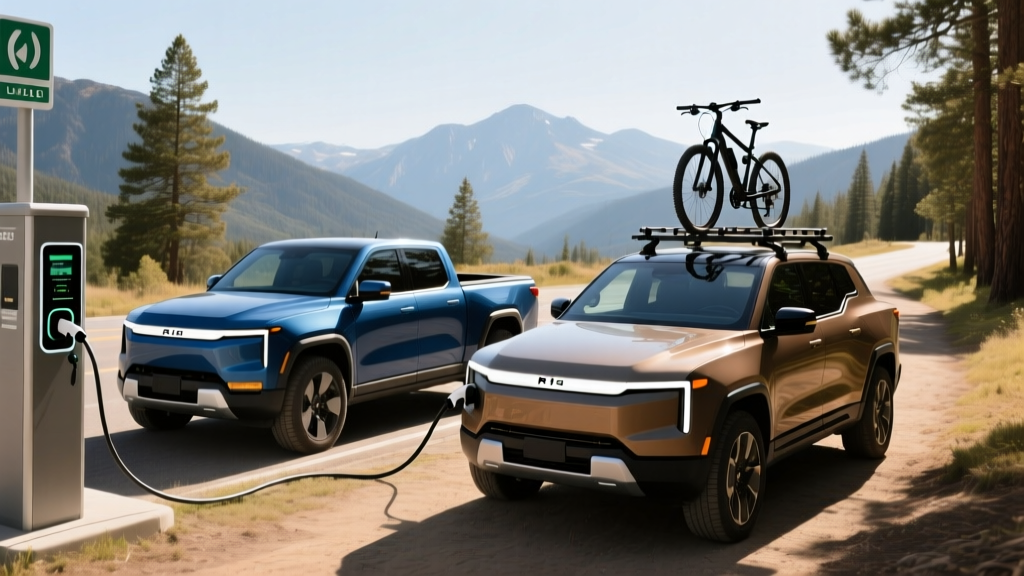
Rivian has carved out a unique position in the electric-vehicle market: adventure-capable trucks and SUVs that also happen to be among the quickest production vehicles on the road. For 2026, the R1T pickup and R1S SUV continue to evolve with updated battery packs, refined software, and a growing Supercharger adapter ecosystem. Whether you're eyeing the R1T for its clever Gear Tunnel or the R1S for three-row family duty, this review covers every spec that matters — and explains why Rivian has become the go-to EV for cyclists who also bikes, Rivian owners hauling mountain bikes, gravel rigs, and e-bikes to the trailhead.
2026 Rivian R1T & R1S: Quick Verdict
The 2026 Rivian R1T remains the only mainstream electric pickup built on a dedicated skateboard platform (not a converted gas truck), and the R1S is its three-row SUV twin. Both offer class-leading acceleration, genuine off-road capability, and clever storage solutions that outshine legacy pickups. The Dual-Motor Standard battery delivers the best value, while the Tri-Motor variant pushes performance into supercar territory. For cyclists and outdoor enthusiasts, the R1T's 4.5-foot bed with integrated tie-downs and optional Gear Tunnel make it arguably the best EV for hauling bikes — no bed rack required.
Range, Battery & Real-World Efficiency
Rivian offers multiple battery configurations for 2026. Here's the full breakdown:
| Spec | R1T Dual-Motor (Standard) | R1T Dual-Motor (Large) | R1T Tri-Motor (Max) | R1S Dual-Motor (Large) |
|---|---|---|---|---|
| Usable Battery (kWh) | ~92 kWh | ~128 kWh | ~141 kWh | ~128 kWh |
| Chemistry | NMC (Lithium Nickel Manganese Cobalt) | NMC | NMC | NMC |
| EPA Range (miles) | ~270 | ~352 | ~420 | ~340 |
| MPGe (Combined) | ~70 MPGe | ~73 MPGe | ~65 MPGe | ~69 MPGe |
| Efficiency (kWh/100mi) | ~48 | ~46 | ~52 | ~49 |
Rivian uses NMC (nickel manganese cobalt) chemistry across its lineup rather than LFP (lithium iron phosphate). NMC offers higher energy density — critical for fitting 400+ miles of range into a truck — but it's less tolerant of sitting at 100% state of charge long-term. Rivian recommends daily charging to 85-90% for battery longevity, which effectively reduces your usable daily range by about 10-15%.
Charging Speed: DC Fast, Level 2 & Home Setup
Charging is where Rivian owners see the biggest practical differences between battery packs. Here's what to expect:
| Charging Level | Rate | Miles Added/Hour | Notes |
|---|---|---|---|
| Level 1 (120V) | ~1.4 kW | ~3-4 mi/hr | Emergency/trickle only |
| Level 2 (240V, 48A) | 11.5 kW | ~25-28 mi/hr | Home Wall Connector; full charge overnight |
| Level 2 (240V, 32A) | 7.7 kW | ~17-19 mi/hr | Portable charger on NEMA 14-50 |
| DC Fast Charge (peak) | Up to 220 kW (Large/Max) | ~140+ mi in 15 min | 10-80% in ~30 min (Large); ~36 min (Max) |
Rivian's DC fast-charging curve is progressive but not class-leading. The Large and Max packs peak around 200-220 kW between 10-30% state of charge, then taper to roughly 150 kW through 50%, and drop significantly above 80%. Expect a realistic 10-80% session on a 350 kW-capable Electrify America or Tesla Supercharger (via adapter) to take about 30 minutes for the Large pack. The Standard pack peaks lower, around 175 kW, and reaches 80% in roughly 25 minutes due to its smaller total capacity.
Home charging reality: Most R1T/R1S owners install a Rivian Wall Connector or a third-party 48-amp Level 2 unit on a 60-amp circuit. This adds roughly 25-28 miles of range per hour — enough to fully replenish even the Max pack overnight. Installation costs typically run $800-$2,500 depending on panel proximity and whether your home needs a 200-amp service upgrade (source: HomeAdvisor EV install data). Rivian includes a portable dual-voltage charger with each vehicle for NEMA 14-50 outlets.
Performance: 0-60, Horsepower & Drivetrain
| Configuration | Horsepower | Torque (lb-ft) | 0-60 mph | Drivetrain |
|---|---|---|---|---|
| Dual-Motor | 533 hp | 610 | 4.5 sec | AWD (dual motor) |
| Performance Dual-Motor | 665 hp | 829 | 3.4 sec | AWD (dual motor) |
| Tri-Motor | 850 hp | 1,103 | 2.9 sec | AWD (tri motor) |
Even the base Dual-Motor R1T hits 60 mph in 4.5 seconds — quicker than most V8 pickups. The Tri-Motor variant's sub-3-second run puts it in the same territory as a Tesla Model S Plaid, albeit in a 7,000-pound truck. All configurations use permanent-magnet motors with torque vectoring, and Rivian's quad-motor setup (one motor per wheel) was available on early builds but has been streamlined to dual- and tri-motor options for 2026.
Off-road, the R1T offers 14.9 inches of ground clearance in its highest air-suspension setting, approach/departure angles that rival a Jeep Gladiator, and a wading depth of over 3 feet. The air suspension also drops the truck 2 inches at highway speeds for improved aerodynamics and range.
Also Bikes, Rivian? Why Cyclists Love the R1T
Search "also bikes Rivian" and you'll find a passionate community of cyclists who've made the R1T their primary bike hauler. Here's why:
The Gear Tunnel: Available on the R1T, this 11-cubic-foot pass-through storage compartment (behind the rear seats, accessible from both sides) fits two road bikes or one mountain bike with the front wheel removed — completely enclosed and locked. It's weatherproof, lit, and has 120V and 12V power outlets for charging e-bike batteries or running a small compressor.
The Bed: At 4.5 feet long (54.5 inches), the R1T bed is shorter than a full-size pickup's, but it's optimized for bike transport. Two mountain bikes fit side-by-side with a standard tailgate pad or bed-mounted fork mounts. The integrated tie-down points (eight total) and lockable tonneau cover mean your bikes stay put and secure. For longer bikes or full e-bikes, the Gear Tunnel + bed combination handles two to three bikes without any aftermarket rack.
The Camp Kitchen & Tailgate: Rivian's optional Camp Kitchen slides out of the Gear Tunnel on the passenger side, but many bike owners use that space for a bike workbench, tools, and a post-ride cooler. The powered tonneau and tailgate create a flat loading surface at waist height — no lifting bikes over a tall tailgate.
Towing for the rest: If you need to tow a bike trailer or a small camper with your bikes inside, the R1T is rated for 11,000 pounds of towing. Expect a 20-30% range reduction when towing near max capacity — so a 352-mile truck becomes roughly 250 miles under load.
Pricing, Trims & Federal Tax Credit
| Trim / Config | Base MSRP | Est. As-Tested | §30D Credit Eligible? |
|---|---|---|---|
| R1T Dual-Motor Standard | $69,900 | $74,000-$78,000 | Yes (MSRP under $80K cap) |
| R1T Dual-Motor Large | $75,900 | $80,000-$86,000 | Yes (truck MSRP cap: $80K) |
| R1T Tri-Motor Max | $99,900 | $105,000+ | No (exceeds $80K MSRP cap) |
| R1S Dual-Motor Large | $79,900 | $85,000-$92,000 | Borderline (SUV cap: $80K) |
| R1S Tri-Motor Max | $104,900 | $110,000+ | No (exceeds $80K MSRP cap) |
Federal tax credit rules (IRS §30D, 2026): The R1T qualifies as a pickup truck, which has an $80,000 MSRP cap. The R1S qualifies as an SUV, also capped at $80,000. Only the Dual-Motor Standard and base Dual-Motor Large R1T trims reliably fall under the cap at base MSRP — add options and you may exceed it. Buyer income limits also apply: $300,000 (joint), $225,000 (head of household), $150,000 (single). Battery component and critical-mineral sourcing requirements must also be met for the full $7,500 credit. The credit can now be transferred to the dealer at point of sale, reducing your purchase price directly. Always verify current eligibility on IRS.gov before purchasing, as sourcing rules tighten annually.
Many state and utility incentives stack on top — check fueleconomy.gov and your local utility for rebates that can add $1,000-$5,000 in savings.
Cargo, Passenger Space & Interior
| Dimension | R1T (Crew Cab) | R1S (3-Row SUV) |
|---|---|---|
| Bed Length | 54.5 in (4.5 ft) | N/A |
| Gear Tunnel | 11 cu ft | N/A |
| Frunk (Front Trunk) | 11 cu ft | 11 cu ft |
| Cargo Behind 3rd Row | N/A | 20.4 cu ft |
| Cargo Behind 2nd Row | N/A | 57.1 cu ft |
| Max Cargo (seats folded) | N/A | 104.6 cu ft |
| Rear Legroom | 38.2 in | 36.5 in (2nd row) |
| Towing Capacity | 11,000 lbs | 7,700 lbs |
The R1T's front trunk (frunk) is a standout: 11 cubic feet with a drain plug, making it ideal for muddy gear, ice, or groceries. The R1S sacrifices some third-row legroom compared to a Chevy Tahoe, but the flat floor and fold-flat seats make it more versatile for cargo than most body-on-frame SUVs.
Tech, Driver Assistance & Software
Rivian's 15.6-inch center touchscreen runs a proprietary OS that's among the best in the EV space — fast, intuitive, and regularly updated over-the-air. Key tech features include:
- Rivian Driver+: A Level 2 driver-assistance system (SAE Level 2 — driver must remain engaged) with adaptive cruise, lane centering, and automatic lane changes on highways. It's competent but not hands-free like GM's Super Cruise or Ford's BlueCruise.
- 15.6" center display + 12.3" driver cluster: High resolution, minimal lag, with trip planning that integrates charging stops.
- Camp Mode & Pet Mode: Climate control presets for overnight camping or leaving pets safely in the vehicle.
- Powered tonneau & tailgate: App-controlled, with programmable positions.
- NACS adapter: Rivian provides a Tesla Supercharger (NACS) adapter, opening access to 20,000+ Supercharger stalls nationwide — a major charging-network advantage.
Warranty & Battery Longevity
| Coverage | Term |
|---|---|
| Basic Vehicle Warranty | 5 years / 60,000 miles |
| Battery & Powertrain | 8 years / 175,000 miles |
| Battery Capacity Retention | 70% minimum over 8 yr / 175,000 mi |
| Corrosion Perforation | 5 years / unlimited miles |
Rivian's 8-year/175,000-mile battery warranty is generous — note the 175K mileage cap, which exceeds the industry-standard 100,000 miles. The 70% capacity retention threshold is standard; if your battery degrades below that within the warranty period, Rivian will repair or replace it. Real-world degradation data from early R1T owners (2022-2023 models) shows roughly 3-5% capacity loss over the first 30,000-40,000 miles, which is typical for NMC packs with active thermal management.
Pros, Cons & Who Should Buy
- Class-leading acceleration (2.9 sec Tri-Motor 0-60)
- Gear Tunnel is unmatched for bike/gear hauling
- NACS adapter = Tesla Supercharger access
- Air suspension with 14.9" ground clearance
- Over-the-air updates continuously improve the vehicle
- 11,000-lb towing (R1T)
- Strong battery warranty (8 yr / 175K mi)
- Expensive — most trims exceed $80K, limiting tax credit
- DC fast charge speed trails Hyundai/Kia E-GMP platform
- Shorter bed (4.5 ft) than full-size pickups
- Service center network still expanding
- Driver+ is competent but not class-leading ADAS
- NMC chemistry requires charge-limit discipline
- Third-row R1S is tight for adults
Who this EV suits best: The R1T is ideal for active-lifestyle buyers — cyclists, skiers, climbers, campers — who want a daily-driver truck that also handles weekend adventure duty. If you need a full 6-foot bed for contractor work, look at the Ford F-150 Lightning or Chevy Silverado EV instead. The R1S fits families who want three rows without the minivan stigma and appreciate EV efficiency. Neither is ideal for budget shoppers; the entry price is steep even before options.
How Does It Compare to Key Competitors?
The R1T's closest rival is the Ford F-150 Lightning, which offers a longer bed (5.5 ft standard), lower starting price (~$55K), and Pro Power Onboard (V2L). But the Lightning is heavier, slower to charge, and lacks the Gear Tunnel. The Chevy Silverado EV brings a massive 400+ mile Max range option and a longer bed, but it's larger, more truck-like, and less refined in software. The Tesla Cybertruck matches Rivian on performance and range but polarizes on design and has a less proven build-quality track record.
For the cyclist specifically, no competitor matches the R1T's Gear Tunnel + bed + frunk combination for enclosed, secure, weather-protected bike transport without an aftermarket rack or trailer.
Frequently Asked Questions
What is the real-world range of the Rivian R1T?
The EPA rates the R1T Dual-Motor Large at ~352 miles. In real-world highway driving at 70-75 mph, expect 290-310 miles. In cold weather (below 32°F), that drops to roughly 250-270 miles. City driving with regenerative braking can match or exceed the EPA number.
How fast does the Rivian R1T charge?
On a DC fast charger, the Large pack peaks at ~200-220 kW, reaching 10-80% in about 30 minutes. At home on a 48-amp Level 2 charger (11.5 kW), expect ~25-28 miles of range per hour — a full charge takes 10-12 hours depending on pack size.
How much does the Rivian R1T cost after tax credits?
The R1T Dual-Motor Standard starts at $69,900. If you qualify for the full $7,500 federal §30D credit (income and sourcing requirements met, MSRP under $80K cap), your effective price drops to ~$62,400. State incentives can reduce this further. Higher trims may exceed the MSRP cap and lose eligibility.
Does the Rivian R1T qualify for the federal EV tax credit?
The base Dual-Motor Standard ($69,900 MSRP) qualifies, as it's under the $80,000 truck cap. The Dual-Motor Large at $75,900 base also qualifies, but adding options may push it over. The Tri-Motor ($99,900+) does not qualify. Buyer income limits ($150K single / $300K joint) and battery-sourcing rules also apply. Verify on IRS.gov.
Can I fit two mountain bikes in the Rivian R1T?
Yes — two mountain bikes fit in the 4.5-foot bed with a tailgate pad or fork mounts. Alternatively, one or two bikes (front wheel removed) fit inside the enclosed, lockable Gear Tunnel. No aftermarket rack required.
Is the Rivian R1T good for towing?
The R1T is rated for 11,000 lbs of towing — competitive with gas half-ton trucks. Expect a 20-30% range reduction when towing near max capacity, so plan charging stops accordingly. The R1S is rated for 7,700 lbs.
How does Rivian's charging network access compare to Tesla?
Rivian provides a NACS adapter for Tesla Supercharger access, unlocking 20,000+ stalls. Rivian also has its own growing Rivian Adventure Network (150-200 kW chargers at outdoor destinations) and full access to Electrify America, EVgo, and ChargePoint via the CCS port. Network access is now on par with Tesla for road trips.