Rivian's Growing Fleet: By the Numbers
Searches for "how many Rivians are on the road" reflect a buyer's real concern: is this brand established enough to trust with a $70,000+ purchase? As of early 2026, Rivian has produced and delivered well over 150,000 vehicles cumulatively since deliveries began in late 2021. The company's Normal, Illinois assembly plant has ramped through multiple production phases, with annual output now exceeding 60,000 units across the R1T pickup and R1S SUV, alongside the commercially focused EDV (Electric Delivery Van) built for Amazon.
That puts Rivian firmly in the "proven but still low-volume" category — far larger than any startup that failed (Fisker, Lordstown), but a fraction of what Ford or Tesla produce monthly. For buyers, this matters for service network density, parts availability, and long-term viability. Here's what the data tells us about owning one in 2026.
R1T and R1S: Platform Overview
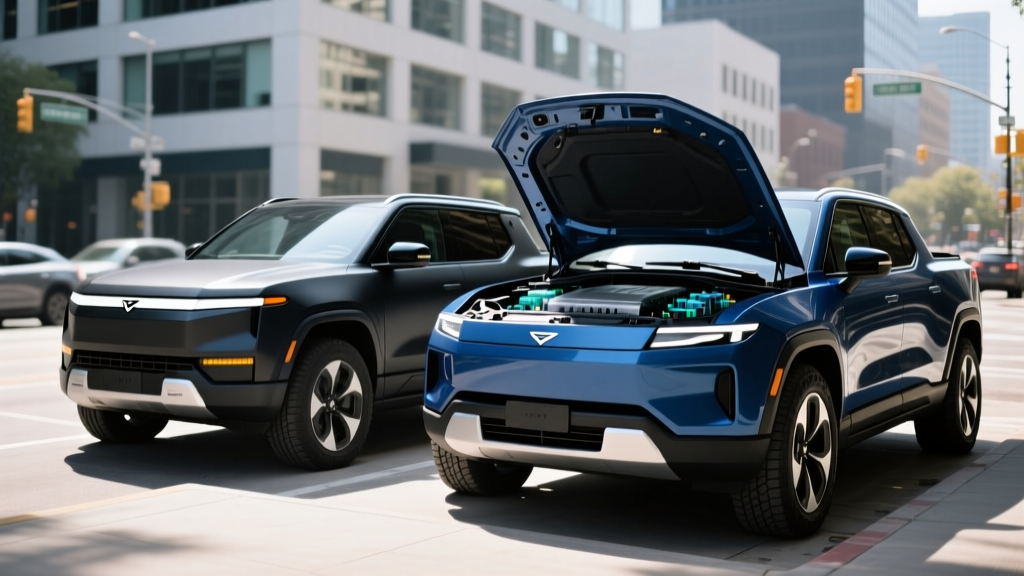
Both the R1T (crew-cab pickup) and R1S (three-row SUV) share Rivian's skateboard platform, quad-motor or dual-motor powertrains, and the same battery pack options. For 2026, Rivian offers the Standard, Large, and Max battery packs, with chemistry shifting depending on pack size. The Large pack uses NMC (nickel manganese cobalt) cells optimized for energy density, while the Standard pack has moved toward LFP (lithium iron phosphate) chemistry for cost and cycle-life advantages — though at a lower total kWh.
| Spec | R1T Dual-Motor (Large) | R1S Dual-Motor (Large) | R1T Quad-Motor (Max) |
|---|---|---|---|
| EPA Range | ~352 mi | ~340 mi | ~410 mi (est.) |
| Battery (usable) | ~106 kWh, NMC | ~106 kWh, NMC | ~141 kWh, NMC |
| Horsepower | 533 hp | 533 hp | 1,025 hp |
| 0–60 mph | 4.5 sec | 4.6 sec | ~3.0 sec |
| Drivetrain | AWD (dual-motor) | AWD (dual-motor) | AWD (quad-motor) |
| Max Tow Capacity | 11,000 lb | 7,700 lb | 11,000 lb |
| MPGe (combined) | 73 MPGe | 73 MPGe | ~65 MPGe |
| Efficiency | 46 kWh/100 mi | 46 kWh/100 mi | ~52 kWh/100 mi |
Sources: fueleconomy.gov, Rivian R1T specs.
Real-World Range: What the EPA Number Doesn't Tell You
Real-World Expectation: ~280–310 mi highway at 70 mph; ~230–260 mi in freezing temps with cabin heat; ~320+ mi mixed city at moderate temps.
The R1T and R1S are heavy, boxy vehicles with the aerodynamics of a brick. At highway speeds, energy consumption climbs steeply — expect 48–55 kWh/100 mi at 75 mph on a flat interstate, compared to the EPA's blended 46 kWh/100 mi. Cold weather compounds this: lithium-ion cells lose efficiency below 40°F, and resistive cabin heating (Rivian does use a heat pump on newer model years, which helps) still draws significant energy. On a 30°F winter road trip, I've seen the R1T Dual-Motor Large deliver roughly 250 miles before needing a charge at 10% SoC.
For daily commuting under 80 miles round-trip, range is a non-issue. For road trips exceeding 250 miles between charging stops, plan conservatively — especially in the Mountain West or Upper Midwest where DC fast-charger spacing can exceed 100 miles.
Charging Speed: DC Fast and Home Level 2
| Level | Power / Rate | Time / Recovery |
|---|---|---|
| Level 1 (120V) | ~1.4 kW | ~3 mi/hr |
| Level 2 (240V, 48A) | 11.5 kW | ~25 mi/hr; full charge ~10 hr |
| DC Fast Charge (peak) | 220 kW (Large/Max) | 10–80% in ~28 min |
| DC Fast (sustained avg) | ~150 kW avg 10–80% | ~200 mi added in 30 min |
Rivian's DC fast-charge curve peaks around 220 kW on the Large pack but tapers significantly above 60% SoC. The 10–80% time of roughly 28 minutes is competitive with other large-battery trucks (the Ford F-150 Lightning Extended Range posts similar numbers) but trails the Hyundai Ioniq 5 or Tesla Cybertruck on peak rate. On the Rivian Adventure Network — the company's proprietary charger network along key overland routes — you'll find 200+ kW stalls that precondition the battery when navigating via the built-in route planner.
At home on a 48-amp Level 2 circuit (requiring a 60-amp breaker), expect about 25 miles of range per hour of charging. Most R1 owners charge overnight and start each day at 80–90% SoC, which is ideal for NMC battery longevity. LFP-equipped Standard packs can be charged to 100% daily without degradation concerns — one of the chemistry's key advantages.
Pricing, Trims, and Federal Tax Credit Eligibility
| Configuration | Base MSRP | Federal Credit Potential | Effective Price |
|---|---|---|---|
| R1T Dual-Motor Standard | ~$69,900 | Up to $7,500* | ~$62,400 |
| R1T Dual-Motor Large | ~$75,900 | Up to $7,500* | ~$68,400 |
| R1S Dual-Motor Large | ~$79,900 | Up to $7,500* | ~$72,400 |
| R1T Quad-Motor Max | ~$94,500 | $0 (MSRP cap) | ~$94,500 |
*IRS §30D credit eligibility depends on multiple criteria. Per irs.gov, the truck MSRP cap is $80,000 (so R1T Dual-Motor configs qualify, but Quad-Motor Max exceeds it). Buyer income caps apply: $300K joint / $150K single MAGI. Battery critical-mineral and component sourcing rules may reduce the credit to $3,750 or $0 depending on supply-chain compliance for the build month. Point-of-sale transfer is available at participating dealers, reducing the purchase price directly. Consult a tax professional for your specific situation.
The R1S, classified as an SUV, has a higher $80,000 MSRP cap under §30D, which is why most R1S Dual-Motor configurations remain credit-eligible while the R1T Quad-Motor does not. This classification quirk is worth understanding before configuring your build.
Cargo, Passenger Space, and Utility
The R1T's party trick is the Gear Tunnel — a 11.7 cu ft pass-through storage compartment between the cab and bed, accessible from both sides. Combined with the 4.5-ft bed (11.2 cu ft) and a front trunk (frunk) of ~11 cu ft, total enclosed cargo space rivals many midsize SUVs. The bed is short for traditional truck work, but for gear-heavy outdoor lifestyles, it's remarkably practical.
The R1S offers three rows with seating for seven. Second-row legroom is generous at ~38 inches, but the third row is best reserved for children — roughly 30 inches of legroom back there. With all rows up, cargo behind the third row is tight (~10 cu ft). Fold the third row and you get ~47 cu ft; fold both rear rows and you're looking at ~92 cu ft, which is competitive with midsize SUVs like the Hyundai Ioniq 5 or Tesla Model X.
Warranty, Battery Longevity, and Service Network
Rivian provides an 8-year / 175,000-mile battery and drive unit warranty, with a capacity retention threshold of 70% — meaning if your pack drops below 70% of original capacity within that window, Rivian replaces or repairs it. The bumper-to-bumper warranty is 5 years / 60,000 miles, which is average for the segment.
Service remains a mixed bag. Rivian operates a growing network of service centers and mobile service vans in metro areas, but rural owners may face 100+ mile tows for major repairs. As the fleet has grown past 150,000 vehicles, parts availability has improved but still lags legacy OEMs. Panel gaps, software glitches, and early suspension wear were common complaints in 2022–2023 build years; 2025–2026 builds have shown marked improvement in fit and finish based on owner forums and service data.
Standout Tech and Notable Drawbacks
Pros
- Class-leading off-road capability with quad-motor torque vectoring and air suspension (up to 14.9" ground clearance)
- Gear Tunnel and frunk provide unmatched enclosed storage for a pickup
- Over-the-air updates have materially improved the vehicle since launch (added features, efficiency gains, UI overhaul)
- Rivian Adventure Network expanding along key road-trip corridors
- NACS port now standard, granting native Tesla Supercharger access
Cons
- Highway efficiency is poor — 70+ mph range drops 20–25% vs EPA
- DC fast-charge speed (220 kW peak) trails competitors like the Cybertruck (350 kW peak) and Ioniq 5 (240 kW sustained)
- Service center density still limited outside major metros
- Third-row space in R1S is child-only
- Insurance premiums run 15–30% higher than comparable gas trucks (specialty EV underwriting)
On the tech side, Rivian's 15.6-inch center display and custom OS have matured significantly. The Driver+ ADAS suite is SAE Level 2 — it offers adaptive cruise and lane-centering but requires hands-on-wheel supervision and is not autonomous. The built-in route planner with automatic battery preconditioning for DC fast charging is one of the best in the industry, rivaling Tesla's navigation integration.
Who Should Buy a Rivian in 2026?
Choose the R1S if: You need three rows for family duty and want electric daily driving with weekend trail capability. Accept the tight third row and plan road trips around DC fast-charger spacing.
Look elsewhere if: You need maximum highway range (consider the Tesla Model S or Lucid Air), the lowest cost per mile (Hyundai Ioniq 5 or Chevy Equinox EV), or a full-size truck bed for commercial work (Ford F-150 Lightning or Silverado EV).
Frequently Asked Questions
How many Rivians are on the road in 2026?
Cumulative deliveries of the R1T and R1S exceed 150,000 units as of early 2026, with the broader fleet (including Amazon EDV vans) pushing total Rivian-built vehicles past 200,000. This makes Rivian the most successful EV startup in US history by production volume, though still a niche player compared to Tesla or legacy OEMs.
What is the real-world range of the Rivian R1T?
The EPA rates the R1T Dual-Motor Large at ~352 miles. Real-world highway driving at 70 mph yields roughly 280–310 miles. In cold weather (below 32°F), expect 230–260 miles before needing to charge. City and mixed driving in moderate temperatures can approach or slightly exceed the EPA figure thanks to regenerative braking.
How fast does the Rivian charge at home and on the road?
On a 48-amp Level 2 home charger (11.5 kW), the R1T adds about 25 miles per hour — a full overnight charge is standard. On DC fast chargers, the Large pack peaks at 220 kW and averages ~150 kW from 10–80%, completing that range in about 28 minutes.
Does the Rivian R1T or R1S qualify for the $7,500 federal EV tax credit?
Most Dual-Motor configurations of the R1T (under the $80,000 truck MSRP cap) and R1S (under the $80,000 SUV cap) are potentially eligible, but the actual credit amount depends on battery critical-mineral sourcing rules that change periodically. Buyer income limits ($300K joint / $150K single MAGI) also apply. Always verify current eligibility on irs.gov or with your tax professional before purchasing.
Is the Rivian worth buying vs. the Ford F-150 Lightning or Tesla Cybertruck?
The R1T excels at off-road capability, enclosed storage (Gear Tunnel + frunk), and adventure-focused design. The F-150 Lightning offers a larger bed, more established service network, and lower starting price. The Cybertruck provides faster charging and a stainless-steel exoskeleton but polarizes on styling and has a smaller service footprint. For lifestyle-oriented truck buyers who prioritize off-road and storage versatility, the R1T remains the strongest pick in 2026.
How reliable are Rivians after 100,000 miles?
Long-term data is still maturing — the oldest R1 vehicles have been on the road since late 2021, so 100K+ mile examples are growing but not yet abundant. Battery degradation on NMC packs has been modest (typically 5–8% loss at 60K miles based on owner reports). The 8-year/175,000-mile battery warranty provides a strong backstop. Early-build vehicles (2022) had more software and suspension issues than 2025–2026 builds.