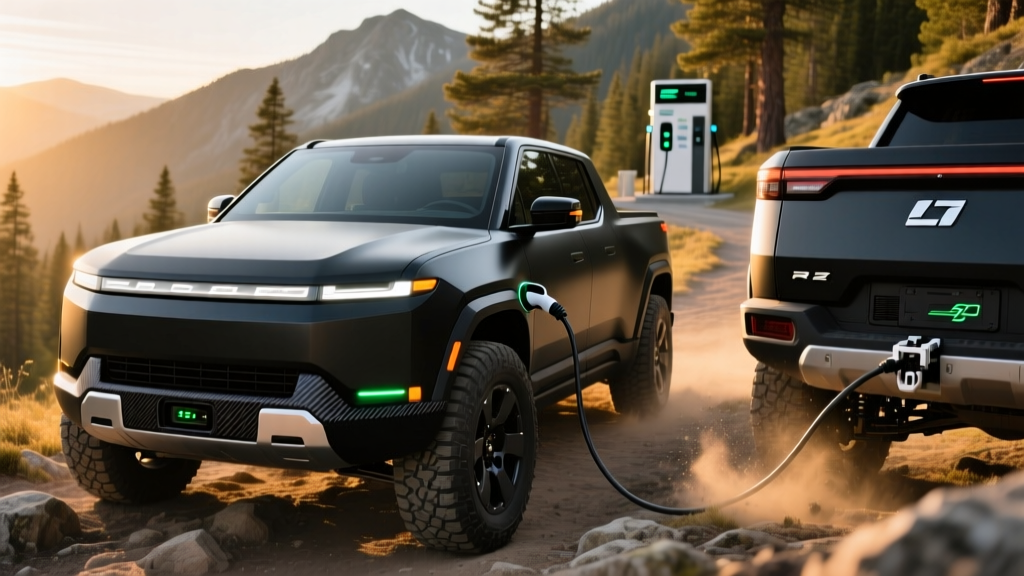
Rivian's Performance Division has been quietly reshaping what an electric truck can do, and the RAD (Rivian Adventure Drive) package represents the culmination of that effort for the 2026 R1T. Built on the second-generation skateboard platform with a massive 149 kWh Max battery pack and quad-motor all-wheel drive, the Performance Division RAD is engineered for buyers who want 800+ horsepower, legitimate off-road hardware, and enough range to actually reach the trailhead without a trailer full of generators. But with a starting price pushing well past $100,000, the question is whether the RAD's spec sheet justifies the premium over the already-capable Dual-Motor R1T — or over competitors like the Ford F-150 Lightning Platinum and the Tesla Cybertruck Beast.
We spent time with the 2026 R1T Performance Division RAD to break down every number that matters: real-world range, charging curves, off-road capability, daily usability, and the federal tax credit situation that could knock thousands off the bottom line.
2026 Rivian R1T Performance Division RAD: Core Specifications
| Attribute | Specification |
|---|---|
| EPA Estimated Range | 352 miles (Max Pack, 20" All-Season) |
| Battery Capacity (Usable) | 149 kWh, NMC (nickel-manganese-cobalt) |
| Drivetrain | Quad-Motor AWD (one motor per wheel) |
| Horsepower | 1,025 hp (Performance Mode) |
| Torque | 1,100 lb-ft |
| 0–60 mph | 3.0 seconds (manufacturer est.) |
| Max DC Fast Charge Rate | ~300 kW peak (NACS connector) |
| 10–80% DC Fast Charge | ~22 minutes (optimal conditions) |
| Level 2 Home Charge Rate | 11.5 kW (~25 mi/hr) |
| Efficiency (Combined) | 73 MPGe / 46 kWh per 100 mi |
| Towing Capacity | 11,000 lbs |
| Payload | 1,760 lbs |
| Cargo (Bed) | 54.0 cu ft (4'6" bed, 30.0" depth) |
| Cargo (Gear Tunnel) | 11.7 cu ft |
| Front Trunk (Frunk) | 11.0 cu ft |
| Ground Clearance (Max) | 14.9 inches (Off-Road mode) |
| Water Fording | 43.1 inches |
| Base MSRP | $112,900 (Performance Division RAD, Tri-Motor) |
| As-Tested (Quad-Motor, Max Pack) | $124,500 |
| Battery/Powertrain Warranty | 8 years / 175,000 miles |
| Bumper-to-Bumper Warranty | 5 years / 60,000 miles |
Real-World Range: What the EPA Sticker Doesn't Tell You
The EPA rates the 2026 R1T Performance Division RAD with the Max Pack and 20-inch All-Season tires at 352 miles. Switch to the available 22-inch Sport wheels and that figure drops to approximately 328 miles due to increased rolling resistance and aerodynamic drag. These are strong numbers for a truck with a 7,150-pound curb weight, but the sticker only tells part of the story.
EPA Sticker: 352 miles (Max Pack, 20" wheels)
Highway (70–75 mph, moderate temps): ~280–300 miles
Mixed driving (55/45 city/highway): ~310–330 miles
Cold weather (20°F, highway, cabin heat): ~230–260 miles
Towing (5,000-lb trailer, flat terrain): ~170–190 miles
Electric trucks suffer disproportionately at highway speeds because of their large frontal area and weight. If your primary use case is 75-mph interstate cruising, budget for roughly 80% of the EPA figure. In sub-freezing conditions, expect a 25–35% range reduction — Rivian's heat pump helps, but it can't fully overcome the physics of heating a large cabin in deep cold.
The 149 kWh Max Pack uses NMC (nickel-manganese-cobalt) chemistry, which offers higher energy density than LFP (lithium iron phosphate) at the cost of slightly faster long-term degradation. Rivian recommends daily charging to 85–90% for NMC longevity and reserving 100% charges for road trips. The battery management system includes a substantial top and bottom buffer — usable capacity is approximately 141 kWh out of 149 kWh gross — which protects the cells from deep-discharge stress.
Charging Speed: DC Fast, Level 2, and the Curve That Matters
Rivian upgraded the second-generation R1T's electrical architecture to support peak DC fast-charging rates of approximately 300 kW via the NACS (North American Charging Standard) connector. That puts the RAD in the top tier of EV trucks for charging speed, though peak rate and sustained rate are very different things.
| Charging Level | Power | Miles Added Per Hour | Notes |
|---|---|---|---|
| Level 1 (120V household) | 1.4 kW | ~3 mi/hr | Emergency/trickle only |
| Level 2 (240V, 48A home) | 11.5 kW | ~25 mi/hr | Full charge in ~13 hours |
| DC Fast (peak) | 300 kW | ~650 mi/hr (at peak) | Only at 10–25% SoC |
| DC Fast (10–80%) | Avg ~210 kW | — | ~22 min, optimal conditions |
| DC Fast (80–100%) | Drops to 40–70 kW | — | Significant taper above 80% |
Understanding the charge curve: The 300 kW peak is only sustainable at low states of charge (roughly 10–25%) and when the battery is properly preconditioned — either via the truck's built-in navigation routing to a charger or manual preconditioning. As the battery fills, the charge rate tapers aggressively. From 80% to 100%, the rate drops to 40–70 kW, meaning the last 20% can take as long as the first 70%. For road trips, plan your stops around 10–80% charges and skip topping off unless you genuinely need those final miles.
At home, the Rivian Wall Connector delivers up to 11.5 kW on a 60-amp circuit (48 amps continuous). That's roughly 25 miles of range per hour of charging, meaning a full 0–100% session takes about 13 hours. Most owners charging overnight from 20% to 80% will wake up to a full daily supply in about 7–8 hours. Installation costs for a Level 2 home charger typically run $800–$2,500 depending on panel capacity and conduit length — factor in a potential $1,000–$3,000 panel upgrade if your home still has a 100-amp service.
Performance: Quad-Motor Power and Off-Road Hardware
The Performance Division RAD in Quad-Motor configuration puts an independent motor at each wheel, producing a combined 1,025 horsepower and 1,100 lb-ft of torque in Performance Mode. The 0–60 mph sprint clocks in at 3.0 seconds — a remarkable figure for a 7,150-pound truck, and one that embarrasses most sports cars at stoplights. Tank turns (rotating the truck in place by spinning opposite wheels in opposite directions) remain a signature feature, though they're restricted to low-traction surfaces to protect driveline components.
The Tri-Motor variant (one front, two rear) drops output to approximately 850 hp and 0–60 in roughly 3.5 seconds — still blisteringly quick, and $12,000 lighter on the wallet.
Off-road, the RAD earns its "Adventure Drive" badge. The adaptive air suspension provides up to 14.9 inches of ground clearance in Off-Road mode, and the truck can ford 43.1 inches of water. Rivian's Performance Division has tuned the suspension damping and torque-vectoring algorithms for rock crawling, sand, and snow modes. Approach, departure, and breakover angles are competitive with a Jeep Wrangler Rubicon when the suspension is at max height. The underbody is protected by a full suite of titanium skid plates — a Performance Division exclusive that saves roughly 30 pounds versus the standard steel units.
On pavement, the quad-motor torque vectoring provides genuinely impressive cornering agility for a vehicle this size. Each wheel's torque is independently managed, creating a yaw moment that pulls the truck into turns with a responsiveness that defies the curb weight. Ride quality in Comfort mode is supple and well-damped, though the 22-inch Sport wheels (optional) transmit more road imperfection than the standard 20-inch All-Seasons.
Interior, Tech, and Driver Assistance
The R1T's cabin has been significantly refreshed for the second generation. A 15.6-inch center touchscreen runs Rivian's in-house infotainment software, which has matured considerably since launch — wireless Apple CarPlay and Android Auto are standard, and the native navigation now includes real-time charger availability and automatic battery preconditioning when a DC fast charger is selected as your destination.
The driver-assistance suite, branded Rivian Driver+, operates at SAE Level 2 — meaning it provides adaptive cruise control and lane-centering on highways, but the driver must remain fully engaged with hands on the wheel and eyes on the road. It is not autonomous driving. The system is competent for long highway stretches, with smooth lane-keeping and predictable braking, but it doesn't yet match the hands-free confidence of GM's Super Cruise on mapped highways. Rivian has indicated that a hands-free highway assist feature is in development, but as of the 2026 model year, Driver+ requires active supervision.
Rivian Driver+ is an SAE Level 2 system. You are the driver at all times. Do not remove your hands from the wheel or your attention from the road. The system can disengage unexpectedly at construction zones, faded lane markings, or in heavy precipitation.
Passenger space is generous for a midsize truck: front legroom measures 41.3 inches, rear legroom 38.2 inches. The rear bench fits three adults for short trips, though the upright seatback angle makes long hauls less comfortable than a full-size crew cab. Storage highlights include the 11-cubic-foot frunk (with a drain for use as a cooler), the 11.7-cubic-foot Gear Tunnel running between the cab and bed (accessible from both sides), and the 54-cubic-foot bed. The Gear Tunnel is a Rivian exclusive and a genuine differentiator for camping gear, wet clothes, or a slide-out kitchen system.
Pricing, Tax Credits, and Ownership Cost
| Configuration | MSRP | Federal §30D Credit | Effective Price |
|---|---|---|---|
| Tri-Motor, Standard Pack (106 kWh) | $112,900 | See eligibility note | Varies |
| Quad-Motor, Max Pack (149 kWh) | $124,500 | See eligibility note | Varies |
| Quad-Motor, Max Pack + Sport Package | $131,200 | See eligibility note | Varies |
Federal tax credit eligibility is complex for the R1T Performance Division RAD. Under current IRS §30D rules, the truck faces two significant hurdles:
- MSRP Cap: The §30D credit applies to trucks, vans, and SUVs with an MSRP at or below $80,000. The Performance Division RAD starts at $112,900 — well above the cap. This means the RAD does not qualify for the new-vehicle federal tax credit.
- Buyer Income Limits: Even for lower-priced Rivian trims that do fall under the cap, buyers must have modified adjusted gross income (MAGI) below $150,000 (single), $225,000 (head of household), or $300,000 (joint) to claim the credit.
- Battery Sourcing: The §30D credit requires that a percentage of critical minerals and battery components be sourced from the U.S. or free-trade-agreement partners. Rivian has been working to localize its supply chain, but the Max Pack's large NMC cells still rely on materials that may not meet all 2026 sourcing thresholds. Always verify current eligibility on IRS.gov before purchasing.
- Point-of-Sale Transfer: If you do qualify for the credit on an eligible Rivian trim, you can transfer it to the dealer at the point of sale for an upfront price reduction, rather than waiting to claim it on your tax return.
The practical takeaway: if you're shopping the Performance Division RAD, plan your budget around the full MSRP. The federal credit is designed for more affordable trims — consider the Dual-Motor Standard Pack (starting around $73,000) if tax credit eligibility is a priority. Consult a tax professional for your specific situation, and check fueleconomy.gov for the latest qualifying vehicle list.
How It Compares: R1T RAD vs. F-150 Lightning Platinum vs. Cybertruck Beast
| Spec | Rivian R1T Perf. Division RAD | Ford F-150 Lightning Platinum | Tesla Cybertruck Beast |
|---|---|---|---|
| EPA Range | 352 mi | 320 mi (Ext. Range) | 340 mi |
| Battery | 149 kWh, NMC | 131 kWh, NMC | ~123 kWh, NMC |
| Horsepower | 1,025 hp | 580 hp | 845 hp |
| 0–60 mph | 3.0 sec | 3.8 sec | 2.6 sec |
| Max DC Charge | ~300 kW | ~150 kW | ~250 kW |
| 10–80% DC | ~22 min | ~41 min | ~28 min |
| Towing | 11,000 lbs | 10,000 lbs | 11,000 lbs |
| Bed Length | 4'6" | 5'5" | 6'0" |
| Base MSRP | $112,900 | $97,875 | $99,990 |
| §30D Eligible | No (MSRP cap) | No (MSRP cap) | No (MSRP cap) |
The RAD holds clear advantages in charging speed (300 kW peak vs. the Lightning's relatively slow 150 kW), ground clearance, and off-road hardware. The Cybertruck Beast is quicker to 60 and offers a longer bed, but its stainless-steel exoskeleton is polarizing, and Tesla's service infrastructure for body repairs remains a concern. The F-150 Lightning wins on bed utility and Ford's dealer service network, but its charging speed is a significant road-trip disadvantage.
Pros and Cons
- Class-leading 300 kW DC fast charging with a practical 22-min 10–80% time
- 1,025 hp quad-motor system with genuine torque-vectoring agility
- Best-in-class off-road hardware: 14.9" clearance, 43.1" water fording, titanium skids
- Unique Gear Tunnel adds 11.7 cu ft of secure, weatherproof storage
- 352-mile EPA range (Max Pack) is top-tier for an electric truck
- 8-year / 175,000-mile battery warranty exceeds the industry-standard 100k
- Continuous OTA updates have meaningfully improved the platform since launch
- $112,900+ starting price; $124,500 as-tested — expensive even in this segment
- Ineligible for the §30D federal tax credit due to MSRP cap
- 4'6" bed is short for traditional truck work; no 6' or 8' option
- Rivian Driver+ requires hands-on supervision; no hands-free highway mode yet
- NMC battery chemistry degrades faster than LFP if routinely charged to 100%
- Rear seat comfort lags full-size crew cabs on long trips
- Service center availability still limited outside major metro areas
Who Should Buy the R1T Performance Division RAD?
- You want the fastest-charging electric truck on the market for road-trip practicality
- Off-road capability is a genuine priority, not just a marketing badge
- You value the Gear Tunnel and frunk for adventure/camping gear
- Budget allows $115,000–$130,000 without relying on the federal tax credit
- You want supercar-rivaling acceleration in a vehicle that can also tow 11,000 lbs
- You need a full-size bed for work (consider the F-150 Lightning or Cybertruck)
- Federal tax credit eligibility is a dealbreaker (look at the Dual-Motor R1T Standard at ~$73k)
- You want hands-free highway driving now (GM's Super Cruise vehicles are ahead here)
- You live far from a Rivian service center and can't tolerate mobile-service-only coverage
Frequently Asked Questions
What is the real-world range of the R1T Performance Division RAD?
The EPA rates it at 352 miles with the Max Pack and 20-inch wheels. Expect roughly 280–300 miles at sustained highway speeds (70–75 mph), 310–330 miles in mixed driving, and 230–260 miles in cold weather (around 20°F). Towing a 5,000-lb trailer cuts range to approximately 170–190 miles on flat terrain.
How fast does the R1T RAD charge at home and on the road?
On a DC fast charger, it peaks at ~300 kW and charges from 10–80% in approximately 22 minutes under optimal conditions (preconditioned battery, warm weather, capable charger). At home on a Level 2 Wall Connector (11.5 kW / 48A), it adds about 25 miles per hour, with a full charge taking roughly 13 hours.
Does the R1T Performance Division RAD qualify for the federal EV tax credit?
No. The §30D credit caps eligible trucks at an MSRP of $80,000, and the RAD starts at $112,900. Lower-priced Rivian trims (Dual-Motor Standard, starting ~$73,000) may qualify, subject to buyer income limits, battery sourcing requirements, and MAGI caps. Always verify on IRS.gov and consult a tax professional.
Is the Rivian R1T RAD worth buying over the F-150 Lightning or Cybertruck?
If charging speed, off-road capability, and adventure-oriented storage (Gear Tunnel) are your priorities, the RAD has no equal in the electric truck segment. If you need a longer bed for work or a lower price, the Lightning or Cybertruck may serve better. The RAD's 300 kW charging is a significant road-trip advantage over the Lightning's 150 kW.
What's the biggest drawback of the R1T RAD?
Price is the obvious one — $112,900+ with no federal tax credit. The short 4'6" bed also limits traditional truck utility, and Rivian's service network is still expanding, which can be a concern for owners outside major metros.
How long will the Max Pack battery last?
Rivian warranties the battery for 8 years or 175,000 miles, whichever comes first, against capacity dropping below 70% of original. NMC chemistry typically retains 85–90% capacity after 100,000 miles with proper care (avoiding routine 100% charges and extreme heat exposure). Replacement cost for a 149 kWh pack is estimated at $18,000–$25,000 out of warranty, though prices are expected to decline as battery costs fall.
Can I use Tesla Superchargers with the R1T RAD?
Yes. The 2026 R1T comes equipped with a native NACS charge port, meaning it can use Tesla Superchargers (V3 and V4) and any other NACS-equipped public charger without an adapter. Rivian owners also retain access to the Rivian Adventure Network and Electrify America stations via the included CCS adapter.