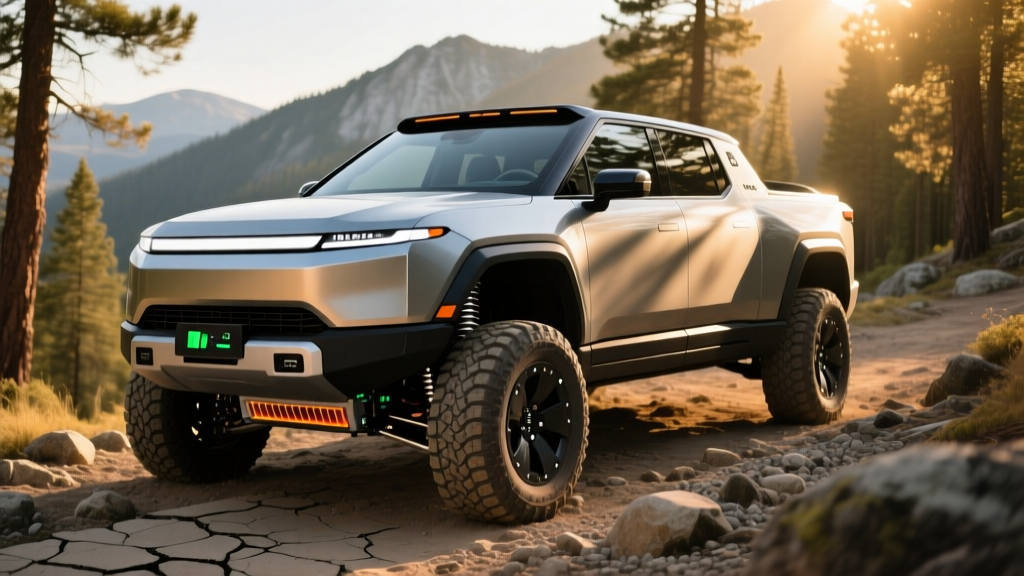
The Rivian R1T has carved out a unique position as the electric truck for buyers who actually plan to leave the pavement. For 2026, the R1T continues to offer its available air suspension system that provides up to 14.9 inches of ground clearance — a lift capability that rivals dedicated off-road trucks. But how does that adventure-ready hardware affect range, charging, and daily usability? We put the numbers to the test.
2026 Rivian R1T Specs at a Glance
| Specification | Dual-Motor Standard | Dual-Motor Max Pack | Tri-Motor Performance |
|---|---|---|---|
| EPA Range | 270 miles | 420 miles | 390 miles |
| Battery Capacity | 92 kWh (LFP) | 141 kWh (NMC) | 141 kWh (NMC) |
| Horsepower | 533 hp | 533 hp | 850 hp |
| 0-60 mph | 4.5 sec | 4.5 sec | 2.9 sec |
| Max DC Charge Rate | 200 kW | 220 kW | 220 kW |
| 10-80% DC Time | ~28 min | ~36 min | ~36 min |
| Level 2 Rate | 11.5 kW (~28 mi/hr) | 11.5 kW (~28 mi/hr) | 11.5 kW (~28 mi/hr) |
| Ground Clearance (Max Lift) | 14.9 inches (air suspension) | ||
| Towing Capacity | 11,000 lbs | ||
| Starting MSRP | $69,900 | $83,900 | $99,900 |
Real-World Range: What the EPA Number Doesn't Tell You
The air suspension's lift mode has a measurable efficiency cost. Running in Off-Road mode at maximum height increases aerodynamic drag, reducing highway efficiency by roughly 5-8% compared to the default All-Purpose ride height. For maximum range on road trips, keep the suspension in its lowest highway setting and let the system automatically adjust based on speed.
According to fueleconomy.gov, the Dual-Motor R1T achieves 73 MPGe combined (46 kWh/100mi). The Tri-Motor drops to 70 MPGe combined due to the additional motor's weight and power demands.
Charging Speed: DC Fast and Home Level 2
| Charging Level | Power | Rate | Notes |
|---|---|---|---|
| Level 1 (120V) | 1.4 kW | ~3 mi/hr | Emergency/trickle only |
| Level 2 (240V, 48A) | 11.5 kW | ~28 mi/hr | Full charge overnight (8-10 hrs) |
| DC Fast (peak) | 200-220 kW | ~200 mi in 20 min | Sustained rate drops above 80% SoC |
Rivian's DC fast charging curve is conservative compared to 800V architectures like Hyundai's E-GMP platform. The R1T peaks at its maximum rate only between 10-40% state of charge, then tapers progressively. Plan on 35-40 minutes for a 10-80% session rather than the optimistic 28-36 minutes Rivian advertises under ideal conditions. The larger Max Pack battery takes longer in absolute time but adds more range per minute of charging due to its capacity.
For home charging, Rivian includes a portable charger capable of 11.5 kW on a 240V/48A circuit. Most owners report 8-10 hours for a full charge from near-empty, which works well for overnight replenishment. A hardwired Level 2 station from ChargePoint or Wallbox provides the same rate with added convenience.
The Lift Suspension: Off-Road Capability and Daily Trade-offs
The R1T's available air suspension provides six ride height settings, from a low Park mode (7.9 inches ground clearance) for easier loading to Off-Road mode's 14.9 inches. That maximum lift clears obstacles that would bottom out most pickups, and the system automatically adjusts damping based on terrain.
In real-world trail use, the lift capability shines on rocky crawls and deep ruts. Approach, departure, and breakover angles all improve dramatically at max height. However, the air suspension adds complexity and potential long-term maintenance cost compared to traditional coil or leaf springs. Rivian's warranty covers the system for 8 years/100,000 miles, but out-of-warranty air strut replacement runs $1,500-2,500 per corner based on current parts pricing.
On pavement, the suspension's adaptive damping provides a compliant ride in Comfort mode and firm body control in Sport. The trade-off is a slightly busier ride quality than a solid-axle truck, with more high-frequency vibration transmitted through the chassis on rough roads.
Pricing, Trims, and Federal Tax Credit Eligibility
| Trim | MSRP | After Potential §30D Credit | Credit Eligible? |
|---|---|---|---|
| Dual-Motor Standard | $69,900 | $62,400 | Yes (meets MSRP cap) |
| Dual-Motor Max Pack | $83,900 | $76,400 | No (exceeds $80K truck cap) |
| Tri-Motor Performance | $99,900 | $92,400 | No (exceeds $80K truck cap) |
The base Dual-Motor R1T qualifies for the full $7,500 federal tax credit under IRS §30D rules, assuming you meet income limits ($150K single/$300K married filing jointly) and the vehicle's battery components satisfy critical minerals and sourcing requirements. The Max Pack and Tri-Motor variants exceed the $80,000 MSRP cap for trucks and are ineligible for the federal credit.
Rivian offers point-of-sale transfer of the credit, reducing your purchase price at delivery rather than waiting for a tax refund. Verify current eligibility on IRS.gov before ordering, as battery sourcing requirements tighten annually.
Cargo, Passenger Space, and Practical Features
The R1T's 54-inch bed is shorter than a full-size truck but compensated by the Gear Tunnel — a 17-cubic-foot pass-through storage compartment behind the cab. Combined with the 11-cubic-foot frunk, total cargo volume reaches 82 cubic feet of enclosed space, more than many SUVs.
Interior passenger space is generous for four adults, with 41.3 inches of front legroom and 38.2 inches rear. The rear seat cushions sit high due to battery packaging, creating a knees-up seating position that some find less comfortable on long trips. The available Camp Kitchen slides out from the Gear Tunnel, adding genuine utility for overlanding.
Notable tech includes Rivian's Driver+ system (Level 2 hands-on assistance), a 15.6-inch infotainment display, over-the-air updates, and vehicle-to-load (V2L) capability that powers accessories via the bed outlets.
Pros and Cons
- Class-leading off-road capability with air suspension lift
- Max Pack's 420-mile range eliminates most range anxiety
- Gear Tunnel and frunk provide versatile storage
- Instant torque and 11,000-lb towing with no turbo lag
- Over-the-air updates continuously add features
- Only base trim qualifies for federal tax credit
- Short 54-inch bed limits traditional truck utility
- Air suspension adds complexity and potential repair cost
- DC charging slower than 800V competitors
- Rear seat comfort compromised by battery height
Who Should Buy the R1T with Lift Suspension?
The R1T with air suspension is ideal for outdoor enthusiasts who need genuine off-road capability combined with daily-driver refinement. If you regularly tackle forest service roads, need to tow a trailer to a trailhead, or want electric torque for technical rock crawling, the R1T delivers where no other EV truck currently matches its blend of range and capability.
It's less suited for buyers prioritizing maximum payload (the Ford F-150 Lightning handles heavier loads), those needing a full-size bed for work, or budget-conscious shoppers who can't absorb the $70K+ entry price. The Chevrolet Silverado EV offers more traditional truck utility at a lower price point, though without the R1T's off-road prowess.
Frequently Asked Questions
What is the real-world range of the Rivian R1T?
Expect 340-360 miles highway for the Max Pack (EPA 420) and 220-240 miles highway for the Standard Pack (EPA 270). Cold weather reduces these figures by 20-30%. Off-road mode at maximum lift height costs an additional 5-8% efficiency.
How fast does the R1T charge at home and on the road?
Level 2 home charging delivers 11.5 kW, adding roughly 28 miles per hour or a full charge in 8-10 hours. DC fast charging peaks at 200-220 kW but tapers above 40% SoC; plan on 35-40 minutes for 10-80% in real-world conditions.
Does the Rivian R1T qualify for the $7,500 federal tax credit?
Only the base Dual-Motor Standard trim at $69,900 MSRP qualifies, as the Max Pack and Tri-Motor exceed the $80,000 truck cap. You must also meet income limits and battery sourcing requirements per current IRS §30D rules.
Is the air suspension reliable long-term?
Rivian covers the air suspension under the 8-year/100,000-mile powertrain warranty. Out-of-warranty, air strut replacement costs $1,500-2,500 per corner. The system adds complexity versus conventional springs but provides unmatched versatility.
How does the R1T compare to the Ford F-150 Lightning?
The Lightning offers a larger bed, higher payload, and lower starting price, but the R1T provides superior off-road capability, more enclosed storage via the Gear Tunnel, and longer range in Max Pack form. Choose the Lightning for work utility, the R1T for adventure.
Final Verdict
The 2026 Rivian R1T with air suspension lift remains the most capable off-road electric vehicle available, combining genuine trail-riding ability with 420 miles of range and daily-driver comfort. The base model's tax credit eligibility helps offset its premium pricing, but most buyers will pay $75K+ for the range they want. If your lifestyle demands both electric efficiency and serious off-road chops, the R1T has no equal — just budget accordingly.