Rivian R1T at a Glance: Specs That Matter
The 2026 Rivian R1T enters its third full model year with revised pricing, a refreshed dual-motor architecture, and continued dominance in the electric pickup segment. For buyers researching the platform — including those curious about aftermarket modifications like a Rivian lift kit — understanding the baseline engineering is essential before touching suspension geometry.
| Specification | Dual-Motor Standard | Dual-Motor Max Pack | Tri-Motor Performance |
|---|---|---|---|
| EPA Range | 270 mi | 420 mi | 352 mi |
| Battery (usable) | 92 kWh (LFP) | 149 kWh (NMC) | 106 kWh (NMC) |
| Horsepower | 533 hp | 533 hp | 850 hp |
| 0–60 mph | 4.5 sec | 4.5 sec | 3.0 sec |
| Max DC Fast Charge | 200 kW | 220 kW | 220 kW |
| 10–80% DC Time | ~28 min | ~41 min | ~22 min |
| Level 2 Home Rate | 11.5 kW (~25 mi/hr) | 11.5 kW (~25 mi/hr) | 11.5 kW (~25 mi/hr) |
| Towing Capacity | 11,000 lb | 11,000 lb | 11,000 lb |
| Base MSRP | $69,900 | $87,500 | $99,900 |
| EPA MPGe | 73 MPGe | 70 MPGe | 68 MPGe |
| Efficiency (kWh/100mi) | 46 kWh | 48 kWh | 49 kWh |
Real-World Range: What the EPA Sticker Doesn't Tell You
The Standard Pack's switch to LFP chemistry for 2026 is a significant move. LFP cells sacrifice energy density (hence the lower range) but offer longer cycle life, reduced fire risk, and tolerance for regular 100% charging — a practical advantage for daily commuters who can charge at home nightly. The Max Pack retains NMC chemistry, necessary to hit 420 miles, but Rivian recommends daily charging to 80–90% to preserve long-term State of Health (SoH).
For road-trippers: the Max Pack's 420-mile figure is genuinely usable on back-road routes with sparse charging, but sustained 80 mph interstate driving with a loaded bed will compress that to 340–360 miles. Still class-leading.
Charging Speed: DC Fast, Level 2, and What You'll Actually Experience
| Charging Level | Power | Miles Added/Hour | Notes |
|---|---|---|---|
| Level 1 (120V) | 1.4 kW | ~3 mi/hr | Emergency/trickle only |
| Level 2 (240V, 48A) | 11.5 kW | ~25 mi/hr | Full overnight charge |
| DC Fast (peak) | 200–220 kW | ~600 mi/hr (peak) | Tapers above 80% SoC |
The R1T's DC fast-charging curve is typical for large-battery EVs: peak rates hold from roughly 10–40% SoC, then taper progressively. A Tri-Motor hitting a 350 kW-capable Electrify America or Rivian Adventure Network station will sustain 180–210 kW through 50%, then drop to ~90 kW by 70%, and ~50 kW past 80%. The published 22-minute 10–80% time assumes optimal battery temperature (preconditioning enabled) and a non-congested charger.
Home Level 2 charging at 11.5 kW requires a 60-amp dedicated circuit. Budget $800–$2,200 for professional installation depending on panel proximity and whether a service upgrade (200A→400A) is needed — a common gotcha in older homes.
Performance and Drivetrain: Dual vs. Tri-Motor
The dual-motor R1T delivers 533 hp through a true all-wheel-drive system with independent front and rear motors. The 4.5-second 0–60 time is brisk for a 7,100-lb truck and more than adequate for highway merging and trail use. The Tri-Motor adds a second rear motor for torque vectoring, cutting 0–60 to 3.0 seconds — supercar territory in a pickup, though the weight penalty shows in cornering dynamics.
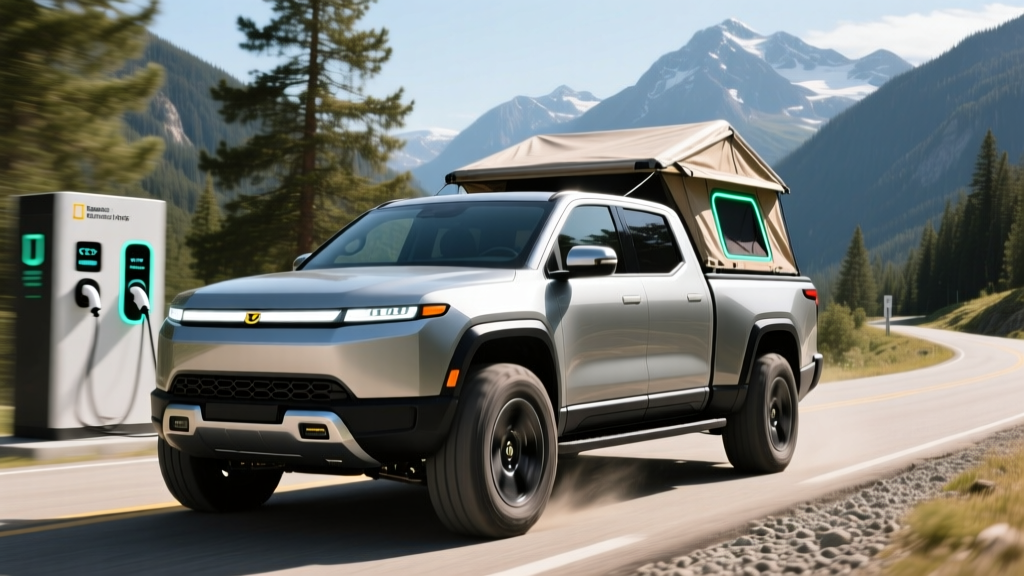
Both configurations include Rivian's quad-corner air suspension as standard, offering 6.5 to 14.4 inches of ground clearance (adjustable). This is where the Rivian lift kit conversation enters: the factory air suspension already provides up to 14.4 inches of clearance in Off-Road mode, rivaling or exceeding most aftermarket static lifts. A fixed aftermarket lift kit (typically 2–3 inches from brands like Rough Country or BDS) eliminates the adjustability that makes the R1T versatile — low for highway aero, high for rock crawling.
Interior, Cargo, and the Gear Tunnel
The R1T seats five with 41.3 inches of front legroom and 36.2 inches rear. Cargo space breaks down as:
- Bed: 4'6" (54") with tailgate up; 6'8" with tailgate down
- Gear Tunnel: 11.7 cu ft (pass-through behind rear seats — R1T-exclusive feature)
- Frunk: 11.0 cu ft (front trunk, drainable for ice/cargo)
- Total enclosed: ~25+ cu ft with bed cap or tonneau
The Gear Tunnel remains the R1T's most distinctive practical feature — a lockable, climate-adjacent pass-through ideal for camping gear, tools, or groceries. No competitor offers equivalent enclosed storage without a bed cap.
Pricing, Tax Credit Eligibility, and Total Cost
| Trim | MSRP | Federal Credit (§30D) | Effective Price |
|---|---|---|---|
| Dual-Motor Standard | $69,900 | $0 (MSRP cap exceeded*) | $69,900 |
| Dual-Motor Max Pack | $87,500 | $0 | $87,500 |
| Tri-Motor Performance | $99,900 | $0 | $99,900 |
*The IRS §30D federal tax credit imposes an $80,000 MSRP cap for trucks/vans/SUVs per IRS guidelines. The Dual-Motor Standard at $69,900 technically clears the cap, but battery component and critical-mineral sourcing requirements for 2026 must also be met. As of early 2026, Rivian's U.S.-built battery packs partially qualify — check fueleconomy.gov for the current eligible-vehicle list before purchasing. Income caps also apply: $300K joint / $225K head-of-household / $150K single MAGI. The credit can now be transferred at point-of-sale as an instant discount.
For buyers who do qualify, the Standard Pack at ~$69,900 (potentially $62,400 after full credit) undercuts the Ford F-150 Lightning Extended Range and Chevrolet Silverado EV on price-per-mile of range. Insurance runs $2,400–$3,800/year depending on trim and driving record — budget accordingly.
Tech, Driver Assistance, and Warranty
The R1T runs Rivian's in-house infotainment on a 15.6-inch center display with wireless CarPlay/Android Auto. The Rivian Driver+ system is a SAE Level 2 driver-assist suite (hands-on-wheel, eyes-on-road required — not self-driving) with adaptive cruise, lane centering, and automatic lane changes on divided highways. It works competently but does not match Tesla FSD Supervised or GM Super Cruise in hands-free capability.
Warranty coverage:
- Battery & Powertrain: 8 years / 175,000 miles (70% capacity retention threshold)
General Vehicle: 5 years / 60,000 miles - Roadside Assistance: 5 years / unlimited miles
The 175,000-mile powertrain warranty exceeds the industry-standard 100K, reflecting Rivian's confidence in its skateboard platform. Per NHTSA, the R1T holds a 5-Star overall safety rating.
Who Should Buy the R1T — And Who Shouldn't
Pros
- Gear Tunnel + frunk = unmatched enclosed storage
- Air suspension: 6.5–14.4" clearance without aftermarket lift
- 420-mile Max Pack is longest-range EV pickup available
- 11,000-lb towing with integrated trailer brake controller
- LFP Standard Pack allows worry-free 100% daily charging
Cons
- Standard Pack's 270 mi range is tight for road trips
- Tri-Motor at $99,900 is luxury-priced; no federal credit
- Service center network still limited outside major metros
- Aftermarket lift kits may void air-suspension warranty
- Rear seat legroom (36.2") trails full-size crew cabs
Buy the R1T if: You need a daily-drivable electric truck with genuine off-road capability, enclosed storage versatility, and road-trip range (Max Pack). It suits outdoor enthusiasts, contractors with light-to-medium hauling needs, and families who tow campers under 10,000 lb.
Look elsewhere if: You need maximum rear-seat space (F-150 Lightning), 3,000+ lb payload capacity (Silverado EV), or sub-$55K pricing (wait for next-gen platforms). If you're set on an aftermarket Rivian lift kit for 37" tires and dedicated rock-crawling, understand you're modifying a $70K–$100K vehicle with warranty implications.
Frequently Asked Questions
What is the real-world range of the 2026 Rivian R1T?
The Tri-Motor's 352-mile EPA rating drops to ~280–310 miles on sustained highway driving and ~240–260 miles in freezing weather. The Standard Pack (270 EPA) realistically delivers 210–230 highway miles.
How fast does the R1T charge at home and on the road?
Level 2 home charging at 11.5 kW adds ~25 miles per hour (full overnight charge). DC fast charging peaks at 200–220 kW, with 10–80% in 22–41 minutes depending on pack size and temperature.
Does the Rivian R1T qualify for the $7,500 federal tax credit?
Possibly. The Dual-Motor Standard ($69,900 MSRP) clears the $80K truck cap, but 2026 critical-mineral and battery-component sourcing rules must also be met. Check the current eligible list at fueleconomy.gov and confirm your income is below IRS caps.
Is an aftermarket Rivian lift kit worth installing?
For most owners, no — the factory air suspension already provides 14.4" of ground clearance in Off-Road mode. A static lift kit is primarily for fitting oversized tires (35"–37") or achieving a specific stance. It risks voiding air-suspension warranty coverage and reduces range by 5–10% due to increased rolling resistance and aerodynamic drag.
How does the R1T compare to the Ford F-150 Lightning?
The R1T wins on range (420 vs. 320 mi max), ground clearance (adjustable air suspension vs. fixed), and enclosed storage (Gear Tunnel). The F-150 Lightning offers more rear-seat space, a larger bed, a broader dealer/service network, and lower starting prices. Choose Rivian for adventure versatility; choose Ford for fleet/trade familiarity.