The Rivian R1T in 2026: More Than Just That Iconic Rivian Grill
The first thing people notice about the Rivian R1T is the light bar — that signature stadium-shaped rivian grill illumination that's become a rolling brand identifier. But the 2026 R1T is far more than its face. Now in its second generation with Rivian's in-house Gen 2 drive units and a refined battery lineup, the R1T has matured from an impressive-but-quirky startup truck into a serious contender in the electric pickup segment. We've spent time with the Dual-Motor Standard Pack and Tri-Motor Max Pack configurations to bring you exact numbers on range, charging, towing, and what ownership actually costs after federal tax incentives.
This review covers the 2026 model year R1T with updated pricing, real-world efficiency data, and the latest IRS §30D tax credit eligibility. Whether you're comparing it against the Ford F-150 Lightning, Chevrolet Silverado EV, or Tesla Cybertruck, the numbers below will give you a clear decision framework.
Range and Efficiency: EPA Sticker vs. Real-World Miles
Rivian offers the 2026 R1T in three battery configurations, each with distinct EPA range ratings. Here's the critical nuance most spec sheets omit: EPA range assumes a mix of city and highway driving at moderate temperatures. The R1T's boxy, truck-shaped aerodynamics mean highway range drops more sharply than in a sedan-based EV.
- Standard Pack (Dual-Motor): EPA 270 miles — expect ~220-235 miles at sustained 75 mph highway speeds; ~180-200 miles in sub-30°F winter conditions.
- Large Pack (Dual-Motor): EPA 352 miles — expect ~285-310 miles highway; ~240-265 miles in cold weather.
- Max Pack (Tri-Motor): EPA 420 miles — expect ~340-370 miles highway; ~290-320 miles in freezing temps.
Rivian's heat pump (standard on 2026 models) mitigates cold-weather cabin energy draw, but battery chemistry itself loses efficiency in extreme cold. Plan for 15-25% range reduction in winter depending on your climate and driving style.
Efficiency varies by configuration. The Dual-Motor Large Pack achieves an EPA-rated 73 MPGe combined (approximately 46 kWh/100 miles), which is competitive with the F-150 Lightning Extended Range (70 MPGe) but trails the more aerodynamic Tesla Cybertruck AWD at 79 MPGe. If you tow — the R1T is rated for 11,000 lbs — expect efficiency to plummet to roughly 1.8-2.2 kWh/mile, effectively cutting range in half under heavy trailer loads.
| Configuration | Battery (kWh usable) | Chemistry | EPA Range | MPGe (combined) | kWh/100mi |
|---|---|---|---|---|---|
| Dual-Motor Standard | 95 kWh | NMC (2170 cells) | 270 mi | 70 | 48 |
| Dual-Motor Large | 128 kWh | NMC (2170 cells) | 352 mi | 73 | 46 |
| Tri-Motor Max | 149 kWh | NMC (4680-type cylindrical) | 420 mi | 70 | 48 |
All R1T batteries use nickel-manganese-cobalt (NMC) chemistry, which offers higher energy density than LFP but requires more careful state-of-charge management. Rivian recommends daily charging to 85-90% and reserving 100% for road trips — a practice that extends long-term battery health.
Charging Speed: DC Fast Charge and Home Level 2
Charging speed is where the 2026 R1T shows meaningful improvement over earlier models. Rivian's Gen 2 architecture supports higher peak charge rates, and the charge curve — the rate at which charging slows as the battery fills — is more gradual than in the first-generation truck.
| Charge Level | Standard Pack | Large Pack | Max Pack |
|---|---|---|---|
| DC Fast Charge (peak kW) | 190 kW | 220 kW | 220 kW |
| 10-80% DCFC time | ~24 min | ~27 min | ~35 min |
| Level 2 Home (kW) | 11.5 kW | 11.5 kW | 11.5 kW |
| Level 2 Miles/Hour | ~25 mi/hr | ~27 mi/hr | ~27 mi/hr |
| Full Level 2 Charge (0-100%) | ~9.5 hrs | ~12.5 hrs | ~14.5 hrs |
| Connector | NACS (native Tesla Supercharger access) | ||
Real-world charging curve reality: The Large Pack peaks at 220 kW only between roughly 15-45% state of charge. From 45-65%, it tapers to ~170 kW, then drops to ~110 kW from 65-80%. The published 10-80% time of 27 minutes reflects this taper. If you're on a road trip, plan stops around 15-75% SoC for the fastest average charging — pushing past 80% at a DC fast charger is painfully slow and rarely worth the wait unless you're at your destination.
The R1T uses the NACS connector natively in 2026, meaning direct access to Tesla Supercharger V3 and V4 stalls without an adapter. This is a significant advantage for road-trip charging reliability. At home, the onboard 11.5 kW charger requires a 60-amp circuit (48-amp continuous draw) to achieve full Level 2 speed. Most owners installing a Rivian Wall Charger or ChargePoint Home Flex will need a licensed electrician to run a 240V/60A line — budget $800-$2,000 for installation depending on your panel's proximity to the garage and whether a panel upgrade is needed.
Performance and Drivetrain
Rivian's Gen 2 drive units are now manufactured in-house at the Normal, Illinois facility, replacing the earlier Bosch-sourced motors. The result is a lighter, more efficient powertrain with improved thermal management for sustained performance.
| Spec | Dual-Motor | Performance Dual-Motor | Tri-Motor |
|---|---|---|---|
| Horsepower | 533 hp | 665 hp | 850 hp |
| Torque (lb-ft) | 610 | 828 | 1,103 |
| 0-60 mph | 4.5 sec | 3.4 sec | 2.9 sec |
| Drivetrain | AWD (2 motors) | AWD (2 motors) | AWD (3 motors) |
| Towing Capacity | 11,000 lbs | 11,000 lbs | 11,000 lbs |
| Payload Capacity | 1,760 lbs | 1,760 lbs | 1,640 lbs |
The Dual-Motor's 533 hp and 4.5-second 0-60 time already outpace most gas-powered half-ton trucks. The Tri-Motor's 2.9-second sprint puts it in supercar territory — though at 7,000+ lbs curb weight, you'll feel that mass in corners and during emergency braking. The R1T's air suspension (standard on most trims) provides up to 14.9 inches of ground clearance in Off-Road mode and drops for easier bed access in Park mode.
The 2026 Rivian Grill and Exterior Design
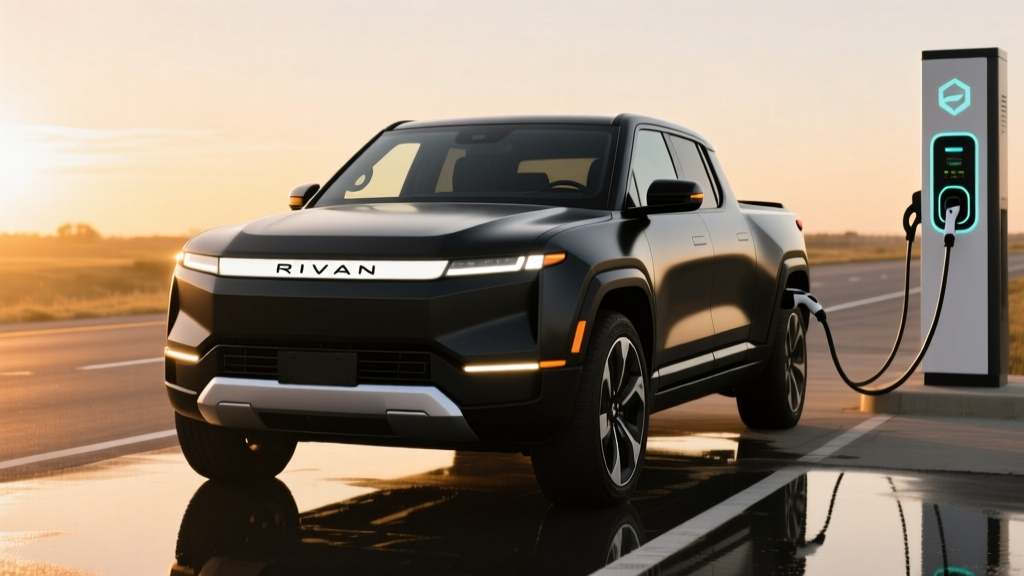
Let's address the keyword directly: the rivian grill — or more accurately, the illuminated stadium light bar that serves as the R1T's visual signature. For 2026, Rivian has refined the front fascia with a slightly more integrated light bar design, updated LED elements with sequential turn signals, and an improved approach to the gear tunnel access panel. The light bar isn't purely aesthetic — it functions as a charge indicator when plugged in, illuminating in segments to display current state of charge at a glance.
Exterior dimensions remain practical for a full-size crew cab:
- Bed length: 4.5 feet (54 inches) — shorter than a traditional 5.5 or 6.5-foot truck bed
- Gear Tunnel: 11 cu ft lockable pass-through storage between cab and bed (a Rivian exclusive)
- Frunk (front trunk): 11 cu ft with a drain plug — usable as a cooler
- Overall length: 217.1 inches
- Approach/Departure angles: 35.5°/30° (Off-Road mode, air suspension raised)
The short bed is the R1T's most common criticism from traditional truck buyers. If you regularly haul 4x8 sheets of plywood with the tailgate down, the R1T can accommodate them — but just barely. The gear tunnel compensates for some lost bed space, and it's ideal for stowing charging cables, tools, or camping gear out of sight.
Interior, Tech, and Driver Assistance
The 2026 R1T's cabin uses a minimalist design language with a 15.6-inch center touchscreen running Rivian's proprietary infotainment OS. The system has improved significantly since launch — response times are faster, the navigation integrates DC fast-charger preconditioning automatically, and wireless Apple CarPlay/Android Auto are standard. Over-the-air updates continue to add features; the 2026 software stack includes enhanced camp mode (maintaining climate control with optimized battery draw) and improved trail mapping for off-road routes.
Driver Assistance — SAE Level 2:
Rivian's Driver+ system combines adaptive cruise control and lane-centering assist on highways. It requires the driver to maintain hands-on-wheel supervision at all times. It does not navigate autonomously, handle construction zones, or respond to all traffic scenarios. This is the same SAE Level 2 classification as Tesla Autopilot, Ford BlueCruise, and GM Super Cruise — the driver remains fully responsible for vehicle operation.
The system performs competently on well-marked interstates but can struggle with faded lane markings and aggressive cut-ins. Rivian has not yet released a hands-free variant comparable to GM's Super Cruise or Ford's BlueCruise hands-free mode. Expect continued refinement through OTA updates, but plan to stay engaged.
Pricing, Trims, and Federal Tax Credit Eligibility
The 2026 Rivian R1T is available in Adventure and Ascend trims, with the Ascend adding premium interior materials, enhanced audio, and additional driver-assist features.
| Configuration | Adventure Trim MSRP | Ascend Trim MSRP |
|---|---|---|
| Dual-Motor Standard Pack | $69,900 | $75,900 |
| Dual-Motor Large Pack | $76,900 | $82,900 |
| Tri-Motor Max Pack | $92,900 | $98,900 |
Federal Tax Credit (§30D) Eligibility — Critical Details:
- MSRP Cap: Trucks/vans/SUVs must be under $80,000 MSRP. The Standard and Large Pack Adventure trims qualify; Ascend trims and all Tri-Motor configurations exceed the cap.
- Buyer Income Cap: Modified AGI must not exceed $150,000 (single), $225,000 (head of household), or $300,000 (married filing jointly).
- Battery Sourcing: The credit splits into two halves — $3,750 for critical minerals and $3,750 for battery component assembly. Sourcing requirements tighten annually; verify current-year compliance on the IRS qualified vehicles list before purchasing.
- Point-of-Sale Transfer: As of 2024, you can transfer the credit to the dealer at purchase, reducing your out-of-pocket cost immediately rather than waiting for tax filing.
Always confirm eligibility with a tax professional. Rules change, and Rivian's battery supply chain evolves — a vehicle eligible in January may have different sourcing status by December. See fueleconomy.gov for the latest qualified vehicle database.
For the Dual-Motor Large Pack Adventure — the most popular configuration — the $76,900 MSRP drops to an effective $69,400 after the full $7,500 credit (assuming you meet all income, sourcing, and MSRP requirements). That positions it competitively against the F-150 Lightning Lariat Extended Range (~$72,000 before credit) and well below the Cybertruck All-Wheel Drive (~$81,830 before credit, which exceeds the MSRP cap).
Warranty, Ownership Costs, and Long-Term Outlook
Rivian provides the following warranty coverage for the 2026 R1T:
- Battery & Drive Units: 8 years / 175,000 miles (whichever comes first), with a capacity retention threshold of 70% of original kWh.
- Limited Vehicle Warranty: 5 years / 60,000 miles bumper-to-bumper.
- Corrosion Perforation: 12 years / unlimited miles.
The 175,000-mile battery warranty is among the best in the segment — matching Tesla's coverage and exceeding Ford's 100,000-mile battery warranty on the F-150 Lightning. Rivian's battery replacement cost is not publicly published as a flat rate, but industry estimates for a 128 kWh NMC pack place it in the $15,000-$22,000 range out of warranty, which is important context for high-mileage or second-ownership scenarios.
5-Year Estimated Total Cost of Ownership (Dual-Motor Large Pack, 15,000 mi/yr):
- Home electricity at $0.14/kWh: ~$3,450/yr fuel cost (vs. ~$2,700/yr for a 22 MPG gas truck at $3.50/gal — the EV costs more to "fuel" at this electricity rate due to the R1T's 46 kWh/100mi consumption)
- Insurance: Expect $2,400-$3,200/yr (EV pickups carry higher premiums; get quotes before purchasing)
- Maintenance: ~$300-$500/yr (no oil changes, fewer brake replacements with regen, but cabin filters, wipers, tire rotation)
- Tire replacement: Budget $1,800-$2,800 every 30,000-40,000 miles (EV truck tires wear faster due to weight and instant torque)
Who Should Buy the 2026 Rivian R1T?
- You want an electric truck that genuinely off-roads (air suspension, quad-motor torque vectoring on Tri-Motor, 14.9" ground clearance)
- You value the gear tunnel and frunk for adventure/camping use cases
- You need NACS native Supercharger access for road trips
- You tow occasionally but not daily (11,000-lb rating, but range drops sharply under load)
- You appreciate distinctive design — the rivian grill light bar turns heads at every charging stop
- You need a full 6.5-foot bed for work use (consider Silverado EV or F-150 Lightning)
- You're on a sub-$60,000 budget (wait for Rivian's R2 platform or look at used Lightning)
- You want hands-free highway driving (GM Super Cruise on Silverado EV offers this)
- You tow heavy trailers long distances regularly (diesel still wins here for range under load)
- Class-leading off-road capability with air suspension
- Native NACS/Supercharger access (2026+)
- Unique gear tunnel + frunk storage
- Strong 175,000-mile battery warranty
- Tri-Motor performance is genuinely thrilling
- OTA updates continue to improve the platform
- Short 4.5-foot bed limits traditional truck utility
- Efficiency (46-48 kWh/100mi) means higher home charging costs
- Insurance premiums run 20-35% higher than comparable gas trucks
- Service center network still expanding — rural owners may face long tow distances
- Driver+ is competent but not hands-free
- Max Pack pricing pushes past $90K before options
Frequently Asked Questions
What is the real-world range of the 2026 Rivian R1T?
The EPA rates the Dual-Motor Large Pack at 352 miles, but sustained 75 mph highway driving yields approximately 285-310 miles. In cold weather (below 30°F), expect 240-265 miles from the same pack. The Standard Pack's 270-mile EPA rating translates to roughly 220-235 real-world highway miles. These numbers assume no towing — add a trailer and cut range by 40-50%.
How fast does the R1T charge at home and on the road?
On a DC fast charger, the Large Pack peaks at 220 kW and charges from 10-80% in approximately 27 minutes, though the charge curve tapers significantly above 65% SoC. At home on a Level 2 charger (11.5 kW, 60-amp circuit), you'll add about 27 miles of range per hour, fully recharging the Large Pack overnight in roughly 12.5 hours.
Does the Rivian R1T qualify for the $7,500 federal EV tax credit?
It depends on the configuration and your income. The Standard Pack ($69,900) and Large Pack Adventure ($76,900) are under the $80,000 truck MSRP cap and can qualify for up to $7,500, provided your modified AGI is within IRS limits and the battery meets current-year critical mineral and component sourcing requirements. Tri-Motor and Ascend trims exceed the MSRP cap and are ineligible. Always verify on the IRS qualified vehicles list and consult a tax professional.
Is the Rivian R1T worth buying over the F-150 Lightning or Cybertruck?
The R1T wins on off-road capability, unique storage (gear tunnel, frunk), and native NACS charging access. The F-150 Lightning offers a longer bed, more traditional truck utility, and a broader dealer/service network. The Cybertruck offers sharper efficiency and a stainless-steel exoskeleton but polarizes on design and has a higher starting price that often exceeds the tax credit MSRP cap. If adventure and off-road use are priorities, the R1T is the strongest pick. If you need a work truck first, the Lightning remains more practical.
What are the biggest drawbacks of the R1T?
The short bed (4.5 feet), higher insurance costs, and still-growing service network are the most common owner complaints. Efficiency at 46-48 kWh/100mi means home charging isn't as cheap as lighter EVs, and the Driver+ system, while competent, doesn't yet offer hands-free highway driving like some competitors.
Has the rivian grill design changed for 2026?
Yes, subtly. The 2026 R1T features a refined light bar with updated LED elements, sequential turn signals, and improved integration with the front fascia. The stadium shape remains — it's the R1T's most recognizable design element — but the execution is cleaner, and the charge-indicator functionality (the light bar segments illuminate to show state of charge while plugged in) has been made more visible from a distance.