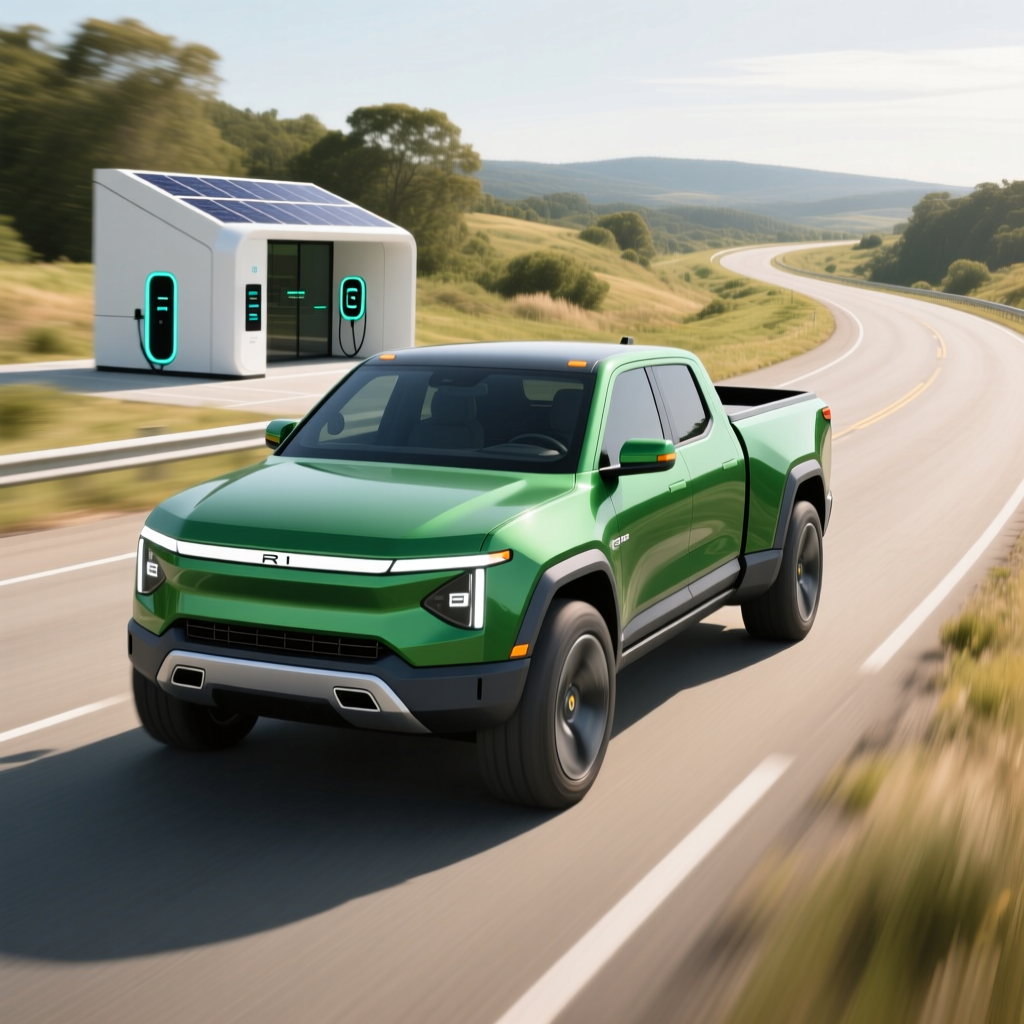
The Rivian R1T has carved out a unique space in the electric vehicle landscape, blending the practicality of a daily commuter with the rugged capability of a serious adventure machine. As one of the first all-electric pickup trucks to reach consumers, the R1T continues to impress with its innovative design, blistering performance, and thoughtful engineering. In this comprehensive review, we put the R1T through its paces as both a weekday commuter and a weekend explorer to determine whether it truly delivers on its dual-purpose promise.
If you are exploring the growing segment of electric trucks, be sure to check out our best electric trucks roundup for a broader look at the competition.
Vehicle Overview: What Makes the Rivian R1T Stand Out
The Rivian R1T is a mid-size electric pickup truck built on a skateboard platform that houses its battery pack between the axles, giving it an exceptionally low center of gravity. Available in dual-motor and quad-motor configurations, the R1T produces anywhere from approximately 533 horsepower in the Dual-Motor variant to a staggering 1,025 horsepower in the Tri-Motor and Quad-Motor setups. Rivian offers multiple battery pack sizes, including the Standard, Large, and Max packs, which significantly influence range and performance characteristics.
What sets the R1T apart from traditional body-on-frame trucks is its unibody construction paired with an independent suspension at all four corners. This engineering choice gives the R1T car-like ride quality on pavement while still providing serious off-road credentials. The truck features a distinctive gear tunnel — a transverse storage compartment between the cab and the bed — that is entirely unique to the R1T and exemplifies Rivian's creative approach to vehicle design.
With a maximum towing capacity of up to 11,000 pounds (when properly equipped) and a payload capacity of approximately 1,760 pounds, the R1T is no lightweight in terms of utility. It also boasts a wading depth of over three feet, making it genuinely capable when the pavement ends. For more on how it stacks up against rivals, see our Rivian R1T vs. Ford F-150 Lightning comparison.
Real-World Range: How Far Can the R1T Actually Go?
Range anxiety remains one of the most common concerns for prospective EV buyers, and the R1T addresses it with multiple battery options. According to EPA ratings, the R1T with the Large battery pack and Dual-Motor configuration achieves an estimated range of approximately 352 miles. The Max pack pushes that figure to around 410 miles in the most efficient configuration, while the Standard pack delivers roughly 270 miles of estimated range.
In real-world driving conditions, our testing revealed that the Dual-Motor R1T with the Large pack consistently delivered between 290 and 330 miles of usable range during mixed driving that included highway cruising at 70 mph, city stop-and-go traffic, and light off-road use. Highway driving at sustained speeds above 75 mph reduced range by approximately 15 to 20 percent compared to the EPA estimate, which is typical for electric vehicles with the aerodynamic profile of a pickup truck.
Off-road excursions naturally consume more energy due to low-speed, high-torque demands and terrain management system usage. During a moderate trail drive covering approximately 40 miles, we observed energy consumption rates roughly 30 to 40 percent higher than normal highway driving. However, the R1T's regenerative braking system proved effective on descents, recapturing a meaningful amount of energy on downhill sections.
For daily commuting, even the Standard pack provides ample range for the vast majority of drivers. The average American commute is under 40 miles round trip, meaning most R1T owners will charge at home and rarely think about range during the workweek. For a deeper analysis of how range holds up over time, visit our EV battery degradation guide.
Charging Speed and Infrastructure: Getting Back on the Road Fast
The Rivian R1T supports DC fast charging at rates up to approximately 220 kW on vehicles equipped with the newer battery architecture. In independent testing at Electrify America and other major networks, the R1T has demonstrated the ability to charge from 10 to 80 percent in roughly 30 to 40 minutes under optimal conditions. Charging speed tapers significantly above 80 percent state of charge, as is standard practice to protect battery longevity.
At home, the R1T supports Level 2 charging at up to 11.5 kW using a 48-amp connected charger. This means a full charge from empty takes approximately 12 to 15 hours depending on the battery pack size — perfectly suited for overnight charging. Rivian also offers the Wall Connector, which provides a streamlined home charging experience with integrated cable management.
Rivian has invested heavily in its own Adventure Network, a growing system of fast chargers strategically located near popular outdoor destinations, national parks, and trailheads. This network is designed specifically to support the adventure use case that Rivian owners gravitate toward. Additionally, through partnerships and adapter availability, R1T owners can access the broader networks of Electrify America and other major providers, ensuring coverage on long road trips.
The built-in navigation system includes intelligent route planning that automatically factors in charging stops, estimates state of charge upon arrival, and preconditions the battery for optimal charging speed when approaching a fast charger. This level of integration makes long-distance travel significantly less stressful and is one of the R1T's strongest features for road trippers.
Interior, Technology, and Cargo Innovation
Step inside the R1T and you are greeted by a clean, modern interior that emphasizes sustainable materials and functional design. The cabin features vegan leather upholstery as standard, with available upgrades including premium natural materials. The minimalist dashboard is dominated by a 15.6-inch center touchscreen running Rivian's proprietary software, which handles everything from navigation and media to vehicle settings and off-road telemetry.
The digital instrument cluster is a 12.3-inch display positioned directly in front of the driver, providing essential information including speed, range, navigation directions, and driver assistance status. A secondary 6.8-inch touchscreen on the rear center console gives back-seat passengers control over climate settings and heated and ventilated seat functions.
Where the R1T truly innovates is in cargo management. The aforementioned gear tunnel provides approximately 11 cubic feet of lockable, weather-sealed storage that runs the full width of the vehicle. It is perfect for storing camping gear, tools, or groceries and can be accessed from either side of the truck. Available accessories include a slide-out kitchen system, a gear tunnel shuttle for easier access, and integrated tie-down systems.
The bed itself measures approximately 4.5 feet in length — shorter than many traditional mid-size trucks — but compensates with features like an integrated air compressor, multiple 120-volt and 12-volt power outlets, built-in LED bed lighting, and a powered tonneau cover. The bed can also be extended by lowering the tailgate and using the bed extender, providing enough length to accommodate larger items like mountain bikes or kayaks.
The R1T comes equipped with a comprehensive suite of advanced driver assistance features, including adaptive cruise control, lane-keeping assist, automatic emergency braking, and a 360-degree camera system. Rivian regularly delivers over-the-air software updates that add new features, improve existing systems, and refine the driving experience. For more on EV technology trends, browse our EV technology buyer's guide.
Driving Dynamics: Performance Meets Practicality
Driving the Rivian R1T is an experience that defies expectations for a pickup truck. The dual-motor all-wheel-drive system delivers smooth, instant torque that propels the R1T from 0 to 60 mph in approximately 4.5 seconds in the standard Dual-Motor configuration. The performance-oriented Dual-Motor variant cuts that time to roughly 3.5 seconds, while the Tri-Motor and Quad-Motor variants achieve supercar-rivaling acceleration times of around 3.0 seconds or less.
On paved roads, the R1T's independent suspension and low center of gravity translate into surprisingly composed handling. Body roll is minimal for a vehicle of this size and weight, and the steering is precise and well-weighted. The air suspension system offers adjustable ride height with over six inches of travel, allowing the driver to lower the truck for improved aerodynamics on the highway or raise it for increased ground clearance on rough terrain.
The R1T offers multiple drive modes, including All-Purpose, Sport, Conserve, Snow, Off-Road, and Towing. Each mode adjusts throttle response, suspension height, regenerative braking intensity, and traction control parameters. Sport mode sharpens everything for spirited driving, while Conserve mode maximizes range by limiting power output and lowering the suspension for better aerodynamics.
Off-road, the R1T reveals capabilities that rival dedicated off-road vehicles. With up to 14.9 inches of ground clearance in its highest suspension setting, approach and departure angles that exceed many body-on-frame competitors, and a sophisticated torque vectoring system that can send power to individual wheels, the R1T tackles rock crawling, sand driving, and muddy trails with confidence. The quad-motor system in particular offers tank turn capability, where the vehicle can rotate in place by spinning the left and right wheels in opposite directions.
Ride quality in everyday driving is excellent. The air suspension absorbs bumps and imperfections with a suppleness that body-on-frame trucks simply cannot match. Noise, vibration, and harshness levels are impressively low, with the electric powertrain producing minimal sound and the cabin well-insulated from wind and road noise. This makes the R1T a genuinely comfortable daily driver, even on longer commutes.
Ownership Costs: Purchase Price, Incentives, and Long-Term Value
The Rivian R1T's starting price varies significantly depending on configuration. The Dual-Motor with the Standard pack typically starts in the mid-$70,000 range, while fully loaded Tri-Motor or Quad-Motor variants with the Max pack and premium packages can exceed $100,000. While this positions the R1T at the premium end of the truck market, it is important to consider the total cost of ownership and the features included at each price point.
Federal tax incentives may apply depending on current legislation and individual tax situations. Many states and local utilities also offer additional rebates, tax credits, or reduced electricity rates for EV charging, which can meaningfully reduce the effective purchase price. We recommend consulting a tax professional and checking our EV tax credits and incentives guide for the most current information.
Operating costs are where the R1T shines compared to internal combustion trucks. Electricity costs for charging are typically a fraction of what equivalent gasoline or diesel trucks spend on fuel. Based on national average electricity rates, charging an R1T at home costs roughly the equivalent of $1.00 to $1.50 per gallon of gasoline. Even using public DC fast chargers at premium rates, the per-mile energy cost remains competitive with fuel-efficient compact cars.
Maintenance costs are also substantially lower than traditional trucks. With no engine oil to change, no transmission fluid to replace, no spark plugs, and no exhaust system to maintain, the R1T's scheduled maintenance primarily consists of cabin air filter replacement, brake fluid checks, tire rotation, and windshield washer fluid. Rivian offers service plans and mobile service options that further simplify the ownership experience.
Insurance costs for the R1T tend to be higher than average for the truck segment, reflecting the vehicle's premium price, advanced technology, and performance capabilities. Shopping around and comparing quotes from multiple insurers is strongly recommended. Depreciation data for the R1T is still maturing, but early indications suggest that strong demand in the used EV market has helped the R1T hold its value reasonably well compared to some competitors.
Pros and Cons: The Honest Assessment
| Category | Specification | Details |
|---|---|---|
| Powertrain | Dual-Motor AWD (standard) | ~533 hp, instant torque, all-wheel drive |
| Powertrain (Upgrade) | Tri-Motor / Quad-Motor | Up to ~1,025 hp, torque vectoring |
| Battery Options | Standard / Large / Max | ~270 / ~352 / ~410 miles EPA est. range |
| 0–60 mph | Dual-Motor | ~4.5 seconds (~3.0s Tri/Quad-Motor) |
| Towing Capacity | Max (when equipped) | Up to 11,000 lbs |
| Payload Capacity | Standard bed | ~1,760 lbs |
| Ground Clearance | Air suspension max height | Up to 14.9 inches |
| DC Fast Charging | Peak rate | Up to ~220 kW |
| Level 2 Charging | Home charging | Up to 11.5 kW (48A) |
| Bed Length | Standard | ~54 inches (4.5 ft) |
| Gear Tunnel | Transverse storage | ~11 cu ft, lockable, weather-sealed |
| Wading Depth | Max rated | Over 3 feet |
Pros
- Exceptional performance: Instant electric torque provides thrilling acceleration and precise off-road control that outperforms most gas-powered trucks.
- Innovative storage solutions: The gear tunnel, front trunk (frunk), and configurable bed system offer more versatile cargo options than any traditional pickup.
- Superior ride quality: Independent suspension and air springs deliver a refined, comfortable ride that rivals luxury SUVs on pavement.
- Serious off-road capability: High ground clearance, torque vectoring, and dedicated off-road modes make the R1T a legitimate trail machine.
- Over-the-air updates: Continuous software improvements add features and refine the experience long after purchase.
- Low operating costs: Significantly cheaper to fuel and maintain than internal combustion trucks over the life of the vehicle.
Cons
- Shorter bed: At approximately 4.5 feet, the bed is shorter than many competitors, limiting utility for larger cargo without accessories.
- Premium pricing: Even base configurations are expensive, and options packages can push the price well beyond six figures.
- Towing range reduction: Towing near maximum capacity can reduce range by 40 to 50 percent, requiring careful trip planning.
- Charging network still growing: Rivian's proprietary Adventure Network is expanding but does not yet match the coverage of established networks.
- Insurance costs: Premiums tend to be higher than average for the truck segment due to the vehicle's price and technology.
- Weight: At over 7,000 pounds, the R1T's mass is noticeable during hard braking and contributes to higher tire wear.
For more context on how the R1T fits into the broader EV market, explore our best electric SUVs and trucks list.
Frequently Asked Questions
Is the Rivian R1T a good daily driver?
Absolutely. The R1T excels as a daily driver thanks to its smooth, quiet ride, comfortable interior, and excellent visibility. The air suspension absorbs road imperfections beautifully, and the instant torque delivery makes merging and city driving effortless. With home charging, most owners start every day with a full battery, eliminating the need for gas station visits entirely. The compact footprint relative to full-size trucks also makes it easier to park and navigate urban environments. The available driver assistance features, including adaptive cruise control and lane-keeping, reduce fatigue on longer commutes.
How does the Rivian R1T perform off-road compared to traditional trucks?
The R1T holds its own against dedicated off-road trucks thanks to its independent air suspension, which provides up to 14.9 inches of ground clearance. The electric powertrain offers precise, instant torque delivery at each wheel, which is a significant advantage in technical off-road situations like rock crawling. The quad-motor system's ability to independently control each wheel provides traction capabilities that mechanical differentials struggle to match. While hardcore off-road enthusiasts may still prefer the simplicity and aftermarket support of a body-on-frame truck like a Jeep Wrangler or Toyota Tacoma, the R1T is far more capable off-road than most buyers will ever need.
What is the real-world range when towing with the R1T?
Towing significantly impacts the R1T's range. When towing a trailer near the truck's maximum capacity, expect range to decrease by approximately 40 to 50 percent compared to the EPA estimate. For example, a Dual-Motor R1T with the Large pack rated at roughly 352 miles may deliver between 175 and 210 miles of range while towing a heavy trailer. Lighter loads and smaller trailers will have a less dramatic impact. Rivian's route planning system accounts for towing when calculating range estimates and charging stops, which helps with trip planning. For frequent towing, the Max battery pack is strongly recommended to provide a larger range buffer.
How reliable is the Rivian R1T?
As a relatively new manufacturer, Rivian's long-term reliability data is still accumulating. Early build-quality issues were reported by some initial owners, particularly related to panel gaps, software glitches, and minor component failures. However, Rivian has been responsive in addressing these issues through warranty service, mobile repair teams, and over-the-air software updates. The electric powertrain itself has fewer moving parts than a traditional internal combustion engine, which theoretically translates to fewer mechanical failures over time. The battery pack is covered by an extensive warranty, providing peace of mind for long-term ownership. Prospective buyers should review owner forums and third-party reliability surveys for the most current data.
Can I charge the Rivian R1T at Tesla Superchargers?
Access to Tesla's Supercharger network depends on current adapter availability and agreements between manufacturers. Rivian has worked to provide adapter solutions that allow R1T owners to access a broader range of charging networks. The most reliable approach is to check Rivian's official communications and the in-vehicle navigation system, which provides real-time information about compatible charging stations along your route. Regardless of Tesla access, the R1T can use CCS-compatible DC fast chargers from networks like Electrify America, EVgo, and others, which collectively provide extensive coverage across major highways and urban areas. For a comprehensive overview of charging options, see our EV charging networks guide.
Final Verdict: Who Should Buy the Rivian R1T?
The Rivian R1T is a remarkably well-rounded electric vehicle that successfully bridges the gap between daily practicality and weekend adventure. It is best suited for buyers who want a premium, technology-forward pickup truck that can serve as a comfortable commuter during the week and a capable exploration vehicle on weekends. The innovative storage solutions, impressive performance, and continuously improving software make it one of the most compelling vehicles in the EV truck segment.
However, buyers who prioritize maximum bed length, budget-friendly pricing, or the simplicity of a traditional body-on-frame truck may find better options elsewhere. The R1T's premium price point means it competes as much with luxury SUVs as it does with mainstream pickups, and buyers should approach it with that expectation.
For those who can accommodate its pricing and appreciate its unique blend of capabilities, the Rivian R1T delivers an ownership experience that is difficult to match. It is not just a truck — it is a platform for adventure, and it gets better with every software update. Explore our complete EV reviews section for more in-depth analysis of the electric vehicle market.