The Evolution of the Electric Pickup: R1T's Place in the Market
The automotive industry is undergoing a seismic shift, and the electric pickup truck segment is at the very forefront of this revolution. When the Rivian R1T first launched, it was widely considered a boutique luxury item for early adopters. Today, however, it stands as a benchmark for what a software-defined, multi-purpose electric vehicle (EV) can achieve. According to data tracked by the Edison Electric Institute, the adoption rate of electric light-duty trucks has accelerated dramatically, driven by consumers who refuse to compromise on utility or daily comfort. The R1T is no longer just a novelty; it is a serious contender for the primary vehicle in a modern household.
As legacy automakers like Ford, General Motors, and Stellantis scramble to electrify their flagship trucks, Rivian’s first-mover advantage with its bespoke "skateboard" platform continues to pay dividends. This review examines the Rivian R1T not just as a static product, but as an evolving platform, analyzing its viability as a daily commuter, its prowess as an adventure vehicle, and its trajectory within the broader EV industry outlook.
Daily Driver Dynamics: Commuting in a 7,000-Pound EV
Using a full-size pickup truck for the daily school run or grocery haul has historically been an exercise in compromise, plagued by stiff ride quality, poor visibility, and terrible fuel economy. The R1T completely rewrites this narrative. Thanks to its standard air suspension, the truck can lower itself at highway speeds to reduce drag and improve efficiency, while simultaneously offering a ride quality that rivals luxury SUVs like the BMW X5 or Porsche Cayenne. The adaptive dampers soak up potholes and expansion joints with remarkable composure, completely isolating the cabin from the harshness of city streets.
Surprisingly, the R1T’s footprint does not hinder its urban maneuverability. With a wheelbase of 121.1 inches and a relatively tight 34-foot turning circle, the R1T is significantly easier to park and navigate through tight suburban drive-thrus than its body-on-frame competitors. The regenerative braking system is highly customizable, allowing for true one-pedal driving that reduces brake wear and makes stop-and-go traffic remarkably stress-free.
Inside, the cabin is a masterclass in minimalist, functional luxury. The 15.6-inch central touchscreen houses an interface that is snappy, intuitive, and logically laid out. Unlike some competitors that bury essential climate controls in sub-menus, Rivian keeps a dedicated, slim digital climate bar at the bottom of the screen. The materials—ranging from vegan leather to sustainably sourced wood and ash—feel durable enough for outdoor excursions yet premium enough for a night out on the town.
Adventure Capabilities: Off-Road Tech and the Gear Tunnel
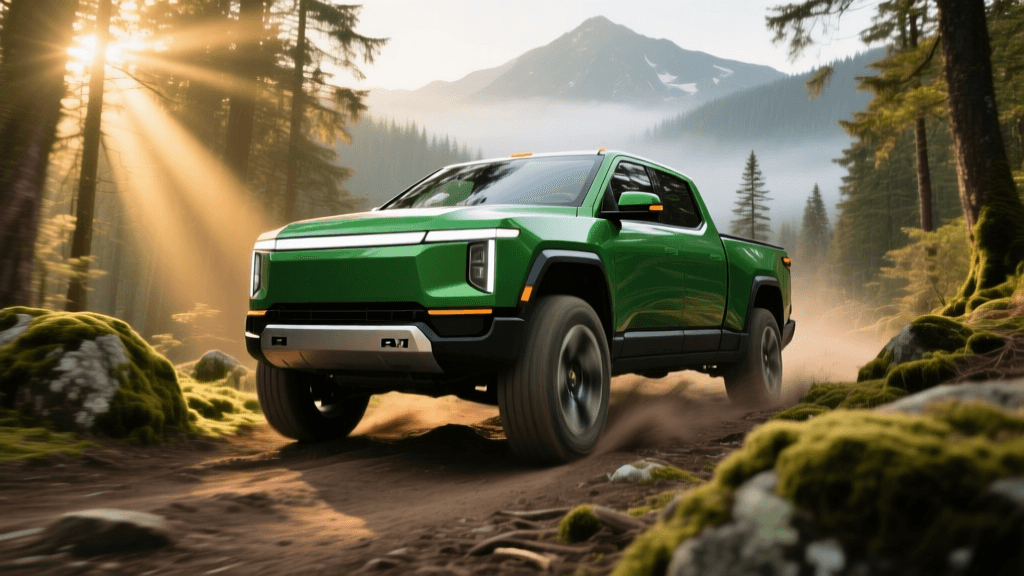
Where the R1T truly separates itself from the Ford F-150 Lightning and the upcoming Chevrolet Silverado EV is in its unapologetic dedication to off-road adventure. The R1T was engineered from the ground up to conquer the backcountry. In its highest ride setting, the air suspension provides an astonishing 14.9 inches of ground clearance, alongside class-leading approach, departure, and breakover angles. Furthermore, the truck boasts a wading depth of over 43 inches, allowing it to cross deep streams that would easily stall a traditional internal combustion engine.
The quad-motor (and newly introduced tri-motor) configurations offer unparalleled torque vectoring. By independently controlling the power at each wheel, the R1T can pull itself out of deep sand, snow, or mud with a level of precision that mechanical locking differentials simply cannot match. The hydraulic roll control system keeps the body remarkably flat during aggressive off-camber maneuvers, inspiring immense driver confidence on technical trails.
Perhaps the most innovative adventure feature is the patented Gear Tunnel. Spanning the width of the vehicle between the cab and the bed, this 11-cubic-foot lockable, climate-adjacent storage space is perfect for housing skis, fishing rods, or muddy hiking boots. When paired with the optional Camp Kitchen—which slides out on a heavy-duty rail to reveal a two-burner induction cooktop, a sink, and a full set of custom cookware—the R1T transforms into the ultimate overlanding basecamp.
Configuration Breakdown: Choosing Your R1T Powertrain
Rivian has streamlined its powertrain offerings to cater to different budgets and range requirements. Below is a comparison of the current R1T configurations to help buyers align their purchase with their specific lifestyle needs.
| Configuration | Horsepower | 0-60 mph | Est. Max Range | Best Use Case |
|---|---|---|---|---|
| Dual-Motor (Standard) | 533 hp | 4.5 sec | 270 miles | Daily commuting, light towing, budget-conscious buyers. |
| Performance Dual-Motor | 665 hp | 3.5 sec | 352 miles (Max Pack) | Enthusiasts wanting sports-car acceleration with solid range. |
| Tri-Motor | 850 hp | 2.9 sec | 320+ miles | Extreme off-roading, heavy towing, and maximum performance. |
Note: Range estimates vary based on wheel size, pack size (Standard, Large, or Max), and driving conditions. Always consult the U.S. Department of Energy's Fuel Economy Guide for official EPA ratings.
Future Outlook: Software-Defined Vehicles and the EV Truck Wars
The most critical factor in the R1T’s long-term value proposition is its architecture as a Software-Defined Vehicle (SDV). In the modern auto industry, hardware is merely the canvas; software is the paint. Rivian’s approach to Over-the-Air (OTA) updates is among the most robust in the business. According to Rivian's official Over-the-Air update portal, the company routinely deploys massive firmware updates that fundamentally alter the vehicle's behavior, introducing new drive modes, enhancing battery thermal management, and refining the user interface without the owner ever visiting a service center.
Looking ahead, Rivian is heavily investing in its proprietary Autonomy+ platform. Unlike Tesla’s vision-only approach, Rivian utilizes a robust suite of LiDAR, radar, and high-definition cameras. This sensor fusion is designed to pave the way for advanced Level 3 and eventually Level 4 autonomous driving capabilities, particularly on highway corridors. As the industry trends toward subscription-based software revenue, Rivian’s ability to unlock features like enhanced Highway Assist or automated trail-mapping via OTA updates positions it to capture high-margin recurring revenue long after the initial vehicle sale.
Furthermore, the R1T’s zonal electrical architecture drastically reduces the amount of copper wiring in the vehicle, lowering weight and manufacturing costs. As Rivian scales production at its Normal, Illinois plant and prepares to launch the smaller, more affordable R2 platform, the lessons learned and the software stack perfected on the R1T will trickle down, ensuring the brand remains competitive against high-volume legacy giants.
Ownership Costs, Charging, and the Road Ahead
Charging infrastructure remains a primary concern for EV truck buyers, especially those planning cross-country road trips. Rivian has tackled this with a two-pronged approach. First, the proprietary Rivian Adventure Network (RAN) continues to expand, strategically placing high-speed DC fast chargers near national parks, ski resorts, and popular outdoor destinations. These chargers are designed specifically to accommodate trucks towing trailers, eliminating the dreaded "unplug-and-repark" dance required at standard retail chargers.
Second, Rivian is transitioning to the North American Charging Standard (NACS). Current R1T owners will receive NACS adapters, granting them access to Tesla’s expansive Supercharger network, while future models will feature the NACS port natively. This dual-network access drastically reduces range anxiety and solidifies the R1T as a viable primary vehicle for families who frequently travel long distances.
In terms of ownership costs, the R1T benefits from significantly lower maintenance requirements compared to gas-powered trucks. With no engine oil, transmission fluid, or spark plugs to replace, and regenerative braking preserving pad life, scheduled maintenance is largely limited to cabin air filters, wiper fluid, and tire rotations. While the initial purchase price places the R1T in the premium tier, the total cost of ownership over a five-year period is highly competitive when factoring in fuel savings and tax incentives.
Final Verdict
The Rivian R1T is a triumph of modern automotive engineering. It successfully bridges the gap between the rugged utility expected of a pickup truck and the refined, tech-forward experience demanded by modern luxury EV buyers. As the industry pivots toward software-defined architectures and sustainable adventure travel, the R1T is not just keeping pace—it is setting the standard. Whether you are navigating a crowded urban commute or forging a new path in the backcountry, the R1T proves that the future of the electric pickup is incredibly bright.