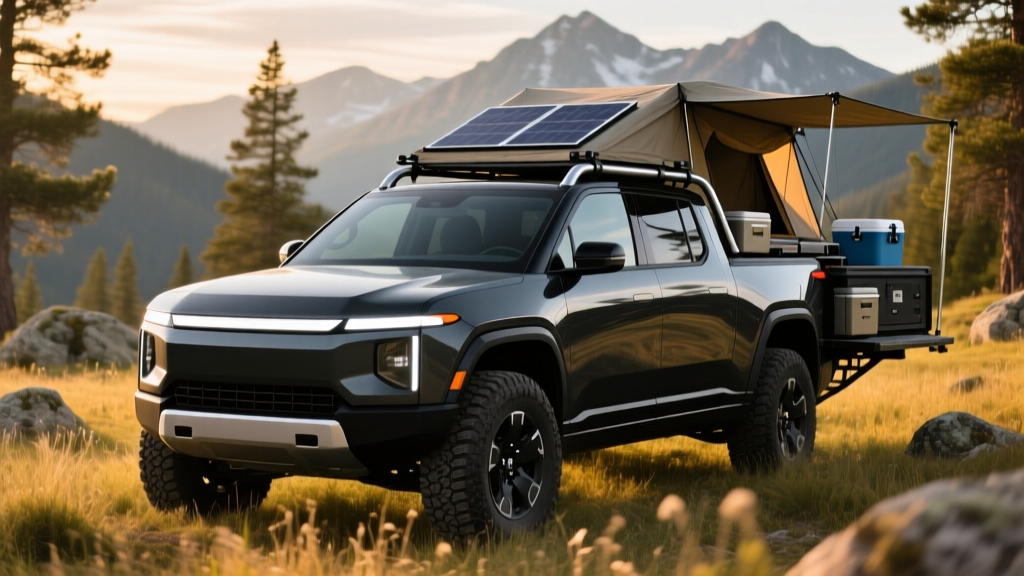
If you search for a rivian camping truck, you're almost certainly looking at the Rivian R1T — the all-electric midsize pickup that has become the default platform for zero-emission overlanding. With its integrated Camp Kitchen, Gear Tunnel, and available 420-mile Max Pack, the R1T is engineered from the ground up for backcountry use. But how does it actually perform when loaded with rooftop tents, coolers, and recovery gear? This 2026-profile review covers range, charging, pricing, and tax-credit reality so you can decide whether the R1T fits your overland build.
Rivian R1T at a Glance: 2026 Specs
| Spec | Standard Pack | Large Pack | Max Pack |
|---|---|---|---|
| EPA Range | ~270 mi | ~352 mi | ~420 mi |
| Usable Battery | ~92 kWh (NMC) | ~116 kWh (NMC) | ~141 kWh (NMC) |
| Peak DC Charge | 200 kW | 220 kW | 220 kW |
| 10–80% Time | ~30 min | ~28 min | ~40 min |
| Level 2 Rate | 11.5 kW / ~25 mi/hr (48A Wall Connector) | ||
| Drivetrain | Dual-Motor AWD (Quad-Motor optional) | ||
| Horsepower | 533 hp (Dual) / 1,025 hp (Quad) | ||
| 0–60 mph | ~4.5 sec (Dual) / ~3.0 sec (Quad) | ||
| Max Tow | 11,000 lb | ||
| Ground Clearance | Up to 14.9 in (air suspension) | ||
| Bed Length | 4.5 ft (54 in) | ||
| Gear Tunnel | 11 cu ft lockable, pass-through | ||
Source: Rivian official specs and fueleconomy.gov.
Real-World Range for the Rivian Camping Truck
Rivian's NMC cells deliver strong energy density, but physics governs camping-truck use: added frontal area from a roof tent, extra 500–800 lb of gear, and cold-soak all compound consumption. Owners on overland forums routinely log 2.0–2.4 kWh/mi when fully loaded — translating to roughly 290–330 real-world miles on the Max Pack before the 15% low-SoC buffer engages. The Standard Pack is best treated as a ~200-mile practical camping radius unless you route-plan DC chargers carefully.
Charging Speed: Trailhead, Home, and Highway
| Level | Power | Miles Added / Hour | Notes |
|---|---|---|---|
| Level 1 (120V) | ~1.4 kW | ~3 mi/hr | Emergency trickle; too slow for camping cadence |
| Level 2 (240V/48A) | 11.5 kW | ~25 mi/hr | Full charge overnight at campsite or home |
| DC Fast (CCS/NACS) | Up to 220 kW | ~140 mi in 20 min | Peak to ~60% SoC, then tapers sharply |
The R1T's charge curve peaks early and tapers aggressively past 70% SoC to protect the NMC pack — a 10–80% session takes ~28 minutes on the Large Pack, but 80–100% adds another 40+ minutes. For camping loops, plan to leave chargers at 80% and top up at your destination. Rivian ships the R1T with a NACS port (native Tesla Supercharger access) on 2025+ builds; earlier CCS1 trucks need the official adapter for Supercharger stalls.
Camp-Specific Features That Matter
The R1T's overland credentials go beyond range:
- Camp Kitchen — slides out of the Gear Tunnel with a two-burner induction cooktop, sink, and 30+ pcs of Snow Peak cookware (~$5,000 option).
- Gear Tunnel — 11 cu ft lockable pass-through between cab and bed, ideal for recovery boards, tools, and a portable fridge.
- Air Suspension — adjustable from 7.9 to 14.9 in clearance; "kneel" mode lowers the bed for easier tent loading.
- V2L (Vehicle-to-Load) — bed and cabin 120V outlets deliver up to 1,920W continuous — enough to run a Dometic fridge, laptop chargers, and LED camp lights simultaneously without a generator.
- Rivian Waypoints — in-app route planner that filters for charger-equipped campgrounds and backcountry trailheads.
Drawbacks: the 4.5-ft bed is short for full-size rooftop tents (most owners use the Gear Tunnel or a bed rack). No rear-seat HVAC zone control for sleeping passengers, and the panoramic roof offers no shade option beyond the factory tint.
Pricing, Trims, and Federal Tax Credit
| Configuration | Base MSRP | Typical As-Tested | §30D Credit Eligibility |
|---|---|---|---|
| Dual-Motor Standard | ~$69,900 | $74,000–$78,000 | Eligible (below $80k truck cap) |
| Dual-Motor Large | ~$75,900 | $82,000–$90,000 | Eligible if as-configured < $80k MSRP |
| Tri-Motor / Max Pack | ~$99,900 | $105,000+ | Exceeds $80k truck cap — ineligible |
| Quad-Motor | ~$99,000+ | $110,000+ | Ineligible (MSRP cap) |
Under IRS §30D, trucks qualify for up to $7,500 if MSRP stays under $80,000, buyer AGI is below $300k (MFJ) / $150k (single), and critical-mineral + battery-component sourcing thresholds are met. Rivian's US-built pack currently satisfies sourcing rules, but always verify via the IRS's official eligibility list at point of sale. Point-of-sale transfer is available through registered dealers — reducing your out-of-pocket at delivery rather than waiting for tax filing.
Efficiency and Ownership Costs
EPA-rated efficiency for the Dual-Motor Large Pack sits around 73 MPGe combined (~46 kWh/100 mi). Real-world overland driving typically lands between 50–60 MPGe due to load, tires, and elevation. At $0.16/kWh national home average, "fueling" the R1T costs roughly $0.07/mile — a meaningful saving over a comparable 17-mpg gas truck at $3.50/gal ($0.21/mile). Public DC fast charging at $0.45/kWh erases much of that advantage on road trips.
Rivian's 8-year/175,000-mile battery and drive unit warranty is among the strongest in the segment, with a guaranteed 70% capacity retention threshold. Scheduled maintenance is minimal (cabin filter, brake fluid, tire rotation), and regenerative braking drastically extends pad life.
R1T vs. Key Camping-Truck Competitors
Why Choose the R1T
- Class-leading range (420 mi Max Pack)
- Integrated Camp Kitchen and Gear Tunnel
- Native Supercharger access (2025+ NACS)
- True off-road capability (14.9" clearance, quad-motor torque vectoring)
- Strong OTA update cadence
Where It Falls Short
- Short 4.5-ft bed limits tent & cargo options
- High price — Max Pack out of §30D reach
- Service-center footprint still expanding
- Heavy (~7,150 lb) eats tires faster than gas trucks
- No rear-seat HVAC zone for sleeping
Against the Ford F-150 Lightning, the R1T wins on off-road geometry, range, and overland features — but the Lightning's 5.5-ft bed, lower price, and Pro Power Onboard (9.6 kW V2L) make it the better budget work-truck. The Chevrolet Silverado EV offers a longer bed and midgate but trails on off-road clearance. For pure camping, the R1T is the most purpose-built option; for mixed work-and-camping, the Lightning is the pragmatic alternative.
Who Should Buy the Rivian Camping Truck?
Look elsewhere if: you need a long bed for work, tow a heavy trailer over 7,000 lb regularly, live far from Rivian service hubs, or want to stay under the $80k §30D cap with the Max Pack.
Frequently Asked Questions
What is the real-world range of the Rivian R1T camping truck?
Expect ~320–350 mi highway on the Max Pack unloaded, dropping to ~250–280 mi with a full overland build in cold weather, and ~200 mi when towing a 5,000-lb trailer.
How fast does the R1T charge on the trail and at home?
Up to 220 kW DC (10–80% in ~28–40 min depending on pack size) and 11.5 kW Level 2 at home (~25 mi/hr).
Does the Rivian R1T qualify for the $7,500 federal tax credit?
Dual-Motor trims priced under the $80,000 truck MSRP cap do, subject to buyer income limits and battery-sourcing rules. Max Pack and Quad-Motor trims exceed the cap and do not qualify.
Is the R1T better than the F-150 Lightning for camping?
For dedicated overlanding, yes — better clearance, longer range, and the Camp Kitchen. For mixed work/camping on a budget, the Lightning's longer bed and lower price win.
What's the biggest drawback of the R1T as a camping truck?
The short 4.5-ft bed forces most owners to use bed racks or the Gear Tunnel for rooftop tents and large coolers, and high trim prices push most builds past the tax-credit threshold.