Quick Verdict: The R1T Is a Pickup First, EV Second
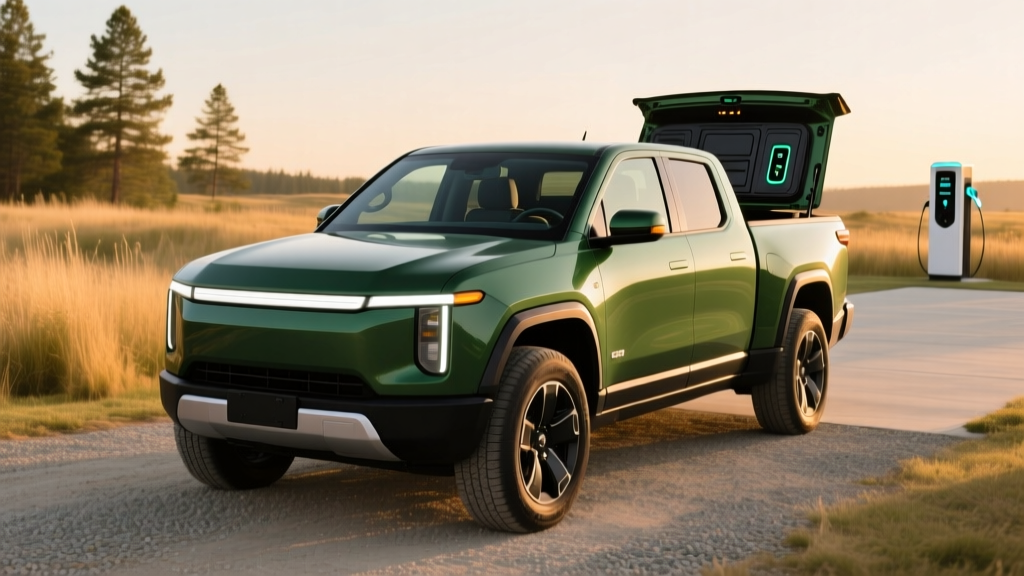
If you're searching for the Rivian R1T bed size before anything else, you're not alone. The R1T occupies a unique niche: it's the only battery-electric pickup that pairs a full-size crew cab with a compact-but-clever 4.5-foot bed and the class-defining Gear Tunnel. For 2026, Rivian's second-generation R1T (introduced for the 2025 model year and carried forward) brings a redesigned battery pack, faster charging, and a tri-motor option that turns this truck into a 3-second supercar with a tow rating. But the bed dimensions, payload reality, and tax-credit picture are what actually determine whether this truck fits your life.
This review covers everything a buyer needs: exact bed measurements, EPA range versus real-world results, DC fast-charging curves, 2026 pricing with §30D tax-credit math, and how the R1T stacks up against the Ford F-150 Lightning and Chevrolet Silverado EV.
Rivian R1T Bed Size, Cargo, and the Gear Tunnel Advantage
The R1T's bed is shorter than a traditional full-size truck bed, and that's by design. Rivian traded bed length for cabin space and the sealed, lockable Gear Tunnel that runs transversely between the cab and the bed. Here are the exact dimensions for the 2026 R1T:
| Measurement | Specification |
|---|---|
| Bed Length (floor) | 54.0 inches (4.5 ft) |
| Bed Length (tailgate down) | 67.0 inches (5.6 ft) |
| Bed Width (between wheel wells) | 50.0 inches |
| Bed Width (max at floor) | 58.5 inches |
| Bed Depth (inside height) | 22.0 inches |
| Bed Volume | ~26.3 cu ft |
| Gear Tunnel Volume | 11.0 cu ft (lockable, sealed) |
| Frunk (Front Trunk) | 11.0 cu ft |
| Total Cargo Volume | ~48.3 cu ft |
| Max Payload | 1,760 lbs (Dual-Motor) |
| Max Towing Capacity | 11,000 lbs (Dual-Motor / Tri-Motor) |
What this means in practice: The 4.5-foot bed fits two dirt bikes standing up (with the front wheel chocked), a week of camping gear for a family of four, or standard home-improvement lumber if you drop the tailgate. It does not fit 8-foot sheets of drywall flat — you'll need a trailer or a roof rack for that. The Gear Tunnel is the R1T's secret weapon: it swallows golf bags, camera cases, coolers, or muddy boots in a sealed, drainable compartment that no traditional truck offers.
Battery, Range, and Real-World Efficiency
The 2026 R1T is available with two battery packs on the Gen 2 architecture:
- Standard Battery: ~92 kWh usable, LFP (lithium iron phosphate) chemistry — heavier but more cycle-life durable and less expensive.
- Max Battery: ~141 kWh usable, NMC (nickel manganese cobalt) chemistry — lighter per kWh, higher energy density, and required for the longest-range configurations.
LFP cells tolerate daily 100% charging without accelerated degradation, while NMC packs are best held at 80% for daily use and charged to 100% only before long trips. Rivian's battery management system enforces these buffers automatically, but owners should understand the chemistry trade-off.
| Configuration | EPA Range | Real-World Expectation |
|---|---|---|
| Dual-Motor / Max Battery | 420 miles | ~340-360 mi (highway 70 mph); ~280-310 mi (cold weather, 20°F) |
| Dual-Motor / Standard Battery | 270 miles | ~220-240 mi (highway); ~180-200 mi (cold weather) |
| Tri-Motor / Max Battery | 380 miles | ~310-330 mi (highway); ~260-280 mi (cold weather) |
EPA estimates assume a mix of city and highway driving at moderate temperatures. Highway speeds above 65 mph, headwinds, elevation gain, and cold weather reduce range by 15-30%. Towing a 5,000+ lb trailer can cut range by 40-50%. Data sourced from fueleconomy.gov and real-world owner testing.
Efficiency for the Dual-Motor Max Battery rates at approximately 73 MPGe combined (about 46 kWh per 100 miles). That's typical for a 7,000+ lb electric truck — efficiency is not the R1T's strong suit. For comparison, a Tesla Model Y AWD achieves 122 MPGe combined. If you're towing or hauling regularly, expect efficiency to drop to 35-45 MPGe.
Charging Speed: DC Fast, Level 2, and the NACS Switch
The 2026 R1T uses the NACS (North American Charging Standard) port natively — no adapter required for Tesla Superchargers. Rivian joined the Tesla Supercharger network in mid-2024, and by 2026, R1T owners have access to over 20,000 Supercharger stalls across North America via Rivian's app or plug-and-charge.
| Charging Level | Power / Rate | Time / Range Added |
|---|---|---|
| Level 1 (120V / 12A) | ~1.4 kW | ~3-4 miles per hour |
| Level 2 (240V / 48A home) | 11.5 kW | ~25 miles per hour; full charge in ~12-14 hrs (Max) |
| DC Fast Charge (Max Battery) | Peak 220 kW | 10-80% in ~21 minutes |
| DC Fast Charge (Standard Battery) | Peak 200 kW | 10-80% in ~19 minutes |
Charging-curve reality: The R1T's peak 220 kW rate is sustained roughly from 10-40% state of charge. Above 60%, the rate tapers to approximately 120 kW, and above 80% it drops below 60 kW. This is normal for NMC packs with active thermal management. For road trips, plan stops at 20-80% to minimize time at the charger — charging from 80-100% can take as long as the 10-80% session.
For home charging, Rivian sells the Rivian Wall Charger (48A, 11.5 kW, NACS connector) for $500. A typical 240V/60A circuit installation by a licensed electrician costs $600-$2,000 depending on panel proximity and whether your electrical panel needs an upgrade to 200A service. Over a week of commuting, Level 2 home charging is all most owners ever need.
Performance: Dual-Motor, Tri-Motor, and Off-Road Capability
The Gen 2 R1T offers three drivetrain configurations:
| Configuration | Horsepower | Torque (lb-ft) | 0-60 mph | Drivetrain |
|---|---|---|---|---|
| Dual-Motor | 533 hp | 610 | 4.5 seconds | AWD (one motor per axle) |
| Performance Dual-Motor | 665 hp | 829 | 3.4 seconds | AWD |
| Tri-Motor | 850 hp | 1,103 | 2.9 seconds | AWD (two rear, one front) |
The Tri-Motor R1T is absurdly fast for a 7,100-lb truck — it will embarrass most sports cars at a stoplight. But for most buyers, the Dual-Motor with Max Battery is the sweet spot: 533 hp is more than sufficient for highway merging, towing, and off-road crawling, and the lighter front end improves range and ride quality.
Off-road, the R1T offers up to 14.9 inches of ground clearance (in Max mode via the air suspension), a wading depth of 36+ inches, approach/departure angles competitive with a Jeep Wrangler, and a quad-motor-per-wheel torque-vectoring system on the Tri-Motor that can send precise torque to individual wheels. The air suspension also enables a kneel mode that lowers the bed for easier loading and a camp mode that self-levels the truck on uneven terrain.
Interior, Tech, and Driver Assistance
The R1T's cabin seats five adults comfortably, with 41.3 inches of front legroom and 38.2 inches of rear legroom. The 15.6-inch center touchscreen runs Rivian's in-house infotainment OS — responsive, clean, and free of the subscription paywalls that plague some competitors. Wireless Apple CarPlay and Android Auto are standard. A 12.3-inch digital cluster, head-up display, and a premium 18-speaker Meridian audio system round out the tech.
The R1T's Rivian Driver+ system combines adaptive cruise control, lane-centering, and automatic lane changes on divided highways. This is an SAE Level 2 system — the driver must remain attentive, keep hands available, and supervise at all times. It is not self-driving. The system is competent for highway cruising but does not handle construction zones, unmapped roads, or complex urban intersections without driver takeover.
Notable drawbacks: The R1T has no Apple Watch integration for phone-as-key (Rivian relies on its own app or the key fob). The rear visibility is compromised by the high bed walls, making the backup camera essential. And while build quality has improved significantly in Gen 2, some owners still report minor panel-gap inconsistencies and software bugs that require over-the-air patches.
Pricing, Trims, and Federal Tax Credit Eligibility
The 2026 R1T is offered in three trims, each configurable with either battery pack and drivetrain:
| Trim / Config | Base MSRP | §30D Credit | Effective Price |
|---|---|---|---|
| Explore / Dual-Motor / Standard | $69,900 | $3,750* | ~$66,150 |
| Adventure / Dual-Motor / Max | $84,500 | $3,750* | ~$80,750 |
| Ascend / Tri-Motor / Max | $99,900 | $0** | $99,900 |
*As of 2026, the IRS §30D tax credit provides up to $7,500 for qualifying new EVs. The R1T qualifies for the $3,750 battery-component half-credit (not the full $7,500) because some critical minerals in its supply chain do not yet meet US free-trade-agreement sourcing thresholds. This is subject to change as Rivian's supply chain evolves.
**The Ascend Tri-Motor exceeds the §30D MSRP cap of $80,000 for pickup trucks and is ineligible for any federal credit.
- MSRP cap: Pickup trucks must have an MSRP ≤ $80,000 (Explore and some Adventure configs qualify; Ascend does not)
- Buyer income cap: AGI ≤ $150,000 (single) / $225,000 (head of household) / $300,000 (joint)
- Battery sourcing: Battery components must be manufactured or assembled in North America (partial credit); critical minerals must be sourced from US or FTA partners (partial credit)
- Point-of-sale transfer: Eligible buyers can transfer the credit to the dealer at purchase for an immediate price reduction
- Final assembly: Must be in North America (R1T is built in Normal, Illinois ✓)
Consult a tax professional for your specific situation. Rules change frequently — verify current-year eligibility at irs.gov.
R1T vs. F-150 Lightning vs. Silverado EV: Which Truck Fits?
| Spec | Rivian R1T (Dual-Motor Max) | Ford F-150 Lightning (Ext. Range) | Chevy Silverado EV (4WT) |
|---|---|---|---|
| EPA Range | 420 mi | 320 mi | 440 mi |
| Bed Length | 54.0 in (4.5 ft) | 67.1 in (5.5 ft) | 72.0 in (6.0 ft) |
| Max Towing | 11,000 lbs | 10,000 lbs | 12,500 lbs |
| 0-60 mph | 4.5 sec | ~5.0 sec | ~5.4 sec |
| Starting MSRP | $69,900 | $59,995 | $72,900 |
| Unique Feature | Gear Tunnel | Pro Power Onboard (V2H) | Midgate (expandable bed) |
Choose the Rivian R1T if you value adventure-oriented design, the Gear Tunnel for sealed gear storage, best-in-class off-road capability, and a premium interior. The shorter bed is the trade-off.
Choose the F-150 Lightning if you need a traditional 5.5-foot bed, lower entry pricing, vehicle-to-home (V2H) backup power capability, and Ford's dealer network for service.
Choose the Silverado EV if maximum range (440 mi EPA) and the Midgate (which extends the bed into the cabin for 9+ ft of length) are priorities, and you can accept a higher starting price.
Warranty, Ownership Costs, and Long-Term Battery Outlook
Rivian provides the following warranty coverage for the 2026 R1T:
- Battery & Drive Units: 8 years / 175,000 miles (whichever comes first), with a minimum 70% capacity retention threshold
- Limited Vehicle Warranty: 5 years / 60,000 miles
- Roadside Assistance: 5 years / unlimited miles
The 175,000-mile battery warranty is among the best in the EV truck segment and signals confidence in the Gen 2 pack architecture. Rivian's LFP Standard Battery should exhibit minimal degradation (typically 5-8% over 100,000 miles based on LFP fleet data), while the NMC Max Battery may see 10-15% degradation over the same distance depending on charging habits.
Insurance costs for the R1T average $2,200-$3,000 annually depending on trim, driving record, and state — roughly 20-30% higher than a comparable gas F-150 due to repair-cost complexity. Maintenance, however, is dramatically lower: no oil changes, no transmission fluid, no spark plugs, and regenerative braking extends pad life to 80,000+ miles in typical driving.
Pros, Cons, and Who Should Buy the R1T
- Gear Tunnel is a category-defining feature no competitor matches
- Class-leading off-road capability with air suspension and 14.9" clearance
- 420-mile Max Battery range covers most road trips without anxiety
- NACS native — full Tesla Supercharger access without adapter
- Tri-Motor performance (2.9 sec 0-60) is supercar-level in a truck
- Premium, minimalist interior with no subscription-gated features
- 4.5-foot bed is too short for full-size truck buyers who haul lumber or ATVs
- No §30D credit on trims above $80,000 MSRP; partial credit on others
- Towing cuts range by 40-50% — a 420-mi truck becomes ~220 mi while towing
- Rivian's service-center footprint is still growing — rural owners may face long tow distances
- Insurance premiums 20-30% higher than comparable gas trucks
- No vehicle-to-home (V2H) capability (unlike F-150 Lightning)
Who the R1T is for: Outdoor enthusiasts, adventure travelers, and tech-forward professionals who need a crew cab with secure, weatherproof cargo storage (Gear Tunnel + frunk) and the ability to explore unpaved roads. It's ideal as a daily driver that can handle weekend camping, ski trips, and light towing.
Who should look elsewhere: Commercial fleets, contractors who need a 6+ foot bed for job-site materials, heavy towers who regularly pull 8,000+ lb trailers over long distances, and budget-conscious buyers for whom the F-150 Lightning XLT at ~$60K is a better value proposition.
Frequently Asked Questions
What is the real-world range of the Rivian R1T?
The EPA rates the Dual-Motor Max Battery R1T at 420 miles. In real-world highway driving at 70 mph, expect 340-360 miles. In cold weather (below 30°F), range drops to approximately 280-310 miles due to battery resistance and cabin heating demands. Towing a 5,000-lb trailer reduces range to roughly 210-240 miles.
How fast does the R1T charge at home and on the road?
On a 240V Level 2 home charger (48A), the R1T adds about 25 miles of range per hour, fully charging the Max Battery in 12-14 hours. On a DC fast charger, the Max Battery peaks at 220 kW and charges from 10-80% in approximately 21 minutes, though the rate tapers significantly above 80%.
Does the Rivian R1T qualify for the federal EV tax credit?
Partially. R1T configurations under the $80,000 MSRP cap for trucks qualify for a $3,750 credit (the battery-component half) under IRS §30D as of 2026, assuming the buyer meets income limits. The Ascend Tri-Motor ($99,900) does not qualify. Always verify current eligibility before purchasing.
Is the R1T worth buying over the F-150 Lightning?
It depends on your priorities. The R1T wins on off-road capability, the Gear Tunnel, interior quality, and Max Battery range (420 vs 320 mi). The F-150 Lightning wins on bed length (5.5 ft vs 4.5 ft), lower starting price (~$60K vs ~$70K), vehicle-to-home power, and Ford's nationwide service network. If you don't need a long bed and value adventure features, the R1T is the stronger choice.
Can the R1T bed fit a motorcycle or ATV?
A standard dirt bike or small motorcycle fits standing up in the 54-inch bed with the tailgate closed. Full-size ATVs (typically 50+ inches wide) are a tight fit — most will require the tailgate down or a small trailer. The 1,760-lb payload capacity is sufficient for most single motorcycles.
How long will the R1T battery last?
Rivian warrants the battery for 8 years / 175,000 miles with at least 70% capacity retention. The LFP Standard Battery is expected to retain 90%+ capacity at 150,000 miles based on LFP chemistry data. The NMC Max Battery should retain 80-85% at the same mileage with proper charging habits (daily limit of 80%). Full battery replacement, if ever needed, is estimated at $15,000-$22,000 out of warranty, though costs are declining annually.