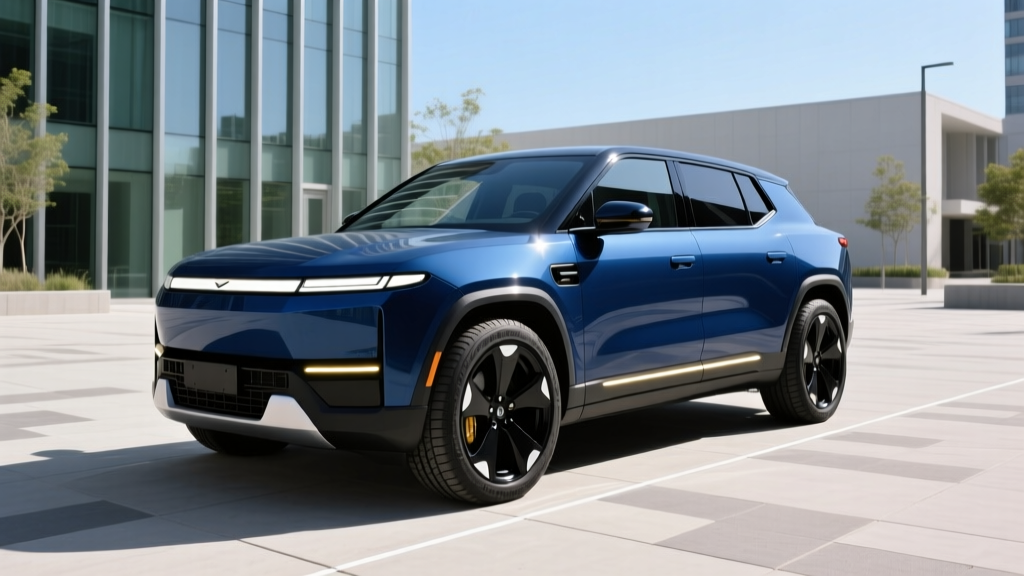
Rivian's compact electric SUV is no longer a concept sketch. The Rivian R2 SUV production timeline has converged on early-to-mid 2026, with vehicles rolling off a retooled line at the company's Normal, Illinois factory. For buyers who have been watching from the sidelines, the R2 represents Rivian's first serious attempt at a mainstream price point — a smaller, more affordable sibling to the R1S that targets the Tesla Model Y and upcoming competitors in the $45,000–$60,000 bracket.
Because the R2 is only now entering early production and customer deliveries have not yet begun at scale, the figures below reflect Rivian's announced preliminary specifications and EPA testing targets. Final EPA certification, trim-level pricing, and §30D tax-credit eligibility will be confirmed as vehicles reach dealers and buyers in mid-to-late 2026. We will update this profile as official data is published.
Rivian R2 Preliminary Specs at a Glance
| Attribute | R2 Standard (RWD) | R2 Dual-Motor (AWD) | R2 Performance (AWD) |
|---|---|---|---|
| EPA Range (est.) | ~330 mi | ~310 mi | ~290 mi |
| Battery Capacity (usable) | ~77 kWh (LFP) | ~92 kWh (NMC) | ~92 kWh (NMC) |
| Drivetrain | Rear-Wheel Drive | Dual-Motor AWD | Dual-Motor AWD (Tri-Motor option TBD) |
| Horsepower | ~285 hp | ~450 hp | ~550+ hp |
| 0–60 mph | ~6.5 sec | ~4.5 sec | ~3.5 sec |
| Max DC Fast Charge | ~175 kW | ~225 kW | ~250 kW |
| 10–80% DCFC Time | ~28 min | ~24 min | ~22 min |
| Level 2 Home Charge | 11.5 kW (~38 mi/hr) | 11.5 kW (~38 mi/hr) | 11.5 kW (~38 mi/hr) |
| NACS Connector | Standard | Standard | Standard |
| Towing Capacity | ~3,300 lbs | ~4,500 lbs | ~4,500 lbs |
| Base MSRP (est.) | ~$45,000 | ~$52,000 | ~$58,000 |
Note: All specifications are preliminary and based on Rivian's published targets and industry reporting as of early 2026. Final EPA-certified range and performance figures may differ. Source: Rivian R2 Official Page.
Range and Efficiency: What the EPA Number Means in the Real World
EPA Estimated: ~330 miles (Standard RWD) / ~310 miles (Dual-Motor AWD)
Real-World Expectation: Plan for ~260–280 miles on sustained highway driving at 70–75 mph. In freezing temperatures (below 32°F), expect a 20–30% reduction — bringing effective range to ~200–240 miles depending on cabin heating use and terrain. City driving with regenerative braking recovers more energy and can match or slightly exceed the EPA sticker.
The R2's targeted efficiency of roughly 3.5–3.8 kWh/mile (approximately 105–115 MPGe combined) places it in the same ballpark as the Tesla Model Y Long Range and the Hyundai Ioniq 5. The Standard RWD trim uses an LFP (lithium iron phosphate) battery pack, which sacrifices some energy density for lower cost, longer cycle life, and the ability to charge routinely to 100% without accelerating degradation. The Dual-Motor and Performance trims step up to NMC (nickel manganese cobalt) chemistry for higher energy density and more range in a compact footprint.
For context, LFP chemistry typically retains 90%+ state of health after 2,000+ full charge cycles, making it a strong choice for buyers who plan to own the vehicle for 10+ years or put on high annual mileage. NMC offers more range per kilogram but benefits from staying in the 20–80% daily charge window for longevity.
Charging Speed: DC Fast Charging and Home Level 2
Rivian has confirmed that every R2 will ship with a native NACS (North American Charging Standard) port, giving owners direct access to the Tesla Supercharger network — now the largest and most reliable DC fast-charging network in North America — without an adapter.
| Charging Level | Power | Miles Added Per Hour | Notes |
|---|---|---|---|
| Level 1 (120V household) | ~1.4 kW | ~4–5 mi/hr | Emergency/trickle only |
| Level 2 (240V, 48A home charger) | 11.5 kW | ~38 mi/hr | Full charge overnight (~8–9 hrs) |
| DC Fast Charge (Standard RWD) | Peak ~175 kW | ~650 mi/hr (peak) | 10–80% in ~28 min |
| DC Fast Charge (Dual-Motor) | Peak ~225 kW | ~830 mi/hr (peak) | 10–80% in ~24 min |
| DC Fast Charge (Performance) | Peak ~250 kW | ~920 mi/hr (peak) | 10–80% in ~22 min |
Charging-curve reality: Peak kW figures are just that — peaks. As with every EV, the R2's charge rate will taper as the battery fills. Expect the fastest charging between 10% and 50% state of charge, with a meaningful taper above 80%. On a road trip, charging from 10–80% is the practical sweet spot; the final 20% can take as long as the first 70%. Preconditioning the battery (via the navigation system routing to a charger) is essential to hitting peak charge rates, especially in cold weather.
At home, the 11.5 kW Level 2 rate means a fully depleted Standard pack (~77 kWh) recharges in roughly 7 hours, while the larger 92 kWh pack needs about 8.5 hours. Most owners charging nightly from 30–80% will wake up to a full battery every morning. Home charger installation typically costs $500–$2,000 depending on panel proximity and whether a 200-amp service upgrade is needed.
Performance and Drivetrain
Rivian has built its reputation on capable, adventure-oriented platforms, and the R2 carries that DNA into a more compact footprint. The base RWD model targets ~285 hp — adequate for commuting and merging but not thrilling. The Dual-Motor AWD is the volume trim Rivian expects most buyers to choose, offering ~450 hp, a ~4.5-second 0–60 time, and genuine all-weather traction.
The R2 uses Rivian's next-generation drive unit architecture, which is smaller, lighter, and more efficient than the R1T/R1S Gen 1 motors. The available air suspension (expected on Dual-Motor and standard on Performance) provides adjustable ride height for light off-road use and improved aerodynamic efficiency at highway speeds.
Towing capacity peaks at an estimated 4,500 lbs on AWD trims — enough for a small camper, a pair of jet skis, or a utility trailer. Towing will cut range by 35–50% depending on trailer weight and profile, so plan road-trip charging stops accordingly.
Pricing, Trims, and Federal Tax Credit Eligibility
| Trim | Est. Base MSRP | §30D Credit Potential | Effective Price (if eligible) |
|---|---|---|---|
| R2 Standard (RWD) | ~$45,000 | Up to $7,500 | ~$37,500 |
| R2 Dual-Motor (AWD) | ~$52,000 | Up to $7,500 | ~$44,500 |
| R2 Performance (AWD) | ~$58,000 | Up to $7,500 | ~$50,500 |
The IRS §30D Clean Vehicle Credit offers up to $7,500 for qualifying new EVs, but eligibility hinges on several rules that may affect R2 buyers in 2026:
- MSRP Cap: SUVs must be priced at or below $80,000. All announced R2 trims clear this threshold comfortably.
- Buyer Income Limits: Modified adjusted gross income cannot exceed $150,000 (single), $225,000 (head of household), or $300,000 (joint). Check your prior-year or current-year MAGI.
- Battery Sourcing Requirements: The credit is split into two $3,750 halves — one for critical-minerals sourcing and one for battery-component manufacturing. Both have escalating domestic-content thresholds under the Inflation Reduction Act. Rivian has stated it is working to qualify, but final determination depends on the specific battery cell supply chain for each trim at the time of purchase.
- Point-of-Sale Transfer: Eligible buyers can transfer the credit to the dealer at purchase, reducing the upfront price rather than waiting for a tax refund. This requires dealer participation and IRS registration.
Important: Tax credit rules are subject to legislative and regulatory change. Consult IRS.gov §30D guidance and a qualified tax professional before making a purchase decision based on credit eligibility. Rivian's LFP Standard pack may face different sourcing scrutiny than its NMC packs, as LFP cell production is currently concentrated in China — a factor that could affect the critical-minerals half of the credit.
Interior, Cargo, and Daily Livability
The R2 is a compact two-row SUV, smaller than the three-row R1S. Rivian targets a five-passenger cabin with the brand's signature adventure-focused design language — durable materials, integrated storage solutions, and a large central touchscreen running Rivian's proprietary infotainment OS.
Expected interior dimensions place the R2 in the same class as the Tesla Model Y and Ford Mustang Mach-E:
- Rear legroom: ~38 inches (estimated)
- Cargo behind rear seats: ~28–32 cu ft (estimated)
- Cargo with rear seats folded: ~65–70 cu ft (estimated)
- Front trunk (frunk): ~8–10 cu ft (estimated) — a Rivian signature feature
The frunk is a genuine differentiator for grocery runs, wet gear, and charging-cable storage. Rivian's camp kitchen accessory (available for the R1T) may see a scaled-down version for the R2, though this has not been confirmed for launch.
Tech, Driver Assistance, and Standout Features
The R2 will ship with Rivian's latest software stack, including:
- 15.6-inch center touchscreen with over-the-air updates
- Rivian Driver Assist+ — a Level 2 driver-assistance system featuring adaptive cruise control, lane-centering, and automated lane changes on divided highways
- Highway Assist with hands-on-wheel monitoring (not hands-free; Rivian has not announced a supervised eyes-off system comparable to GM's Super Cruise)
- Phone-as-key with NFC backup card
- Vehicle-to-load (V2L) capability for powering devices and small appliances from the traction battery
- Integrated trail maps and adventure routing in the native navigation app
Rivian's Driver Assist+ is an SAE Level 2 system. The driver must remain fully engaged — hands on the wheel, eyes on the road — at all times. This is not autonomous driving. SAE Level 4 driverless capability (like Waymo's robotaxi service) does not exist in any consumer vehicle sold today.
Warranty and Long-Term Ownership
Rivian is expected to carry forward warranty coverage similar to the R1 platform:
- Battery & Drive Unit: 8 years / 175,000 miles (expected, with a minimum 70% capacity retention threshold)
- Vehicle Limited Warranty: 5 years / 60,000 miles
- Roadside Assistance: 5 years / 60,000 miles
The 175,000-mile battery warranty is competitive with the industry standard (most automakers offer 8 years/100,000 miles) and signals confidence in the pack's longevity. LFP chemistry in the Standard trim may further extend usable life beyond the warranty period, as LFP cells historically degrade more slowly than NMC at equivalent cycle counts.
One ownership consideration: Rivian's service-center network is still growing. As of early 2026, the company operates roughly 50+ service centers nationwide, supplemented by mobile service vans. Buyers in rural or low-population states should verify service access before committing.
Pros, Cons, and the Competition
- Native NACS port — no adapter needed for Tesla Superchargers
- LFP battery option for maximum longevity and daily 100% charging
- Class-leading frunk + rear cargo versatility
- Competitive ~$45K starting price (before credit)
- Rivian's adventure-oriented brand identity and software
- V2L capability for camping and emergency power
- Early-production risk: build quality and software bugs in year one
- Service center network still limited outside major metros
- Tax credit eligibility uncertain due to LFP battery sourcing
- Driver assist is Level 2 only — no hands-free highway system at launch
- No third-row option; families needing 7 seats must look at the R1S or competitors
- Final EPA range and pricing not yet certified
Key competitors: The R2 slots directly against the Tesla Model Y (the segment benchmark, with ~320 miles EPA and Supercharger-native access), the Hyundai Ioniq 5 (~310 miles, 800V ultra-fast charging), and the Ford Mustang Mach-E (~312 miles Extended Range). The R2's differentiation lies in its adventure positioning, frunk utility, LFP battery option, and Rivian's software experience. The Model Y still wins on charging-network maturity and production scale; the Ioniq 5 wins on peak DC charge speed (up to 350 kW on compatible chargers).
- You want a compact EV SUV with genuine outdoor/adventure capability
- You value NACS-native Supercharger access without an adapter
- You prefer LFP chemistry for long-term battery health
- You want a frunk and V2L for camping and gear hauling
- You need a third row (consider the R1S, Kia EV9, or Model X)
- You want the fastest possible DC charging (Hyundai Ioniq 5 at 800V)
- You need hands-free highway driving today (GM Super Cruise vehicles)
- You live far from a Rivian service center and cannot tolerate mobile-only service
Frequently Asked Questions
What is the real-world range of the Rivian R2?
Rivian targets ~330 miles EPA for the Standard RWD and ~310 miles for the Dual-Motor AWD. In real-world highway driving at 70–75 mph, plan for ~260–280 miles. In freezing weather, expect a 20–30% reduction, bringing effective range to ~200–240 miles. These are estimates pending final EPA certification.
How fast does the R2 charge at home and on the road?
At home on a 240V Level 2 charger (48A), the R2 adds roughly 38 miles of range per hour, reaching a full charge overnight. On DC fast chargers, the Dual-Motor peaks at ~225 kW, charging from 10–80% in approximately 24 minutes. The Performance trim targets ~250 kW and a ~22-minute 10–80% session.
How much does the Rivian R2 cost after tax credits?
The base Standard RWD starts at an estimated ~$45,000. If the full $7,500 §30D credit applies, the effective price drops to ~$37,500. However, credit eligibility depends on buyer income limits, battery-sourcing compliance, and MSRP caps. The LFP battery in the Standard trim may face sourcing challenges. Always verify eligibility on IRS.gov before purchasing.
Is the Rivian R2 worth buying over the Tesla Model Y?
The R2 offers a compelling alternative for buyers who want Rivian's adventure-oriented design, a frunk, V2L capability, and an LFP battery option. The Model Y still leads in production maturity, service infrastructure, and proven efficiency. If you prioritize brand identity and outdoor utility, the R2 is worth a close look. If you prioritize lowest risk and maximum service access, the Model Y remains the default.
Does the Rivian R2 qualify for the $7,500 federal EV tax credit?
All announced R2 trims fall under the $80,000 SUV MSRP cap. However, the §30D credit also requires buyer income below threshold limits and battery-component/critical-minerals sourcing from approved supply chains. Rivian has indicated it is working toward compliance, but the final determination — especially for the LFP-equipped Standard trim — will depend on the cell supply chain at time of delivery. Confirm on IRS.gov closer to your purchase date.
When can I actually buy a Rivian R2?
Rivian R2 SUV production is targeted for early-to-mid 2026 at the Normal, Illinois facility, with customer deliveries expected to follow. Reservation holders will likely receive priority. Check Rivian's official R2 page for the latest timeline updates.