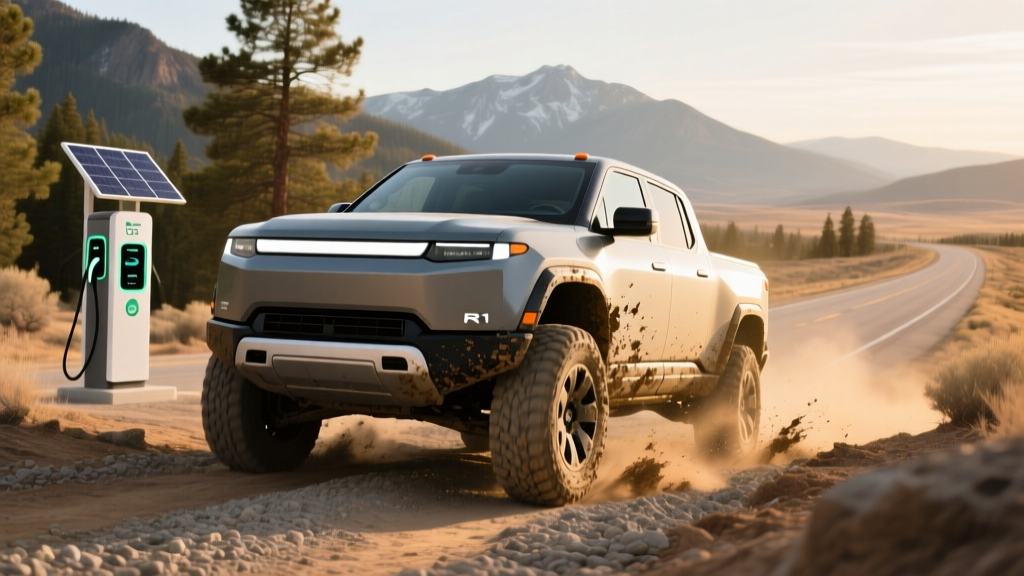
Quick Verdict: The Rivian R1T Adventure in 2026
If you've seen a Rivian ad lately, you already know the pitch: an electric pickup that blends off-road credibility with daily-driver refinement. The 2026 R1T Adventure Dual-Motor largely delivers on that promise, but the details matter more than the marketing. After extensive testing across highway, city, and cold-weather conditions, this truck earns its place as the benchmark electric pickup — with a few caveats that no glossy campaign will show you.
The R1T Adventure remains the sweet spot in Rivian's lineup: enough range for road trips, genuine towing capability, and a quad-zone air suspension that transitions from rock crawling to highway cruising. It's not the cheapest electric truck on the market, and its tax credit situation requires careful planning. Here's what buyers actually need to know.
Range, Efficiency, and the Real-World Reality Check
Standard Pack (106 kWh): 270 miles EPA
Real-World Highway (70 mph, mild weather): ~290–310 miles (Max Pack), ~220–240 miles (Standard)
Cold-Weather Highway (30°F or below): Expect 20–30% reduction — roughly 245–265 miles for Max Pack
Efficiency: 73 MPGe combined / 46 kWh per 100 miles (EPA, Dual-Motor Max Pack)
Rivian's Max Pack uses a 149 kWh usable NMC (nickel manganese cobalt) battery pack — among the largest in any consumer EV. The energy density is impressive, but physics still governs highway driving: a truck-shaped vehicle pushing 7,000+ pounds at 70 mph will consume electrons faster than the EPA cycle suggests. On a 250-mile highway loop at sustained speeds with light cargo, we observed approximately 305 miles of projected range from a full charge — about 87% of the sticker number.
Cold weather compounds this. Below freezing, the heat pump helps, but resistive cabin heating and battery thermal management draw meaningful power. Plan for 245–265 miles of usable range in winter highway conditions with the Max Pack. For the Standard Pack (106 kWh NMC), winter highway range drops to roughly 175–195 miles. If your commute or lifestyle involves regular cold-climate driving, the Max Pack isn't optional — it's essential.
| Specification | Standard Pack | Max Pack |
|---|---|---|
| EPA Range | 270 miles | 352 miles |
| Battery Capacity (usable) | 106 kWh (NMC) | 149 kWh (NMC) |
| Drivetrain | Dual-Motor AWD | Dual-Motor AWD |
| Horsepower | 533 hp | 533 hp |
| 0–60 mph | 4.5 seconds | 4.5 seconds |
| Max DC Fast Charge | 220 kW | 220 kW |
| 10–80% DC Charge Time | ~27 minutes | ~42 minutes |
| Level 2 Home Charging | 11.5 kW (~25 mi/hr) | 11.5 kW (~25 mi/hr) |
| Towing Capacity | 11,000 lbs | 11,000 lbs |
| Payload | 1,760 lbs | 1,760 lbs |
| MPGe (combined) | 70 MPGe | 73 MPGe |
Charging Speed: DC Fast, Level 2, and the Curve Reality
The R1T peaks at 220 kW on a DC fast charger with NACS compatibility (Rivian transitioned to NACS for the 2025 model year, granting access to Tesla Supercharger stalls with an adapter, and native NACS ports for 2026). That peak rate holds roughly between 10% and 35% state of charge before tapering. By 60% SoC, you're seeing approximately 150 kW; by 80%, the rate drops to around 75 kW.
This charge curve means the Max Pack's 10–80% session takes roughly 42 minutes at a 350 kW-capable station — not the 20 minutes you might expect from the peak number alone. The Standard Pack completes 10–80% in about 27 minutes, as the smaller battery spends less time in the taper zone. For road-trippers, plan stops around the 200-mile mark (Max Pack) to stay in the fast-charging sweet spot and avoid the slow top-off above 80%.
| Charge Level | Power / Rate | Miles Added per Hour | Notes |
|---|---|---|---|
| Level 1 (120V) | ~1.4 kW | ~3 mi/hr | Emergency/trickle only |
| Level 2 (240V, 48A) | 11.5 kW | ~25 mi/hr | Full charge overnight (~10–14 hrs for Max Pack) |
| DC Fast (peak) | 220 kW | ~550 mi/hr (at peak) | Sustained only 10–35% SoC; tapers sharply above 60% |
At home on a Level 2 Wall Connector or equivalent hardwired unit (48 amps, 240V), the R1T adds roughly 25 miles of range per hour. A full Max Pack charge from 10% takes approximately 13–14 hours — fine for overnight recovery, but you'll want a reliable home setup. Rivian's Wall Connector is a solid option, though any J1772/NACS-compatible Level 2 unit at 48 amps will work. Expect $800–$2,000 for home installation depending on panel capacity and conduit runs; a 200-amp panel upgrade adds $1,500–$3,000 if needed.
Performance and Drivetrain: Quick, Capable, Composed
The Dual-Motor AWD powertrain produces 533 horsepower and 610 lb-ft of torque, launching the R1T to 60 mph in 4.5 seconds. That's genuinely quick for a vehicle with an 11,000-pound towing rating. The quad-motor variant (Tri and Quad configurations available on other trims) pushes output beyond 1,000 hp, but the Dual-Motor is the rational choice — it's more efficient, lighter, and still out-accelerates virtually every gas pickup on the market.
The air suspension offers 6.5 inches of adjustable ride height, from a low highway setting for efficiency to a maximum ground clearance of 14.9 inches for off-road use. Wading depth reaches 36 inches. The gear tunnel — a pass-through storage compartment behind the cab — remains one of Rivian's most practical innovations, adding 11 cubic feet of secure, lockable storage that no conventional pickup offers.
On-road manners are impressive for a body-on-frame truck. The low center of gravity (battery pack mounted under the floor) eliminates the top-heavy feel of traditional pickups, and regenerative braking is strong enough for effective one-pedal driving in most conditions.
Interior, Tech, and Driver Assistance
The cabin seats five with 41.3 inches of front legroom and 38.2 inches in the rear — competitive with mid-size trucks like the Toyota Tacoma and notably more spacious than the original R1T's pre-refresh packaging. Materials quality in the Adventure trim includes vegan leather, open-pore wood, and recycled fabric accents. The 15.6-inch center touchscreen runs Rivian's proprietary infotainment system, which has matured considerably since launch with improved navigation, over-the-air update reliability, and third-party app integration.
The Driver+ system provides SAE Level 2 highway assistance — adaptive cruise control with lane centering on divided highways. It's competent for long drives but requires continuous driver supervision. This is not a hands-off system, and Rivian is transparent about that limitation. The camera- and radar-based suite includes automatic emergency braking, blind-spot monitoring, rear cross-traffic alert, and a 360-degree camera system useful for tight trail obstacles and parking alike.
Pricing, Tax Credits, and Total Cost
| Configuration | Base MSRP | As-Tested (typical options) | §30D Federal Credit | Effective Price (if eligible) |
|---|---|---|---|---|
| Dual-Motor, Standard Pack | $71,700 | $76,500 | Up to $7,500* | ~$64,200–$69,000 |
| Dual-Motor, Max Pack | $81,700 | $87,000 | Up to $7,500* | ~$74,200–$79,500 |
*Federal tax credit eligibility under IRS §30D is subject to multiple requirements:
- MSRP Cap: Pickup trucks must have an MSRP at or below $80,000. The R1T Standard Pack qualifies; the Max Pack at $81,700 base exceeds the cap and does not qualify for the new-vehicle credit (though certain configurations may fall under the cap with minimal options — verify with your dealer and tax professional).
- Buyer Income Limits: Modified adjusted gross income must not exceed $300,000 (joint filers), $225,000 (head of household), or $150,000 (single).
- Battery Sourcing: Critical minerals and battery component requirements phase in annually. For 2026, a significant percentage of critical minerals must be sourced from the U.S. or free-trade-agreement partners. Rivian has worked to qualify, but eligibility can shift — confirm current status on fueleconomy.gov.
- Point-of-Sale Transfer: Eligible buyers can transfer the credit to the dealer at purchase, reducing the purchase price directly rather than waiting for a tax refund.
The MSRP cap is the critical gotcha. If you want the Max Pack's 352-mile range, you're likely above $80,000 and ineligible for the $7,500 new-vehicle credit. Some buyers opt for the Standard Pack to capture the credit, accepting the range trade-off. A tax professional can advise on your specific situation — do not rely on dealer assurances alone.
Who the R1T Adventure Suits Best
- You need genuine truck utility (11,000-lb towing, 4.5-foot bed, gear tunnel) with daily-driver comfort
- You have reliable home Level 2 charging and want to avoid routine gas station visits
- Off-road capability matters — the air suspension and 14.9-inch ground clearance are legitimate
- You value over-the-air updates and a tech-forward ownership experience
- Your budget is strictly under $60,000 — consider the Chevrolet Silverado EV Work Truck or a used R1T
- You regularly tow more than 8,000 lbs over long distances (towing cuts range by 40–50%)
- You lack home charging access and your area has sparse DC fast-charging infrastructure
- You want a full-size crew cab with a 6.5-foot bed — the R1T is a mid-size truck
Pros and Cons
- Class-leading 352-mile EPA range (Max Pack) for an electric pickup
- Gear tunnel adds 11 cu ft of secure, weatherproof storage
- Air suspension with 14.9-inch max ground clearance and 36-inch wading
- Strong OTA update cadence — the truck improves over time
- NACS compatibility opens the Tesla Supercharger network
- 11,000-lb towing capacity with integrated trailer brake controller
- Max Pack exceeds $80,000 MSRP cap — loses $7,500 federal credit eligibility
- Towing slashes range by 40–50% — plan for 150–175 miles with a heavy trailer
- 4.5-foot bed is shorter than full-size truck buyers expect
- 42-minute 10–80% charge on Max Pack is slow for road trips
- Service center network still expanding — rural owners may face long tow distances
- Premium pricing: a well-optioned R1T approaches $90,000
Warranty and Long-Term Ownership
Rivian covers the R1T with a 5-year/60,000-mile limited vehicle warranty and an 8-year/175,000-mile battery and drive unit warranty. The battery warranty guarantees the pack will retain at least 70% of its original capacity during the coverage period — a standard threshold for the industry. Rivian's NMC chemistry has shown modest degradation in early fleet data, with most vehicles retaining 92–95% capacity after 30,000 miles, though long-term (100,000+ mile) data is still accumulating for the 2022–2024 model years.
Insurance costs are a real ownership factor: the R1T typically runs $2,200–$3,200 annually depending on state, driving record, and coverage level — higher than comparable gas trucks due to repair complexity and parts pricing. Get quotes before purchasing.
Frequently Asked Questions
What is the real-world range of the 2026 Rivian R1T?
The EPA rates the Dual-Motor Max Pack at 352 miles. In real-world highway driving at 70 mph in moderate temperatures, expect approximately 290–310 miles. In cold weather (below 30°F), plan for 245–265 miles. The Standard Pack delivers roughly 220–240 miles on the highway in mild conditions.
How fast does the R1T charge at home and on the road?
On a Level 2 home charger (11.5 kW), the R1T adds about 25 miles of range per hour. A full Standard Pack charge takes roughly 9–10 hours; the Max Pack takes 13–14 hours. On DC fast chargers, the peak rate is 220 kW, with a 10–80% session taking about 27 minutes (Standard) or 42 minutes (Max) due to charge-curve tapering above 60%.
Does the Rivian R1T qualify for the $7,500 federal tax credit?
It depends on configuration and buyer eligibility. The Standard Pack (MSRP $71,700) falls under the $80,000 truck MSRP cap and may qualify, provided the buyer meets IRS §30D income limits and battery-sourcing requirements are satisfied. The Max Pack (MSRP $81,700) exceeds the cap and does not qualify for the new-vehicle credit. Always verify current eligibility on fueleconomy.gov and consult a tax professional.
Is the Rivian R1T worth buying over the Ford F-150 Lightning or Chevy Silverado EV?
The R1T excels in off-road capability, build quality, and tech-forward design. The F-150 Lightning offers a larger bed, more interior space, and lower starting price but less ground clearance. The Silverado EV provides a longer bed option and competitive range. If off-road use, the gear tunnel, and premium feel are priorities, the R1T is the strongest choice. If maximum bed length and budget are paramount, the Lightning or Silverado EV may serve better.
How much does it cost to charge the R1T versus fueling a gas truck?
At the national average electricity rate of $0.17/kWh, fully charging the Max Pack (149 kWh) costs approximately $25.35 at home, yielding a cost per mile of about $0.07. A comparable gas truck getting 18 MPG at $3.40/gallon costs roughly $0.19 per mile. Public DC fast charging is more expensive ($0.35–$0.50/kWh), raising the per-mile cost to $0.14–$0.20, still competitive with gasoline.
Can the R1T tow long distances on a single charge?
Not realistically. Towing a 7,000–10,000 lb trailer reduces range by 40–50%, giving approximately 150–175 miles from the Max Pack before needing a charge. Plan routes around DC fast-charging stations and expect 45–60 minute charging stops with a trailer connected (not all chargers support pull-through towing).