Rivian R1S Tri-Motor: The Verdict Up Front
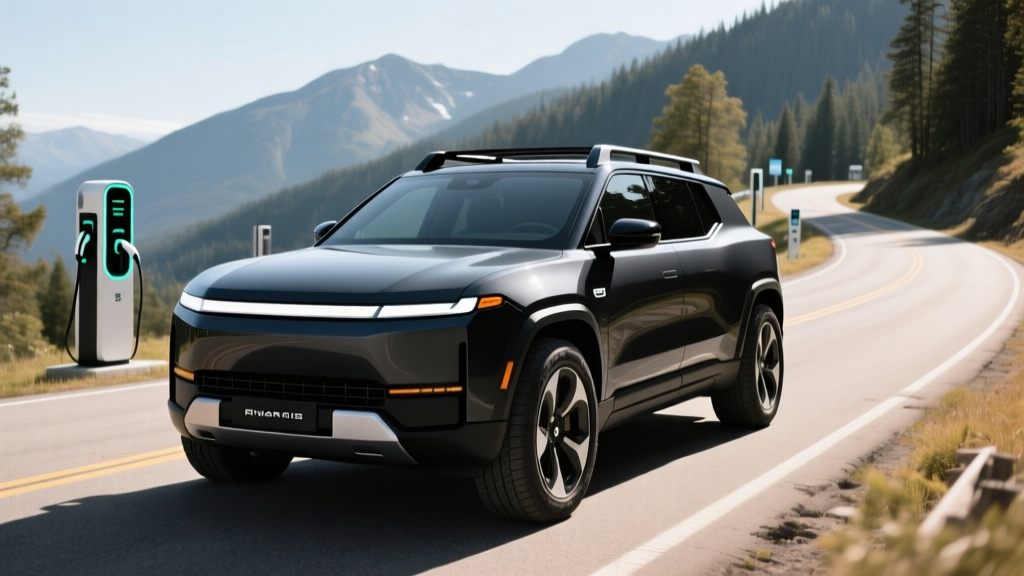
The 2026 Rivian R1S Tri-Motor sits at the apex of the three-row electric SUV segment. With a 149 kWh Max battery pack delivering an EPA-estimated 410 miles of range, 850 horsepower, and a towing capacity of 7,700 pounds, it is simultaneously a long-distance cruiser, a performance machine, and a legitimate body-on-frame family hauler. It is also a $110,000-plus vehicle that will not qualify most buyers for the federal §30D tax credit due to MSRP caps. This review breaks down the exact numbers you need before writing a check.
Full Specification Sheet at a Glance
| Spec | R1S Tri-Motor (Max Pack) |
|---|---|
| EPA Range | 410 miles |
| Battery Usable Capacity | ~149 kWh (NMC lithium-ion) |
| Drivetrain | Tri-Motor AWD (1 front, 2 rear) |
| Horsepower | 850 HP |
| 0-60 mph | ~3.0 seconds |
| Max DC Fast Charge | 220 kW (peak) |
| 10-80% DC Time | ~30 minutes |
| Level 2 Home Charging | 19.2 kW / ~50 mi/hr |
| MPGe (Combined) | 73 MPGe (est.) |
| Efficiency | ~46 kWh/100 mi |
| Towing Capacity | 7,700 lbs |
| Cargo (behind 3rd row) | 20.6 cu ft |
| Cargo (all rows folded) | 104.7 cu ft |
| Base MSRP (Tri-Motor) | $112,600 |
| Battery Warranty | 8 years / 175,000 miles |
Range and Efficiency: EPA vs. Reality
EPA Estimate: 410 miles (Max Pack, Tri-Motor, 21" wheels)
Real-World Expectation: ~330-360 miles highway at 70 mph; ~280-310 miles in sub-30°F cold weather
Rivian's 410-mile EPA figure applies to the Max Pack with the most efficient 21-inch wheel and all-season tire configuration. The tri-motor drivetrain adds roughly 250 pounds and more mechanical drag compared to the dual-motor, which is why the Dual-Motor Max Pack edges slightly higher on the EPA cycle. In practice, highway driving at sustained 70-75 mph speeds pushes consumption to roughly 50-52 kWh/100 mi, yielding approximately 330-360 miles before you need to plug in.
Cold-weather impact is significant on a pack this large. In temperatures below 30°F, expect a 20-30% reduction in usable range, partly from cabin heating demands and partly from reduced battery discharge efficiency. Rivian's heat pump system helps mitigate this compared to resistive heating, but physics wins in deep winter. If you live in the upper Midwest or Northeast, plan for ~280-310 miles of practical winter range.
One owner-relevant nuance: the 149 kWh pack is heavy. Curb weight exceeds 7,100 pounds. Aggressive acceleration, roof cargo boxes, and towing all compress range further. At 7,700 lbs towed, expect range to drop to roughly 180-220 miles depending on trailer aerodynamics and terrain.
For authoritative efficiency data, see the EPA's fueleconomy.gov listing for the R1S.
Charging Speed: DC Fast, Level 2, and the Charge Curve
| Charging Level | Power | Speed / Time |
|---|---|---|
| Level 1 (120V) | ~1.4 kW | ~3 mi/hr |
| Level 2 (240V, 48A) | 11.5 kW | ~25 mi/hr |
| Level 2 (240V, 80A) | 19.2 kW | ~50 mi/hr (full overnight) |
| DC Fast Charge (peak) | 220 kW | 10-80% in ~30 min |
| DC Fast Charge (sustained avg) | ~150 kW | ~170 miles added in 30 min |
The R1S Tri-Motor Max Pack peaks at 220 kW on a compatible DC fast charger using its NACS connector (native Tesla Supercharger compatibility is standard on 2025+ Rivians). However, as with all large battery packs, peak kW is not sustained kW. The charge curve holds near peak from roughly 10-40% State of Charge, then tapers progressively. From 60-80%, expect speeds closer to 100-120 kW. The 10-80% time of ~30 minutes is competitive but not class-leading; the Hyundai Ioniq 5 and Porsche Macan Electric can complete the same window in 18-21 minutes thanks to smaller packs and higher C-rates.
At home on a 19.2 kW Level 2 wall connector (requiring a 100-amp dedicated circuit), the Max Pack charges from empty to full in roughly 9-10 hours. This is a critical consideration: a standard 48A/11.5 kW Level 2 setup needs 13+ hours for a full charge. Most owners will never deplete to zero, so overnight topping from 30-80% is practical on any Level 2 setup. Budget $800-$2,500 for home Level 2 installation depending on your panel capacity and run distance — consult a licensed electrician to confirm your 200-amp panel can support an 80A circuit.
Preconditioning matters. The R1S navigation system will automatically warm the battery when you route to a charger, which is essential for achieving peak charge rates in cool weather. Always navigate to your charging stop rather than just driving to it.
Performance and Drivetrain
The tri-motor layout uses one front motor and two rear motors, enabling torque vectoring across the rear axle. Total output is 850 horsepower, and the 0-60 mph time of approximately 3.0 seconds places this 7,100-pound SUV in sports-car territory off the line. The dual rear motors also improve traction in low-grip conditions and enable more precise power delivery when towing or traversing uneven off-road terrain.
Rivian's quad-motor variant (available on the R1T and R1S Adventure trim) produces over 1,000 HP, but the tri-motor strikes a better balance between performance, efficiency, and weight for most buyers. The air suspension provides up to 14.4 inches of ground clearance in Off-Road mode and drops for easy loading in Park mode. Approach, departure, and breakover angles are genuinely impressive for a three-row family SUV.
Drive modes include All-Purpose, Sport, Snow, Off-Road, and a Tow mode that adjusts suspension height, throttle mapping, and regen behavior. The one-pedal driving experience is strong, with aggressive regen capable of bringing the R1S to a full stop without touching the brake pedal in most conditions.
Interior, Cargo, and Family Practicality
The R1S is a true three-row SUV with seating for up to seven. Second-row captain's chairs are standard on higher trims, reducing capacity to six but dramatically improving third-row access and passenger comfort. Key dimensions:
- Front headroom: 41.1 inches
- Second-row legroom: 38.9 inches
- Third-row legroom: 30.4 inches (usable for children and shorter adults on trips under two hours)
- Cargo behind 3rd row: 20.6 cu ft
- Cargo behind 2nd row (3rd folded): 57.7 cu ft
- Total cargo (all rows folded): 104.7 cu ft
- Front trunk (frunk): 11.1 cu ft — lockable, drainable, useful for groceries or wet gear
The gear tunnel — a signature Rivian feature running laterally between the second and third rows — is standard on the R1T but not available on the R1S. However, the R1S compensates with under-floor rear storage and a well-organized center console. The 15.6-inch center touchscreen runs Rivian's proprietary OS, which has improved substantially since launch with over-the-air updates adding route planning, camp mode, and enhanced voice commands. A 12.3-inch digital driver display and an optional rear-seat entertainment screen round out the tech.
Pricing, Trims, and Federal Tax Credit Eligibility
| Trim / Configuration | Base MSRP | As-Tested (typical options) |
|---|---|---|
| R1S Dual-Motor Standard Pack | $79,900 | $83,000-$87,000 |
| R1S Dual-Motor Max Pack | $94,600 | $98,000-$103,000 |
| R1S Tri-Motor Max Pack | $112,600 | $118,000-$128,000 |
| R1S Quad-Motor Max Pack | $120,600 | $130,000-$140,000 |
Here is the tax credit reality for the R1S Tri-Motor: under IRS §30D rules, the federal clean vehicle credit of up to $7,500 applies only to SUVs with an MSRP at or below $80,000. The Tri-Motor at $112,600 base is categorically ineligible. Even the Dual-Motor Standard Pack at $79,900 only qualifies when configured without options that push it above the cap, and only if the buyer meets income thresholds ($150,000 single / $300,000 joint modified AGI) and the vehicle meets critical mineral and battery component sourcing requirements, which shift annually.
Point-of-sale transfer of the credit (available since 2024) allows eligible buyers to apply the credit as an immediate price reduction at the dealer, but only if all requirements are satisfied. For the Tri-Motor, focus your financial planning on state and utility incentives, which vary by jurisdiction — check your state energy office and local utility for rebates that may apply. Consult a tax professional for your specific eligibility.
Ownership Costs and Warranty
Rivian covers the R1S with a 5-year/60,000-mile bumper-to-bumper warranty and an 8-year/175,000-mile battery and powertrain warranty. The battery warranty guarantees at least 70% capacity retention over the coverage period. For a 149 kWh pack, that means at least ~104 kWh usable after 175,000 miles — still enough for roughly 280+ miles of range. Real-world degradation data from early Rivian owners suggests NMC packs lose approximately 5-8% over the first 50,000 miles before leveling off, consistent with industry norms.
Insurance premiums for the Tri-Motor are substantial. Expect $3,200-$4,800 annually depending on your driving record, location, and coverage level — roughly 30-50% more than a comparably priced gas SUV. Rivian has been working to expand its in-house insurance program, which may offer competitive rates for owners who share telematics data.
Charging costs are a bright spot. At the national average residential electricity rate of ~$0.16/kWh, fully charging the 149 kWh Max Pack at home costs approximately $23.84, yielding a cost-per-mile of about $0.058. Compare that to a gas SUV at 20 MPG with $3.50/gallon fuel: $0.175/mile. Over 15,000 miles annually, that is roughly $1,755 in fuel savings with home charging. DC fast charging on the road is more expensive ($0.35-$0.55/kWh on networks like Electrify America), so savings narrow for frequent road-trippers.
Who the R1S Tri-Motor Is For
Choose the R1S Tri-Motor if:
- You need three rows, genuine off-road capability, and 7,700-lb towing in a single electric vehicle
- You regularly drive 250+ mile routes where the 410-mile range buffer reduces charging stops
- You value over-the-air updates and a software-defined vehicle architecture
- You have home Level 2 charging and want to minimize public charging dependency
Look elsewhere if:
- Your budget is under $90,000 — the Dual-Motor Standard or Large Pack is the value play
- You need the fastest DC charging in the segment — the Ioniq 9 or Cadillac Escalade IQ charge faster relative to pack size
- Federal tax credit eligibility is essential to your purchase math — the Tri-Motor does not qualify
- Third-row space is a priority for full-size adults — the Kia EV9 and Escalade IQ offer more rear room
Pros and Cons
Pros
- 410-mile EPA range eliminates range anxiety on most road trips
- 850 HP tri-motor with torque vectoring is genuinely thrilling
- Best-in-class off-road capability among three-row electric SUVs
- 7,700-lb towing capacity with integrated trailer brake controller
- Excellent OTA software updates continuously adding features
- Large frunk adds practical cargo versatility
Cons
- $112,600 base price — ineligible for federal §30D tax credit
- Heavy curb weight (7,100+ lbs) impacts tire wear and efficiency
- 30-minute 10-80% charge is slower than some competitors with smaller packs
- Third row is tight for adults on long trips
- Insurance costs are above segment average
- Service center network still expanding in rural areas
Frequently Asked Questions
What is the real-world range of the Rivian R1S Tri-Motor?
The EPA rates the R1S Tri-Motor Max Pack at 410 miles. In real-world highway driving at 70-75 mph, expect 330-360 miles. In cold weather below 30°F, plan for 280-310 miles. Towing near max capacity drops range to approximately 180-220 miles.
How fast does the R1S Tri-Motor charge?
On DC fast charging, it peaks at 220 kW and completes a 10-80% charge in approximately 30 minutes. At home on a 19.2 kW Level 2 charger, a full charge takes about 9-10 hours. On a standard 11.5 kW/48A home charger, expect 13+ hours for a full charge.
Does the Rivian R1S Tri-Motor qualify for the federal EV tax credit?
No. Under IRS §30D rules, the SUV MSRP cap is $80,000. The Tri-Motor starts at $112,600, making it ineligible regardless of buyer income or battery sourcing. State and utility incentives may still apply depending on your location.
How does the R1S Tri-Motor compare to the Tesla Model X or Kia EV9?
The R1S offers superior off-road capability and towing (7,700 lbs vs. Model X's 5,000 lbs) and far more range than the EV9 GT (410 vs. 280 miles). The Model X charges faster and has the Supercharger network advantage. The EV9 starts at roughly half the price and qualifies for the tax credit in certain trims but offers less range and no off-road capability.
Is the R1S Tri-Motor worth the premium over the Dual-Motor?
If you need towing capacity, off-road confidence, and the fastest acceleration Rivian offers short of the Quad-Motor, yes. For pure commuting and family hauling, the Dual-Motor Max Pack at $94,600 delivers nearly identical range (415 miles) with lower cost and slightly better efficiency. The tri-motor is a performance and capability upgrade, not a range upgrade.
What is the battery warranty on the R1S?
Rivian covers the battery and drive units for 8 years or 175,000 miles, whichever comes first, with a guaranteed capacity retention of at least 70% over that period. The bumper-to-bumper warranty is 5 years / 60,000 miles.