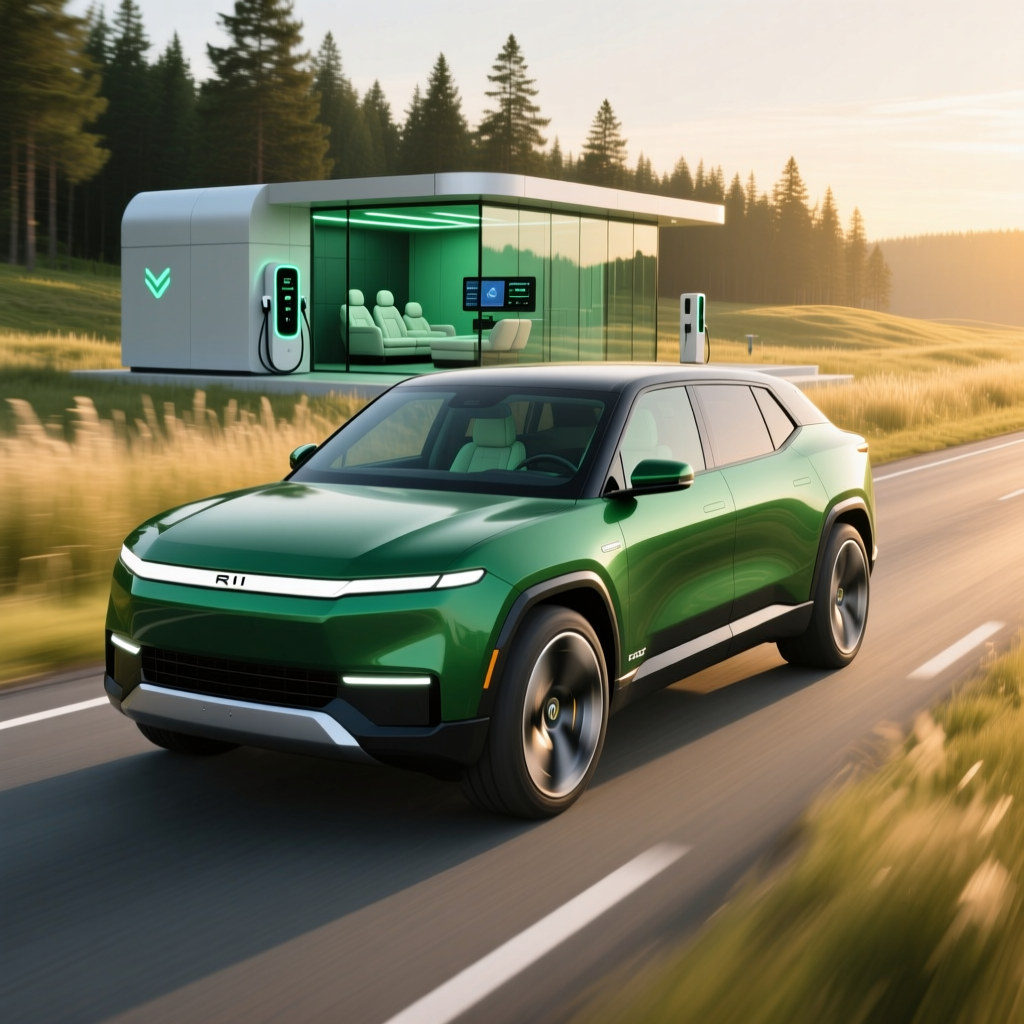
The Rivian R1S has carved out a unique position in the electric vehicle landscape as one of the few three-row electric SUVs built from the ground up for adventure-seeking families. Combining genuine off-road capability with daily-driver practicality, the R1S asks a compelling question: can a full-size electric SUV truly replace your gas-powered family hauler? In this comprehensive review, we examine every aspect of the R1S ownership experience — from real-world range and charging speeds to interior technology, driving dynamics, and long-term costs — so you can decide whether this electric adventure vehicle is the right fit for your family.
Vehicle Overview: What Is the Rivian R1S?
The Rivian R1S is a three-row, seven-passenger electric SUV built on Rivian's skateboard platform — a versatile architecture that houses the battery pack, electric motors, and suspension components in a low-slung chassis. Unlike many electric crossovers that prioritize efficiency above all else, the R1S was engineered with a dual mission: serve as a comfortable, tech-forward family vehicle during the week and transform into a capable off-road explorer on weekends.
Available in multiple configurations including Dual-Motor, Performance Dual-Motor, and Quad-Motor variants, the R1S offers power outputs ranging from approximately 533 horsepower to over 1,000 horsepower in the top-spec Quad-Motor model. Battery options include the Standard, Large, and Max packs, each providing different range and performance characteristics. According to EPA ratings, the R1S achieves between 270 and over 400 miles of estimated range depending on the selected battery and drivetrain configuration.
Starting prices position the R1S in the premium SUV segment, competing with vehicles like the Tesla Model X, the Kia EV9, and traditional luxury SUVs such as the BMW X7 and Mercedes-Benz GLS. For families evaluating their options, our best three-row electric SUVs guide provides a broader comparison of available models.
Real-World Range & Battery Performance
EPA range estimates provide a useful baseline, but families need to know how the R1S performs in real-world conditions — loaded with passengers, cargo, and gear for weekend trips. Independent testing by organizations like Edmunds and Car and Driver has shown that the R1S generally delivers range figures close to its EPA estimates under mixed driving conditions, which is a notable achievement for a boxy, heavy SUV.
The Large Pack with Dual-Motor configuration tends to offer the best balance of range and value for most families, with an EPA-estimated range in the mid-300-mile range. The Max Pack pushes that figure above 400 miles in certain configurations, making it an attractive option for families who regularly take long road trips. However, the Max Pack adds significant weight and cost, so it is worth evaluating your typical driving patterns before upgrading.
Several factors affect real-world range in the R1S. Highway driving at speeds above 70 mph reduces range noticeably due to the vehicle's upright, SUV-profile aerodynamics. Cold weather can reduce range by 15 to 30 percent, a common trait among all electric vehicles. Using the R1S's built-in heat pump helps mitigate cold-weather losses compared to EVs without thermal management systems of this caliber. When towing — the R1S is rated for up to 7,700 pounds — expect range to drop significantly, often by 40 percent or more depending on trailer weight and conditions.
One standout feature is Rivian's battery preconditioning system. When you set a charging stop in the navigation, the R1S automatically warms or cools the battery to optimize charging speed upon arrival. This system works seamlessly and can make a meaningful difference in charging times during cold weather.
Charging Speed & Infrastructure
Charging capability is one of the most critical factors for families considering an electric SUV, and the R1S delivers competitive performance on both DC fast charging and Level 2 home charging fronts.
On DC fast chargers, the Large Pack R1S can accept peak charging rates of over 200 kW, allowing it to add approximately 140 miles of range in about 20 minutes under ideal conditions. The Max Pack configuration supports even higher peak rates, approaching 220 kW or more. While these peak rates are impressive, it is important to note that charging speed tapers as the battery fills, so the average charging rate over a full session from 10 to 80 percent is somewhat lower. Real-world fast charging sessions from 10 to 80 percent typically take between 30 and 45 minutes depending on the charger's output, ambient temperature, and battery state.
The R1S uses the NACS (North American Charging Standard) connector on newer models, granting access to Tesla's extensive Supercharger network in addition to other public charging networks. Earlier models equipped with CCS connectors can use NACS adapters to access the same network. For a full breakdown of what this means for your daily life, check out our EV charging networks comparison guide.
At home, the R1S supports Level 2 charging at up to 11.5 kW using a 48-amp connection, which can add roughly 25 to 30 miles of range per hour of charging. For most families, overnight charging on a home Level 2 setup is more than sufficient to start each day with a full battery. Rivian also offers the Wall Charger accessory, which integrates neatly with the vehicle's software for scheduled charging and energy management.
| Specification | Dual-Motor (Large Pack) | Performance Dual-Motor | Quad-Motor (Max Pack) |
|---|---|---|---|
| Power Output | 533 hp | 665 hp | 1,025 hp |
| EPA Est. Range | ~352 miles | ~340 miles | ~410 miles |
| 0–60 mph | ~4.5 sec | ~3.5 sec | ~3.0 sec |
| Towing Capacity | 7,700 lbs | 7,700 lbs | 7,700 lbs |
| Peak DC Fast Charge | 200+ kW | 200+ kW | 220+ kW |
| Seating Capacity | 7 passengers | 7 passengers | 7 passengers |
| Cargo (Behind 3rd Row) | ~20 cu ft | ~20 cu ft | ~20 cu ft |
| Ground Clearance | Up to 14.9 in | Up to 14.9 in | Up to 14.9 in |
Note: Specifications are approximate and may vary by model year and configuration. Always verify with Rivian's official specifications before purchasing.
Interior, Technology & Family Practicality
Step inside the R1S and you will find a cabin that balances minimalist design with genuine family-friendly functionality. The dashboard is dominated by a 15.6-inch central touchscreen running Rivian's proprietary software, which handles everything from navigation and media to vehicle settings and drive mode selection. A 12.3-inch digital driver display provides essential information without clutter, and an optional head-up display projects key data onto the windshield.
The software experience is one of Rivian's strongest attributes. Over-the-air updates regularly introduce new features, improve existing ones, and refine the user interface. The navigation system is EV-aware, automatically planning routes around charging stops and preconditioning the battery accordingly. Wireless Apple CarPlay and Android Auto are supported, and the built-in infotainment system is responsive and intuitive enough that many owners rarely feel the need to rely on phone mirroring.
For families, the three-row layout is a defining feature. The second row offers generous legroom and headroom, comfortably accommodating adult passengers or rear-facing child seats. The third row is best suited for children or occasional adult use on shorter trips — a common limitation in this vehicle class. When the third row is folded, cargo space expands substantially, and folding both the second and third rows creates a cavernous load area suitable for camping gear, bicycles, or a full grocery run for the week.
The front trunk (frunk) adds approximately 11 cubic feet of additional storage, perfect for charging cables, groceries, or gear you want to keep separate from the main cabin. The gear tunnel — an available storage compartment that runs laterally through the vehicle behind the second row — is an ingenious feature unique to Rivian, offering secure, weatherproof storage for longer items like skis, snowboards, or fishing rods.
Rear-seat entertainment is handled through the central screen and available rear displays, and multiple USB-C ports throughout the cabin ensure every passenger can keep devices charged. The available Camp Kitchen accessory and built-in air compressor further reinforce the R1S's adventure-oriented identity, though these are optional extras that add to the total cost.
Driving Dynamics & Off-Road Capability
Behind the wheel, the R1S defies expectations for a vehicle of its size and weight. The low center of gravity inherent to its skateboard platform gives it a planted, confident feel on paved roads that is more reminiscent of a sport sedan than a body-on-frame SUV. Steering is precise and well-weighted, and the air suspension adapts continuously to road conditions, smoothing out imperfections while maintaining composure through corners.
The Dual-Motor configuration provides more than enough acceleration for daily driving, highway merging, and passing maneuvers. Step up to the Performance Dual-Motor or Quad-Motor variants and the R1S transforms into a genuinely quick vehicle, with the Quad-Motor model delivering supercar-rivaling acceleration that feels almost surreal in a seven-passenger SUV. The Quad-Motor's individual wheel torque vectoring also enhances cornering grip and stability, making the R1S feel remarkably agile for its dimensions.
Off-road capability is where the R1S truly separates itself from most electric SUV competitors. With up to 14.9 inches of ground clearance thanks to the adjustable air suspension, approach and departure angles that rival dedicated off-road vehicles, and a wading depth of over three feet, the R1S is genuinely capable on challenging terrain. Rivian's software includes dedicated drive modes for sand, rock crawling, mud, and snow, each adjusting throttle response, suspension height, traction control, and torque distribution to suit the conditions.
The available quad-motor setup takes off-road performance to another level with tank turns (rotating the vehicle in place by spinning wheels on opposite sides in different directions) and precise low-speed control that makes technical trails manageable even for less experienced off-roaders. For a closer look at how the R1S stacks up against other adventure-oriented EVs, see our best electric SUVs for off-road roundup.
Ride quality in everyday driving is excellent. The air suspension absorbs bumps with a suppleness that rivals luxury competitors, and the cabin remains impressively quiet at highway speeds. Wind noise around the mirrors and roof rack crossbars is present but well-managed, and the absence of engine noise allows conversations to flow easily across all three rows.
Ownership Costs & Long-Term Value
The financial case for the R1S extends well beyond the sticker price. While the initial purchase price places it firmly in the premium category, total cost of ownership can be surprisingly competitive with similarly sized gas-powered SUVs when you factor in fuel savings, reduced maintenance, and available incentives.
Electricity costs for charging the R1S vary by region and charging method, but most owners report spending significantly less per mile on energy compared to gasoline equivalents. Home charging on off-peak electricity rates offers the best value, while frequent DC fast charging is more expensive but still generally cheaper per mile than premium gasoline. Over 100,000 miles, fuel savings alone can amount to several thousand dollars compared to a gas-powered SUV achieving 18 to 22 mpg combined.
Maintenance costs are another area where the R1S shines. Without an internal combustion engine, there are no oil changes, spark plug replacements, timing belt services, or exhaust system repairs to worry about. Regenerative braking significantly extends brake pad life, with many EV owners reporting original brake pads lasting well beyond 100,000 miles. The primary maintenance items are cabin air filter replacements, tire rotations, windshield washer fluid, and eventual tire replacement — and given the R1S's substantial weight, tire wear can be accelerated compared to lighter vehicles.
Rivian offers a competitive warranty package, including a bumper-to-bumper limited warranty and an extended battery warranty that covers degradation below a specified threshold. The company's service model combines mobile service technicians who handle many repairs at your home or office with physical service centers for more complex work. Service experience has improved considerably as Rivian has expanded its network, though wait times for parts and appointments can still vary by region.
Insurance costs for the R1S tend to be higher than average for the SUV segment, reflecting the vehicle's premium price, performance capabilities, and repair costs. Shopping around for quotes is strongly recommended, as rates vary significantly between providers. For more on what to expect, our EV insurance costs guide breaks down the factors that affect your premium.
Depreciation is an important consideration. As with many EVs, the R1S has experienced some volatility in resale values as the electric vehicle market matures, new competitors enter the segment, and federal incentive structures evolve. Purchasing with available federal and state tax credits can help offset initial costs and improve long-term value retention. Always check current incentive eligibility before purchasing.
Pros, Cons & Verdict
Pros
- Class-leading off-road capability — Genuine trail-ready performance with adjustable air suspension and multiple terrain modes
- Excellent real-world range — Large and Max Pack options deliver range that supports road trips without excessive charging stops
- Thoughtful family features — Gear tunnel, frunk, three-row seating, and abundant storage solutions
- Strong software experience — Regular OTA updates, intuitive interface, and EV-aware navigation
- Impressive performance — Even the base Dual-Motor is quick, while the Quad-Motor delivers extraordinary acceleration
- Low running costs — Reduced maintenance and energy costs compared to gas-powered alternatives
- NACS compatibility — Access to the extensive Supercharger network for hassle-free road trips
Cons
- Premium pricing — Well-equipped examples push into luxury SUV territory financially
- Third-row space is limited — Best suited for children; adults will find it cramped on longer journeys
- Tire wear — Heavy vehicle weight can lead to faster tire consumption
- Service network still growing — Some regions have limited service center access and longer wait times
- Towing significantly reduces range — Expect range to be cut nearly in half when towing heavy loads
- Insurance costs above average — Premium pricing and repair costs translate to higher premiums
Our Verdict: The Rivian R1S is the most well-rounded three-row electric SUV for families who want genuine adventure capability alongside daily practicality. It is not the most affordable option in its class, and families who rarely venture off pavement may find better value in more road-focused alternatives. But if your lifestyle includes camping trips, ski weekends, or trail exploration — and you need three rows of seating — the R1S delivers a combination of capabilities that no other electric SUV currently matches. For more options, browse our complete best electric SUVs buyer's guide.
Frequently Asked Questions
Is the Rivian R1S a good family vehicle?
Yes, the R1S is an excellent family vehicle for households that need three rows of seating and value versatility. It offers ample cargo space with the third row folded, a front trunk for additional storage, the unique gear tunnel for outdoor equipment, and a cabin designed with durable, easy-to-clean materials. The second row comfortably fits child seats, and the third row works well for children or occasional adult passengers. Families who regularly carry seven adults may want to consider larger alternatives, but for most family configurations, the R1S is exceptionally well-suited.
How long does it take to charge the Rivian R1S at home?
Using a Level 2 home charger at 48 amps, the R1S can add approximately 25 to 30 miles of range per hour. A full charge from near-empty to 100 percent typically takes between 10 and 14 hours depending on the battery pack size. Most owners plug in overnight and wake up to a fully charged vehicle every morning. Installing a home charger requires a 240-volt circuit, typically a NEMA 14-50 outlet or a hardwired connection, and should be performed by a licensed electrician.
How does the R1S compare to the Tesla Model X?
The R1S and Model X take different approaches to the three-row electric SUV formula. The Model X offers slightly more third-row space and the distinctive falcon-wing rear doors, along with access to the mature Tesla Supercharger network (though Rivian now has access as well). The R1S counters with superior off-road capability, more creative storage solutions like the gear tunnel, a more rugged design aesthetic, and generally more competitive pricing. For a detailed head-to-head analysis, check our Rivian R1S vs. Tesla Model X comparison.
Can the Rivian R1S tow a camper or boat?
The R1S is rated to tow up to 7,700 pounds across all configurations, making it capable of pulling many campers, boat trailers, and utility trailers. However, towing has a dramatic impact on range — expect reductions of 30 to 50 percent depending on trailer weight, aerodynamics, terrain, and speed. If you plan to tow frequently over long distances, carefully plan charging stops and consider the Max Pack configuration for additional range buffer. Rivian's software includes a dedicated tow mode that adjusts power delivery and regenerative braking for trailer use.
What is the warranty coverage on the Rivian R1S?
Rivian provides a bumper-to-bumper limited warranty covering most vehicle components and a separate battery and drive unit warranty that extends for a longer period or higher mileage threshold, whichever comes first. The battery warranty guarantees that the pack will retain a specified minimum percentage of its original capacity over the warranty period. Rivian also includes roadside assistance coverage. Specific warranty terms may vary, so review the current warranty documentation on Rivian's website or consult with a Rivian advisor for the most up-to-date details before purchasing.