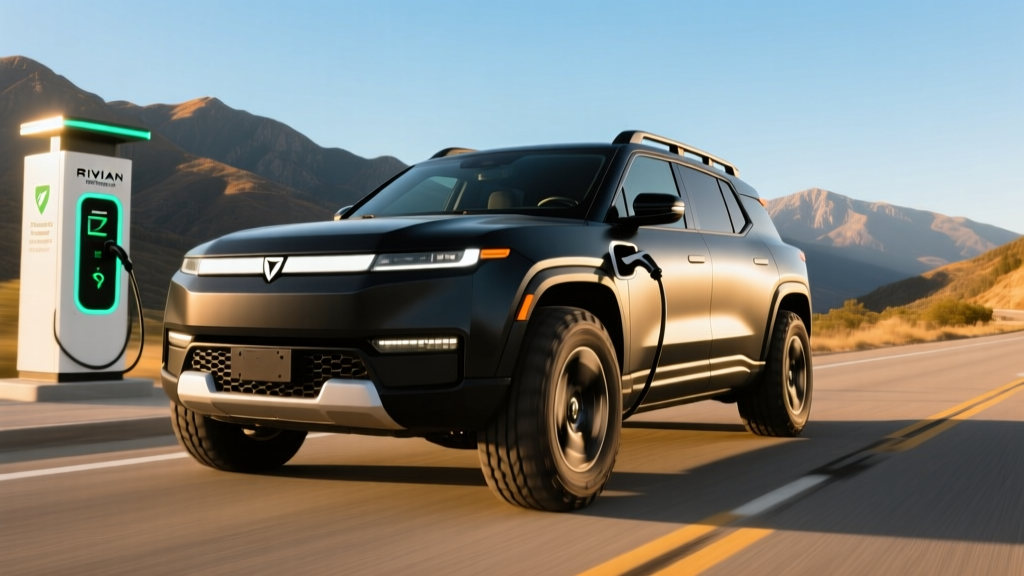
The 2026 Rivian R1S sits at the intersection of luxury electric SUV capability and adventure-ready engineering. With dual- and quad-motor powertrains, up to 410 miles of EPA-estimated range, and access to the expanding Rivian Charge Network plus Tesla Superchargers via NACS, the R1S is one of the most versatile three-row electric SUVs on the market. But how do the real-world numbers stack up against the spec sheet? This review covers every figure that matters — range, charging, pricing, and tax credit eligibility — so you can decide if the R1S earns a spot in your driveway.
Quick Verdict: Who Is the Rivian R1S For?
The R1S is built for buyers who need three rows of seating, genuine off-road capability, and a usable towing rating — without sacrificing acceleration or technology. If your use case includes family road trips, light trail use, boat towing, and daily commuting with access to home Level 2 charging, the R1S is a top-tier choice. If you prioritize the lowest possible price or need access to a dense urban fast-charging ecosystem without adapters, competitors like the Tesla Model X or Hyundai Ioniq 9 may warrant a cross-shop.
Range, Battery, and Efficiency: Real Numbers
The R1S Dual-Motor with the Max Pack (149 kWh usable, NMC chemistry) carries an EPA-estimated 410 miles of range. In real-world highway driving at 70-75 mph in moderate temperatures, expect approximately 340-370 miles. In cold weather (below 30°F), range can drop to 280-320 miles depending on cabin heating demands and whether you precondition the battery. The Standard Pack (106 kWh) yields an EPA-estimated 270 miles; plan for roughly 220-240 miles on the highway in fair conditions.
Rivian uses NMC (nickel manganese cobalt) lithium-ion cells in both its Standard and Max battery packs for 2026. NMC offers higher energy density than LFP, which is critical for fitting large capacity into the R1S's skateboard platform while preserving ground clearance. The trade-off is that NMC batteries benefit from careful charging habits — Rivian recommends daily charging to 80-85% and reserving 100% charges for road trips.
| Specification | Dual-Motor Standard | Dual-Motor Max | Quad-Motor Max |
|---|---|---|---|
| EPA Range | 270 mi | 410 mi | 380 mi |
| Battery (usable) | 106 kWh (NMC) | 149 kWh (NMC) | 149 kWh (NMC) |
| Horsepower | 533 hp | 533 hp | 1,025 hp |
| 0-60 mph | 4.5 sec | 4.5 sec | 2.9 sec |
| Drivetrain | AWD (dual-motor) | AWD (dual-motor) | AWD (quad-motor) |
| Max DC Fast Charge | 200 kW | 220 kW | 220 kW |
| 10-80% DC Charge | ~28 min | ~34 min | ~34 min |
| Level 2 Home Rate | 11.5 kW (~30 mi/hr) | 11.5 kW (~30 mi/hr) | 11.5 kW (~30 mi/hr) |
| Efficiency | 73 MPGe / 46 kWh/100mi | 78 MPGe / 43 kWh/100mi | 70 MPGe / 48 kWh/100mi |
| Towing Capacity | 7,700 lbs | 7,700 lbs | 7,700 lbs |
Source: fueleconomy.gov and Rivian official specifications.
Charging: The Rivian Charge Network and Beyond
The Rivian Charge Network is Rivian's proprietary destination and adventure charging network, strategically placed near national parks, trailheads, ski resorts, and Rivian Outpost locations. As of early 2026, the network includes over 50 locations with DC fast chargers (typically 150-200 kW) and Level 2 Wall Chargers. While smaller than Electrify America or Tesla's Supercharger network, the Rivian Charge Network fills a niche: it's located where adventure-oriented drivers actually need it, often in areas underserved by other networks.
| Charging Level | Power | Speed (mi/hr added) | Typical Use Case |
|---|---|---|---|
| Level 1 (120V outlet) | ~1.4 kW | ~3-4 mi/hr | Emergency / overnight trickle |
| Level 2 (240V home) | 11.5 kW | ~30 mi/hr | Daily home charging |
| DC Fast (Rivian Waypoint/Adventure) | 150-200 kW | ~300-400 mi/hr (peak) | Rivian Charge Network locations |
| DC Fast (Tesla Supercharger V3/V4) | Up to 250 kW | ~350-450 mi/hr (peak) | Road trips via NACS port |
| DC Fast (Electrify America / third-party) | Up to 220 kW | ~300-400 mi/hr (peak) | Urban and highway corridors |
A critical detail for 2026: the R1S now ships with a native NACS (North American Charging Standard) port, meaning direct plug-in access to Tesla Superchargers without an adapter. This dramatically expands the R1S's usable fast-charging footprint to over 25,000 Supercharger stalls nationwide.
Charging curve reality: The Max Pack's peak rate of 220 kW is sustained from roughly 10-40% state of charge, then tapers progressively. From 60-80%, expect approximately 120-140 kW. This is why the 10-80% time is ~34 minutes rather than the theoretical ~20 minutes that a flat peak rate would suggest. Preconditioning the battery (via the Rivian app before arriving at a charger) is essential to hitting peak rates, especially in cold weather.
Performance and Capability
The Dual-Motor R1S delivers 533 horsepower and 610 lb-ft of torque, achieving 0-60 mph in 4.5 seconds — brisk for a three-row SUV weighing over 7,000 pounds. The Quad-Motor variant is in a different performance tier entirely: 1,025 hp and a 2.9-second 0-60 time, enabled by independent motors at each wheel with torque vectoring.
Off-road, the R1S offers up to 14.9 inches of ground clearance (in Max suspension height), approach/departure angles competitive with body-on-frame SUVs, and a wading depth of over 3 feet. The quad-motor system allows tank turns (slow-speed 180-degree pivots), which is a genuine trail tool, not a gimmick.
Towing is rated at 7,700 lbs across all trims — sufficient for most boat trailers, campers, and horse trailers. Note that towing at or near max capacity will reduce range by 40-50%, a reality for every electric SUV in this class.
Interior, Cargo, and Technology
The R1S seats up to seven passengers across three rows. Third-row legroom measures 30.4 inches, adequate for children on longer trips but tight for adults beyond short drives. Cargo volume behind the third row is 10.4 cubic feet, expanding to 57.1 cu ft with the third row folded and 104.7 cu ft with both rear rows down. The front trunk (frunk) adds 11.1 cu ft of lockable storage.
The 15.6-inch center touchscreen runs Rivian's in-house infotainment software, which has improved significantly with over-the-air updates through 2025-2026. Wireless Apple CarPlay and Android Auto are standard. The digital driver display is 12.3 inches.
Driver assistance is branded Rivian Driver+, which includes adaptive cruise control, lane centering, and automatic lane changes on divided highways. This is an SAE Level 2 system — the driver must remain fully engaged and is responsible for the vehicle at all times. It is not autonomous driving.
Pricing, Trims, and Federal Tax Credit
| Trim / Configuration | Base MSRP | Est. §30D Credit | Effective Price |
|---|---|---|---|
| Dual-Motor Standard Pack (Explore) | $79,900 | Up to $7,500* | ~$72,400 |
| Dual-Motor Max Pack (Adventure) | $89,900 | Up to $7,500* | ~$82,400 |
| Quad-Motor Max Pack (Ascend) | $105,900 | Up to $7,500* | ~$98,400 |
*Federal tax credit eligibility under IRS §30D depends on multiple factors:
- MSRP cap: SUVs must be at or below $80,000 MSRP. The Dual-Motor Standard Pack (Explore) qualifies; Max Pack and Quad-Motor trims exceed the cap and are not eligible for the new-vehicle credit.
- Buyer income cap: Modified AGI must not exceed $150,000 (single), $225,000 (head of household), or $300,000 (joint).
- Battery sourcing: Critical minerals and battery components must meet escalating domestic-sourcing thresholds. Verify current-year compliance at purchase.
- Point-of-sale transfer: Eligible buyers can transfer the credit to the dealer at purchase, reducing the out-of-pocket price immediately rather than waiting for tax filing.
Consult a tax professional before relying on credit eligibility. Rules are subject to legislative change.
For buyers priced out of the §30D credit on higher trims, Rivian also offers leasing, which may qualify for the commercial clean vehicle credit (§45W) passed through as a lease incentive — check current lease terms directly with Rivian.
Pros and Cons
- Up to 410 miles EPA range (Max Pack) — class-leading for a three-row electric SUV
- Native NACS port provides direct Tesla Supercharger access
- Genuine off-road capability with up to 14.9" ground clearance
- 7,700-lb towing capacity
- Rivian Charge Network targets adventure destinations other networks ignore
- Quad-Motor performance (2.9 sec 0-60) is unmatched in the segment
- Over-the-air software improvements continue to add features
- Base price starts near $80K; only the base trim qualifies for the §30D credit
- Third-row space is tight for adults on long trips
- Towing at max capacity cuts range by ~40-50%
- Max Pack 10-80% charge time of ~34 minutes trails the fastest-charging competitors
- Service center network is still expanding — rural owners may face longer wait times
- Driver+ is capable but not class-leading vs. GM Super Cruise or Tesla FSD Supervised
Warranty and Ownership
Rivian covers the R1S with a 5-year/60,000-mile limited vehicle warranty and an 8-year/175,000-mile battery and drive unit warranty. The battery warranty guarantees retention of at least 70% of original capacity during the coverage period — a competitive threshold for the segment. Rivian also provides 24/7 roadside assistance for the duration of the basic warranty.
Insurance costs for the R1S tend to run 15-25% higher than comparable ICE three-row SUVs, driven by repair costs for the aluminum-intensive structure and high-voltage components. Get quotes from multiple carriers before purchase.
Competitor Comparison: R1S vs. the Field
The R1S competes with the Tesla Model X (348 mi EPA, starts ~$79,990), the Kia EV9 (304 mi EPA, starts ~$54,900), and the upcoming Hyundai Ioniq 9. The Model X offers more Supercharger density and a slightly faster charge rate, but lacks the R1S's off-road hardware. The EV9 is significantly more affordable and qualifies for the §30D credit on more trims, but offers less range, no frunk, and no serious off-road pretensions. The R1S wins on range, capability, and adventure-oriented charging access; it loses on price and third-row comfort.
Frequently Asked Questions
What is the real-world range of the 2026 Rivian R1S?
The Max Pack's EPA estimate is 410 miles. In real-world highway driving at 70-75 mph, expect 340-370 miles in moderate weather and 280-320 miles in sub-freezing conditions. The Standard Pack delivers roughly 220-240 real-world highway miles.
How fast does the R1S charge on the Rivian Charge Network?
Rivian Charge Network stations typically deliver 150-200 kW DC. At a 200 kW charger with a preconditioned Max Pack battery, you can expect 10-80% in approximately 34 minutes, with peak rates sustained through ~40% SoC before tapering.
Does the Rivian R1S qualify for the federal EV tax credit?
Only the Dual-Motor Standard Pack (Explore trim at $79,900 MSRP) falls within the §30D MSRP cap of $80,000 for SUVs. Higher trims exceed the cap. All buyers must also meet income limits and battery-sourcing requirements. Verify eligibility at irs.gov before purchase.
Can I charge the R1S at Tesla Superchargers?
Yes. The 2026 R1S ships with a native NACS port, providing direct access to Tesla's Supercharger network (over 25,000 stalls in North America) without an adapter.
Is the Rivian R1S good for towing?
The R1S is rated for 7,700 lbs of towing, competitive with ICE three-row SUVs. However, towing at or near max capacity reduces range by approximately 40-50%, so plan charging stops accordingly on longer hauls.
How does the Rivian Charge Network compare to other networks?
The Rivian Charge Network is smaller than Electrify America or Tesla Superchargers but uniquely placed at adventure destinations — national parks, ski areas, trailheads — where other networks have limited coverage. For daily and highway charging, R1S owners rely primarily on home Level 2, Superchargers, and third-party DC networks.
What is the battery warranty on the R1S?
Rivian provides an 8-year/175,000-mile battery and drive unit warranty, guaranteeing at least 70% capacity retention over the coverage period.