Quick Verdict: The R1S in 2026
The 2026 Rivian R1S remains the benchmark three-row electric SUV for buyers who want genuine off-road chops without sacrificing on-road refinement. With the Dual-Motor Standard pack starting at $79,900 and the Quad-Motor Tri-Motor variant pushing 850+ horsepower, the R1S covers an unusually wide performance envelope. Add the also Rivian bike ecosystem — the brand's electric cargo and mountain bikes — and you get a lifestyle package no legacy automaker currently matches.
But the R1S is not without compromises. Real-world highway range falls short of the EPA sticker, insurance premiums run high, and the federal tax credit eligibility depends on your income, the trim's MSRP, and battery-sourcing rules that shift year to year. This review breaks down every number that matters.
Range, Battery, and Real-World Efficiency
The 2026 R1S is offered with three battery configurations. Here is the full spec breakdown:
| Configuration | Battery (usable kWh) | Chemistry | EPA Range (mi) | MPGe (combined) | kWh/100 mi |
|---|---|---|---|---|---|
| Dual-Motor Standard | 106 kWh | NMC (2170 cells) | 290 | 73 | 46 |
| Dual-Motor Max | 141 kWh | NMC (2170 cells) | 380 | 70 | 48 |
| Tri-Motor Max | 141 kWh | NMC (2170 cells) | 350 | 65 | 52 |
Real-World Range Reality: The EPA 380-mile figure on the Dual-Motor Max is impressive on paper, but expect ~310–330 miles on sustained highway driving at 70–75 mph. In cold weather (below 30°F), plan for a 20–30% reduction, bringing usable range closer to 240–270 miles on the Max pack. The Standard pack's real-world highway range lands around 230–250 miles in mild conditions.
Rivian continues to use Samsung SDI 2170 NMC (nickel-manganese-cobalt) cylindrical cells across the R1S lineup. NMC offers higher energy density than LFP (lithium iron phosphate), which is critical for a vehicle this heavy — the R1S tips the scales at roughly 6,800–7,100 lbs depending on configuration. The trade-off is that NMC cells are more sensitive to sustained high states of charge; Rivian recommends daily charging to 80–85% and reserving 100% for road trips.
Charging Speed: DC Fast, Level 2, and Home Setup
Charging speed is where the R1S's large battery becomes a double-edged sword. The 141 kWh Max pack takes a long time to fill even at high power. Here is the full charging profile:
| Charge Level | Power | Standard Pack (106 kWh) | Max Pack (141 kWh) |
|---|---|---|---|
| Level 1 (120V household) | ~1.4 kW | ~3 mi/hr | ~3 mi/hr |
| Level 2 (240V home, 48A) | 11.5 kW | ~25 mi/hr (~9.5 hr full) | ~25 mi/hr (~13 hr full) |
| Level 2 (240V, 60A circuit) | ~14 kW (vehicle-limited to 11.5 kW) | ~25 mi/hr | ~25 mi/hr |
| DC Fast Charge (peak) | Up to 220 kW | 10–80% in ~30 min | 10–80% in ~42 min |
Charging curve reality: The R1S peaks near 220 kW only between roughly 10–30% state of charge on the Max pack. Above 50%, the curve tapers significantly, dropping below 100 kW past 70%. This means the advertised "10–80% in 42 minutes" is an average — the second half takes considerably longer than the first. Always precondition the battery via the Rivian app before arriving at a DC fast charger; skipping this step can add 10–15 minutes to your session in cold weather.
The R1S uses the NACS (North American Charging Standard) connector natively as of the 2025 model year, giving direct access to the Tesla Supercharger network — now the largest and most reliable DC fast-charging network in the U.S. with over 25,000 stalls. For home charging, a 60-amp circuit with a hardwired Level 2 station (such as the ChargePoint Home Flex or Tesla Wall Connector) is strongly recommended, especially for the Max pack. Budget $800–$2,000 for professional installation depending on your panel capacity and run length.
Performance and Drivetrain
The 2026 R1S lineup offers three drivetrain configurations:
- Dual-Motor AWD: ~533 hp, 610 lb-ft torque, 0–60 mph in 4.5 seconds
- Performance Dual-Motor AWD: ~665 hp, 829 lb-ft torque, 0–60 mph in 3.5 seconds
- Tri-Motor AWD: ~850 hp, 1,100+ lb-ft torque, 0–60 mph in ~2.9 seconds
All configurations use a single-speed reduction gear with torque vectoring across axles. The R1S features a true four-wheel independent air suspension with up to 14.9 inches of ground clearance in Off-Road mode — genuinely capable on technical trails, not just a marketing badge. The quad-corner air suspension also enables a kneeling function for easier cargo loading and passenger entry.
Towing capacity is rated at 7,700 lbs across all trims, though expect a 40–50% range reduction when towing near max capacity at highway speeds. That 380-mile Max pack becomes roughly 190–220 miles while towing a 5,000-lb trailer.
Pricing, Tax Credits, and Ownership Costs
Here is the 2026 R1S pricing ladder before any incentives:
| Trim | Base MSRP | Federal §30D Credit | Effective Price (if eligible) |
|---|---|---|---|
| Dual-Motor Standard (Adventure) | $79,900 | Up to $7,500* | ~$72,400 |
| Dual-Motor Max (Adventure) | $89,900 | $0 (over MSRP cap) | $89,900 |
| Performance Dual-Motor Max | $99,900 | $0 (over MSRP cap) | $99,900 |
| Tri-Motor Max | $114,900 | $0 (over MSRP cap) | $114,900 |
*Federal tax credit caveats (IRS §30D, 2026 rules): The $7,500 credit applies only if all of the following are met:
- MSRP cap: SUVs must be priced at or below $80,000. Only the Dual-Motor Standard qualifies.
- Income cap: Modified AGI must not exceed $150,000 (single), $225,000 (head of household), or $300,000 (joint).
- Battery sourcing: A percentage of critical minerals and battery components must be sourced from the U.S. or free-trade-agreement countries. These thresholds increase annually — verify current-year requirements at irs.gov.
- Point-of-sale transfer: You can elect to transfer the credit to the dealer at purchase, reducing your out-of-pocket cost immediately rather than waiting for tax filing.
For the Max-pack trims exceeding $80,000, the only path to a federal incentive is the used-EV credit (§25E) if you purchase a qualifying pre-owned R1S for $25,000 or more — offering up to $4,000 or 30% of the sale price, whichever is less. State incentives vary widely; check your local energy office or the AFDC state incentive database.
Interior, Cargo, and the Rivian Bike Ecosystem
The R1S seats up to seven across three rows. Cargo volume behind the third row is approximately 10.6 cu ft, expanding to 46.7 cu ft behind the second row and 88.2 cu ft with both rear rows folded. A front trunk (frunk) adds 11.1 cu ft of secure, weatherproof storage — useful for charging cables, groceries, or gear you want separated from the cabin.
Legroom is generous in the first two rows (41.3 inches front, 38.4 inches second row), but the third row is best suited for children or short trips. The flat floor (no transmission tunnel) improves foot space across all rows.
The Rivian Bike Connection
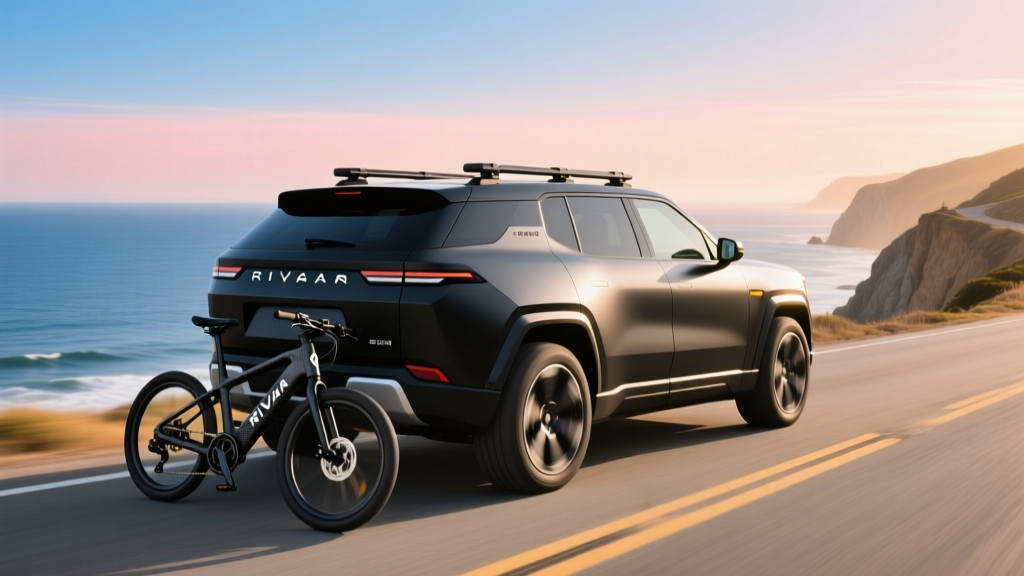
When enthusiasts search for also Rivian bike, they are usually referring to Rivian's expanding electric bicycle lineup and the R1S's purpose-built bike-carrying capability. Rivian offers a branded Rivian Electric Cargo Bike (developed in partnership with a major e-bike manufacturer) and has showcased an electric mountain bike concept. These bikes integrate with the R1S ecosystem in several ways:
- Hitch-mounted bike rack: The R1S's 2-inch receiver hitch supports a Rivian-branded rack system rated for two e-bikes (up to 80 lbs each), with integrated lighting and tilt-away access to the tailgate.
- Vehicle-to-bike charging: The R1S's 12V and 120V outlets in the cargo area and frunk can top up e-bike batteries during trailhead trips.
- Adventure Network integration: Rivian's in-app trip planner can route you to trailheads and coordinate with the Rivian Waypoints charging network near outdoor recreation areas.
This vehicle-plus-bike ecosystem is a genuine differentiator. No other EV manufacturer currently offers a tightly integrated electric-bike-and-SUV lifestyle package, and it factors into the R1S's appeal for the outdoor-active buyer.
Tech, Driver Assistance, and Notable Drawbacks
The R1S runs Rivian's proprietary infotainment system on a 15.6-inch center touchscreen with a 12.3-inch digital instrument cluster. Key tech features include:
- Over-the-air (OTA) software updates adding features and performance improvements
- Rivian Driver+ (SAE Level 2) — adaptive cruise control with lane centering on highways, hands-on-wheel required
- 360-degree camera system with trail-specific views for off-road navigation
- Camp Mode (maintains climate control while parked), Pet Mode, and Gear Guard (cable lock for public chargers)
- Native navigation with real-time charger availability and battery preconditioning
SAE Automation Note: Rivian Driver+ is an SAE Level 2 system. It assists with steering, acceleration, and braking on divided highways but requires the driver to remain fully engaged with hands on the wheel and eyes on the road. It is not self-driving and does not handle construction zones, unmapped roads, or adverse weather autonomously.
Notable Drawbacks:
- Third-row space is tight for adults — a minivan or extended-wheelbase SUV is better for frequent seven-passenger use
- Insurance premiums run 20–35% higher than comparable ICE SUVs due to repair costs and parts availability
- Rivian's service center network is still expanding; some owners face 60–90 mile drives for warranty work
- Max-pack DC fast charging is slower than competitors like the Hyundai Ioniq 9 or Lucid Gravity due to the larger battery and 220 kW peak cap
- No Apple CarPlay or Android Auto — Rivian uses its own interface exclusively
Who Should Buy the 2026 Rivian R1S?
Choose the R1S if:
- You need three rows, genuine off-road capability, and electric powertrain benefits
- You tow occasionally (boats, campers, horse trailers under 7,700 lbs)
- You value the outdoor-adventure ecosystem (Rivian bikes, Waypoints, gear integration)
- You have home Level 2 charging and access to Superchargers or Electrify America for road trips
Look elsewhere if:
- You need regular adult-sized third-row seating (consider the Kia EV9 or a minivan)
- Your budget is under $75,000 (the Standard pack barely qualifies for the tax credit at MSRP)
- You prioritize fastest possible DC charging (Lucid Gravity or 800V Hyundai/Kia platforms charge faster)
- You want Apple CarPlay/Android Auto or a more established dealer/service network
Pros and Cons at a Glance
Pros
- Up to 380 mi EPA range (Max pack); strong real-world efficiency for its class
- Genuine off-road capability with air suspension and 14.9" ground clearance
- NACS native — direct Supercharger access without adapters
- 7,700-lb towing capacity
- Rivian bike ecosystem and adventure-oriented features
- Frunk + generous cargo flexibility
Cons
- Only base trim qualifies for §30D credit (MSRP cap)
- DC fast charging peaks at 220 kW — slower than 800V competitors
- Third row is child-sized
- Insurance and service access remain pain points
- No phone mirroring (CarPlay/Android Auto)
Frequently Asked Questions
What is the real-world range of the 2026 Rivian R1S?
The EPA rates the Dual-Motor Max at 380 miles, but sustained highway driving at 70+ mph yields roughly 310–330 miles. In cold weather (below 30°F), expect 240–270 miles from the Max pack and 180–210 miles from the Standard pack. City and mixed driving with regenerative braking recovers closer to the EPA sticker.
How fast does the R1S charge at home and on the road?
At home on a 240V Level 2 charger (48 amps), the R1S adds about 25 miles of range per hour — a full Standard pack charge takes ~9.5 hours and the Max pack ~13 hours. On DC fast chargers, peak power is 220 kW with a 10–80% session taking roughly 30 minutes (Standard) or 42 minutes (Max), though the curve tapers significantly above 50% state of charge.
Does the 2026 Rivian R1S qualify for the federal EV tax credit?
Only the Dual-Motor Standard trim at $79,900 MSRP qualifies under the §30D SUV cap of $80,000. You must also meet income limits ($150K single / $300K joint) and the vehicle must satisfy current-year battery-sourcing requirements. Verify at irs.gov before purchasing. Max-pack and Tri-Motor trims exceed the MSRP cap and are ineligible for the new-vehicle credit.
Is the R1S worth buying over the Tesla Model X or Kia EV9?
The R1S wins on off-road capability, adventure features (including the Rivian bike ecosystem), and build quality. The Tesla Model X offers faster Supercharger speeds, more third-row space, and a lower starting price after credits. The Kia EV9 is significantly more affordable (starting ~$55,000) and charges faster on 800V architecture but sacrifices ground clearance and towing capacity. Your priority — luxury adventure, value, or tech — determines the best pick.
What is the Rivian bike and how does it connect to the R1S?
Rivian offers branded electric cargo and mountain bikes designed to integrate with the R1S ecosystem. The SUV's hitch-mounted rack system carries two e-bikes, and the vehicle's 120V outlets can charge bike batteries on the go. Rivian's trip planner also routes to trailheads near Waypoints charging stations, making the R1S-plus-bike combo a unique adventure package in the EV market.
What is the R1S battery warranty?
Rivian covers the battery pack and electric drivetrain for 8 years or 175,000 miles, whichever comes first, with a capacity retention threshold of 70%. The bumper-to-bumper limited warranty is 5 years / 60,000 miles. Rivian also offers extended service plans for purchase.