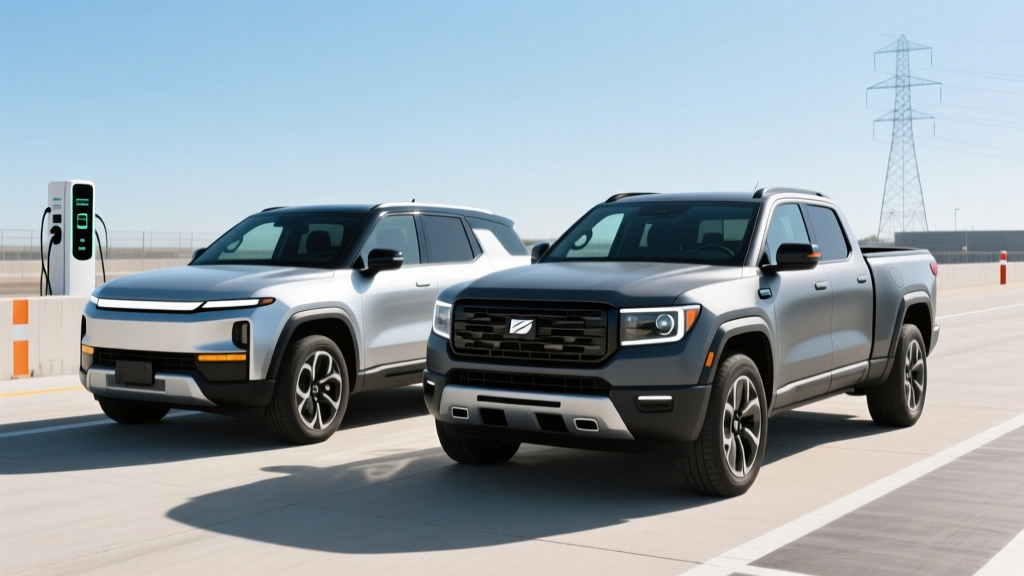
Rivian's R1S SUV and R1T pickup have carved out a unique niche in the electric-vehicle market: body-on-frame adventure rigs that tow, trail, and commute with equal competence. But for family buyers and fleet managers alike, the question that often precedes a deposit is straightforward — what is the Rivian safety rating from the agencies that matter?
This profile covers the 2026 Rivian R1S and R1T lineup through the lens of crash-test performance, active-safety hardware, and the ownership fundamentals (range, charging, pricing, tax credits) that determine whether these trucks earn a spot in your driveway.
2026 Rivian Safety Rating: IIHS, NHTSA, and Active-Safety Hardware
As of early 2026, the Insurance Institute for Highway Safety (IIHS) has evaluated the R1S and R1T across its updated crashworthiness battery. The R1S has historically earned Good ratings in the moderate overlap front, side, and roof-strength tests — the highest mark on the IIHS scale. The R1T pickup shares the same underlying skateboard platform and high-strength steel/aluminum safety cell, and its crew-cab configuration delivers comparable occupant protection.
The National Highway Traffic Safety Administration (NHTSA) rates vehicles on a 5-star scale across frontal, side, and rollover tests. Rivian's low center of gravity — the battery pack sits beneath the floor — gives both models an inherent rollover advantage over body-on-frame ICE trucks. The R1S has posted strong side-impact and frontal scores in prior model years, with the battery enclosure acting as an additional structural member.
Rivian R1S & R1T: Range, Battery, and Real-World Efficiency
Rivian offers the 2026 R1S and R1T with multiple battery configurations. The current-generation platform uses nickel-manganese-cobalt (NMC) lithium-ion cells in a structural pack.
| Spec | Standard Pack | Large Pack | Max Pack |
|---|---|---|---|
| Battery capacity (usable) | ~92 kWh | ~128 kWh | ~141 kWh |
| Chemistry | NMC | NMC | NMC |
| EPA range (R1S Dual-Motor) | ~270 mi | ~352 mi | ~410 mi |
| EPA range (R1T Dual-Motor) | ~270 mi | ~352 mi | ~415 mi |
| Efficiency (R1S Dual-Motor) | 70 MPGe combined / ~48 kWh per 100 mi | ||
Charging Speed: DC Fast Charge and Home Level 2
Charging speed determines how livable a long-range EV is on road trips. Rivian's second-generation platform supports significantly faster DC charging than the original 2022 models.
| Charging Level | Power (kW) | Speed / Time |
|---|---|---|
| Level 1 (120V household) | ~1.4 kW | ~3 mi/hr |
| Level 2 (240V home, 48A) | 11.5 kW | ~25 mi/hr; full charge overnight |
| DC Fast Charge (peak) | Up to 220 kW (Max Pack) | 10–80% in ~30 minutes |
The DC fast-charging curve is not flat. The Max Pack peaks near 220 kW at low state-of-charge (SoC), then tapers progressively above 60%. By 80% SoC, charge rates drop below 80 kW — this is normal for NMC chemistry and protects long-term battery health. On a road trip, plan stops around the 10–80% window; pushing to 100% at a DC charger adds significant time with diminishing returns.
Rivian uses the NACS (North American Charging Standard) connector on 2026 models, giving native access to Tesla Superchargers — a significant advantage for road-trip charging infrastructure coverage.
Performance: Dual-Motor, Quad-Motor, and 0-60 Times
Rivian's dual-motor AWD powertrain is standard on most trims, with a quad-motor option for maximum performance. Here's what the numbers look like:
| Powertrain | Horsepower | Torque (lb-ft) | 0–60 mph | Drivetrain |
|---|---|---|---|---|
| Dual-Motor AWD | 533 hp | 610 | ~4.5 sec | AWD |
| Performance Dual-Motor | 665 hp | 829 | ~3.5 sec | AWD |
| Quad-Motor AWD | 1,025 hp | 1,198 | ~3.0 sec | AWD (torque vectoring) |
For towing, the R1T is rated at 11,000 lbs maximum (properly equipped), and the R1S at 7,700 lbs. Both figures are competitive with mid-size and half-ton ICE trucks, though towing at capacity will reduce range by nearly half.
Cargo, Passenger Space, and Practicality
The R1S is a three-row SUV; the R1T is a crew-cab pickup with a 4.5-foot bed. Practical dimensions:
- R1S cargo (behind 3rd row): ~10.4 cu ft | Behind 2nd row: ~46.7 cu ft | Max (both rows folded): ~104 cu ft
- R1S front trunk (frunk): ~11.1 cu ft — large enough for charging cables and a soft-sided cooler
- R1T bed volume: ~25.9 cu ft | Frunk: ~11.1 cu ft | Gear Tunnel: ~11.7 cu ft (a lockable, pass-through compartment unique to Rivian)
- R1S second-row legroom: ~38.5 inches | Third-row legroom: ~30.4 inches (best for children)
- R1T rear-seat legroom: ~36.4 inches
The R1T's Gear Tunnel — a full-width compartment between the cab and bed — is a standout feature for camping and gear storage. It's weather-sealed, lockable, and accessible from both sides.
Pricing, Trims, and Federal Tax Credit Eligibility
| Trim / Config | Base MSRP | Est. As-Tested | §30D Credit Eligible? |
|---|---|---|---|
| R1S Dual-Motor Standard | ~$75,900 | $79,000–$84,000 | Yes (SUV MSRP cap $80,000) |
| R1S Dual-Motor Large | ~$81,900 | $86,000–$92,000 | Exceeds $80K cap — No |
| R1T Dual-Motor Standard | ~$69,900 | $73,000–$78,000 | Yes (truck MSRP cap $80,000) |
| R1T Quad-Motor Max | ~$99,000 | $102,000+ | Exceeds $80K cap — No |
- Credit amount: Up to $7,500, split between critical-minerals ($3,750) and battery-components ($3,750) requirements.
- MSRP cap: SUVs/vans/pickups must have an MSRP ≤ $80,000. This eliminates most Large and Max Pack Rivians.
- Buyer income cap: AGI ≤ $300,000 (married filing jointly), $225,000 (head of household), $150,000 (single).
- Battery sourcing: Critical minerals and component sourcing thresholds tighten annually. Check the latest IRS qualified vehicle list before purchasing.
- Point-of-sale transfer: Eligible buyers can transfer the credit to the dealer at purchase, reducing the out-of-pocket price immediately.
Consult a tax professional for your specific situation. State and local incentives may stack on top.
Warranty, Battery Longevity, and Ownership Costs
Rivian provides the following warranty coverage for the 2026 model year:
- Battery & drivetrain: 8 years / 175,000 miles (whichever comes first), with a capacity-retention threshold of 70%.
- Vehicle limited warranty: 5 years / 60,000 miles bumper-to-bumper.
- Corrosion perforation: 8 years / unlimited miles.
NMC batteries in Rivians have shown modest degradation in early model-year data — typically 5–8% capacity loss over the first 50,000 miles. The Max Pack's larger buffer provides more absolute range headroom as the pack ages. Rivian's over-the-air update system continuously optimizes thermal management and charge algorithms.
Insurance costs for Rivians tend to run 15–25% higher than comparable ICE trucks, reflecting repair costs for aluminum body panels and the battery pack's structural role. Get quotes before ordering.
Standout Tech and Notable Drawbacks
- Class-leading off-road capability with quad-motor torque vectoring
- NACS connector = native Tesla Supercharger access
- Over-the-air updates continuously add features
- Gear Tunnel (R1T) is a genuinely innovative storage solution
- Low center of gravity = excellent rollover protection
- Strong IIHS crash-test scores across categories
- 11,000-lb towing capacity (R1T) rivals full-size ICE trucks
- High starting price; most trims exceed the $80K tax-credit MSRP cap
- Third row in R1S is tight for adults
- Insurance premiums above segment average
- Real-world highway range drops significantly when towing
- Service center network still expanding in rural areas
- No LFP battery option (heavier pack weight vs. LFP competitors)
Standout tech: Rivian's 15.6-inch center touchscreen runs a custom OS with embedded navigation, camp/trail mapping, and a built-in Wi-Fi hotspot. The driver display is a 12.3-inch digital cluster. The R1T's powered tonneau cover, built-in air compressor, and camp kitchen accessory (slide-out induction cooktop) are unique in the EV truck segment. Highway Assist (Level 2) is competent for long highway stretches but requires hands-on-wheel attention.
Who Should Buy a Rivian R1S or R1T?
- You need a three-row electric SUV that can genuinely off-road and tow a camper
- Adventure lifestyle (skiing, camping, overlanding) is core to your vehicle use
- You want Supercharger access without an adapter
- You need a daily-driver pickup that also handles weekend hauling and towing
- The Gear Tunnel and camp-ready accessories appeal to your use case
- You can spec within the $80K MSRP cap to capture the federal tax credit
- Budget is the primary concern — the Ford F-150 Lightning and Chevy Silverado EV start significantly lower
- You need a spacious third row for adults (consider the Kia EV9)
- You primarily drive in urban environments and don't need truck capability
Frequently Asked Questions
What is the real-world range of the 2026 Rivian R1S and R1T?
EPA estimates range from ~270 miles (Standard Pack) to ~410 miles (Max Pack). Real-world highway driving at 75 mph yields roughly 80–85% of the EPA figure. In sub-freezing temperatures, expect a further 15–25% reduction. Towing at or near capacity cuts range roughly in half regardless of pack size.
How fast does the Rivian charge at home and on the road?
On a 48-amp Level 2 home charger (11.5 kW), the R1S/R1T adds about 25 miles of range per hour — a full overnight charge for any pack size. On DC fast chargers, the Max Pack peaks at ~220 kW and charges from 10–80% in roughly 30 minutes. The Standard Pack peaks lower (~190 kW) but charges a smaller battery in similar time.
Does the 2026 Rivian qualify for the $7,500 federal EV tax credit?
It depends on the trim. The Dual-Motor Standard Pack R1S (~$75,900 MSRP) and R1T (~$69,900 MSRP) fall under the $80,000 MSRP cap for SUVs/pickups and are eligible if you meet income requirements and the vehicle passes battery-sourcing rules. Large Pack and Max Pack trims generally exceed the cap and are not eligible. Always verify on the fueleconomy.gov tax credit page before purchasing.
Is the Rivian worth buying versus key competitors?
Versus the Ford F-150 Lightning: the R1T is more expensive but offers superior off-road capability, a more premium interior, and better range on equivalent packs. Versus the Chevy Silverado EV: the R1T is more refined but the Silverado offers a larger bed and lower entry price. Versus the Tesla Model X (for R1S shoppers): the Rivian is far more capable off-road and tows better, but the Model X offers Falcon Wing doors and access to the broadest charging network natively.
What is the Rivian safety rating from IIHS and NHTSA?
The R1S has earned Good ratings (the highest score) in key IIHS crashworthiness tests including moderate overlap front and side impact. NHTSA has awarded strong star ratings, aided by the low center of gravity from the under-floor battery pack. Both models come standard with comprehensive active-safety features including AEB, blind-spot monitoring, and lane-keeping assist.
How long will the Rivian battery last?
Rivian warranties the battery for 8 years or 175,000 miles, guaranteeing at least 70% capacity retention. Real-world data from early R1T/R1S owners shows approximately 5–8% degradation at 50,000 miles. With NMC chemistry, avoiding routine 100% charges and frequent DC fast charging from very low SoC will help maximize long-term battery health.
Sources: IIHS, NHTSA, IRS §30D Clean Vehicle Credit, fueleconomy.gov, Rivian official specifications. Pricing and tax-credit rules reflect 2026 model-year data and are subject to change. Verify all figures with the manufacturer and a tax professional before purchasing.