Who Makes Rivian Cars? The Company Behind the Brand
If you've searched "who makes Rivian cars" and landed here, the answer is straightforward: Rivian Automotive, Inc. designs, engineers, and manufactures its vehicles in-house at a converted Mitsubishi plant in Normal, Illinois. Unlike many EV startups that outsource production or badge-engineer existing platforms, Rivian controls its entire stack — from the skateboard chassis and battery pack architecture to the software and over-the-air update pipeline.
Founded in 2009 by MIT graduate RJ Scaringe (originally as Mainstream Motors, later A127, before settling on Rivian), the company went public in November 2021 and has since delivered over 150,000 vehicles across its R1S SUV and R1T pickup lineup. In 2024, Volkswagen Group invested up to $5 billion in a joint venture to co-develop EV architecture and software, signaling serious industry validation. As of the 2026 model year, Rivian operates over 60 retail and service locations across the U.S. and Canada, plus a growing mobile service fleet.
Rivian positions itself as an "adventure" brand — think Toyota Land Cruiser meets Tesla, with serious off-road chops, available three-row seating, and a proprietary charging network (the Rivian Adventure Network) supplementing CCS and NACS public charging access.
Rivian R1S & R1T: 2026 Lineup at a Glance
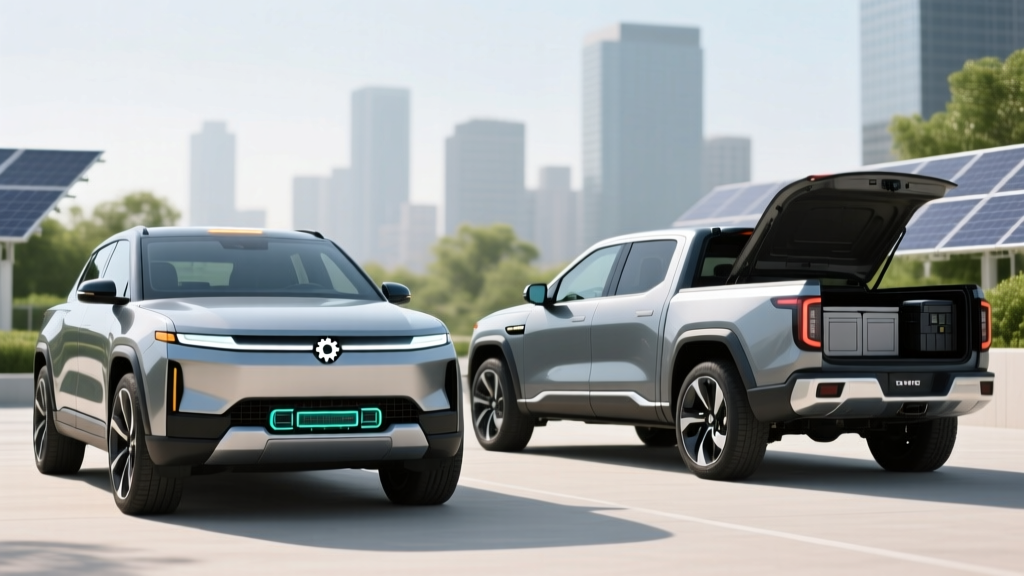
For 2026, Rivian offers the second-generation R1S (three-row SUV) and R1T (crew-cab pickup) on its updated Gen 2 platform, which introduced a new electrical architecture, fewer moving parts, and improved thermal management. Both vehicles share the same core powertrain options across three battery sizes.
| Spec | Standard (LFP) | Large (NMC) | Max (NMC) |
|---|---|---|---|
| Battery Chemistry | LFP (Lithium Iron Phosphate) | NMC (Nickel Manganese Cobalt) | NMC |
| Usable Capacity | ~92 kWh | ~109 kWh | ~141 kWh |
| EPA Range (R1S Dual-Motor) | 270 mi | 352 mi | 410 mi |
| EPA Range (R1T Dual-Motor) | 270 mi | 352 mi | 420 mi |
| Drivetrain Options | Dual-Motor AWD | Dual / Tri / Quad-Motor AWD | Dual / Tri / Quad-Motor AWD |
| Max DC Fast Charge | 200 kW | 220 kW | 220 kW |
| Level 2 Home Charge | 11.5 kW (~25 mi/hr) | 11.5 kW (~25 mi/hr) | 11.5 kW (~25 mi/hr) |
| Towing Capacity | 7,700 lb | 7,700 lb (R1S) / 11,000 lb (R1T) | 7,700 lb (R1S) / 11,000 lb (R1T) |
Real-World Range: What the EPA Sticker Doesn't Tell You
Rivian's thermal management system is robust — the Gen 2 platform uses a heat pump as standard equipment, which mitigates cold-weather range loss better than resistive cabin heaters found in older EVs. Preconditioning the battery via the Rivian app before a DC fast-charge session or a cold morning commute is essential for both range preservation and charge speed.
Efficiency varies meaningfully by configuration. The R1S Dual-Motor Large Pack returns roughly 73 MPGe combined (per fueleconomy.gov), translating to about 46 kWh/100 mi. Quad-Motor trims dip to around 65 MPGe. For context, that's less efficient than a Tesla Model X but on par with other body-on-frame electric SUVs of this size and capability.
Charging Speed: DC Fast, Home, and the Adventure Network
| Charging Level | Power (kW) | Miles Added per Hour | Notes |
|---|---|---|---|
| Level 1 (120V) | ~1.4 kW | ~3 mi/hr | Emergency/trickle only |
| Level 2 (240V, 48A) | 11.5 kW | ~25 mi/hr | Full overnight charge in 10–14 hrs |
| DC Fast (Standard LFP) | Up to 200 kW | ~140 mi in 20 min | 10–80% in ~28 min |
| DC Fast (Large/Max NMC) | Up to 220 kW | ~150 mi in 20 min | 10–80% in ~25 min |
Rivian's Gen 2 vehicles use the NACS (Tesla-style) charge port as standard, giving access to Tesla Superchargers via the Rivian app integration. The R1S and R1T can also use CCS stations with a NACS-to-CCS adapter (sold separately, ~$200).
Charging curve reality: The 220 kW peak rate on Large and Max packs holds roughly from 10% to 35% State of Charge (SoC), then tapers to ~150 kW through 60%, and drops sharply above 80%. That 10–80% time of ~25 minutes assumes a preconditioned battery at a capable 350 kW charger (Electrify America, Tesla V4 Supercharger, or Rivian Adventure Network station). At a typical 150 kW public charger, expect 10–80% in 35–40 minutes.
Home charging at 11.5 kW requires a 60-amp dedicated circuit (hardwired Wall Connector or Rivian Wall Charger). Most owners report a full charge from 10% to 100% overnight in about 11–13 hours for the Large Pack. Installation costs typically run $800–$2,000 depending on panel capacity and run length — factor in a possible $1,500–$3,000 panel upgrade if your home has a 100-amp service.
Performance, Drivetrain, and What Each Motor Config Gets You
Rivian offers three drivetrain configurations across the 2026 R1S and R1T:
- Dual-Motor AWD: One motor per axle. 533 hp, 610 lb-ft torque. 0–60 mph in ~4.5 seconds. Best efficiency and range.
- Tri-Motor AWD (Performance): One front, two rear motors. 850 hp, 1,100 lb-ft. 0–60 in ~3.4 seconds. Enhanced torque vectoring for off-road and sport driving.
- Quad-Motor AWD: One motor per wheel. 1,025 hp, 1,190 lb-ft. 0–60 in ~2.9 seconds (R1T). Independent wheel torque control — the most capable off-road configuration.
All trims feature an adaptive air suspension with up to 14.9 inches of ground clearance (in Off-Road mode), a wading depth of 36 inches, and approach/departure/breakover angles that rival dedicated off-road SUVs. The R1T adds a 12.5-cubic-foot Gear Tunnel (lockable, weather-sealed cross-body storage) and a powered tonneau cover on the 4.5-foot bed.
Pricing, Trims, and Federal Tax Credit Eligibility
| Trim / Config | Base MSRP | Est. Federal Credit | Effective Price |
|---|---|---|---|
| R1S Dual-Motor Standard (LFP) | $75,900 | Up to $7,500* | ~$68,400 |
| R1S Dual-Motor Large (NMC) | $82,900 | Up to $7,500* | ~$75,400 |
| R1S Tri-Motor Large (NMC) | $94,900 | Up to $7,500* | ~$87,400 |
| R1S Quad-Motor Max (NMC) | $104,900 | Up to $7,500* | ~$97,400 |
*Federal tax credit (§30D) caveats: The full $7,500 credit requires meeting critical-mineral and battery-component sourcing thresholds set by the IRS. As of 2026, the R1S qualifies because its MSRP is under the $80,000 SUV cap on the Standard and Large Dual-Motor trims. Tri-Motor and Quad-Motor trims exceed the MSRP cap and are not eligible. Buyer income limits also apply: modified AGI must not exceed $300,000 (joint), $225,000 (head of household), or $150,000 (single). The credit can be transferred to the dealer at point of sale as an instant discount. Always verify current eligibility on the IRS website or with a tax professional before purchasing.
As-tested pricing climbs quickly with options. A loaded R1S Tri-Motor with the Max Pack, Glacier White exterior, Forest Edge interior, and 22-inch Sport wheels lands around $108,000 before any incentives. Rivian also offers a no-subscription-required approach to software features — navigation, driver assists, and OTA updates are included.
Interior, Cargo, and Daily Usability
The R1S seats up to seven (2-3-2 configuration) with genuine leather or vegan leatherette options. Third-row legroom is 30.4 inches — tight for adults on long trips but adequate for children. Cargo volume behind the third row is 10.8 cu ft, expanding to 56.4 cu ft behind the second row and 97.2 cu ft with both rear rows folded.
The R1T crew cab seats five with 41.5 inches of rear legroom and a 33.9-cubic-foot bed (with the tonneau deployed). The signature Gear Tunnel adds 12.5 cu ft of lockable side-access storage. A front trunk (frunk) provides 11.1 cu ft of sealed, drainable storage — useful for wet gear, groceries, or a cooler.
The Gen 2 interior uses a 15.6-inch center touchscreen running Rivian's in-house OS, a 12.3-inch digital gauge cluster, and a head-up display. Wireless Apple CarPlay and Android Auto are standard. The Rivian app provides remote preconditioning, charge monitoring, location tracking, and digital key functionality.
Driver Assistance and Standout Tech
Rivian's Driver+ includes a capacitive steering wheel (no torque nudge required) and a driver-monitoring camera. It works well on divided highways but does not currently support hands-free operation on city streets. The system receives regular OTA improvements, and Rivian has indicated future "eyes-off" capability on select highways, though no timeline has been confirmed for 2026.
Other standout tech features:
- Camp Kitchen option (R1T): Slide-out induction cooktop, sink, and utensil set integrated into the Gear Tunnel.
- Powered tonneau and tailgate: Both operate via app, key fob, or bed-side buttons.
- Vehicle-to-Load (V2L): Up to 3.5 kW of AC power output from bed and cabin outlets — enough to run power tools, a campsite, or emergency home appliances.
- Over-the-air updates: Rivian has pushed significant feature additions (including range improvements and new drive modes) post-delivery.
Warranty, Battery Longevity, and Ownership Costs
Rivian provides the following warranty coverage on 2026 models:
- Basic vehicle: 5 years / 60,000 miles
- Battery and drive units: 8 years / 175,000 miles (retains at least 70% capacity)
- Corrosion: 5 years / unlimited miles
The 175,000-mile battery warranty is among the most generous in the segment. Rivian's LFP Standard pack should exhibit minimal degradation over typical ownership — LFP chemistry tolerates regular 100% charging and has a longer cycle life than NMC. The NMC Large and Max packs benefit from daily charging to 80–90% with periodic 100% calibration, following Rivian's app-configurable charge-limit settings.
Insurance costs run 15–25% higher than comparable ICE trucks and SUVs, a common EV pattern. Maintenance is minimal — no oil changes, no transmission fluid, and regenerative braking extends pad life significantly. Rivian's mobile service vans handle ~70% of routine service calls at your home or workplace.
Pros, Cons, and Who the Rivian Is For
- Class-leading off-road capability (air suspension, wading, torque vectoring)
- Generous 8-yr/175,000-mi battery warranty
- Gear Tunnel and frunk add versatile storage
- NACS port = Tesla Supercharger access
- V2L capability (3.5 kW) for camping/job-site use
- OTA updates continue adding features post-purchase
- MSRP cap disqualifies Tri/Quad-Motor from federal credit
- Efficiency trails car-based EVs (~46 kWh/100 mi)
- Third-row space is tight for adults
- Service center footprint still growing in rural areas
- Max Pack adds ~$10,000 and 800+ lb of weight
- No hands-free city driving (Driver+ is highway-focused)
- Outdoor families: Three rows, serious off-road ability, and the Gear Tunnel make the R1S ideal for ski trips, camping, and national park touring.
- Truck buyers who tow: The R1T's 11,000-lb capacity and integrated trailer brake controller rival full-size ICE trucks, with lower fuel costs for daily driving.
- Tech-forward commuters: If you have home Level 2 charging and want a distinctive, software-defined vehicle that improves over time.
- Budget-focused buyers (consider the Hyundai Ioniq 5 or Tesla Model Y for under $50K).
- Those needing maximum highway efficiency (a sedan or crossover will outperform a body-on-frame SUV).
- Buyers in areas with no Rivian service presence — check coverage maps before committing.
Frequently Asked Questions
Who makes Rivian cars and where are they built?
Rivian Automotive designs and manufactures the R1S and R1T at its own production facility in Normal, Illinois. The company is independent, though Volkswagen Group holds a significant investment stake and co-develops future EV technology with Rivian.
What is the real-world range of a Rivian R1S or R1T?
The EPA-rated 352 miles (Large Pack, Dual-Motor) translates to roughly 280–310 miles in real-world highway driving and 240–270 miles in freezing temperatures. The LFP Standard pack's 270-mile rating yields about 220–250 miles in mixed real-world use.
How fast does a Rivian charge at home and on the road?
At home on a 240V/48A Level 2 charger, a Rivian adds about 25 miles per hour (11.5 kW), fully charging overnight. On a DC fast charger, the Large/Max NMC packs peak at 220 kW, reaching 10–80% in approximately 25 minutes with a preconditioned battery at a 350 kW-capable station.
Does the Rivian R1S qualify for the $7,500 federal EV tax credit?
The R1S Dual-Motor Standard ($75,900) and Dual-Motor Large ($82,900) trims fall under the $80,000 SUV MSRP cap and may qualify for up to $7,500 under IRS §30D rules, subject to buyer income limits and battery-sourcing requirements. Tri-Motor and Quad-Motor trims exceed the cap and do not qualify. The credit can be applied as a point-of-sale discount.
Is Rivian worth buying over a Tesla Model X or Ford F-150 Lightning?
If off-road capability, build quality, and adventure-focused features (Gear Tunnel, Camp Kitchen, air suspension) are priorities, the Rivian stands apart. The Tesla Model X offers more range and Supercharger convenience but less ruggedness. The F-150 Lightning is more affordable and larger but less refined in ride quality and software. Each serves a different buyer — test-drive all three before deciding.
What is Rivian's battery warranty?
Rivian covers the battery pack and drive units for 8 years or 175,000 miles, whichever comes first, guaranteeing at least 70% capacity retention over that period. This is notably longer than the industry-standard 8-year/100,000-mile coverage.