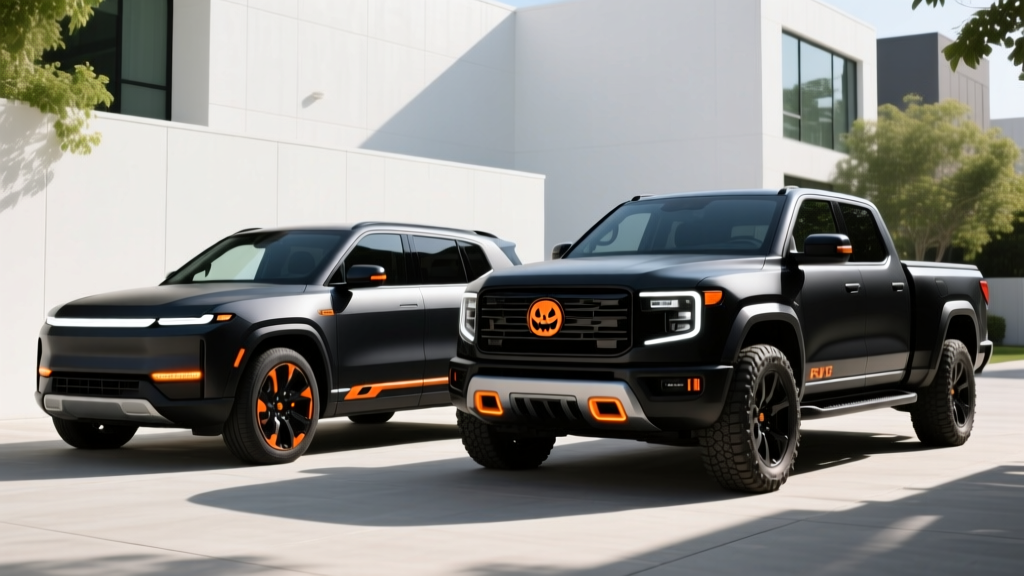
Rivian's seasonal special editions have become a hallmark of the brand's community-driven identity, and the Rivian Halloween 2025 package — available on both the R1S SUV and R1T pickup — layers exclusive cosmetic and software features onto the already-capable Gen 2 platform. But beyond the Pumpkin Spice paint and themed camp-mode animations, buyers need to know what they're actually getting in terms of range, charging speed, and real-world utility. This review breaks down the 2025 Rivian R1S and R1T with the Halloween edition package, covering everything from EPA range and battery chemistry to federal tax credit eligibility under current IRS §30D rules.
Quick Verdict: The Halloween Edition Is a Spec Monster in Disguise
The Halloween 2025 package doesn't alter the powertrain — it's a cosmetic and software overlay on the Dual-Motor and Performance Dual-Motor configurations. That means you're getting the same Gen 2 hardware that launched for the 2025 model year: a redesigned battery pack, improved efficiency, and faster DC charging. The package adds an exclusive exterior color (El Cap Granite with orange accent stitching), Halloween-themed Gear Guard animations, custom camp-mode lighting scenes, and a numbered interior badge. For buyers already committed to an R1S or R1T, it's a fun limited run. For cross-shoppers, the underlying vehicle specs are what matter — and they're strong.
Range, Efficiency, and Real-World Expectations
The 2025 R1S and R1T Dual-Motor with the Standard battery pack carries an EPA-estimated range of 270 miles (R1S) and 270 miles (R1T). The Large battery option pushes the R1S to 352 miles EPA and the R1T to 352 miles EPA, according to fueleconomy.gov. The Max battery (available on Performance Dual-Motor and Tri-Motor trims) extends the R1S to approximately 420 miles EPA.
EPA estimates assume a mix of city and highway driving at moderate temperatures. In our experience and consistent with third-party testing:
- Highway (75 mph, 70°F): Expect ~85-90% of EPA — roughly 300 miles from the Large pack R1S.
- Cold weather (30°F, mixed driving): Plan for 20-30% range loss, dropping the Large pack to ~250-280 miles.
- Towing (R1T, 5,000-lb trailer): Range roughly halves to ~160-180 miles regardless of pack size.
The R1S and R1T are tall, heavy, and boxy — aerodynamic drag is the primary efficiency killer at highway speeds. If your commute is mostly suburban at 45 mph or less, you'll see numbers close to or even above the EPA sticker.
Efficiency for the Dual-Motor Large pack is rated at approximately 73 MPGe combined (R1S) and 73 MPGe (R1T), translating to roughly 46 kWh per 100 miles. That's typical for a 6,000+ lb electric SUV/truck — the Hyundai Ioniq 5 achieves 110+ MPGe by comparison, but it doesn't tow 7,700 pounds.
Battery Chemistry, Capacity, and Longevity
Rivian's Gen 2 platform uses three battery tiers:
| Pack | Usable Capacity | Chemistry | Notes |
|---|---|---|---|
| Standard | ~92 kWh | LFP (Lithium Iron Phosphate) | Lower energy density; excellent cycle life; can charge to 100% daily |
| Large | ~109 kWh | NMC (Nickel Manganese Cobalt) | Higher energy density; better for max range; 80% daily charge recommended |
| Max | ~141 kWh | NMC | Longest range; heaviest pack; reserved for upper trims |
The LFP Standard pack is a smart choice for buyers who charge at home nightly and don't need 350+ miles. LFP chemistry tolerates regular 100% charges without accelerated degradation, and its cycle life typically exceeds 3,000 full cycles before reaching 80% state of health. The NMC Large and Max packs offer more range but benefit from staying between 20-80% for daily use — reserving 100% charges for road trips.
Rivian covers the battery and powertrain with an 8-year / 120,000-mile warranty (whichever comes first), guaranteeing a minimum of 70% capacity retention. This is competitive with Tesla's 8-year/120,000-mile coverage and exceeds the federal minimum of 8 years/100,000 miles for emissions-related components.
Charging Speed: DC Fast, Level 2, and the Charge Curve
The Gen 2 Rivians support peak DC fast-charge rates of up to 220 kW (Large and Max NMC packs) and approximately 180 kW (Standard LFP pack). Here's what that translates to in real charging time:
| Charging Level | Power (kW) | Rate / Time | Notes |
|---|---|---|---|
| Level 1 (120V household) | ~1.4 kW | ~3-4 miles/hour | Emergency/top-up only |
| Level 2 (240V, 48A home charger) | 11.5 kW | ~25 miles/hour | Full overnight charge in 9-12 hours |
| DC Fast Charge (peak) | 220 kW | 10-80% in ~21 minutes | Large/Max pack; tapers above 80% |
| DC Fast Charge (Standard LFP) | 180 kW | 10-80% in ~25 minutes | Slightly slower curve, but LFP accepts charge well |
A critical note on the charge curve: the 220 kW peak is sustained roughly from 10-40% state of charge, then tapers progressively. From 80-100%, charging slows dramatically — plan on an additional 20+ minutes if you need a full pack. For road trips, the practical strategy is to charge from 10-80% and go. Rivian's built-in route planner preconditioning (warming the battery before arrival at a charger) is essential in cold weather to achieve advertised speeds.
At home, the Rivian Wall Charger delivers up to 11.5 kW (48 amps on a 60-amp circuit), adding roughly 25 miles of range per hour. A full charge from 10-100% on the Large pack takes about 10 hours — easily manageable with overnight charging. Installation costs for a Level 2 home setup typically range from $500-$2,000 depending on panel proximity and whether a service upgrade is needed.
Performance: Dual-Motor, Tri-Motor, and 0-60 Times
The Halloween 2025 edition is available on Dual-Motor and Performance Dual-Motor configurations. Here's how they stack up:
| Spec | Dual-Motor | Performance Dual-Motor | Tri-Motor (R1S only) |
|---|---|---|---|
| Horsepower | 533 hp | 665 hp | 850 hp |
| Torque | 610 lb-ft | 829 lb-ft | 1,103 lb-ft |
| 0-60 mph | 4.5 sec | 3.4 sec | 2.9 sec |
| Drivetrain | AWD (dual motor) | AWD (dual motor) | AWD (tri motor) |
| Towing Capacity (R1T) | 7,700 lbs | 7,700 lbs | N/A (R1S: 7,700 lbs) |
| Ground Clearance | 7.9 – 14.9 in (adjustable) | 7.9 – 14.9 in | 7.9 – 14.9 in |
Even the base Dual-Motor's 4.5-second 0-60 time is brisk for a vehicle weighing over 6,000 pounds. The Performance Dual-Motor's 3.4 seconds puts it in sports-car territory at stoplights. The air suspension is standard across all trims, offering adjustable ride height from a 7.9-inch highway mode to 14.9 inches for off-road use — a genuine advantage over fixed-suspension competitors like the Kia EV9.
Pricing, Trims, and the Federal Tax Credit (§30D)
The Halloween 2025 package adds approximately $2,500 to the base price of the selected configuration. Here's the pricing landscape for the 2025 model year:
| Configuration | Base MSRP | With Halloween Pkg | Est. §30D Credit | Effective Price |
|---|---|---|---|---|
| R1S Dual-Motor Standard | $75,900 | $78,400 | $0* | $78,400 |
| R1S Dual-Motor Large | $82,900 | $85,400 | $0* | $85,400 |
| R1T Dual-Motor Standard | $69,900 | $72,400 | Up to $7,500** | ~$64,900 |
| R1T Dual-Motor Large | $76,900 | $79,400 | Up to $7,500** | ~$71,900 |
*R1S tax credit note: The IRS §30D credit imposes an MSRP cap of $80,000 for SUVs (vans and pickups have a higher cap). Most R1S configurations with the Halloween package exceed this threshold, making them ineligible for the new-vehicle credit. Always verify current eligibility at irs.gov.
**R1T tax credit note: The R1T, classified as a pickup, falls under the $80,000 MSRP cap for trucks. The Dual-Motor Standard and Large configurations with the Halloween package can qualify, but the full $7,500 credit also depends on:
- Buyer income caps: $300,000 joint / $225,000 head of household / $150,000 single (modified AGI)
- Battery component sourcing: A percentage of battery components must be manufactured or assembled in North America, and critical minerals must meet sourcing thresholds — these percentages increase annually
- Point-of-sale transfer: Eligible buyers can transfer the credit to the dealer at purchase, reducing the out-of-pocket price immediately
Tax rules shift frequently. Consult a tax professional and check the latest IRS §30D guidance before relying on credit eligibility in your purchase decision.
Interior, Cargo, and Technology
The R1S offers three rows of seating with the following dimensions:
- Cargo behind 3rd row: 20.5 cu ft
- Cargo behind 2nd row (3rd row folded): 57.0 cu ft
- Max cargo (all rear rows folded): 104.0 cu ft
- Front headroom: 41.1 in | Front legroom: 41.3 in
- 2nd-row legroom: 39.5 in | 3rd-row legroom: 30.4 in
The R1T provides a 4.5-foot bed (extending to 6+ feet with the Gear Tunnel open), an 11.0 cu ft front trunk (frunk), and an 11.0 cu ft Gear Tunnel accessible from both sides — a genuinely unique storage solution no competitor matches.
The 15.6-inch center touchscreen runs Rivian's proprietary infotainment system, which is responsive and well-designed but lacks Apple CarPlay and Android Auto. Rivian provides its own navigation, music streaming, and phone integration. The driver display is a 12.3-inch digital cluster. Over-the-air updates are frequent and have historically added meaningful features post-launch.
Driver assistance falls under Rivian's Driver+ system, which includes adaptive cruise control with lane centering, automatic emergency braking, blind-spot monitoring, and rear cross-traffic alert. This is a SAE Level 2 system — the driver must remain fully engaged with hands on the wheel and eyes on the road. It is not self-driving and should not be confused with Level 4 autonomous services like Waymo.
Rivian's Driver+ does not support hands-free driving on mapped highways (unlike GM's Super Cruise or Ford's BlueCruise). Lane centering can be inconsistent on faded road markings. The system requires continuous steering-wheel torque input. Treat it as an enhanced cruise control, not an autonomous feature.
Who the Rivian Halloween 2025 Edition Is For
- You want a genuine off-road-capable electric SUV/truck with adjustable air suspension
- You need towing capacity (7,700 lbs) that most EV SUVs can't match
- You value community-oriented brand culture and limited-edition exclusivity
- You have access to home Level 2 charging and can accommodate the vehicle's size
- The R1T pickup variant fits your budget within the §30D MSRP cap
- You need Apple CarPlay / Android Auto — Rivian doesn't offer it
- You want hands-free highway driving (consider GM Super Cruise or Ford BlueCruise vehicles)
- Third-row space is a priority — the R1S 3rd row is tight for adults (30.4 in legroom)
- Budget is under $70,000 after credits — the R1T Standard barely fits; the R1S does not
Pros and Cons at a Glance
- Class-leading off-road capability with 14.9" ground clearance
- Up to 420 miles EPA range (Max pack R1S)
- 220 kW DC fast charging; 10-80% in ~21 minutes
- Unique Gear Tunnel storage (R1T) and spacious frunk
- Strong OTA update track record adding real features
- 8-year/120,000-mile battery warranty with 70% retention guarantee
- No Apple CarPlay or Android Auto
- Driver+ is basic Level 2 — no hands-free highway mode
- R1S mostly exceeds $80K MSRP cap, losing §30D eligibility
- Highway efficiency (~46 kWh/100mi) means expensive public charging
- Third-row seating is cramped for adults
- Service center network still expanding in rural areas
Frequently Asked Questions
What is the real-world range of the Rivian R1S/R1T with the Large battery?
The EPA rates the Large-pack Dual-Motor at 352 miles. Expect roughly 300 miles at highway speeds in mild weather, and 250-280 miles in freezing temperatures. Towing cuts range approximately in half.
How fast does the 2025 Rivian charge on DC fast chargers?
The Large and Max NMC packs peak at 220 kW, achieving 10-80% in approximately 21 minutes on a capable charger. The Standard LFP pack peaks at 180 kW with a 10-80% time of roughly 25 minutes. Charging slows significantly above 80%.
Does the Rivian R1S qualify for the $7,500 federal EV tax credit?
Most likely not. The §30D credit caps SUV MSRP at $80,000, and most R1S configurations — especially with the Halloween package — exceed this. The R1T pickup, subject to the same $80,000 truck cap, may qualify in Standard and some Large Dual-Motor configurations. Always verify current rules at irs.gov and consult a tax professional.
Is the Rivian R1T worth buying over the Ford F-150 Lightning?
The R1T offers superior off-road capability (air suspension, 14.9" clearance), a more premium interior, and the unique Gear Tunnel. The F-150 Lightning provides a larger bed, more traditional truck utility, and broader service infrastructure. If off-road performance and innovation matter most, the R1T wins. If you need a work truck with a full-size bed and lower starting price, the Lightning is more practical.
What battery chemistry does the Rivian Standard pack use, and can I charge it to 100%?
The Standard pack uses LFP (lithium iron phosphate) chemistry. Unlike NMC, LFP tolerates regular 100% charges without accelerated degradation. Rivian recommends charging LFP packs to 100% at least once per week for accurate state-of-charge calibration.
Does Rivian offer Apple CarPlay or Android Auto?
No. Rivian uses its proprietary infotainment system exclusively. It supports Bluetooth phone connectivity, built-in navigation, and streaming apps, but does not mirror your phone's interface.