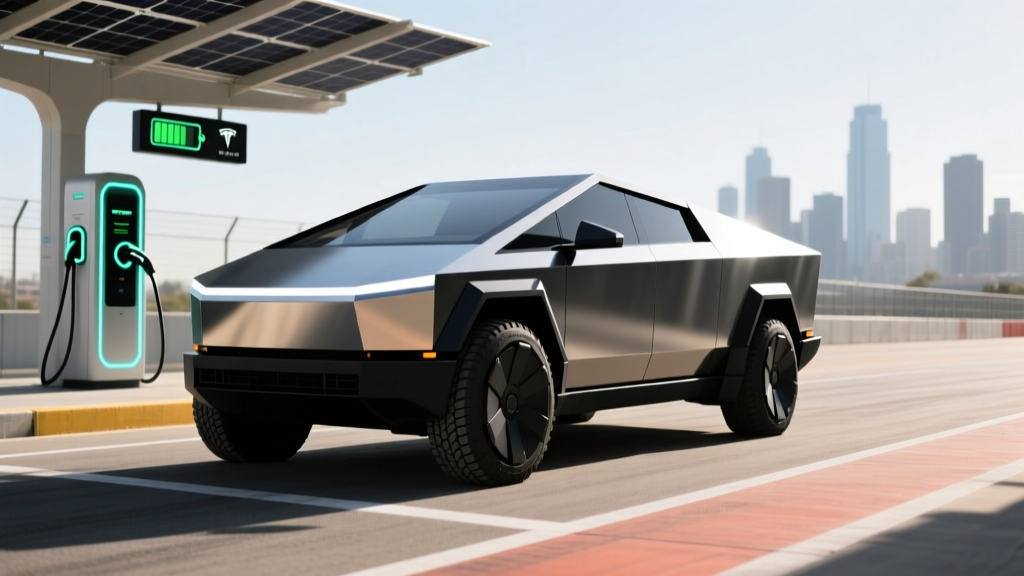
The Tesla Cybertruck is arguably the most polarizing vehicle on the road. Its angular, stainless-steel exoskeleton and massive weight have sparked intense debates about pedestrian safety and crash compatibility. But for prospective buyers, the most critical question is how well it protects the people inside. In this 2026 Tesla Cybertruck safety rating analysis, we look at the official data from the NHTSA and IIHS, as well as the truck's range, charging, and real-world ownership costs.
Tesla Cybertruck Safety Rating: NHTSA and IIHS Results
Safety testing for vehicles with unconventional architectures like the Cybertruck often takes time to materialize. As of early 2026, the National Highway Traffic Safety Administration (NHTSA) has yet to release a comprehensive 5-star safety rating for the Cybertruck. This is common for low-volume or highly specialized vehicles, though buyers should be aware that the official government star rating is currently pending.
The Insurance Institute for Highway Safety (IIHS) has also not completed its full battery of crashworthiness evaluations. However, Tesla's active safety technology—standard across the fleet—continues to perform well in crash-avoidance testing. The Cybertruck comes equipped with the latest version of Tesla's Automatic Emergency Braking (AEB), which has historically earned superior scores in preventing vehicle-to-vehicle and vehicle-to-pedestrian collisions.
Spec Table: Performance, Range, and Safety Tech
| Feature | AWD Trim | Cyberbeast Trim |
|---|---|---|
| EPA Estimated Range | 340 miles | 320 miles |
| Real-World Highway/Cold Note | ~270 mi (highway); ~230 mi (cold) | ~255 mi (highway); ~220 mi (cold) |
| Battery Capacity (Usable) | ~123 kWh (NMC Architecture) | ~123 kWh (NMC Architecture) |
| Max DC Fast-Charge (Peak kW) | 250+ kW (800V System) | 250+ kW (800V System) |
| 10-80% Charge Time | ~15-20 minutes | ~15-20 minutes |
| 0-60 mph | 4.1 seconds | 2.6 seconds |
| Horsepower | 600 hp | 845 hp |
| Starting MSRP (2026) | $79,990 | $99,990 |
Real-World Range and Efficiency
EPA Sticker: 340 miles (AWD) / 320 miles (Cyberbeast)
Real-World Expectation: Due to the Cybertruck's massive frontal area and poor aerodynamics, expect highway range to drop to roughly 270 miles at 75 mph. In freezing weather, that figure can dip to 230 miles or lower, even with the heat pump engaged.
Efficiency is the Cybertruck's biggest compromise. The AWD model achieves approximately 2.0 kWh/mile (50 MPGe). While this is competitive for a full-size truck, it is significantly less efficient than a Model Y or Rivian R1T. If your daily commute exceeds 100 miles, the frequency of charging stops will be higher than in smaller EVs.
Charging Speed: 800V Architecture Explained
The Cybertruck utilizes an 800-volt architecture, which allows for thinner, lighter wiring and higher peak charging speeds. At a Tesla V4 Supercharger or a high-power third-party station, the truck can peak at over 250 kW.
- DC Fast Charging: 10-80% in approximately 15-20 minutes (preconditioned).
- Level 2 Home Charging: At 11.5 kW (48A), the truck adds about 20-23 miles of range per hour. A full charge from 10-100% takes roughly 11-13 hours.
- Charge Curve Taper: Like all NMC batteries, speeds taper significantly above 80% to protect cell health. Expect the final 20% to take as long as the initial 80%.
Federal Tax Credit and Pricing
The Cybertruck's pricing and the IRS §30D tax credit rules present a significant hurdle for most buyers. Under current federal guidelines, the $7,500 credit is subject to MSRP caps for trucks ($80,000) and strict buyer income limits.
| Trim | Base MSRP | MSRP Cap Status | Credit Eligibility |
|---|---|---|---|
| AWD | $79,990 | Eligible (Under $80k) | Possible (if income/sourcing met) |
| Cyberbeast | $99,990 | Ineligible (Over $80k) | None |
Note: Even for the AWD trim, you must meet MAGI income caps ($150k single/$300k joint) and the vehicle must satisfy critical mineral and battery component sourcing requirements. Consult a tax professional or IRS.gov for final eligibility.
Pros and Cons: The Ownership Verdict
Pros
- Exoskeleton Durability: Stainless steel body is highly dent-resistant.
- Performance: Cyberbeast offers supercar-level acceleration in a truck.
- Utility: 6-foot bed with a motorized tonneau and built-in ramp.
- Power: Includes 120V and 240V bed outlets for job-site tools.
Cons
- Efficiency: Poor aerodynamics result in high kWh/mile costs.
- Visibility: Large blind spots and a massive hood make urban driving tricky.
- Wiper/Build Quirks: Early models faced quality control issues; 2026 is better but still unique.
- Pedestrian Safety: Rigid front-end design is a concern for crash compatibility.
Frequently Asked Questions
Is the Cybertruck safe in a rollover?
While official NHTSA rollover data is pending, the Cybertruck's extremely low center of gravity (due to the battery pack placement) suggests a very low risk of rollover compared to traditional gas-powered trucks.
Does the Cybertruck qualify for the $7,500 tax credit in 2026?
The AWD trim starts at $79,990, which is just under the $80,000 truck cap. However, eligibility depends on your income and the specific battery sourcing of the unit you purchase. The Cyberbeast does not qualify.
How does the steer-by-wire system affect safety?
The Cybertruck uses a 48-volt steer-by-wire system with no mechanical link. While it offers variable ratios for tight parking, some drivers find the lack of physical feedback at highway speeds requires an adjustment period.
What is the towing capacity and how does it affect range?
The Cybertruck is rated to tow up to 11,000 lbs. When towing near max capacity, expect range to be cut by 40-50%, reducing the effective range to roughly 150-170 miles.